This site is supported by our readers. We may earn a commission, at no cost to you, if you purchase through links. This content is for general informational and educational purposes only and is not a substitute for professional medical, dermatological, or nutritional advice.

If you’ve ever run your fingers through a head of tight, springy spirals and wondered how those curls manage to look so full and defined, you’re not alone. 3C hair stands out in a crowd—bold corkscrews, packed with volume, that refuse to be tamed by humidity or a single hair tie.
But with that beauty comes a daily balancing act: keeping every curl hydrated, frizz-free, and healthy without weighing it down. Understanding what makes 3C hair unique unlocks a world of care and styling that feels less like a battle and more like a celebration of your natural texture.
Table Of Contents
Key Takeaways
- 3C hair features tight, springy corkscrew curls about the width of a pencil, creating dense volume and strong curl definition.
- This hair type is naturally prone to dryness and frizz because its curved strands lose moisture quickly and attract humidity.
- Caring for 3C hair means prioritizing regular hydration, sulfate-free cleansers, and protective styling to maintain healthy, defined curls.
- Compared to 3B and 4A hair, 3C curls sit in the middle—denser than 3B, looser than 4A—and require tailored products for moisture and frizz control.
Defining 3C Hair
If you’ve got tight, springy curls that seem to defy gravity, there’s a good chance you’re rocking 3C hair. This texture sits right at the intersection of curly and coily, with its own unique personality and needs.
If you’re curious how 3C compares to other curl types, breaks down the differences in curl tightness.
Let’s break down what makes 3C hair distinct, from its signature corkscrew pattern to how it holds onto moisture.
Characteristics of 3C Hair
Type 3C hair characteristics reveal themselves through tight corkscrew spirals that pack densely together, creating outstanding volume and bounce. Your curls measure about pencil-width in diameter, forming defined S-shapes when stretched.
The hair texture feels coarse and wiry, with strands ranging from medium to thick. You’ll notice curl definition stays strong even after manipulation, though the open cuticles make moisture levels harder to maintain.
This combination of curl pattern and texture demands attention to scalp health and frizz control for ideal 3C hair characteristics. For more detail on the importance of hydration and moisture balance, see recommended practices and products suited for type 3C hair.
Curl Pattern and Texture
Your Type 3C hair forms tight corkscrew curls about the width of a pencil or straw, creating bold curl formation that stays defined from root to tip. These spirals naturally clump into ringlets, giving you serious volume and bounce. The texture feels coarse yet springy, with hair elasticity that snaps back when stretched—though frizz control becomes your constant companion since raised cuticles grab humidity like magnets. A key to maintaining healthy curls is understanding the importance of intense hydration in 3C hair.
- Curl clumping happens easily when your curls are wet and conditioned, forming distinct spiral clusters
- Texture analysis shows medium to coarse strands that feel thick between your fingers, creating that signature full look
- Curl pattern stays consistent across your head, though some sections might show tighter coils than others
Hair Porosity and Moisture Retention
Porosity—how easily water enters and exits your cuticle—shapes everything about 3C hair hydration. Low porosity strands resist moisture, taking minutes to soak through in the shower, while high porosity curls drink up product fast but lose it just as quick. Test yours by dropping a clean strand in water: if it floats, you’ve got tight cuticles needing lightweight curl sealing; if it sinks, focus on richer moisturization.
| Porosity Level | What It Means for Your 3C Curls |
|---|---|
| Low Porosity | Tight cuticles resist water absorption; products sit on surface; needs heat-assisted deep treatments |
| Medium Porosity | Balanced moisture levels; absorbs and retains hydration well; easiest to maintain |
| High Porosity | Lifts quickly but dries fast; requires butter-rich formulas and daily moisture sealing |
What is 3C Hair
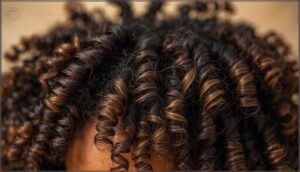
Now that you understand the basic characteristics, let’s get specific about what 3C hair actually is. Within the hair typing system, your 3C sits at the tightest edge of type 3, bridging the gap between looser curls and tighter coils. It’s all about hair genetics, and your curl pattern shows up as tight corkscrews about the width of a pencil or straw—roughly the same diameter whether you’re looking at one strand or a full clump.
What sets 3C apart from other curly hair types is its S-shaped definition that holds strong even when wet. Your curls naturally pack together, creating impressive volume without much effort. Hair porosity plays a big role here too, affecting how your strands grab and hold moisture. That’s why curl enhancement products work differently on 3C than on looser textures—you need formulas that support curl definition while tackling frizz control from the inside out.
3C Hair Traits
Now that you know what 3C hair is, let’s get into what makes it different from other curl types.
If you’re curious about transitioning from 4C to 3C curls, breaks down your options and what to expect.
These curls have a few signature traits that shape how they look, behave, and what they need to stay healthy. Understanding these characteristics will help you figure out the best way to care for your hair.
Curl Width and Shape
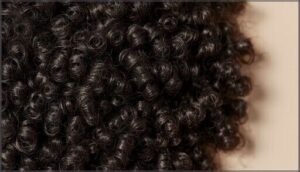
Think of each ringlet as a tiny spring coiled around a pencil—that’s your 3C curl diameter in action, measuring about 7 millimeters across. Your spiral patterns start right at the scalp, forming tight corkscrew textures that wrap consistently from root to tip.
These curls naturally group into small, defined clumps you can count and separate, creating serious curl definition without much effort. Type 3 hair like yours shows remarkable curl pattern identification: when you gently stretch a ringlet, it reveals a clear S-curve, then springs back instantly.
This curl type sits perfectly between looser 3B ringlets and tighter 4A coils, giving you a dense field of uniform spirals that demand respect—and smart frizz control through proper curl clumping techniques.
Hair Density and Volume
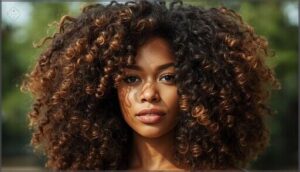
Your 3C curls pack serious density—often hundreds of strands per square inch—creating that cloud-like hair volume everyone notices.
Hair thickness varies widely: fine strands can still form a massive, airy shape, while coarser ones create compact, heavyweight curls.
This density management directly affects scalp health, since tight curl patterns trap oils close to the roots.
To optimize curl enhancement without collapse, choose volume boosters that respect your hair texture and unique hair porosity needs.
Prone to Dryness and Frizz

Cuticle care makes all the difference when your 3C curls feel chronically dry. The curved structure of each strand lifts the cuticle easily, so moisture escapes fast and humidity sneaks in to create halo frizz. That’s why moisture balance and dryness prevention matter more than any single product—your curl definition depends on keeping the cuticle smooth and sealed.
- Raised cuticles let water vanish within hours, leaving your curl pattern dull and thirsty by afternoon.
- High hair porosity means your strands drink up leave-ins quickly but can’t hold hydration overnight.
- Rough towels and cotton pillowcases cause mechanical damage that turns defined coils into a frizzy cloud.
Frizz control and management starts with understanding your hair health and growth cycle, not fighting your natural texture.
Caring for 3C Hair
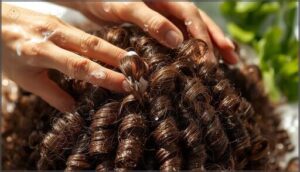
Caring for 3C hair isn’t about fighting your curls—it’s about working with them. The right approach keeps your spirals hydrated, defined, and healthy without hours of complicated routines.
Focus on these three essential areas to give your 3C curls what they really need.
Moisture and Hydration
Moisture isn’t a one-and-done thing for your 3C curls—it’s a daily commitment. Your tight corkscrew pattern holds onto water at first, but without sealing oils or creams, that hydration escapes fast. Deep conditioning weekly keeps strands soft, while daily misting and light leave-ins revitalize yesterday’s definition. Match your moisture balance to your porosity level for curls that stay bouncy between washes.
| Hydration Method | How It Helps Your 3C Curls |
|---|---|
| LOC Layering | Liquid, oil, cream trap moisture inside strands for longer-lasting softness |
| Weekly Deep Conditioning | Rich masks penetrate tight coils, fighting chronic dryness and shrinkage |
| Daily Curl Revitalizing | Light misting reactivates products, reducing dull patches without rewashing |
| Humectant Use | Aloe and glycerin draw water into hair, boosting hydration in moderate climates |
Sulfate-Free Shampoos and Conditioners
Your tight 3C coils deserve better than harsh detergents that leave them parched and brittle. Sulfate-free shampoo cleanses with gentle surfactants like sodium cocoyl isethionate, protecting hair moisture while removing buildup.
You’ll notice improved curl definition and scalp comfort since milder formulas won’t strip your natural oils or irritate sensitive skin. These products also offer color protection if you’ve dyed your hair.
Look for curly hair formulas enriched with coconut oil or shea butter for curl maintenance that keeps each corkscrew bouncy between washes.
Protecting Curls From Heat and Damage
Heat styling tools can scorch your delicate 3C curls faster than you’d think—but smart thermal styling doesn’t have to mean damage. Heat protection methods start with a quality protectant spray that shields each corkscrew before blow-drying, creating a barrier against temperatures.
For curl preservation and hair health, stick to low or medium settings while diffusing, then finish with a cool blast to seal the cuticle. Between heat sessions, protective styling like braids gives curls a break, while deep conditioning masks support damage repair and hair reinforcement for stronger curl maintenance.
3C Hair Care Routine
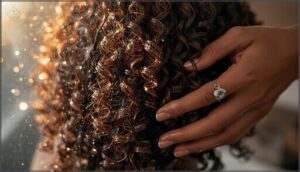
Building a solid routine is the key to keeping your 3C curls healthy, defined, and manageable. You’ll want to focus on three main areas: how you wash and condition, how you lock in moisture between washes, and how you style while protecting your curl pattern.
Let’s break down each step so you can create a routine that works for your specific needs.
Washing and Conditioning
Most people with 3C hair thrive washing once or twice weekly with sulfate-free shampoo, which cleanses without stripping precious moisture. Between washes, co-washing with gentle cleansing conditioner refreshes your scalp while preserving natural oils. Always detangle on soaking wet, conditioned hair using curl detangling tools like wide-tooth combs, and focus hydrating masks on your ends where dryness hits hardest.
| Wash Method | Best For |
|---|---|
| Sulfate-free Shampoo | Weekly deep conditioning and removing buildup |
| Co Washing | Mid-week refresh without drying curls |
| Low-Poo Routine | Balancing scalp cleanliness with moisture retention |
| Clarifying Cleanse | Monthly reset when curl creams create heavy buildup |
Leave-in Conditioners and Masks
Once your wash routine wraps up, leave-in conditioners deliver slip benefits that make detangling gentle while deep conditioning masks provide weekly deep moisture boosts your curls desperately need. Protein balance prevents breakage without turning strands brittle, and these treatments act as a frizz shield when humidity strikes. Smart application techniques mean working product through damp 3C hair in sections, concentrating on thirsty mid-lengths and ends where moisturization matters most.
- Leave-ins coat the cuticle to slow moisture loss and keep tight curls soft between washes
- Deep conditioning masks penetrate for 20–30 minutes, flooding your hair with rich oils and butters
- Protein-rich formulas strengthen fragile curls, reducing snapping during detangling and styling
- Regular masking shortens detangling time because your hair stays smoother and less matted
Styling and Protecting Curls
Your styling routine keeps 3C hair healthy between washes. When heat styling is necessary, apply protectant before blow-drying or diffusing, keeping temperatures below 350°F for safe diffusing.
Protective styles like box braids, twist-outs, or bantu knots reduce daily manipulation while boosting curl definition. At night, sleep protection matters—wrap curls in a satin scarf or switch to silk pillowcases to prevent friction damage and preserve your work.
3C Hair Vs Other Curl Types
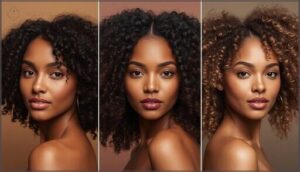
If you’ve been trying to figure out where your hair fits on the curl spectrum, you’re not alone. The line between 3B, 3C, and 4A can feel pretty blurry since they share similar qualities but behave differently.
Let’s break down how 3C hair compares to its closest neighbors so you can pinpoint exactly what makes your curls unique.
Comparison to 3B and 4A Hair
Your 3C curls sit right between 3B’s looser spirals and 4A’s tighter coils in the Hair Typing System, each with distinct needs.
The table below shows how Type 3 and Type 4 patterns differ in curl pattern and identification, hair density, moisture levels, frizz control, and styling techniques.
| Feature | 3B → 3C → 4A |
|---|---|
| Shrinkage | 3B: 25-40% → 3C: 40-60% → 4A: 60-70% |
| Hair Density | 3B: Medium gaps → 3C: Tightly packed → 4A: Maximum fullness |
| Moisture Levels | 3B: Holds moisture → 3C: Medium retention → 4A: Dries fastest |
| Frizz Control | 3B: Easier detangling → 3C: Prone to tangles → 4A: Most fragile |
| Styling Techniques | 3B: Light gels → 3C: Rich creams → 4A: Heavy butters |
Differences in Curl Pattern and Texture
Understanding the nuances between 3B, 3C, and 4A helps you choose products that actually work for your unique curl pattern. Your Type 3C hair features a curl diameter about the size of a pencil, creating tight corkscrews that differ from 3B’s marker-sized spirals and 4A’s even smaller coils. This texture variance affects everything from frizz control to hair elasticity.
When you examine curl pattern and identification closely, 3C curls show distinct clumping behavior—individual ringlets that spring back quickly when stretched. Unlike 3B’s bouncier waves, your hair texture produces a denser, more voluminous look.
The table below shows how hair texture and structure vary across these types:
| Feature | 3B Hair | 3C Hair | 4A Hair |
|---|---|---|---|
| Curl Diameter | Marker-sized spirals | Pencil-width coils | Crochet needle width |
| Strand Feel | Smoother, softer | Medium to coarse | Wiry, springy |
| Natural Sheen | Glossy finish | Matte appearance | Very matte |
| Hair Elasticity | Moderate stretch | Strong spring-back | Maximum bounce |
Unique Needs and Challenges
Your Type 3C hair demands a balancing act that looser curl patterns simply don’t face. While 3B curls bounce back from occasional neglect and 4A coils thrive with simpler routines, your pencil-width spirals need constant attention to moisture balance and scalp health. The tight bends in your curl pattern create stress points where hair breakage sneaks in, especially when you’re detangling without enough slip or sleeping without protection.
Your hair density works against you too—all those packed-in curls trap styling products at the roots, leading to buildup that sabotages frizz control no matter how many curl creams you layer on. Shrinkage becomes your daily reality, with strands coiling up to half their stretched length and hiding your progress. Managing Type 3C hair means understanding that curl definition and moisture retention aren’t optional extras—they’re survival tactics your specific texture absolutely requires to stay healthy and strong.
For 3C hair, curl definition and moisture retention aren’t luxuries—they’re daily essentials for fighting shrinkage, buildup, and frizz
| Your Challenge | Why It Hits Harder | What Actually Works |
|---|---|---|
| Persistent Frizz | Raised cuticles lift in any humidity | Anti-humidity serums before styling |
| Relentless Breakage | Tight spirals create weak points | Finger-detangle with conditioner always |
| Stubborn Buildup | Dense curls trap heavy products | Monthly clarifying, lighter root application |
| Extreme Shrinkage | Coils retract 50-75% when dry | Banding overnight, strategic stretching |
| Moisture Theft | Oils can’t slide down tight bends | Weekly deep treatments, layered hydration |
Maintaining Healthy 3C Hair
Keeping your 3C curls healthy takes more than just the right products—it’s about protecting your hair from everyday wear and giving it consistent care.
Small habits like reducing friction and staying on top of trims make a real difference in how your curls look and feel. Here’s what you need to know to keep breakage, frizz, and damage at bay.
Tips for Reducing Frizz and Breakage
Your 3C curls deserve better than constant frizz and breakage. These tight corkscrews need a gentler approach—one that honors their natural texture instead of fighting it. Here’s how to keep your hair strong, defined, and thriving:
- Detangle only when wet with a wide-tooth comb and slippery conditioner, starting from the ends and working upward to prevent snagging.
- Switch to microfiber towels or soft cotton T-shirts to gently scrunch out water without roughing up the cuticle.
- Balance moisture and protein by rotating hydrating masks with occasional light protein treatments so your curls stay flexible yet strong.
- Choose low-tension protective styles like loose braids or chunky twists, keeping them in for one to two weeks to minimize daily manipulation.
- Sleep with satin pillowcases or bonnets to reduce friction damage and preserve your curl pattern overnight.
These simple shifts reduce hair breakage, boost frizz control, and give you the curl definition you’re after—without stripping away your hair’s natural strength.
Importance of Regular Trims and Scalp Care
Think of your trim schedule as a reset button—snipping split ends every ten to twelve weeks keeps hair breakage at bay and your curl definition sharp.
Pair that with regular scalp massage and gentle cleansing, and you’re laying the groundwork for scalp health and hair growth. A consistent hair care routine is your best defense against limp curls, buildup, and uneven hair maintenance. Strong roots, strong curls.
Frequently Asked Questions (FAQs)
What is 4 a hair type?
Like tightly coiled springs, 4A hair forms small, defined S-shaped ringlets.
This coily texture stands out on the Hair Type Chart for its visible curl definition, high hair density, and unique moisture needs in Coily Hair Care routines.
How do I know if my hair is 3B or 3C?
If your curl pattern forms tight corkscrews about the width of a straw and your hair feels dense, voluminous, and prone to frizz, you likely have Type 3C hair.
Pencil-sized, looser spirals point to 3B.
Is 3C hair African American?
Funny how a curl pattern can spark debates about Cultural Identity and Racial Stereotypes—yet Type 3C hair isn’t exclusive to African Americans.
Natural Hair transcends boundaries, weaving through Ethnic Diversity and Hair Politics, challenging Social Perception every day.
Do I have 3C or 4A hair?
To decide between 3C and 4A, use Curl Pattern Analysis: pencil-sized spirals that stretch into an S-shape signal 3C hair, while tighter, crochet needle-sized coils with extra shrinkage and zigzag patterns point toward Type 4A.
What products are best for 3C hair?
If your 3C coils are parched, reach for a sulfate-free shampoo, a rich curl defining cream, and nourishing hair masks.
Product reviews praise leave-ins with moisturizing ingredients and oils—these Hair Product Recommendations keep curls soft, bouncy, and frizz-free.
What are the characteristics of 3C hair?
Your 3C hair stands out for its tight, springy corkscrew curl pattern—about pencil-sized—creating full volume and dense texture.
It’s naturally dry, so frizz control, moisture levels, and scalp health are key for defined, healthy curls.
How to care for 3C hair?
To care for 3C hair, focus on product layering—use water-based leave-ins, lightweight hair oils, and creams. Embrace curl revitalizing sprays, sulfate-free shampoos, weekly masks, and a gentle nighttime routine with satin pillowcases for frizz control and maintenance.
What is 2c hair?
Type 2C hair sits at the curliest end of the wavy spectrum, with thick strands and strong S-shaped wave patterns starting right at the roots.
You’ll notice plenty of volume, defined texture, and a need for frizz control.
What is 4c hair?
Imagine a cloud of cotton—4C hair is all about tight zigzag coils, notable shrinkage, and bold volume.
This coily pattern needs gentle care, intense moisture locking, and frizz control for resilient, healthy natural hair texture and curl definition.
Can 3C hair be permanently straightened or relaxed?
Yes, Type 3C hair can be permanently straightened using chemical relaxers or salon smoothing treatments.
These straightening methods break your curl pattern, require regular touch-ups, and pose relaxer risks—so weigh the impact on your curly hair texture and health.
Conclusion
Did you know that 65% of people worldwide have curly or textured hair, yet many still struggle to identify their unique curl pattern? Understanding what’s 3C hair gives you the power to care for those corkscrews with intention—hydration, gentle cleansing, and mindful styling become second nature.
When you honor your curl’s individuality, you’re not just maintaining hair; you’re embracing a legacy of texture and volume. The journey starts with knowledge, and every curl tells its own story.