This site is supported by our readers. We may earn a commission, at no cost to you, if you purchase through links.
You glance in the mirror and notice it again—glints of copper threading through your otherwise dark beard. It’s not a dyeing mistake or trick of the light, and you’re definitely not imagining things. Plenty of guys with jet-black beards wonder why they have red hair in their black beard, especially when there’s no obvious redhead in their family tree.
The answer lies in your DNA, specifically in gene variants that control pigment production in facial hair follicles. These genetic wildcards can activate differently in your beard than on your scalp, producing pheomelanin—the pigment responsible for red and auburn tones—even when eumelanin dominates elsewhere.
Understanding the science behind this colorful quirk reveals how your genetics, hormones, and even sun exposure team up to paint your facial hair in unexpected shades.
Table Of Contents
- Key Takeaways
- Genetic Reasons for Red Hairs in Black Beards
- The MC1R Gene and Beard Color
- Melanin Types and Their Impact on Beard Color
- Environmental and Hormonal Influences on Beard Pigmentation
- Beard Color Changes Over Time
- Embracing and Managing Red Hairs in Your Beard
- Top 5 Red Beard Costume Accessories
- Frequently Asked Questions (FAQs)
- Conclusion
Key Takeaways
- Your red beard hairs come from MC1R gene variants that trigger pheomelanin (red-yellow pigment) production in facial follicles, even when eumelanin dominates elsewhere—and these variants can hide for generations before showing up unexpectedly in your beard.
- Beard follicles respond differently to hormones and genes than scalp hair does, which is why your face can express red tones while your head stays dark, creating that patchwork effect you see in the mirror.
- Sun exposure, testosterone fluctuations, and aging all shift the melanin balance in your beard over time, potentially revealing or intensifying those copper strands as environmental factors interact with your genetic blueprint.
- You can embrace your unique multi-colored beard through proper grooming and oils, experiment with temporary or permanent dyes if you want uniformity, or simply celebrate the genetic story your facial hair tells.
Genetic Reasons for Red Hairs in Black Beards
If you’ve spotted red hairs popping up in your otherwise dark beard, you’re not imagining things—it’s all about the genes you inherited from your family. Your DNA carries instructions for hair color that can mix and match in surprising ways, even if no one in your immediate family has red hair.
Let’s break down how your genetic blueprint creates this colorful beard combination.
The Role of Inherited Genes in Beard Color
Your beard color story starts with gene inheritance—the genetic blueprint you got from both parents. Here’s how genetic variations shape your facial hair:
- Multiple genes control pigment expression in your beard
- MC1R gene variants trigger red hair production
- Genetic factors in beard color differ from scalp hair
- Recessive genes can surface unexpectedly in facial hair
- Unique combinations create your one-of-a-kind beard palette
Even if you aren’t a redhead, environmental factors can influence beard color.
Why Red Hair Genes Can Skip Generations
You might wonder why red hair seems to vanish, then pop up generations later. It’s all about recessive inheritance and silent carriers. If your grandparents carried MC1R gene variants without showing red hair themselves, those genetic variations quietly traveled through your parents—who also mightn’t be redheads—straight into your beard.
Pedigree analysis reveals this unpredictable expression happens more often than you’d think, making your copper strands a fascinating genetic surprise.
The ratio of eumelanin to pheomelanin determines resulting hair color.
Unique Genetic Combinations and Beard Pigmentation
When you carry a single MC1R mutation, your follicle variability creates a pigment lottery. About 31% of single-variant carriers show red in their beards, while others don’t—it depends on how eumelanin levels and pheomelanin ratios balance out in each follicle. That’s why genetics presents such surprises in hair color.
Here’s what makes your beard unique:
- Localized gene expression means MC1R mutations activate differently across your face
- Melanin mixing creates auburn or strawberry blonde shades in 85% of red-bearded individuals
- Genetic variations from both parents combine unpredictably in facial follicles
The MC1R Gene and Beard Color
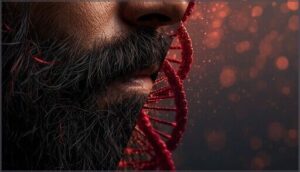
The MC1R gene, which sits on chromosome 16, quietly determines whether your beard grows in black, red, or somewhere in between. Most people don’t realize they’re carrying a variant of this gene until random ginger hairs start popping up in their facial hair.
Let’s break down how this gene works, why you can carry it without being a full redhead, and why your beard might express it differently than the hair on your head.
How MC1R Variants Create Red Pigments
Your body’s MC1R gene acts like a pigment switch that controls which color your hair follicles produce. When the MC1R activation mechanism works normally, it triggers eumelanin for dark hair. But MC1R variants—tiny genetic tweaks—weaken this signal, shifting your melanin factory toward the pheomelanin production pathway instead. That red-yellow pigment creates those surprising ginger strands in your otherwise black beard.
Your MC1R gene acts as a pigment switch—when variants weaken its signal, your beard produces red-yellow pheomelanin instead of dark eumelanin
| MC1R Status | Melanin Type Produced | Beard Color Result |
|---|---|---|
| Normal function | 90% eumelanin | Black/dark brown |
| One variant copy | 50-70% pheomelanin | Mixed black and red |
| Two variant copies | 90-95% pheomelanin | Fully red/ginger |
| Partial function | Variable pigment ratio | Copper or orange tones |
| Age-related changes | Decreasing both types | Grey with red undertones |
Effects MC1R variants create fascinating pigment ratio variance—even a single mutated gene copy can produce enough pheomelanin for those red hairs you’re noticing.
Carrying The Red Hair Gene Without Full Red Hair
Even if you don’t have a fiery head of hair, you’re probably an MC1R carrier—nearly 70% of people in some studies carry at least one red hair gene variant. This recessive inheritance pattern means partial expression shows up as random red hairs rather than full ginger locks.
The trait can hide for skipped generations, silently passing through your family tree until phenotypic correlates like those copper beard strands suddenly appear, revealing your melanin genetics.
Differences Between Head Hair and Beard Hair Gene Expression
Your beard-specific genes respond differently to androgens than scalp follicles do. The dermal papilla cells in facial hair show heightened androgen sensitivity, which triggers differential gene expression—meaning your MC1R gene variant can activate pheomelanin production in your beard while your head stays dark.
Epigenetic factors and localized melanin regulation explain why these hair color differences emerge in different body regions, even with identical genetics.
Melanin Types and Their Impact on Beard Color
Now that you understand how the MC1R gene works, it’s time to zoom in on what’s actually happening inside your hair follicles. The color of your beard comes down to two types of melanin, and the balance between them determines whether you end up with jet black strands, fiery red ones, or that surprising mix of both.
Let’s break down how these pigments create the unique palette you see in the mirror.
Eumelanin Vs. Pheomelanin in Hair Follicles
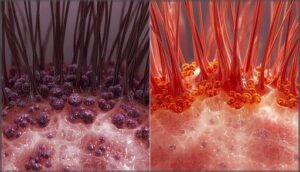
Your hair follicles are tiny melanin factories, each churning out one of two pigments that determine your beard’s color. Eumelanin creates dark brown to black tones, while pheomelanin produces red and yellow hues. Here’s what makes them different:
- Chemical structure: Eumelanin is a dark polymer; pheomelanin contains sulfur that creates lighter colors
- Light absorption: Eumelanin absorbs UV broadly; pheomelanin absorbs less efficiently
- Stability: Pheomelanin degrades more easily under sunlight and oxidation
- Genetic control: The MC1R gene regulates which pigment your melanocytes produce
- Melanin production: High activity favors eumelanin; low activity shifts toward pheomelanin
Your genetics determine which pigment dominates in each follicle.
How Melanin Ratios Produce Red, Black, or Mixed Beard Hair

The ratio of eumelanin dominance to pheomelanin proportion determines your beard’s color. Over 95% eumelanin produces black hair, while equal amounts create red strands.
Mixed follicles arise because genetic instructions differ across individual facial hairs—the MC1R variant increases pheomelanin in some follicles while others maintain eumelanin production. That’s why your beard can display both black and red hairs simultaneously.
Why Some Black Beards Have Orange or Copper Strands
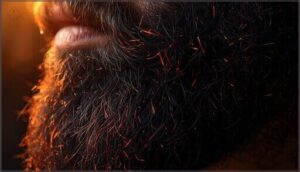
When follicles pump out moderate pheomelanin alongside low eumelanin levels, you’ll spot those strawberry-blond or light orange strands threading through darker areas. UV exposure accelerates this—sunlight oxidizes eumelanin faster than pheomelanin, revealing warmer copper tones you didn’t notice before.
MC1R variants influence how individual follicles balance these melanin ratios, explaining why environmental factors like sun can unmask hidden genetic traits in your beard’s pigmentation patterns.
Environmental and Hormonal Influences on Beard Pigmentation

Your genes aren’t the only thing controlling those surprise red hairs in your beard. Your environment and hormones play a bigger role than you might think, quietly shifting pigmentation behind the scenes.
Let’s look at three outside factors that can turn your black beard a little more ginger.
Sun Exposure and Its Effect on Beard Color
Ever notice your beard looks lighter after a summer vacation? UV radiation breaks down melanin in your facial hair, particularly pheomelanin, which produces reddish hues. Because your beard gets more direct sun exposure than your scalp—especially on your chin and jawline—those UV beard damage effects can reveal copper or orange tones.
Melanin degradation happens fastest during peak UV hours, creating seasonal color changes that highlight genetic factors already present in your follicles.
Testosterone and Hormonal Changes in Beard Hair
Beyond UV rays, testosterone levels play a surprising role in your beard’s palette. DHT influence on melanocytes can shift melanin production ratios, allowing red pigment to sneak through.
Hormonal imbalance—whether from stress, age-related shifts, or natural fluctuations—affects how your follicles express color. That’s why androgens don’t just fuel beard growth; they can literally rewrite your beard color genetics mid-strand.
How Aging and Stress Can Alter Beard Pigmentation
As you age, oxidative stress damages melanocyte stem cells in your follicles, triggering an age-related decline in melanin production.
Stress accelerates premature pigment loss by depleting those same stem cells—sometimes within just a few hair cycles.
The good news? Early reversibility patterning shows some hairs can regain color when stress eases, though most aging-driven changes stick around permanently.
Beard Color Changes Over Time
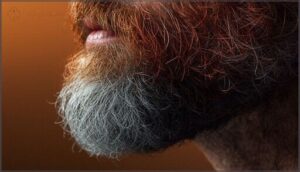
Your beard color isn’t set in stone—it evolves as you age, often in ways that surprise you. If you’ve noticed your once-solid black beard now sports red, grey, or even white hairs, you’re seeing your melanin production shift in real time.
Let’s break down what’s happening at the follicle level and why your beard becomes this fascinating patchwork of colors.
Why Beards Become Multi-colored (black, Red, Grey)
Why do some beards look like a patchwork quilt of black, red, and grey? Genetics, hormonal influence, and ageing effects team up to create this look.
Your MC1R gene determines whether follicles produce dark eumelanin or red pheomelanin, while melanin degradation from sun exposure and environmental factors can shift shades.
As testosterone fluctuates and genetic mosaicism plays out, your beard becomes a unique color story.
The Process of Red Hairs Turning White
Once red strands lose their pheomelanin—less resistant to degradation than dark eumelanin—your hair graying journey begins. Melanin depletion accelerates when melanocyte stem cell failure occurs in follicles, while oxidative stress from hydrogen peroxide buildup breaks down pigment-producing enzymes.
This whitening progression happens unevenly across your beard, influenced by age and genetics, creating that salt-and-pepper look before full depigmentation sets in.
How Age Impacts Melanin Production in Facial Hair
Around your mid-thirties, testosterone levels drop roughly 1% annually, triggering hormonal shifts that slow melanin production in your beard follicles.
Cellular aging compounds this decline as melanocyte stem cells fail and oxidative stress damages pigment-producing enzymes.
These environmental effects create multi-colored beards—mixing black, red, and gray strands—because genetic factors determine which follicles lose pigment first during this natural aging process.
Embracing and Managing Red Hairs in Your Beard
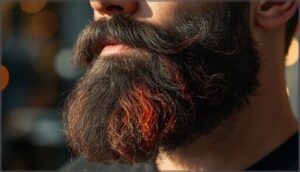
Now that you understand the genetics behind your red-tinted beard, you might be wondering what to do about it. Whether you want to blend those copper strands or wear them with pride, you’ve got options.
Let’s look at practical grooming strategies and dyeing techniques. Embracing your unique beard might be the best choice of all.
Grooming Tips for Mixed-color Beards
Think of your mixed-color beard as a canvas—you’re just working with the colors nature gave you. Solid beard care starts with moisturizing methods using quality oils daily, protecting your facial hair appearance from sun damage with SPF balms, and following a consistent grooming routine.
Blending techniques with beard brushes distribute natural oils evenly, while nutritional support through balanced meals keeps your hair health strong.
Smart styling practices and regular trims complete your beard grooming and style.
Beard Dye Options and Their Maintenance
You’ve got three main paths for dealing with those stray red hairs. Here’s what works:
- Permanent dyes penetrate deeply, lasting 4-6 weeks—ideal for consistent hair color changes requiring monthly touch-ups
- Semi-permanent options fade gradually over 2-4 weeks, gentler for testing new beard dyes
- Natural henna from Lawsonia inermis provides chemical-free coverage for 3-6 weeks
- Temporary tints wash out in 1-3 cycles, perfect for special occasions
- Maintenance best practices: use sulfate-free products, apply UV-protecting beard oil daily, and rinse with cool water to extend color fading duration
Chemical dye risks include potential allergic reactions, while natural dye ingredients minimize irritation through plant-based formulas.
Celebrating Unique Beard Characteristics
Your mixed-toned beard isn’t a flaw—it’s a genetic badge of honor. Those red hairs tell stories of MC1R gene variants passed down through generations, creating beard variety that sets you apart. Embracing this unique genetic fingerprint boosts confidence and celebrates cultural heritage.
| Mindset Shift | Action | Benefit |
|---|---|---|
| From flaw to feature | Document beard positivity journey | Authentic self-expression |
| Genetic uniqueness | Share heritage stories | Community connection |
| Natural variation | Skip unnecessary dyeing | Time and money saved |
Top 5 Red Beard Costume Accessories
If you’re curious about rocking a red beard without waiting for your genetics to fully express themselves, costume accessories offer a fun shortcut. Whether you’re channeling a Viking warrior, a mystical dwarf, or just want to experiment with a ginger look for a party, there are surprisingly realistic options out there.
Here are five standout red beard accessories that can transform your appearance in seconds.
1. Ginger Fake Beard and Eyebrow Set
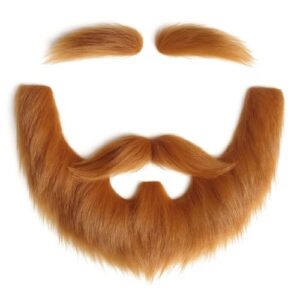
If you’re curious about red hairs in your beard from a genetics standpoint but want to rock the look instantly, this self-adhesive ginger fake beard and eyebrow set offers quick customization options for costume events. It includes everything you need—beard, eyebrows, double-sided tapes, and a comb.
However, adhesive quality and hair retention can be hit-or-miss, with some users reporting fit issues and realism concerns. While it won’t explain your MC1R gene or natural beard hair color, it’s perfect for Halloween or cosplay when you’re embracing that red-haired character vibe.
Best For: Costume enthusiasts and cosplayers who need a quick ginger beard transformation for Halloween, themed parties, or character impersonation without the commitment of dyeing real facial hair.
- Complete kit with everything included—beard, eyebrows, adhesive tapes, and comb—so you don’t need to buy extras separately
- Reusable and customizable design lets you trim and style it for different characters or events
- Easy application and removal saves time compared to traditional stage makeup or prosthetics
- Adhesive quality is inconsistent and may require extra face glue to keep the beard securely attached
- Realism can be lacking, with some users finding the look too obviously fake for certain settings
- Fit issues reported by some customers, particularly if the beard is too large for smaller faces
2. Red Fake Beard Costume Cosplay
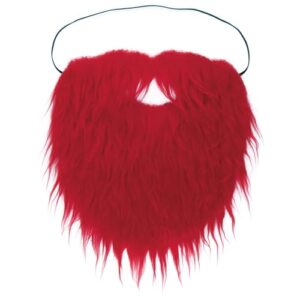
When cosplay market growth explodes—projected to hit USD 6.2 billion by 2030—you’ll notice beard material options like synthetic polyester or crepe wool dominating convention floors. Realistic beard techniques using spirit gum adhesives and hand-laid fibers create authentic looks for Viking or fantasy characters.
Cosplay accessory trends show seasonal sales spikes during Halloween and Renaissance fairs, perfect timing if you’re considering whether to embrace your natural red hairs or experiment with beard dyes. These costume pieces won’t change your MC1R genetics, but they let you explore different hair color expressions temporarily.
Best For: Cosplayers, Halloween enthusiasts, and costume party-goers looking for an affordable and customizable red beard accessory to complete Viking, dwarf, or fantasy character looks.
- Reusable and easy to apply with stretchy elastic bands that fit most face shapes without hassle
- Customizable so you can trim, style, and even dye it to match your specific character vision
- Budget-friendly at $5.99, making it accessible for casual costumers and frequent convention attendees alike
- Quality can be hit-or-miss with some users reporting scratchy synthetic fibers or inconsistent construction
- Size may run small for some adults, with reported dimensions around 6 by 6 inches that might not provide full coverage
- Not suitable for eating or drinking while wearing, and requires dry cleaning only for maintenance
3. Ginger Fake Beard Costume Accessory
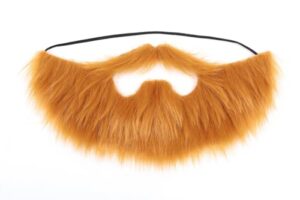
If synthetic beard experiments interest you more than permanent beard dyes, elastic strap options start around $15.99 and let you test ginger tones without commitment.
These synthetic fiber accessories mirror the unpredictable hair color genetics you’ve learned about—your MC1R variants creating random red strands in black facial hair.
Customer ratings average 89-93% approval for reusable sets that work across multiple usage applications, from St. Patrick’s Day to Viking themes, giving you creative control over your look while your natural beard tells its own genetic story.
Best For: Costume enthusiasts who want a quick ginger beard transformation for themed parties, cosplay events, or theatrical performances without committing to permanent dye.
- Comes with everything you need—beard, double-sided tape, and a small comb—so you can style and attach it right out of the package.
- Reusable across multiple events with elastic band or tape options, making it cost-effective for occasional costume use.
- Customizable through trimming, styling, and even dyeing, letting you adjust the look to match different characters or face sizes.
- Material can feel itchy or raspy against skin during extended wear, which some users find uncomfortable.
- Tends to shed when you open your mouth, requiring pre-use combing and occasional touch-ups throughout the event.
- Not truly self-adhesive as advertised—you’ll need to rely on the included tape or elastic strap for secure attachment.
4. Red Curly Costume Beard and Mustache
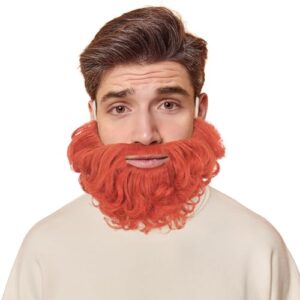
For fuller coverage at $3.25, polyester curly sets with integrated mustaches deliver that fiery-haired Viking look you’ve connected to your MC1R gene studies. The scraggly texture mimics how pheomelanin creates untamed red strands in your black beard naturally. Elastic bands secure the synthetic fibers during movement, though you’ll want to trim for best comfort—much like managing your own mixed hair color genetics.
With 93 units sold across Halloween markets, these accessories let you boost the red hairs your genetic code already produces in unpredictable follicle patterns.
Best For: Anyone wanting to complete a Viking, wizard, or fantasy costume with full curly red facial hair coverage, especially if you’re looking for an affordable option under $15.
- Super affordable at $3.25-$13.99 depending on where you shop, making it easy to try without much commitment
- The integrated mustache and beard combo gives you full coverage so you don’t need to buy separate pieces
- Elastic strap keeps everything secure even when you’re moving around at parties or events
- You’ll probably need to trim it yourself since it’s one-size-fits-most and can feel stiff out of the package
- Gets warm and uncomfortable if you’re wearing it for more than an hour or two
- The red color might not match exactly what you’re picturing, and you can’t eat or drink normally with it on
5. Realistic Braided Viking Dwarf Beard
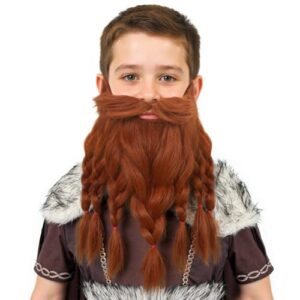
At $37.99, synthetic Viking dwarf beards offer installation methods through clip-in wefts or ponytail ties that mirror how your MC1R gene surprises you with scattered red hairs. Costume popularity peaks during Renaissance fairs—over 1,100 reviews averaging 4.9 stars prove beard material quality matters when you’re celebrating those genetic quirks.
Maintenance tips include flat storage and avoiding heat, while safety concerns center on keeping small parts away from children. Your natural hair color variations make this braided accessory feel authentic.
Best For: Adults looking for a realistic, comfortable costume beard for Viking or dwarf characters at Renaissance fairs, Halloween parties, or cosplay events.
- High satisfaction with 4.9 out of 5 stars from over 1,100 reviews, showing strong product quality and realistic appearance
- Quick installation with clip-in wefts or ponytail ties that secure easily and stay in place during wear
- Customizable with color matching options, heat molding, trimming, and dyeing to match your natural hair or desired look
- Elastic bands can press uncomfortably on ears during extended wear, especially for people with sensitive skin
- Eating or drinking while wearing the beard can get messy since it fully covers the lower face
- Strict return policy only allows refunds for unused items in sealed packaging due to sanitary concerns
Frequently Asked Questions (FAQs)
Can diet or vitamins change beard color?
Vitamin deficiencies and mineral deficiencies can affect pigmentation, but they won’t override your genetic coding.
Nutritional factors like copper or B12 restore natural color when deficient, yet supplement limitations prevent changing DNA-programmed beard shade.
Do redheads experience different beard growth rates?
No—red hairs don’t speed up or slow your beard growth. Genetics and androgen receptor sensitivity control growth rate, while MC1R affects only pigmentation. Red-bearded and non-red-bearded men grow facial hair at similar speeds.
Are red beard hairs thicker than black?
Generally, red beard hairs feel coarser due to shaft diameter and hair texture differences.
Melanin density varies with genetics and ethnic variation, but measurement limitations mean precise comparisons remain uncertain across hair pigmentation patterns.
Can laser hair removal target specific colors?
Laser color selectivity targets dark hair best because melanin absorbs light energy. Red hairs contain less eumelanin, so standard lasers struggle with them.
Emerging approaches and mixed modality regimens combining electrolysis show promise for varied beard pigmentation.
Do siblings share the same beard patterns?
Siblings can share similar patterns—about 72% mirror their father’s beard—but genetic recombination and different allele combinations mean brothers often develop unique distributions.
Multiple genes interact, so familial aggregation doesn’t guarantee identical beards.
Conclusion
The truth is in your genes—literally. Once you understand why you have red hair in your black beard, those copper strands stop feeling like a mystery and start looking like a badge of honor.
Your MC1R variants, melanin mix, and genetic heritage have conspired to give you a one-of-a-kind look that no barber could replicate.
So whether you rock it, dye it, or just shrug and let it grow, your beard tells a story only your DNA could write.
- https://www.businessinsider.com/why-beard-hair-is-a-different-color-than-head-hair-2017-1
- https://thebeardclub.com/blogs/beard-culture/why-beard-hair-is-a-different-color-than-your-head-hair
- https://www.reddit.com/r/mildlyinteresting/comments/10tyngc/theres_one_red_hair_amongst_my_black_hair_in_my/
- https://en.wikipedia.org/wiki/Red_hair
- https://medicover-genetics.com/red-hair-its-in-your-genes/