This site is supported by our readers. We may earn a commission, at no cost to you, if you purchase through links. This content is for general informational and educational purposes only and is not a substitute for professional medical, dermatological, or nutritional advice.
Skincare shelves didn’t use to be complicated.
Then retinol became dermatology’s reference point for aging skin—backed by decades of clinical research, prescription-level results, and enough irritation warnings to make sensitive-skin folks wince.
Enter bakuchiol: a plant-derived compound that quietly accumulated a surprisingly solid body of evidence showing comparable collagen-boosting and pigment-evening results, without the peeling, the photosensitivity, or the strict nighttime-only rules.
One works faster and deeper; the other works smarter and gentler.
Knowing fits your skin your lifestyle, and your timeline changes everything about how quickly you’ll actually see results.
Table Of Contents
- Key Takeaways
- Bakuchiol Vs Retinol: What’s The Difference?
- How Retinol Works at The Cellular Level
- How Bakuchiol Works in Skincare
- Anti-Aging Results: What The Evidence Shows
- Side Effects and Tolerability Compared
- Who Should Choose Retinol
- Who Should Choose Bakuchiol
- How to Use Retinol or Bakuchiol Safely
- Can You Use Bakuchiol and Retinol Together?
- Top 9 Retinol and Bakuchiol Products to Try
- 1. SkinMedica Retinol Renewal Serum
- 2. Neutrogena Retinol Hyaluronic Face Moisturizer
- 3. Fig1 Retinol Night Cream
- Herbivore Bakuchiol Anti-Aging Face Serum
- 4. Ole Henriksen Peptide Moisturizer Duo
- 5. Ordinary High Strength Retinol Serum
- 6. Elf Holy Hydration Daily Cleanser
- 7. Inkey List Glycolic Acid Toner
- 8. CeraVe Moisturizing Cream for Dry Skin
- Frequently Asked Questions (FAQs)
- Is bakuchiol the same as retinol?
- Does Bakuchiol really work?
- What is Bakuchiol?
- Is Bakuchiol a good anti-aging cream?
- Should I use Bakuchiol or retinoid?
- Is bakuchiol really as effective as retinol?
- What are the downsides of bakuchiol?
- What do Asians use instead of retinol?
- Is it OK to use bakuchiol everyday?
- Can I use bakuchiol and retinol together?
- Conclusion
Key Takeaways
- Retinol delivers faster results (4–6 weeks) by converting to retinoic acid and directly driving collagen production, but it comes with a real adjustment period — expect redness, peeling, and mandatory SPF every single morning.
- Bakuchiol reaches comparable anti‑aging results by week 12 through a completely different biological pathway, with under 5% of users reporting irritation — making it the go‑to for sensitive skin, pregnancy, or anyone who wants a morning‑friendly active.
- Clinical biopsies confirm both ingredients genuinely increase type I and type III collagen in the dermis, so neither choice is a compromise — it’s about speed and tolerance, not efficacy.
- Using both together isn’t just possible, it’s smart — bakuchiol stabilizes retinol against light breakdown while softening the irritation, letting you keep your routine consistent instead of quitting during rough weeks.
Bakuchiol Vs Retinol: What’s The Difference?
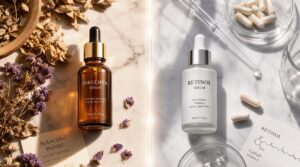
Two skincare ingredients, one shared goal — and a surprisingly heated debate among dermatologists. Both retinol and bakuchiol promise smoother, younger-looking skin, but they work in completely different ways and suit very different people. Here’s what actually sets them apart.
Some people even use both together, since pairing retinol with bakuchiol can boost results while keeping irritation in check.
Two Actives, One Anti-aging Goal
Both retinol and bakuchiol share one mission: slow visible skin aging. Retinol, a vitamin A derivative, converts inside your skin to retinoic acid to drive collagen production and faster cell turnover. Bakuchiol, drawn from plant seeds, reaches the same goal through a completely different chemical pathway — no conversion needed.
| Feature | Retinol | Bakuchiol |
|---|---|---|
| Origin | Vitamin A derivative | Plant-derived phenol |
| Efficacy Timeline | 4–6 weeks | ~12 weeks |
| Ingredient Stability | Degrades in light/air | Stable in light and air |
| Skin Barrier Impact | Can thin temporarily | Maintains barrier integrity |
| User Experience | Adjustment period likely | Minimal irritation |
For maximum protection, incorporating broad-spectrum SPF 30 into your routine guards against UV‑induced aging.
Why This Comparison Matters in 2026
Skincare in 2026 isn’t one-size-fits-all anymore. People want individualized regimens that match their skin type, lifestyle, and even life stage — pregnancy included. The bakuchiol vs retinol conversation sits right at the center of that shift, helping you choose smarter rather than just harder.
| What Consumers Want in 2026 | Which Active Fits |
|---|---|
| Barrier-first, low-irritation routine | Bakuchiol |
| Deep collagen remodeling, fast results | Retinol |
| Daytime suitability | Bakuchiol |
| Pregnancy-safe antiaging | Bakuchiol |
| Clinical research-backed potency | Retinol |
How Each Ingredient is Sourced
Where these two actives come from is surprisingly different.
Bakuchiol is a botanical extract pulled from the seeds and leaves of the babchi plant (Psoralea corylifolia), cultivated mainly in India and China. Plant extraction methods — including supercritical CO2 — isolate and purify it into a concentrated oil.
Retinol, by contrast, comes from synthetic production processes using beta-carotene feedstocks.
How Retinol Works at The Cellular Level
Retinol doesn’t work the moment it touches your skin — it has to earn its effects through a series of steps happening beneath the surface. Understanding those steps helps explain why results take time, why irritation happens, and why how you store your product actually matters. Here’s what’s going on at the cellular level.
Converts to Retinoic Acid in Skin

Think of retinol as a raw ingredient your skin has to cook before it’s useful. After absorption, enzymes convert retinol into retinaldehyde — then into retinoic acid, the biologically active form that actually drives change.
This rate-limiting conversion step happens inside keratinocytes and depends entirely on enzyme availability. That’s why results take weeks, not days.
Activates Retinoid Receptors RAR-β and RAR-γ
Once retinoic acid forms, it heads straight for the nucleus — where the real action happens. It binds RAR-β and RAR-γ receptors, which pair with RXR partners to form active complexes.
These lock onto specific DNA response elements, triggering ligand-dependent transcription.
Corepressors get swapped out, coactivators are recruited in, and your skin’s gene expression profile shifts toward repair.
Boosts Cell Turnover and Collagen
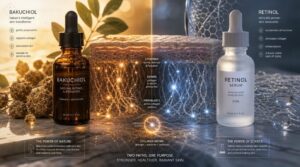
All that receptor activity sets off a chain reaction that your skin actually feels. Retinol accelerates Cell Turnover Rate, pushing fresher cells to the surface faster — which smooths texture and fades dullness over time.
Simultaneously, it drives Fibroblast Stimulation, signaling the deeper skin cells responsible for Collagen Production to ramp up.
The result? Stronger Matrix Support and measurably increased collagen synthesis with consistent use.
Why Packaging and Stability Matter
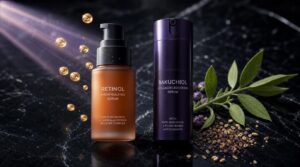
Retinol is genuinely fragile — expose it to light or air, and it starts breaking down before it ever reaches your skin. That’s why packaging integrity matters so much.
Look for opaque, airtight containers that provide both an oxygen barrier and light blocking, protecting the formula’s potency.
Better yet, seek out encapsulated retinol, which shields the active until it’s absorbed.
How Bakuchiol Works in Skincare
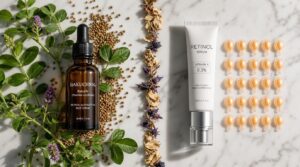
Bakuchiol takes a completely different route to the same destination. It’s a plant-derived compound with its own set of tricks — none of which involve converting into retinoic acid. Here’s exactly how it earns its anti-aging reputation.
Plant-derived Meroterpene Phenol Explained
Bakuchiol comes from the seeds and leaves of Psoralea corylifolia — a plant long used in Ayurvedic medicine. Chemically, it’s a meroterpene phenol, meaning its molecule is a hybrid: part terpenoid, part phenolic ring. That dual structure gives it some genuinely useful traits:
- Hydrophobic terpenoid portion helps it penetrate lipid-rich skin layers
- Phenolic ring provides built-in antioxidant activity
- Remains stable under light and air — unlike retinol
- Naturally modulates inflammatory pathways like NF-kB and Nrf2
- Extracted and purified from plant material, making it a true plant-derived alternative
That stability alone sets it apart from most anti-aging ingredients.
Upregulates Collagen Gene Expression
Here’s what’s quietly impressive: bakuchiol builds collagen without ever touching retinoic acid receptors.
Instead, it triggers TGF-beta signaling, which switches on collagen gene expression — specifically upregulating COL1A1 and COL3A1 mRNA. It also promotes DNA demethylation at the collagen promoter, in effect unlocking genes that drive dermal collagen synthesis.
Your skin gets the remodeling results through a completely different biological door.
Built-in Antioxidant and Anti-inflammatory Effects
Think of bakuchiol as a built-in shield — it fights oxidative damage while it works on your skin.
Its phenolic structure gives it plant-based antioxidant properties roughly five to six times stronger than vitamin E. That means it neutralizes free radicals through radical scavenging before they can trigger the inflammation cascade that accelerates aging.
Here’s why that matters practically:
- Oxidative defense reduces lipid peroxidation, protecting cell membranes from breakdown
- Inflammation reduction lowers cytokine activity, visibly calming redness and irritation
- Barrier support keeps transepidermal water loss in check during consistent use
- Skin calming cuts the inflammatory feedback loop that worsens reactive skin conditions
These anti-inflammatory effects and antioxidant action work together — quieting the oxidative stress that often drives sensitivity in the first place.
Stable in Light and Air
That stability is one of bakuchiol’s quiet advantages.
Unlike retinol, it doesn’t break down under UV light or oxygen exposure — meaning it stays potent in standard packaging without requiring airless pump design or opaque containers.
You can leave it on your bathroom shelf without worrying about oxidative damage, quietly eroding its effectiveness before it ever reaches your skin.
Anti-Aging Results: What The Evidence Shows
Both ingredients sound impressive on paper — but what do actual clinical studies say? The evidence covers everything from wrinkle depth to collagen production, and the results might surprise you. Here’s what the research shows across four key areas.
12. week Clinical Trial Findings
One 12-week randomized double-blind study put 0.5% retinol and 0.5% bakuchiol head-to-head — and the results surprised a lot of people. Here’s what the clinical trial outcomes showed across the board:
- Inflammatory biomarker trends improved in both groups, with bakuchiol users showing fewer irritation signals
- Hydration improvement metrics rose in both groups, especially when paired with supportive moisturizers
- Pigment evenness outcomes were statistically comparable by week 12
- Texture roughness changes favored earlier cosmetic smoothing in the bakuchiol group
Fine Lines, Wrinkles, and Hyperpigmentation
So what does that actually mean for your skin?
Retinol delivers results faster — measurable wrinkle improvement in 4–6 weeks — while bakuchiol reaches comparable fine lines and hyperpigmentation reduction by week 12.
Both reduce UV-driven pigment darkening and smooth texture, just at different speeds. Same destination, different pace.
Collagen Density Improvements in Biopsies
Speed tells part of the story — but biopsies tell the deeper one.
When researchers took actual skin samples and analyzed them using Masson trichrome staining and digital image analysis, both actives showed measurable increases in type I and type III collagen gene expression.
The dermis, layer by layer, was genuinely rebuilding.
Where Retinol Still Has The Edge
Bakuchiol is impressive — but let’s be honest: retinol still wins on speed and depth. It reaches retinoid receptors directly after converting to retinoic acid, driving faster collagen remodeling and measurable wrinkle reduction within four to six weeks.
For acne-prone skin or anyone eyeing the prescription strength path, retinol is the natural starting point — and the stronger foundation.
Side Effects and Tolerability Compared
Both ingredients work — but they don’t feel the same on your skin. Retinol comes with a learning curve, and bakuchiol is a much gentler ride. Here’s how they actually compare regarding side effects and tolerability.
Retinol’s Retinization Adjustment Period
Think of retinization as your skin’s learning curve. When you first introduce retinol, your skin needs 2–6 weeks to adapt — sometimes longer for sensitive types.
Symptoms like redness and peeling often peak around weeks two to three. Starting at 0.2%–0.3% once or twice weekly, then slowly increasing, makes that adjustment far more manageable.
Redness, Dryness, and Flaking Risks
Redness, dryness, and flaking — often called the "retinol uglies" — are the most common complaints during the retinization process. Around 30% of users report scaling or stinging, especially at higher strengths.
Here’s what commonly triggers it:
- Hot water strips protective skin oils
- Low humidity accelerates moisture loss
- Over-cleansing disrupts the barrier
- Skipping moisturizer worsens peeling
- Harsh actives combined exacerbate irritation
Bakuchiol’s Minimal Irritation Profile
If retinol is the high-maintenance roommate, bakuchiol is the one who never leaves dishes in the sink. Its zero adaptation period means you can start using it consistently from day one — no stop-and-start cycles driven by irritation.
In the same 12-week clinical trial, fewer than 5% of bakuchiol users reported any discomfort, compared to roughly 30% of retinol users.
Photosensitivity Differences Between Both Actives
Here’s where the two actives genuinely diverge in daily life. Retinol increases your skin’s UV sensitivity — not because it absorbs sunlight like a classic photosensitizer, but because it disrupts your barrier, leaving the skin more reactive to sun exposure. That’s why nighttime-only application and a morning SPF 30+ aren’t optional extras.
Bakuchiol skips that concern entirely — daytime use, no sunscreen mandate.
Who Should Choose Retinol
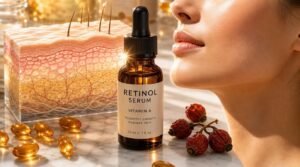
Retinol isn’t for everyone — but for the right person, it’s genuinely hard to beat. A few specific skin types and goals make it the stronger choice over bakuchiol. Here’s who stands to benefit most.
Oily and Acne-prone Skin Types
If your skin often stays shiny by noon and breakouts feel like a constant battle, retinol is genuinely your ally. It unclogs pores, reduces sebum overproduction, and targets inflammatory lesions directly — benefits bakuchiol simply can’t match at the same level.
- Regulates excess sebum at the follicle
- Minimizes enlarged, debris-filled pores
- Reduces papules, pustules, and comedones
- Compatible with oil-control ingredients like niacinamide.
Users Targeting Deep Collagen Remodeling
If acne‑prone skin is retinol’s first home, deep collagen remodeling is where it truly excels. Retinol’s receptor‑level signaling drives upregulation of type I and type III collagen gene expression — changes confirmed in dermal biopsies.
Results take time; expect 8–12 weeks minimum. Protect that investment with daily SPF, since UV quietly dismantles new collagen faster than any serum can rebuild it.
Those Without Sun-sensitivity Concerns
If you don’t deal with photosensitivity concerns, retinol fits your routine cleanly. You can commit to the nighttime protocol, apply SPF in the morning as standard practice, and let the ingredient do its job.
Three reasons this works in your favor:
- Retinol’s collagen benefits compound over weeks without interference
- Your sun-safe routine already covers the photosensitivity gap
- Wrinkle reduction results arrive faster than with bakuchiol
Who Should Choose Bakuchiol
Bakuchiol isn’t a compromise — it’s often the smarter starting point. Whether your skin is easily irritated, you’re experiencing pregnancy, or you simply want an active you can use morning and night, this ingredient covers more ground than most people expect. Here’s who often benefits most.
Sensitive, Rosacea, or Eczema-prone Skin
If your skin flares at the slightest provocation — a new product, a change in weather, even stress — bakuchiol is almost certainly your safer starting point. Unlike retinol, it skips the retinization adjustment period entirely, meaning no peeling, no stinging, and no redness while your skin adapts.
| Skin Concern | Why Bakuchiol Wins |
|---|---|
| Rosacea | No photosensitivity risk |
| Eczema | Preserves barrier integrity |
| Dryness | Built-in antioxidant support |
| Reactivity | Under 5% irritation rate |
| Barrier damage | No stratum corneum thinning |
Pair it with a ceramide-rich daily moisturizer and broad-spectrum SPF 30+ — sun exposure is a known rosacea trigger — and you’ve built a solid, skin-respecting routine around one gentle active.
Pregnant or Breastfeeding Individuals
Pregnancy changes everything about your skincare calculus. Retinol is contraindicated during pregnancy and breastfeeding — it’s a vitamin A derivative, and even topical absorption carries teratogenic risk.
Retinol is contraindicated during pregnancy — even topical absorption carries teratogenic risk
Bakuchiol isn’t a vitamin A analogue at all, so it sidesteps that concern entirely. It’s the pregnancy-safe alternative dermatologists actually feel comfortable recommending.
Daytime Active Ingredient Users
If your routine runs on morning hours, bakuchiol fits naturally.
Retinol demands nighttime use — the photosensitivity risk makes daytime application genuinely counterproductive.
Bakuchiol doesn’t share that limitation, so your morning routine stays simple: apply it, layer a moisturizer for daytime barrier care, then finish with SPF 30 sunscreen.
No rescheduling, no extra caution.
Just consistent, comfortable anti-aging without rearranging your whole day.
Beginners to Anti-aging Skincare
Starting fresh with anti-aging? Bakuchiol is your safest first step. It builds confidence without the harsh adjustment period retinol demands.
Here’s why beginners love it:
- No retinization period — zero redness or peeling as your skin adapts
- Twice-daily use fits naturally into any simple routine
- Patch test first, then introduce gradually alongside a ceramide moisturizer and daily SPF 30+
How to Use Retinol or Bakuchiol Safely
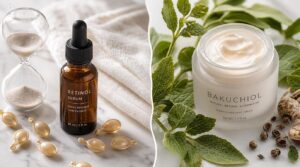
Getting the most out of either ingredient comes down to how you use it — not just what you use. Both retinol and bakuchiol have their own rhythm, and following the right protocol makes all the difference between results and irritation. Here’s exactly how to work each one into your routine safely.
Starting Retinol: Concentrations and Frequency
Think of retinol like a new workout program — you don’t start with heavy weights. Begin with a low-strength retinol of 0.01% to 0.03%, applying just a pea-sized amount across your entire face.
Week one means once only, at night. Increase to twice weekly only when your skin tolerates it well, always watching for redness or peeling.
The Moisturizer Sandwich Method
The moisturizer sandwich method is exactly what it sounds like — you’re wrapping your retinol between two layers of hydration. Here’s the basic order:
- Base hydration layer: Apply a thin coat of moisturizer to clean skin first, then wait for it to absorb.
- Active buffer: Place your retinol serum in the middle — never directly on bare skin.
- Top seal: Finish with another moisturizer layer to lock in comfort and support skin barrier health.
If it’s morning, sunscreen always closes the routine.
Bakuchiol Twice-daily Application Protocol
Bakuchiol is refreshingly low-maintenance.
Apply a few drops to clean, dry skin each morning after cleansing. Follow with moisturizer, then sunscreen. Repeat the same steps at night. No sandwiching required.
If your skin feels irritated, drop to once daily until it settles.
Consistent morning and evening use is what delivers those steady bakuchiol benefits over time.
Nighttime Routine With Retinol
Your retinol night routine doesn’t have to be complicated — but the order matters.
Start with a gentle cleanser, then wait 20–30 minutes for skin to fully dry. Apply a pea-sized amount of retinol serum, moisturize after, and skip AHAs or vitamin C that night.
Simple, consistent steps are what release real retinol benefits over time.
Nighttime Routine With Bakuchiol
Unlike retinol, bakuchiol doesn’t ask much of you.
Cleanse before application to clear away the day’s buildup, pat skin dry, then press a few drops of bakuchiol serum into your face and neck.
Wait a minute, then layer your moisturizer on top for barrier support.
You can do this every night — no ramp-up drama required.
Can You Use Bakuchiol and Retinol Together?
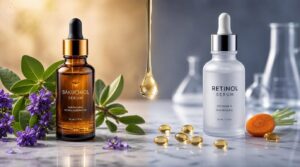
Yes, you can — and the results are worth it. Using both together isn’t just possible; it’s actually one of the smarter moves in anti-aging skincare when done right. Here’s what you need to know before layering them.
Combination Therapy Benefits
Using both actives together isn’t just possible — it’s perhaps smarter than choosing one.
Here’s what ingredient synergy delivers:
- Synergistic collagen boost targets both cell turnover and collagen gene expression simultaneously
- Irritation reduction lets you stay consistent instead of quitting during rough retinization weeks
- Stability improvement because bakuchiol naturally shields retinol from light degradation
- Day-night flexibility keeps anti-aging coverage around the clock
- Layered efficacy targets fine lines, tone, and texture through complementary pathways
The 4:1 Bakuchiol-to-retinol Ratio Explained
So where does the 4:1 ratio come in? Research shows that four parts bakuchiol to one part retinol delivers complete retinol stabilization against photo‑oxidative breakdown — while a 1:1 ratio offers only partial protection.
It’s a formulation decision, not a dosing claim, rooted in bakuchiol’s excellent antioxidant strength: roughly 50–60 times more effective than tocopherol at inhibiting lipid peroxidation.
How Bakuchiol Stabilizes Retinol in Formulas
Think of bakuchiol as retinol’s personal bodyguard inside the bottle. Its phenolic structure actively scavenges free radicals before they can break retinol down — a process called photo-oxidative defense.
In oxidative environments, bakuchiol dose-dependently preserves retinol concentration, outperforming tocopherol considerably. That’s formulation stability in action: more retinol survives to your skin, keeping retinoid potency exactly where it needs to be.
Layering Tips to Minimize Irritation
Even the best combo can backfire without smart layering. Apply bakuchiol first — it’s lighter — then wait 30–60 seconds before adding your retinol.
Seal everything with a moisturizer after retinol to lock in hydration and buffer irritation.
Stick to one active per night, and patch test the combination before going full-face.
Less friction, fewer surprises.
Top 9 Retinol and Bakuchiol Products to Try
Knowing which ingredient suits your skin is one thing — finding a product that actually delivers it well is another. Whether you’re drawn to retinol’s deeper remodeling power or bakuchiol’s gentler approach, there’s a formula out there that fits your routine. Here are nine worth putting on your radar.
1. SkinMedica Retinol Renewal Serum
If you’re ready to commit to a real retinol routine, the SkinMedica Retinol Renewal Serum is a solid place to start. At 0.25% retinol, it’s strong enough to drive cell turnover and collagen remodeling — but gentle enough for newcomers.
The airless pump protects against oxidation, so you’re actually getting active retinol with every use.
Expect some initial dryness; that’s normal.
Pair it with a good moisturizer nightly, and sunscreen every morning without exception.
| Best For | Anyone easing into a retinol routine who wants real results without jumping straight into a high-strength formula. |
|---|---|
| Skin Type | All skin types, acne-prone |
| Key Ingredient | Retinol 0.25% |
| Cruelty-Free | Not specified |
| Fragrance-Free | Not specified |
| Primary Benefit | Anti-aging, pore control |
| Sun Protection | Sunscreen required |
| Additional Features |
|
- The airless pump keeps retinol fresh and active — no wasted product
- 0.25% strength is effective yet forgiving, great for first-timers
- Works on multiple concerns at once: fine lines, pores, texture, and occasional breakouts
- The price tag is higher than most drugstore retinol options
- New users may deal with dryness, redness, or peeling while their skin adjusts
- Daily sunscreen becomes non-negotiable — UV sensitivity is a real trade-off
2. Neutrogena Retinol Hyaluronic Face Moisturizer
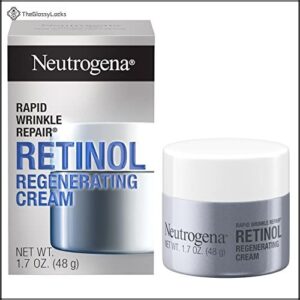
If you’re looking for an accessible entry point into retinol without the steep learning curve, the Neutrogena Rapid Wrinkle Repair Moisturizer deserves a spot on your radar. It pairs retinol with hyaluronic acid — so you’re getting cell turnover support alongside real hydration, which helps cushion that initial adjustment period.
It’s fragrance-free, clinically tested to visibly smooth fine lines within a week, and gentle enough for nightly use.
Still, apply your SPF every morning — retinol and sunlight don’t mix well.
| Best For | Anyone just getting into retinol who wants real results without harsh side effects or a complicated routine. |
|---|---|
| Skin Type | All skin types |
| Key Ingredient | Retinol + Hyaluronic Acid |
| Cruelty-Free | Not specified |
| Fragrance-Free | Yes |
| Primary Benefit | Fine lines, dark spots |
| Sun Protection | Sunscreen required |
| Additional Features |
|
- Retinol and hyaluronic acid work together — you get wrinkle-fighting and hydration in one step
- Clinically tested to smooth fine lines in as little as a week
- Fragrance-free and gentle enough for nightly use on face and neck
- Can cause irritation or burning at first, especially if your skin runs sensitive
- You have to wear SPF every morning — retinol makes your skin more vulnerable to sun damage
- Not a great pairing with facial waxing or flaky makeup
3. Fig1 Retinol Night Cream
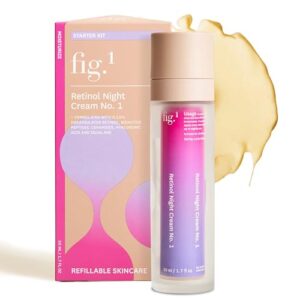
Fig1 Retinol Night Cream No. 1 is a smart pick if you’re just dipping your toes into retinol.
It uses time-release encapsulated retinol at 0.15% — gentle enough for sensitive skin, but still effective. Squalane and glycerin keep the barrier supported overnight. The airless pump dispenser protects potency, though some users report occasional pump issues.
Expect visible improvement around week four. As always, SPF every morning is non-negotiable.
| Best For | First-time retinol users and anyone with sensitive or mature skin who wants a gentle, no-fuss intro to anti-aging. |
|---|---|
| Skin Type | Sensitive, all types |
| Key Ingredient | Retinol 0.15% + Squalane |
| Cruelty-Free | Yes |
| Fragrance-Free | Yes |
| Primary Benefit | Smoothing, overnight hydration |
| Sun Protection | Nighttime use only |
| Additional Features |
|
- Time-release retinol is easy on sensitive skin while still getting the job done
- Squalane and glycerin keep your skin hydrated and balanced overnight
- Fragrance-free, vegan, and dermatologist-tested — hard to argue with that lineup
- The airless pump can be hit or miss, which is frustrating when you’re running low
- Some users notice an off-putting musty smell, hinting at possible batch inconsistencies
- At 0.15%, it’s a starter dose — not enough for anyone ready to level up their retinol game
Herbivore Bakuchiol Anti-Aging Face Serum
If you want retinol results without the drama, Herbivore’s Bakuchiol Anti-Aging Face Serum is worth a look. This vegan bakuchiol serum comes in a sleek glass bottle with dropper precision dispensing — no guesswork, no waste.
Work it into your evening regimen after cleansing, and let its antioxidant‑rich, gentle formula quietly support skin elasticity night after night.
4. Ole Henriksen Peptide Moisturizer Duo
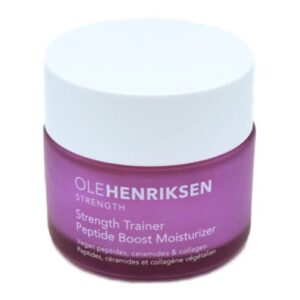
The Ole Henriksen Peptide Moisturizer Duo pairs two rich peptide‑boost moisturizers in one set — a smart move if you’re building a complete routine.
Each jar delivers ceramides, hyaluronic acid, and peptides like Palmitoyl Tripeptide-1 to support collagen signaling and lock in moisture.
At $48.87, it’s an investment, but you’re getting barrier‑strengthening ingredients twice daily.
Note: a lemon‑citrus fragrance is included, so sensitive skin types should patch test first.
| Best For | Anyone with dry or mature skin who wants a solid, peptide-packed moisturizer they can use head-to-toe every day. |
|---|---|
| Skin Type | Sensitive, reactive |
| Key Ingredient | Bakuchiol + Peptides |
| Cruelty-Free | Yes |
| Fragrance-Free | Not specified |
| Primary Benefit | Wrinkle reduction, radiance |
| Sun Protection | Compatible with SPF layering |
| Additional Features |
|
- Peptides, ceramides, and hyaluronic acid work together to seriously boost hydration and support your skin’s barrier
- Versatile enough for face, neck, chest, and hands — and plays well under makeup
- Vegan, cruelty-free, and packaged in recyclable glass, so it’s a cleaner choice all around
- At $48.87, it costs more than a lot of comparable moisturizers on the market
- The lemon-citrus fragrance could irritate sensitive skin — worth patch testing first
- Anti-aging results are subtle and take consistent use over time to notice
5. Ordinary High Strength Retinol Serum
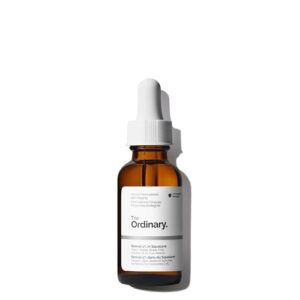
If the Ole Henriksen duo is your hydration anchor, think of The Ordinary High Strength Retinol Serum as your collagen engine — doing the heavy lifting underneath.
At 1% retinol in a squalane base, this serum is built for experienced users who mean business. The squalane helps buffer dryness, and added antioxidants like rosemary and tomato extract protect stability. Apply at night only, start slowly, and always follow with SPF.
| Best For | Experienced retinol users who want serious anti-aging results and are ready to handle a high-potency formula. |
|---|---|
| Skin Type | Dry, mature |
| Key Ingredient | Peptide Complex |
| Cruelty-Free | Yes |
| Fragrance-Free | No (lemon-citrus scent) |
| Primary Benefit | Hydration, firmness |
| Sun Protection | No SPF included |
| Additional Features |
|
- 1% retinol is one of the strongest over-the-counter concentrations you can get — real collagen-boosting power
- Squalane base keeps dryness in check, making it more tolerable than most high-strength retinols
- Works on fine lines, uneven texture, dull skin, and enlarged pores all at once
- Too intense for beginners — sensitive skin will likely react with dryness, redness, or peeling
- You have to wear SPF every single day without fail, since retinol makes skin more sun-sensitive
- Can’t be mixed with other retinoids, strong acids, or vitamin C, so it takes some routine planning
6. Elf Holy Hydration Daily Cleanser
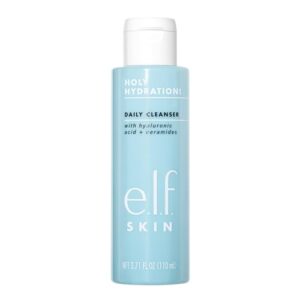
Powerful actives need a clean slate — and that’s where the e.l.f. Holy Hydration Daily Cleanser earns its place. At just $7, this gel-based formula lathers gently, sweeping away oil and impurities without stripping your barrier.
Hyaluronic acid and ceramides keep skin feeling balanced post-cleanse — not tight, not dry. It’s vegan, cruelty‑free, and gentle enough for sensitive skin.
Think of it as the quiet foundation your retinol or bakuchiol routine quietly depends on.
| Best For | Anyone with normal, combination, or sensitive skin who wants a gentle, hydrating daily cleanser that supports their skincare routine without breaking the bank. |
|---|---|
| Skin Type | Experienced, normal |
| Key Ingredient | Retinol 1% + Squalane |
| Cruelty-Free | Not specified |
| Fragrance-Free | Not specified |
| Primary Benefit | Collagen boost, texture |
| Sun Protection | Sunscreen required |
| Additional Features |
|
- Hyaluronic acid and ceramides leave skin clean without that tight, stripped feeling
- Vegan and double-certified cruelty-free (Leaping Bunny and PETA) at just $7
- Great for post-procedure or post-laser skin that needs extra gentleness
- The mild scent might still bother those who are really sensitive to fragrance
- Not strong enough to take off waterproof makeup on its own
- Very oily skin types may need a toner on top for better oil control
7. Inkey List Glycolic Acid Toner
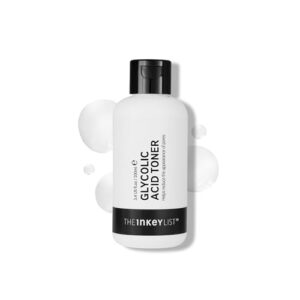
Once your skin is clean, it’s ready to work — and that’s where The INKEY List Glycolic Acid Toner steps in. At $15, it delivers 10% glycolic acid to accelerate cell turnover, smooth texture, and brighten your complexion over time.
The added witch hazel helps control oil without overdrying.
Use it 2–3 nights per week on a cotton pad, and always follow with SPF the next morning.
It’s not for sensitive skin, but for oily or blemish-prone types it punches well above its price.
| Best For | People with oily or blemish-prone skin who want an affordable, no-fuss exfoliating toner to smooth texture and shrink pores over time. |
|---|---|
| Skin Type | Normal, combination, sensitive |
| Key Ingredient | Hyaluronic Acid + Ceramides |
| Cruelty-Free | Yes (Leaping Bunny, PETA) |
| Fragrance-Free | Mild scent |
| Primary Benefit | Cleansing, hydration |
| Sun Protection | No SPF included |
| Additional Features |
|
- 10% glycolic acid is a solid concentration for the price — real results without the luxury markup
- Witch hazel keeps oil in check without stripping your skin dry
- Fragrance-free and vegan, so fewer ingredients to worry about
- Might sting or feel warm the first few times — ease into it
- Not a good fit for dry or sensitive skin types
- The 3.4 oz bottle goes fast if you’re using it regularly
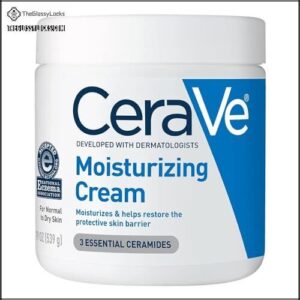
8. CeraVe Moisturizing Cream for Dry Skin
No active leaves your skin more vulnerable than one that strips moisture — so a solid moisturizer isn’t optional, it’s the anchor of your routine.
CeraVe Moisturizing Cream earns its place here at $17.06 for a generous 19 oz tub.
Three ceramides plus hyaluronic acid work together to rebuild your barrier, while MVE technology releases hydration steadily over 24 hours.
Fragrance-free, non-comedogenic, and dermatologist-developed — it layers beautifully under retinol or bakuchiol without clogging pores.
| Best For | Anyone with dry, sensitive, or eczema-prone skin who needs a reliable, no-frills moisturizer that works hard without irritating skin or breaking the bank. |
|---|---|
| Skin Type | Oily, blemish-prone |
| Key Ingredient | Glycolic Acid 10% + Witch Hazel |
| Cruelty-Free | Yes |
| Fragrance-Free | Yes |
| Primary Benefit | Exfoliation, pore minimizing |
| Sun Protection | No SPF included |
| Additional Features |
|
- Three ceramides plus hyaluronic acid actively rebuild your skin barrier while keeping moisture locked in all day.
- MVE technology delivers hydration steadily over 24 hours — no need to reapply constantly.
- Fragrance-free, non-comedogenic, and dermatologist-developed, so it plays nicely with acne treatments and sensitive skin routines. If you’re unsure how exfoliating acids fit into a sensitive skin routine, this guide to chemical body exfoliant benefits breaks it down simply.
- No SPF, so you’ll need a separate sunscreen if you’re applying this in the morning.
- The rich, thick texture can feel heavy or greasy on oily skin types.
- Zero fragrance is a win for sensitive skin, but if you like your moisturizer to smell like something, this one won’t do it for you.
Frequently Asked Questions (FAQs)
Is bakuchiol the same as retinol?
No, they’re not the same. Bakuchiol is plant-derived, extracted from babchi seeds, while retinol is a vitamin A derivative. They share anti-aging goals but work through completely different chemical pathways.
Does Bakuchiol really work?
Yes, it really does. Research shows bakuchiol reduces fine lines and hyperpigmentation meaningfully over 12 weeks — with far less irritation than most actives. For sensitive skin, it’s a genuinely effective option.
What is Bakuchiol?
Derived from the seeds of Psoralea corylifolia — the babchi plant — bakuchiol is a naturally occurring meroterpene phenol used in skincare for its antioxidant, anti-inflammatory, and collagen-supporting properties.
Is Bakuchiol a good anti-aging cream?
It’s genuinely effective. Bakuchiol reduces fine lines, improves skin tone, and boosts collagen — all with minimal irritation. Most users see real results within 12 weeks of consistent twice-daily use.
Should I use Bakuchiol or retinoid?
It really comes down to your skin type and lifestyle. Sensitive or pregnant? Go bakuchiol. Oily, acne-prone, or chasing faster results? Retinol wins. Both work — just differently.
Is bakuchiol really as effective as retinol?
Like two roads leading to the same destination, both deliver comparable anti-aging results. A 12-week clinical trial found bakuchiol matched retinol for reducing fine lines and hyperpigmentation.
What are the downsides of bakuchiol?
Bakuchiol isn’t irritation-free for everyone. Some people notice redness or itching at first, and product quality varies widely — a weak formula simply won’t deliver results.
What do Asians use instead of retinol?
Asian skincare leans on peptides, adenosine, vitamin C derivatives, and centella asiatica — gentle actives that target fine lines, dullness, and barrier health without the irritation retinol often brings.
Is it OK to use bakuchiol everyday?
Yes — for most people, daily bakuchiol use is perfectly fine. It’s gentle enough to apply morning and evening without an adjustment period, making it one of the few actives you don’t have to ease into slowly.
Can I use bakuchiol and retinol together?
Absolutely — these two work well together. Many people use retinol at night and bakuchiol in the morning, or alternate nights to reduce irritation while keeping anti-aging benefits consistent.
Conclusion
Retinol remodels deep; bakuchiol restores gently—and your skin deserves exactly the right tool for the job.
The bakuchiol vs retinol decision isn’t about which ingredient wins; it’s about which one works with your skin, your routine, and your life.
Start where your skin is, not where you wish it were.
Give it time, stay consistent, and trust the process.
The best anti‑aging ingredient is simply the one you’ll actually use.