This site is supported by our readers. We may earn a commission, at no cost to you, if you purchase through links. This content is for general informational and educational purposes only and is not a substitute for professional medical, dermatological, or nutritional advice.
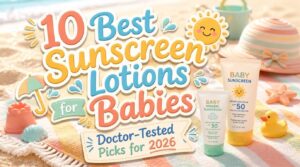
Your pediatrician’s office has probably said it a dozen times: babies under six months should stay out of direct sun, full stop. But once that birthday candle gets closer, or you’re chasing a mobile eight-month-old across a beach towel, you need a formula you can trust on skin that’s still developing its natural barrier.
That’s where mineral formulas earn their keep. Zinc oxide and titanium dioxide sit on top of the skin instead of absorbing into it, which matters when you’re dealing with a stratum corneum that’s thinner and more permeable than an adult’s.
After weeks of testing texture, white cast, and how formulas hold up after a pool day, ten sunscreen lotions for babies rose to the top, each one earning its spot for a different reason.
Table Of Contents
- Key Takeaways
- Top 10 Baby Sunscreen Lotions and Sticks
- 1. La Roche-Posay Anthelios Mineral SPF 50 Lotion
- 2. Babo Botanicals Mineral Sunscreen Lotion SPF50
- 3. Hello Bello Mineral Sunscreen Stick SPF 50
- 4. Mustela Baby Mineral Sunscreen Lotion SPF 50
- 5. Aveeno Baby Zinc Oxide SPF 50 Sunscreen
- 6. Thinkbaby Mineral Sunscreen SPF 50+
- 7. Baby Bum Mineral Sunscreen Lotion SPF 50
- 8. Sun Bum Baby Bum Mineral Sunscreen Stick
- 9. Badger Mineral Baby Sunscreen Cream SPF 40
- 10. Tubby Todd Mineral Sunscreen SPF 50
- How We Tested Baby Sunscreens
- Safe Baby Sunscreen Ingredients Explained
- How to Choose Baby Sunscreen Lotion
- How to Apply Baby Sunscreen Safely
- Sun Protection for Babies Under Six Months
- Frequently Asked Questions (FAQs)
- What is the best sunscreen lotion for babies?
- Why can’t babies under 6 months use sunscreen?
- What kind of sunscreen is safe for babies?
- Can babies under 12 months have sunscreen?
- Can babies with eczema use mineral sunscreen daily?
- Is expired baby sunscreen still safe to use?
- Can baby sunscreen be used on newborns scalps?
- How should baby sunscreen be stored between uses?
- Conclusion
Key Takeaways
- Babies under six months should skip sunscreen entirely and rely on shade, UPF clothing, and hats instead, since their skin barrier isn’t developed enough to handle it safely.
- Once your baby hits six months, mineral sunscreens with zinc oxide or titanium dioxide are the safest bet because they sit on top of the skin and reflect UV rays instead of absorbing them.
- No matter which formula you pick, apply it 15-30 minutes before heading outside, use a generous amount, and reapply every two hours (or right after swimming or heavy sweating).
- Look for fragrance-free, 80-minute water-resistant formulas with sensitive-skin certification, since these hold up best in testing and are gentlest on eczema-prone or reactive skin.
Top 10 Baby Sunscreen Lotions and Sticks
After years of reading ingredient labels and watching parents wrestle wiggly babies into sunscreen, I’ve narrowed the field down to ten formulas worth your trust.
If your own routine needs a refresh too, this guide to skin care essentials for mature women pairs nicely with sunscreen shopping for the whole family.
Each one made this list for a reason, whether that’s a texture your baby won’t fight or a formula gentle enough for eczema-prone skin.
Here’s where you’ll find the details on each, starting with the option many pediatricians reach for first.
1. La Roche-Posay Anthelios Mineral SPF 50 Lotion
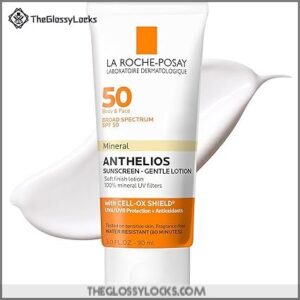
A lightweight lotion that doesn’t fight you back, that’s the appeal here. With 5% zinc oxide as its mineral filter, this SPF 50 formula spreads on velvety rather than pasty, and blends into most skin tones without that chalky cast babies (and parents) tend to hate.
It’s fragrance-free, water-resistant, and built for reactive skin. Reapplication is easy since it doesn’t sit greasy. For sensitive-skinned babies past six months, it’s become something of a go-to in my practice.
| Best For | This mineral sunscreen is best for those with sensitive skin who want daily broad-spectrum SPF 50 protection without oxybenzone or added oils. |
|---|---|
| Active Ingredient | Titanium Dioxide/Zinc Oxide |
| SPF Level | SPF 50 |
| Protection Type | Broad Spectrum |
| Water Resistance | Sweat-resistant |
| Skin Sensitivity | Sensitive skin |
| White Cast | Visible white cast |
| Additional Features |
|
- Broad spectrum SPF 50 protection with titanium dioxide and zinc oxide filters
- Oil-free, oxybenzone-free formula recommended by dermatologists for sensitive skin
- Sweat-resistant, making it suitable for outdoor activities
- Can leave a visible white cast, particularly on medium to deep skin tones
- Thick texture may be hard to spread and can feel pasty
- Some users report irritation, rashes, or difficulty removing the product
2. Babo Botanicals Mineral Sunscreen Lotion SPF50
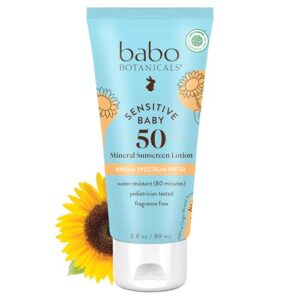
If La Roche-Posay wins on texture, Babo Botanicals wins on strength. It skips titanium dioxide altogether, leaning on 20% zinc oxide alone for broad-spectrum coverage, which means a thicker shield but also a heavier feel going on.
Fragrance-free and water-resistant to 80 minutes, it’s held up well through pool days in my testing. Eczema-prone babies tend to tolerate it fine. The tradeoff? Expect a touch more white cast until it’s rubbed in fully.
| Best For | Parents seeking a strong, reef-safe mineral sunscreen for babies and children with sensitive or eczema-prone skin. |
|---|---|
| Active Ingredient | Zinc Oxide |
| SPF Level | SPF 50 |
| Protection Type | Broad Spectrum |
| Water Resistance | 80 minutes |
| Skin Sensitivity | Sensitive skin |
| White Cast | Visible white cast |
| Additional Features |
|
- 20% zinc oxide delivers strong broad-spectrum UVA/UVB protection
- Fragrance-free, vegan, and gentle enough for extra sensitive or eczema-prone skin
- Water-resistant for up to 80 minutes, holding up well during swimming or sweating
- Leaves a noticeable white cast if not rubbed in thoroughly
- Feels heavier on skin due to relying solely on zinc oxide
- Needs shaking before each use and isn’t formulated to moisturize dry or eczema-prone skin
3. Hello Bello Mineral Sunscreen Stick SPF 50
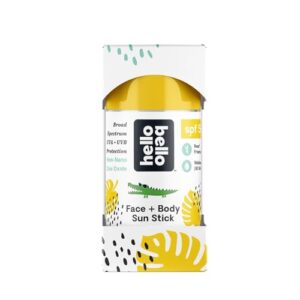
For the nose, ears, and cheeks, a lotion isn’t always the easiest tool, which is where the Hello Bello stick earns its spot.
It uses 20% zinc oxide in a mess-free stick format, gliding on without needing your hands at all. Cocoa seed butter and avocado oil keep it from feeling chalky.
Reef-friendly and water-resistant, it’s a smart glovebox staple. Just keep it out of hot cars: sticks soften fast, and a melted one is no fun to reapply.
| Best For | Parents wanting a mess-free way to apply sunscreen to kids’ faces, ears, and noses, especially those with sensitive skin. |
|---|---|
| Active Ingredient | Zinc Oxide |
| SPF Level | SPF 50 |
| Protection Type | Broad Spectrum |
| Water Resistance | 80 minutes |
| Skin Sensitivity | Sensitive skin |
| White Cast | Visible white cast |
| Additional Features |
|
- Non-nano zinc oxide offers broad-spectrum mineral protection without needing to rub in lotion by hand
- Moisturizing ingredients like coconut oil, cocoa butter, and shea butter keep skin from feeling dry or chalky
- Compact, portable stick design makes it easy to toss in a diaper bag or take on hikes and travel
- Can leave a visible white cast, though how noticeable it is varies by user
- May feel sticky or tacky on the skin after application
- Softens or melts in high heat, so it needs to be stored somewhere cool
4. Mustela Baby Mineral Sunscreen Lotion SPF 50
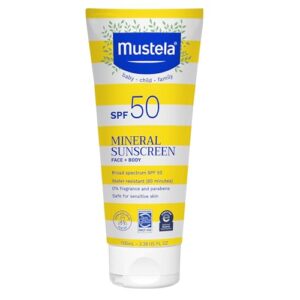
If sticks aren’t your thing, Mustela’s lotion covers more ground fast. It packs 24% zinc oxide, higher than most on this list, into a lightweight base that absorbs within seconds and leaves barely a white cast.
Glycerin and caprylic/capric triglyceride keep skin hydrated rather than tight. Fragrance-free and water-resistant to 80 minutes, it’s gentle enough for daily use, on babies and parents alike.
The controlled-dispense bottle helps you avoid dolling out more than needed.
| Best For | Parents seeking a fragrance-free, water-resistant SPF 50 mineral sunscreen for babies and toddlers with sensitive or eczema-prone skin. |
|---|---|
| Active Ingredient | Zinc Oxide |
| SPF Level | SPF 50 |
| Protection Type | Broad Spectrum |
| Water Resistance | 80 minutes |
| Skin Sensitivity | Sensitive/eczema skin |
| White Cast | Visible white cast |
| Additional Features |
|
- Broad spectrum SPF 50 protection with a non-nano zinc oxide mineral filter
- Water resistant for up to 80 minutes, ideal for swimming or sweating
- Fragrance-free formula gentle enough for sensitive baby skin
- Can leave a visible white cast if not rubbed in thoroughly
- Thick consistency makes it harder to spread and absorb
- Some users report irritation or itching despite the fragrance-free label
5. Aveeno Baby Zinc Oxide SPF 50 Sunscreen
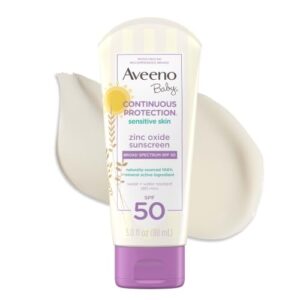
Consistency is Aveeno’s calling card. This lotion runs 21.6% zinc oxide, glides on smoothly, and dries to a matte, non-greasy finish instead of the usual chalky sheen.
Oat-based ingredients calm sensitive skin, and the fragrance-free formula keeps irritation risk low. It’s tear-free too, so accidental swipes near the eyes won’t trigger a meltdown.
Between the reliable texture and gentle formulation, it’s a dependable pick for daily wear, not flashy, but it does exactly what a baby sunscreen should.
If you’re planning pool days or beach trips, this mineral formula holds up well when you follow smart sun protection tips for swimming.
| Best For | parents seeking a gentle, reliable SPF 50 sunscreen for daily use on babies with sensitive or eczema-prone skin. |
|---|---|
| Active Ingredient | Zinc Oxide |
| SPF Level | SPF 50 |
| Protection Type | Broad Spectrum |
| Water Resistance | 80 minutes |
| Skin Sensitivity | Eczema-prone skin |
| White Cast | Noticeable white cast |
| Additional Features |
|
- 100% naturally sourced zinc oxide with broad-spectrum SPF 50 protection
- Tear-free, fragrance-free, and paraben-free formula with soothing colloidal oatmeal
- Water- and sweat-resistant for up to 80 minutes, great for beach or pool days
- Leaves a noticeable white cast, especially right after application
- Thick texture needs warming and extra effort to spread evenly
- Can feel sticky or tacky before it fully absorbs, especially in humid weather
6. Thinkbaby Mineral Sunscreen SPF 50+
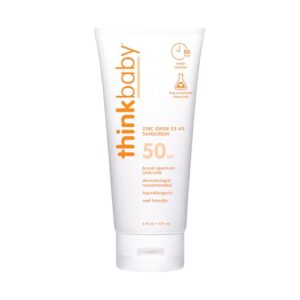
If your toddler treats bath time like a wrestling match, Thinkbaby’s thicker texture might test your patience some, but its 20% non-nano zinc oxide delivers serious broad-spectrum coverage.
The formula skips fragrance and blends in aloe vera and glycerin, so sensitive skin stays soothed rather than stripped. It’s paraben and phthalate free too.
For more on building a routine around ingredients like these, choosing the right shaving soap for acne-prone skin can make a real difference in keeping breakouts at bay.
Expect a sweet, faintly fruity scent, not chemical-smelling, and know it takes a bit more rubbing to fully absorb. Water resistance holds for 80 minutes.
| Best For | Parents seeking a gentle, mineral-based sunscreen for babies and toddlers with sensitive skin who need reliable protection during extended outdoor water play. |
|---|---|
| Active Ingredient | Zinc Oxide |
| SPF Level | SPF 50+ |
| Protection Type | Broad Spectrum |
| Water Resistance | 80 minutes |
| Skin Sensitivity | Sensitive skin |
| White Cast | Temporary white cast |
| Additional Features |
|
- Uses 20% non-nano zinc oxide for broad-spectrum SPF 50 protection suitable for babies over 6 months
- Stays water resistant for up to 80 minutes during swimming or sweating
- Absorbs with minimal greasy or sticky residue despite its thicker texture
- May leave a temporary white cast that needs thorough rubbing to minimize
- Thicker consistency can make application tricky on active, wriggly toddlers
- Needs reapplication every 80 minutes or after swimming/sweating to stay effective
7. Baby Bum Mineral Sunscreen Lotion SPF 50
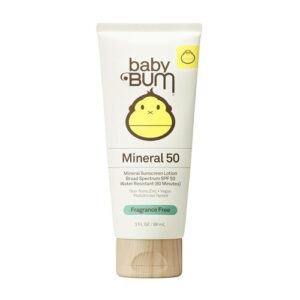
Where Thinkbaby leans thick, Baby Bum’s lotion goes the other direction, blending zinc oxide with coconut oil, shea, and cocoa butter into something closer to a body lotion than a chalky sunscreen.
It’s fragrance-free and holds up for 80 minutes in water. Reviewers like the quick absorption, though some report a lingering white cast if you rush the rub-in.
A few parents noted mild irritation despite the "sensitive skin" label, so patch-test first if your baby’s skin runs reactive.
| Best For | Parents seeking a lightweight, moisturizing mineral sunscreen for babies and children with sensitive skin who’ll be spending time outdoors near water. |
|---|---|
| Active Ingredient | Zinc Oxide |
| SPF Level | SPF 50 |
| Protection Type | Broad Spectrum |
| Water Resistance | 80 minutes |
| Skin Sensitivity | Sensitive skin |
| White Cast | Visible white cast |
| Additional Features |
|
- Blends zinc oxide with coconut oil, shea butter, and cocoa butter for a lotion-like feel instead of a chalky texture
- Fragrance-free formula that’s water resistant for up to 80 minutes
- Absorbs quickly and doesn’t leave a greasy residue
- Can leave a visible white cast if not rubbed in thoroughly
- Some parents report mild irritation even though it’s marketed for sensitive skin
- The 3 oz travel-size tube may need frequent repurchasing for regular family use
8. Sun Bum Baby Bum Mineral Sunscreen Stick
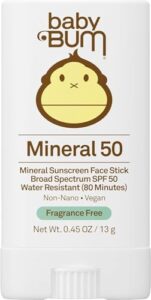
For faces that won’t sit still, a stick beats a lotion bottle every time.
This 0.45-ounce version packs 19.2% zinc oxide into a solid glide, blended with coconut oil, shea, and meadowfoam seed oil.
It’s fragrance-free, water-resistant to 80 minutes, and small enough for any diaper bag pocket.
Texture runs slightly stiffer than the lotion, so expect a light white cast until you’ve rubbed it in fully across cheeks and nose.
| Best For | Parents of babies and toddlers with sensitive skin who need a quick, mess-free mineral sunscreen for on-the-go application. |
|---|---|
| Active Ingredient | Zinc Oxide |
| SPF Level | SPF 50 |
| Protection Type | Broad Spectrum |
| Water Resistance | Not specified |
| Skin Sensitivity | Sensitive skin |
| White Cast | Visible white cast |
| Additional Features |
|
- Mineral-only formula with 19.2% zinc oxide offers broad-spectrum SPF 50 protection without octinoxate or oxybenzone
- Compact, travel-friendly stick fits easily in a diaper bag or pocket and resists melting or freezing in extreme temperatures
- Unscented, gentle formula is well-suited to sensitive skin, including babies and toddlers
- Can leave a visible white cast that needs thorough rubbing to blend in
- Stiffer, stickier texture can make application trickier on wiggly kids
- Small 0.45 oz size means you’ll likely need to repurchase it fairly often
9. Badger Mineral Baby Sunscreen Cream SPF 40
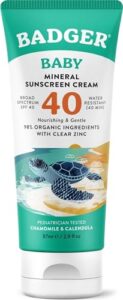
Uncoated zinc oxide is Badger’s whole philosophy in a tube: nothing fancy, just 40 minutes of water resistance and a creamy, sunflower-oil-softened texture that spreads without much fight.
It runs lighter than the stick, with a mild white tint that blends out fast, and skips synthetic fragrance entirely.
One caveat worth knowing: that 40-minute water resistance is considerably shorter than the 80-minute standard we favor for pool days, so reapply often if your baby’s splashing.
| Best For | families with babies or toddlers who have sensitive or eczema-prone skin and want a reef-safe, mostly organic mineral sunscreen. |
|---|---|
| Active Ingredient | Zinc Oxide |
| SPF Level | SPF 40 |
| Protection Type | Broad Spectrum |
| Water Resistance | 80 minutes |
| Skin Sensitivity | Eczema-prone skin |
| White Cast | Minimal white cast |
| Additional Features |
|
- Made with 98% organic ingredients and non-nano zinc oxide, and pediatrician tested for sensitive, eczema-prone skin
- Reef-safe formula free of oxybenzone and octinoxate, with broad spectrum UVA/UVB protection
- Water resistant for up to 80 minutes, with a minimal white cast compared to other mineral sunscreens
- Thick consistency makes it hard to dispense from the tube and takes extra effort to rub in, especially on wiggly kids
- Can leave a temporary white sheen and feel slightly greasy after application
- Some users report mild eye irritation if the product gets too close to the eyes
10. Tubby Todd Mineral Sunscreen SPF 50
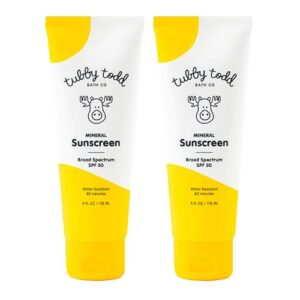
Rounding out the list, zinc oxide does the heavy lifting here, with a lotion texture built to skip the chalky white cast babies (and parents) tend to dread.
It’s water-resistant for up to 80 minutes, rubs in smoothly without heavy residue, and stays fragrance-free for reactive skin.
The tradeoff is price, it runs higher than most on this list. But for eczema-prone kids needing gentle daily protection, that cost often buys real peace of mind.
| Best For | Families with young children who have eczema or sensitive skin and need dependable, gentle sun protection for everyday outdoor time. |
|---|---|
| Active Ingredient | Zinc Oxide |
| SPF Level | SPF 50 |
| Protection Type | Broad Spectrum |
| Water Resistance | 80 minutes |
| Skin Sensitivity | Sensitive/eczema skin |
| White Cast | No white residue |
| Additional Features |
|
- Broad spectrum zinc oxide protection guards against both UVA and UVB rays
- Rubs in smoothly with no white cast or sticky residue, even on little ones
- Hypoallergenic, fragrance-free formula that’s gentle on sensitive and eczema-prone skin
- Costs more than many other mineral sunscreens on the market
- Texture runs a bit thicker than typical chemical sunscreens
- Needs reapplying after 80 minutes of swimming, sweating, or towel drying
How We Tested Baby Sunscreens
Picking a baby sunscreen isn’t just about grabbing whatever’s on the shelf at SPF 50, so I put each formula through the same hands-on checks in my own practice and at home. My testing looked at everything from what’s actually in the bottle to how it holds up after a sweaty afternoon at the park. Here’s exactly what I looked for, and why each factor matters more than you might think.
Formula and Ingredient Safety
Trust starts with the ingredient list, not the marketing copy. Every product we tested had to pass on mineral filter safety, non-nano zinc oxide or titanium dioxide, full ingredient transparency, and fragrance-free formulation. We flagged anything with photoallergenic scents or vague "fragrance" listings.
Hypoallergenic certification and reef-safe ingredients earned extra credit, since nontoxic baby skincare should protect skin and the ocean it swims in. Just as clear, jargon-free labeling helps parents make informed choices, researchers stress the importance of writing for naive readers so information stays accessible rather than obscured by technical terms.
Texture and Spreadability
Once ingredients pass muster, the real test begins on skin. We rubbed each sunscreen lotion between fingers, checking for smooth spreadability:
- Silky light cream that vanishes with minimal pressure
- Rich emollient emulsions needing gentle rubbing, no white residue
- Non greasy gels absorbing fast, tearfree formula intact
Satin matte textures and water resistant formulations kept slip through wiggly, sunscreen-averse toddlers.
White Cast and Blending
Smooth spread is one thing, but every mineral sunscreen fights the same visible fight: white cast. Titanium dioxide leans lighter, so we massaged each formula for a full 60 seconds, watching edge lines fade at the jaw and ears.
Smaller zinc particles blended fastest, leaving a nongreasy finish. Tinted formulas won points here, cutting chalkiness without sacrificing protection.
Water Resistance After Activity
Chalk marks fading is one test. Staying put in a pool is another entirely.
We soaked each formula, then toweled dry and checked for shear. Products rated water resistant for 80 minutes held their film best, that light haze visible even after a gentle rinse.
Sweat cut wear time slightly. For beach trips and pool use, plan on reapplying every two hours regardless.
Long-term Parent Tester Feedback
Because a single afternoon test tells you nothing about week six, we followed families for eight weeks straight, tracking scent tolerance, skin irritation, and application ease along the way.
Zero new rashes turned up for most testers. Texture consistency held steady, washability stayed simple, and fragrance-free, reef-safe formulas earned true parent-approved, dermatologist-tested status for long-lasting wear.
Safe Baby Sunscreen Ingredients Explained

Once you know what to look for on a label, choosing gets a lot less stressful. Every ingredient on that ingredient list is doing a job, whether it’s blocking rays or calming skin, and knowing which is which puts you back in control. Here’s what those labels actually mean for your baby.
Zinc Oxide Protection
Think of zinc oxide as a tiny physical shield sitting on top of your baby’s skin, reflecting UVA and UVB rays instead of absorbing them. That’s why protection starts immediately, no waiting around.
It’s water-resistant, gentle on sensitive skin, and non-nano formulas keep particles too large to enter the bloodstream, a detail parents in my clinic always ask about.
Titanium Dioxide Protection
A pale mineral called titanium dioxide works a bit like tiny mirrors on your baby’s skin, scattering UVA and UVB before they cause damage.
Particle size matters: smaller particles mix better but still reflect light effectively. Coatings like silica boost photostability and cut whiteness.
In SPF 50 formulas, TiO2 stays inert, non-volatile, and gentle, an eczema-friendly, environmentally low-impact choice.
Mineral Versus Chemical Filters
Mineral versus chemical filters comes down to how each blocks UV rays. Mineral sunscreen sits on skin, reflecting rays; chemical sunscreen absorbs and converts them to heat.
| Factor | Mineral | Chemical |
|---|---|---|
| Feel | Thicker, white cast | Lighter, blends fast |
| Skin sensitivity | Lower irritation risk | Possible reactions |
| Reef safety | Water-stable | May leach |
Fragrance-free Hypoallergenic Formulas
Fragrance-free" sounds simple, but check the INCI list: no parfum means no hidden allergens.
Hypoallergenic formulas skip common triggers through:
- Low-sensitization preservatives
- No added fragrance compounds
- Patch-tested bases
- pH-balanced systems
- Mild, lipid-friendly surfactants
For sensitive skin, this gentle profile matters. Pediatrician-recommended, dermatologist-tested products reduce guesswork, so you’re not gambling on your baby’s delicate skin.
Calendula and Aloe Additives
Ever notice how some sunscreens leave skin calmer than others? Calendula extract and organic aloe explain why. This natural soothing combination offers gentle skin hydration plus mild anti-inflammatory properties, ideal for a sensitive skin formula.
You’ll find this pairing in dermatologist tested, fragrance-free baby lines, proof that baby-safe ingredients can feel as good as they protect.
How to Choose Baby Sunscreen Lotion

With so many bottles and sticks lining the shelf, picking the right one for your baby’s skin can feel overwhelming fast. A few key factors actually matter here, and the rest is mostly marketing noise. Here’s what to check before it goes in your cart.
Broad-spectrum SPF Protection
Two letters matter most on any bottle: UVA and UVB. Broad-spectrum SPF means both are covered, since UVB causes sunburn while UVA drives long-term aging and cancer risk. The FDA requires testing for both before that label applies.
Choose SPF 30 or higher; SPF 50 blocks roughly 97 to 98% of UVB rays. Pediatrician recommended, dermatologist tested mineral formulas deliver this reliably.
See whether you can still tan while wearing sunscreen to understand why protection matters even when color develops.
Eighty-minute Water Resistance
Broad spectrum SPF matters little if the film washes off in the pool. Look for water resistant for 80 minutes on the label, meaning testing standards simulate real swimming, sweat included.
A quality mineral sunscreen forms a solid layer that survives towel drying. Reapply after swimming or every 80 minutes, whichever comes first, even if skin still looks dry.
Sensitive Skin Certifications
Once that 80-minute timer resets, check the label for something else: sensitive skin certification. It means dermatologists patch-tested the formula on eczema-prone volunteers over 48 to 72 hours, checking for redness.
Look for:
- Fragrance-free and hypoallergenic claims
- Preservative safety limits documented
- Dermatologist endorsement on packaging
- Annual revalidation, not one-time testing
That paper trail matters more than marketing.
Lotion Versus Stick Formats
Certifications tell you a formula is safe. Format decides whether you’ll actually use it.
Sunscreen lotion spreads fast over arms, legs, and torso, giving even coverage on irregular surfaces. A sunscreen stick offers targeted, mess-free application, perfect for noses, ears, and quick touch-ups on the go. Both deliver mineral SPF 50 protection; the difference is texture, application speed, and reapplication ease for your baby’s sun protection routine.
Non-greasy Comfortable Finish
Once a mineral sunscreen sits on your baby’s skin like a chalky mask, you’ll skip the next application, so texture matters as much as SPF.
Look for a lightweight feel with quick absorption, ideally under 90 seconds, and a matte finish that blends into skin and clothes.
A non-sticky, non greasy finish keeps gentle baby skincare comfortable through two hours of play, fragrance free and dermatologist tested.
How to Apply Baby Sunscreen Safely
Even the best sunscreen only works if you put it on right, and a few small habits make a bigger difference than most parents expect. It’s not just about which bottle you grab, but when and how generously you use it. Here’s what I tell parents at every well-child visit about applying baby sunscreen safely.
Apply Before Sun Exposure

Waiting until you’re already at the park is too late. Mineral filters need a few minutes to settle onto skin, so apply sunscreen 15 to 30 minutes before heading outdoors. This timing rule holds for the lotion for body use and facial sticks alike, giving you a real head start on infant sunburn prevention before UV rays even hit.
Use a Generous Amount

A little dab won’t cut it. Aim for a full teaspoon per limb and one for the torso, enough that you see visible layering on the skin rather than a thin, rubbed-in sheen.
Thicker mineral formulas need that generous amount to deliver their full SPF 50, broad spectrum, water resistant promise.
Cover Easily Missed Areas

Where do parents miss most? Ears, scalp, and feet, every time.
- Ear application guide: behind the lobe and outer cartilage, never the canal
- Scalp protection methods: part the hair, dab the crown thin
- Shoulder coverage tips: merge into the neck junction, smooth past the armpit crease
- Hand and finger coverage: between fingers, over knuckles
- Foot and ankle application: toe tops, ankle sock lines, heel arches
Reapply Every Two Hours
Set a timer the moment sunscreen touches skin, because that’s when the clock actually starts.
Reapply every two hours, no exceptions, whether you’re using SPF 30 or SPF 50, sunny skies or cloudy ones (up to 80% of UV still sneaks through clouds). Swimming or heavy sweating? Reapply immediately after.
Use a full, generous amount each time, skimping cuts protection short.
Avoid Inhaling Sunscreen Sprays
Here’s a rule worth tattooing on your diaper bag: sprays and baby faces don’t mix. Skip aerosols entirely and stick with fragrance-free mineral sunscreen lotion or stick formulas instead.
If a spray’s your only option, mist hands first, then apply.
- Avoid direct facial spraying
- Cover mouth and nose nearby
- Let sprays dry before flames
Sun Protection for Babies Under Six Months

If your baby hasn’t hit the six-month mark yet, sunscreen isn’t your main tool, and that’s by design, not an oversight. Their skin needs other kinds of backup instead. Here’s what actually works when sunscreen’s off the table.
Why Sunscreen Use is Limited
Because their skin barrier is still developing, infant UV protection relies less on sunscreen and more on physical barriers before six months. Pediatric guidance favors shade reliance, hats, and clothing over chemical or mineral application.
| Age | Primary Protection | Sunscreen Role |
|---|---|---|
| Under 6mo | Shade, clothing | Minimal, small areas only |
| 6mo+ | Sunscreen | Primary |
Prioritize Shade Outdoors
With sunscreen off the table, shade becomes your best defense. A mature tree canopy can cut UV exposure by 90%, no lotion required.
A mature tree canopy can cut a baby’s UV exposure by 90 percent, no sunscreen required
- Position shade sails to track the sun’s path
- Add side screening to shelters for extra coverage
- Try portable canopies at parks or beaches
- Prioritize south-facing shade structures
- Choose UV-rated fabric, 80% or higher
Choose UV-protective Clothing
Once shade is set up, clothing does the rest. Look for UPF-rated fabrics, tightly knit polyester or blends beat loose cotton every time.
| Fabric Choice | UV Protection |
|---|---|
| Tight weave | Blocks more UVA/UVB |
| Loose knit | Higher UV transmittance |
| Dark color | Not a guarantee |
| Lightweight, tight weave | Still high UPF |
Don’t assume dark equals safe. UPF 50+ clothing paired with shade offers broad-spectrum coverage sunscreen simply can’t, for these tiny, sensitive-skinned months.
Add Hats and Canopies
Clothing covers the torso, but a good wide brim hat shades what fabric can’t reach, blocking up to 90% of UV rays across the face, neck, and ears.
Flap hats add a cape over the nape, cutting sunburn risk on that easily-missed strip of skin.
Stroller-mounted sun canopies build a shaded pocket for naps outdoors, rounding out your baby’s under-six-months sun defense.
Ask Your Pediatrician First
Why guess when you’ve got an expert on speed dial? Your pediatrician knows your baby’s history, so ask your pediatrician first about sunscreen safety, skin reaction concerns, or sensitive skin guidance before that first beach trip.
At your well-child visit, raise product suitability questions early. A pediatrician-recommended sunscreen, chosen for your child specifically, beats guesswork every time.
Frequently Asked Questions (FAQs)
What is the best sunscreen lotion for babies?
One formula keeps rising to the top of every parent’s bag and every dermatologist’s list. Babo Botanicals Sensitive Baby SPF 50 blends 20% zinc oxide, fragrance free comfort, and true water resistance into a non-greasy, pediatrician-recommended pick.
Why can’t babies under 6 months use sunscreen?
Their newborn skin barrier isn’t fully developed, so it can’t metabolize sunscreen chemicals safely. That’s why pediatric guidance favors sun avoidance strategies, shade, and protective clothing over any product for babies this young.
What kind of sunscreen is safe for babies?
Think of a shield, not a filter: mineral-based sunscreen with zinc oxide or titanium dioxide is safest, sitting atop skin rather than absorbing in.
For babies over six months, choose fragrance-free, pediatrician recommended formulas with 80-minute water resistance and sensitive skin certification.
Can babies under 12 months have sunscreen?
Not before six months, per pediatrician sun advice. Under 12 months, shade and UV clothing take priority over sunscreen safety infants concerns. Once your baby hits six months, mineral sunscreen ingredients like zinc oxide become appropriate for exposed skin.
Can babies with eczema use mineral sunscreen daily?
Better safe than sorry: yes, daily fragrance-free mineral sunscreen works well for eczema-prone skin. Patch test on the forearm for 3-5 days first, and choose zinc oxide or titanium dioxide formulas your pediatrician approves for sensitive skin.
Is expired baby sunscreen still safe to use?
Once past its expiration date, sunscreen can’t guarantee labeled SPF strength. Skip anything discolored, separated, or off-smelling. For babies, always reach for a fresh, pediatrician-recommended sunscreen rather than risking sunburn on delicate skin.
Can baby sunscreen be used on newborns scalps?
Newborns need a gentler game plan than scalp sunscreen safety allows. Skip it entirely under six months, favor fragrance-free sensitive skin hats and shade instead.
Zinc oxide mineral filters are for older babies, once newborn skin barrier protection matures past the earliest weeks.
How should baby sunscreen be stored between uses?
Keep it capped, upright, and cool: 68 to 77°F, away from windows and steamy bathrooms. Heat above 100°F separates the formula. Note your open date, since most tubes expire within 12 to 24 months.
Conclusion
Picture a sandy little foot, freshly slathered, catching afternoon light without a single red patch by bedtime. That’s the real test.
The best sunscreen lotions for babies aren’t the ones with the prettiest label, they’re the ones you’ll actually reach for on day thirty of summer.
Zinc oxide and titanium dioxide do the quiet work of a physical shield. Pick one, apply it generously, and let your child’s skin do what skin does best: play.