This site is supported by our readers. We may earn a commission, at no cost to you, if you purchase through links. This content is for general informational and educational purposes only and is not a substitute for professional medical, dermatological, or nutritional advice.
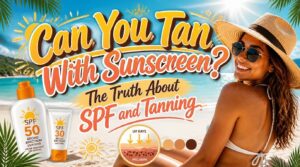
Slathering on SPF 50 and still coming home with a golden glow isn’t a sunscreen failure—it’s just biology doing what biology does. Sunscreen filters UV radiation; it doesn’t create a force field.
Even a well-applied SPF 30 lets through roughly 3% of UVB rays, and most formulas leave a slice of UVA exposure unblocked entirely.
That residual UV is enough to darken existing melanin, trigger new pigment production, and yes—produce a tan. The catch? That color is your skin’s damage response, not a sign of health.
Understanding what SPF actually does changes how you approach sun protection altogether.
Table Of Contents
- Key Takeaways
- Yes, You Can Tan With Sunscreen
- Why Sunscreen Doesn’t Stop Tanning
- What SPF Really Means
- Tanning Risks Even With Sunscreen
- Apply Sunscreen for Best Protection
- Safer Ways to Look Tan
- Frequently Asked Questions (FAQs)
- Does sunscreen prevent tanning?
- Can you use a tanning bed with or without sunscreen?
- Which sunscreen should I use when tanning?
- Can sunscreen reverse a tan?
- Can you get a tan with sunscreen?
- Which SPF is best for tanning?
- Do you tan quicker without sunblock?
- Why do I tan so quickly even with sunscreen?
- Can you get a tan using sunscreen?
- What SPF is best for tanning?
- Conclusion
Key Takeaways
- Sunscreen only filters UV rays, it doesn’t block them completely, so even SPF 50 lets some rays through, and you can still tan.
- That golden color you see isn’t a sign of healthy skin; it’s your skin’s stress response to UV damage that’s already happened.
- SPF measures UVB protection only, so it won’t stop UVA rays from darkening existing pigment in your skin.
- If you want color without the risk, self‑tanners, tinted sunscreens, or bronzing moisturizers give you that glow without any UV damage.
Yes, You Can Tan With Sunscreen
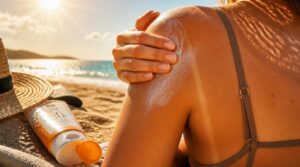
Yes, sunscreen does reduce how much UV radiation reaches your skin — but it doesn’t create a complete barrier. A small percentage of rays still get through, and that’s enough to trigger tanning over time. Here’s what’s actually happening when you tan through SPF.
Even with broad-spectrum SPF 30+ sunscreen blocking up to 98% of UV rays, that remaining 2% is still enough to gradually darken your skin.
Sunscreen Reduces UV Exposure
Sunscreen works by using UV filter mechanisms to reduce how much ultraviolet radiation actually reaches your skin. Mineral filters like zinc oxide and titanium dioxide physically scatter and reflect UV rays away. Chemical filters absorb UV photons and convert them into heat. Think of it as a shield — imperfect, but genuinely effective at cutting down your overall UV exposure.
This dual defense against both UVA and UVB means consistent daily use protects against premature aging and sunburn alike, a distinction worth understanding in this breakdown of how sunscreen protects skin from sun damage.
- Fewer UV rays reach your skin cells
- Your skin has more time before damage accumulates
- Both UVA and UVB wavelengths are targeted
- Your risk of burning drops markedly
- Your skin gets real, meaningful protection
Research shows that SPF 30 sunscreen prevents epigenetic aging, keeping skin’s biological age stable despite UV exposure.
No Sunscreen Blocks Everything
Even the best sunscreen has a ceiling. No filter—mineral or chemical—blocks the entire UV spectrum.
Titanium dioxide, for instance, leaves UVA 1 rays largely unfiltered. Chemical filters can also degrade with sun exposure, quietly losing effectiveness.
So even under a well‑applied SPF 50, some ultraviolet radiation still slips through and reaches your skin.
Tanning Still Signals Damage
That golden color isn’t your skin glowing with health — it’s your skin reacting to stress. When UV radiation hits, your melanocytes ramp up melanin production to shield deeper cells.
It’s a protective reflex, but it also signals that hidden DNA injury has already occurred.
A visible tan means damage came first.
SPF Slows Burning
SPF stands for Sun Protection Factor — and it’s really about slowing UVB from burning you, not stopping it entirely. SPF 30 blocks around 97% of UVB rays, while SPF 50 blocks about 98%. A small but real percentage still gets through. Think of it as a dimmer switch, not an off switch.
That’s why picking a formula that actually stays put matters, and our roundup of best sunscreens for swimming and sweat-proof protection narrows down which ones truly hold their SPF in the water.
If you’re wondering whether that jump from SPF 30 to 50 is worth it, this breakdown of what each SPF level actually means lays out the numbers so you can decide for yourself.
For that reason, it’s worth choosing a formula with real staying power — this guide to sunscreen lotions for babies breaks down fragrance-free, 80-minute water-resistant options gentle enough for sensitive skin.
Safer Than Unprotected Tanning
Using sunscreen isn’t a perfect shield, but it’s far better than going unprotected. You’re still reducing the UV dose your skin absorbs — and less UV means less damage.
Skipping sunscreen turns that dimmer switch off completely.
If a tan is your goal, protecting your skin along the way is simply the smarter trade-off.
Why Sunscreen Doesn’t Stop Tanning
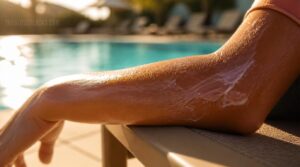
Sunscreen does a lot of good, but it can’t put up a total wall between your skin and the sun. A few things explain why tanning still happens even when you’re applying it faithfully. Here’s what’s actually going on beneath the surface.
UVA Darkens Existing Pigment
Here’s something most people don’t realize: your skin can darken within minutes of UVA exposure — no new melanin needed. UVA rays work by oxidizing pigment that’s already sitting in your skin, triggering immediate pigment darkening fast. Here’s what that process actually looks like:
- UVA hits existing melanin and oxidizes it directly
- Melanosome redistribution shifts pigment closer to the skin’s surface, making it visually darker
- The color change can appear grayish at first, then deepen to brown
- Persistent pigment darkening can linger anywhere from 2 to 24 hours
No new melanin production required — just chemistry already in motion beneath your skin.
Your existing pigment just needs time to surface, so hold off on scrubbing — check out these exfoliation timing tips for post-shave skin to avoid undoing the process.
UVB Triggers New Melanin
While UVA darkens pigment that’s already there, UVB does something slower — and deeper. It actually triggers new melanin production by activating tyrosinase, the key enzyme that kicks off pigment synthesis inside melanocytes. This process doesn’t happen overnight; you’re looking at delayed darkening that builds over several days.
| UVB Effect | What It Means |
|---|---|
| Tyrosinase activation | Starts new melanin production |
| Keratinocyte cytokine signaling | Sends chemical cues to melanocytes |
| MSH receptor activity | Boosts melanocyte sensitivity |
| UVB dose thresholds | Higher doses drive stronger pigment response |
Even with sunscreen on, enough UVB reaches your skin to set this process in motion.
Broad-spectrum Still Allows Exposure
Broad-spectrum sunscreen sounds like a shield, but it’s more like a screen door. It blocks most UVA and UVB rays, not all of them.
Filter limitations and application gaps mean some UV transmission always slips through. Real-world efficacy rarely matches lab conditions, especially with incomplete coverage or thin layers.
That leftover sun exposure is still enough to trigger tanning, even when you’re doing everything right.
Time Outdoors Matters
The longer you’re outside, the more sun exposure adds up — sunscreen only slows that clock, it doesn’t stop it. A quick walk under a low UV index won’t tan you much. Hours at the beach will, even with SPF 30 on.
Checking the UV index and following sun exposure guidelines helps you balance vitamin D, mood, and skin safety without overdoing your time outdoors.
Skin Type Affects Tanning
Not everyone tans the same way, even with the same SPF on. The Fitzpatrick scale groups skin types by how they react to sun, and it explains a lot. Lighter types burn fast; darker types tan more easily with less redness.
That comes down to melanin production and the eumelanin-to-pheomelanin ratio. Freckle-prone skin is likely to burn sooner, signaling higher sensitivity regardless of tone.
What SPF Really Means
That number on the bottle gets thrown around a lot, but most people don’t actually know what it’s measuring. SPF isn’t as simple as "more protection equals no tan," and the math behind it might surprise you. Let’s break down what those numbers actually tell you.
SPF Measures UVB Protection
Here’s something worth knowing: SPF only measures UVB protection — not UVA. The number tells you how much longer your skin can resist UVB-induced redness, called the erythemal response, compared to bare skin.
UV filters absorb or scatter UVB rays before they reach you. But no sunscreen blocks UVB completely — some UVB still gets through, even at high SPF.
SPF 30 Versus SPF 50
SPF 30 blocks ~97% of UVB; SPF 50 blocks ~98%. One percent feels like nothing — until you’re fair-skinned and hours into a high UV index day.
- SPF 30 — ~97% of UVB filtered
- SPF 50 — ~98% of UVB filtered
- Higher SPF means less margin for error
- Sensitive skin benefits more from SPF 50
- Sweat and water shrink real-world burn times
Higher SPF Still Tans
That 1% gap still lets UV rays through. Higher sun protection factor numbers reduce burning, not tanning. Sunscreen allows residual UVB transmission, triggering melanin response variation, while UVA darkening effects deepen pigment—even at SPF 50. Application thickness impact: thin layers speed gradual pigment development.
| SPF | UVB Blocked |
|---|---|
| 30 | 97% |
| 50 | 98% |
Your skin still tans under sun exposure, just slower.
Broad-spectrum Protects Better
Sun protection factor only measures UVB. It tells you nothing about UVA rays—the ones that age skin and deepen pigment.
Broad‑spectrum sunscreen covers both, passing a critical wavelength test that confirms real UVA/UVB synergy. That combined filter benefit, often zinc oxide plus avobenzone, boosts absorption spectrum efficacy and enhances pigment change prevention, even without total UV protection.
Water Resistance Wears Off
Ever notice your sunscreen feels fine, then your shoulders still turn pink? Water‑resistant doesn’t mean waterproof.
Labels promise 40 or 80 minutes in water before sunscreen efficacy drops. Sweat, friction, and towel drying all speed that decline.
Even within the time window, rubbing off with a towel removes protection. That’s why sunscreen reapplication timing matters most right after swimming, sweating, or changing clothes—not just every two hours.
Tanning Risks Even With Sunscreen

So sunscreen helps, but it doesn’t make tanning risk-free. Even with SPF on, your skin is still dealing with some real consequences underneath. Here’s what’s actually happening when that tan starts to show up.
Tan Means Skin Injury
Here’s a hard truth: tanned skin is damaged skin, full stop. That golden color comes from melanin, your body pumps out as a damage signal, racing to shield cells from UV radiation already causing harm.
A tan is not a glow—it is your skin’s damage signal written in melanin
The change shows up over the next 48 hours, but don’t let that delay fool you. Even with sunscreen on, any tan means UV cellular injury occurred—and that quietly raises your skin cancer risk.
Sunburn and Inflammation
Burning isn’t just redness—it’s your skin sounding an alarm. UVB rays trigger DNA damage, and your body responds with a cascade of inflammatory chemicals: cytokines like IL-1, prostaglandins, eicosanoids. These widen blood vessels and flood the area with immune cells.
That peak soreness hitting 24–48 hours later? That’s the inflammatory response peaking—not fading. Sunscreen reduces this, but won’t eliminate it entirely.
Premature Aging and Wrinkles
Think of collagen as your skin’s scaffolding—UV light slowly tears it down. That tan comes largely from UVA, the same rays driving collagen fiber breakdown and elastin loss.
Less elastin means less bounce, so skin sags and creases sooner. Oxidative stress piles on, fueling an ongoing aging cycle. The result: photoaging shows up as rougher texture and premature wrinkles, often years ahead of schedule.
Skin Cancer Risk
A tan isn’t just a color change — it’s a record of cumulative DNA damage building in your skin cells over time. Every UV exposure adds to that total, and the body can’t repair all of it.
- Melanoma risk rises with repeated sun exposure
- UVA and UVB rays both damage skin cell DNA
- Tanning bed dangers are severe — using one before age 20 raises melanoma risk by up to 50%
- Sunscreen reduces but doesn’t eliminate UV rays reaching your skin
- Genetic susceptibility factors like fair skin or family history increase the risk
Skin cancer types linked to UV include basal cell carcinoma, squamous cell carcinoma, and melanoma. No SPF blocks everything, so consistent, correct sunscreen use genuinely matters.
Hyperpigmentation and Melasma
UV exposure doesn’t just raise cancer risk — it can also quietly reshape your skin’s tone. Hyperpigmentation and melasma develop when melanocytes overproduce pigment in response to sun, hormones, or even visible light.
Melasma often appears as brown, blotchy patches across the cheeks, forehead, or jaw — and it often relapses whenever sun protection slips.
Apply Sunscreen for Best Protection
Knowing sunscreen matters is one thing — using it right is another. A few simple habits make a real difference in how well it actually works. Here’s what to keep in mind.
Use Enough Product
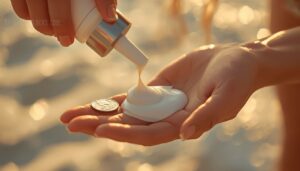
If your sunscreen looks patchy or your skin peeks through, you’re using too little. Dermatologists recommend roughly 2 milligrams per square centimeter — about a nickel-to-quarter amount for your face, a shot glass for your body.
Sprays need enough mist for full coverage, not a quick pass.
Skimping on dosage measurement accuracy quietly lowers your actual sun protection factor, no matter the bottle’s rating.
Apply Before Sun Exposure

Getting the dose right matters, but so does timing. Apply sunscreen at home 15 to 30 minutes before heading outside.
That window lets the formula bond evenly with your skin, forming one consistent film instead of a patchy mess. It also gives you a mirror and good light to catch missed spots before the UV index climbs.
Reapply Every Two Hours
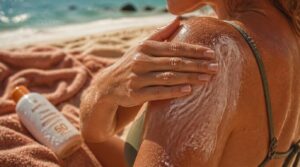
That even film won’t last all day. Sweat, swimming, and towel drying wear sunscreen down fast, and friction from straps or sand finishes the job. So reapply every two hours, sooner after:
- Heavy sweating
- Swimming
- Towel drying
- Friction from clothing
Skimping on amount each round creates real reapplication dosage errors—and gaps in your SPF protection.
Cover Commonly Missed Areas
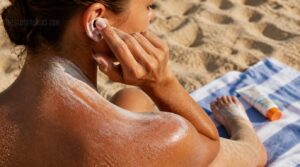
Quick swipes leave gaps. Shoulder cap coverage often gets skipped once arms are done, and the ear rim protection area burns fast in updos. Wrap sunscreen around the full neck circumference, not just the front.
Don’t forget hand knuckle sunscreen and foot instep care—both face constant friction and reflected UV rays during long sun exposure, quietly undoing your sun protection factor SPF and inviting uneven tanning.
Choose SPF 30 Plus
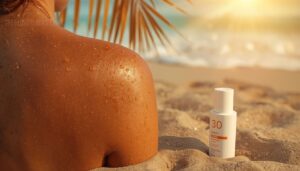
The number to remember is SPF 30 or higher. At SPF 30, about 97% of UVB rays are blocked — and jumping to SPF 50 only nudges that to 98%. Not a dramatic leap.
- Blocks roughly 97% of UVB
- Leaves about 3% UVB transmission
- SPF 50 offers only marginally more protection
- Both allow tanning with enough sun exposure
- Standardized testing confirms diminishing returns above SPF 30
Safer Ways to Look Tan

Getting a sun-kissed look doesn’t have to mean sitting under UV rays. There are a few solid options that give you that warm glow without the skin damage. Here’s what actually works.
Self-tanning Lotions
Self-tanning lotions give you a genuine-looking glow without any UV exposure at all. The active ingredient, DHA, reacts with dead skin cells to create a brown tone within four to six hours — no sun damage, no burned skin, no cancer risk. Just color.
For the best result, exfoliate the day before to smooth the surface.
Spray Tans
Want a faster glow? Spray tans rely on the same DHA chemical reaction, but use an aerosol application technique for even coverage.
A bronzer visibility guide shows missed spots instantly. Post-application drying matters most — skip sweating or showering for several hours.
Like other sunless tanning methods, color fades through natural exfoliation; no UV involved at all.
Tinted Sunscreens
Here’s a two-in-one trick: tinted sunscreen gives you color and protection in the same swipe. Iron oxides create the tint, matching real skin tones while adding visible light protection — a real plus for melasma-prone skin. They’re blended with zinc oxide or titanium dioxide for solid UV coverage.
- Pigments mimic your skin tone, not a costume
- Visible light protection guards against stubborn pigmentation
- Mineral pigment emulsions feel lighter than old-school sunscreen
Bronzing Moisturizers
Ever wished for a glow without the sun? Bronzing moisturizers blend hydration boosting ingredients like hyaluronic acid and glycerin with DHA, which builds color in about two hours—no UV needed.
| Ingredient | Benefit |
|---|---|
| Shea butter | Locks in moisture |
| Vitamin E | Strengthens skin barrier |
Squalane adds lightweight moisture. Blend gently, reapply after swimming or towel-drying, and enjoy a safer, sunless tan today.
Avoid Tanning Beds
Tanning beds are worth skipping entirely. They emit UV radiation roughly 12 times more intense than natural sunlight — and using them before age 20 raises your melanoma risk by up to 50%. That’s not a small number.
Here’s what else indoor tanning does:
- Increases squamous cell carcinoma risk by 58%
- Suppresses your skin’s immune defenses
- Causes corneal burns and irreversible eye damage
No glow is worth that.
Frequently Asked Questions (FAQs)
Does sunscreen prevent tanning?
As the old saying goes, *protection isn’t flawless.
- Sunscreen reduces UV radiation reaching your skin, slowing the melanin response — but it can’t block every ray, so some pigment change still happens.
Can you use a tanning bed with or without sunscreen?
You can use sunscreen in a tanning bed, but it won’t make the experience safe. Tanning beds emit intense UVA — roughly 12 times natural sunlight — and no sunscreen blocks it all.
Which sunscreen should I use when tanning?
Go with a broad-spectrum SPF 30+. Mineral options like zinc oxide are FDA-recognized and gentle on sensitive skin. Apply enough — about one ounce for your body — and reapply every two hours.
Can sunscreen reverse a tan?
Sunscreen can’t reverse a tan. Melanin is already in your skin, and only natural cell turnover fades it over weeks. Sunscreen stops more UV damage — it doesn’t erase existing pigment.
Can you get a tan with sunscreen?
Yes — UV radiation still slips past your SPF, triggering melanin production. UVA darkens existing pigment while UVB sparks new color, so careful sunscreen use means a slower, less damaging tan, not zero tan at all.
Which SPF is best for tanning?
SPF 30 is the sweet spot. It blocks about 97% of UVB rays — enough to slow burning while still letting gradual color develop. SPF 50 offers marginally more protection if you burn easily.
Do you tan quicker without sunblock?
Skin darkens faster without protection, since unfiltered UV radiation hits at full strength. Melanin response speeds up, but so does sunburn risk. That faster color often means more damage, not a safer or smarter tan.
Why do I tan so quickly even with sunscreen?
Think of sunscreen as a leaky umbrella—some rain still gets through. Application errors, sweat breakdown, and your own melanin production rate all let UV reach deeper layers, speeding up tanning despite protection.
Can you get a tan using sunscreen?
Your skin can still darken even with SPF 30 on. UV penetration triggers melanin production despite sunscreen’s efficacy limits, and missed spots or thin application speed up tanning.
Cumulative UV damage builds regardless, so sunscreen lowers risk without erasing tanning or sun damage entirely.
What SPF is best for tanning?
There’s no magic number that hands you a golden tan overnight. SPF 30 hits the sweet spot — about 97% UVB blockage, slower melanin synthesis, less burning risk. Higher SPF won’t stop tanning during longer sun exposure, just softens the damage.
Conclusion
That sun-kissed glow you’re chasing is really your skin waving a small red flag, asking for grace. So can you tan with sunscreen? Yes, but what you’re seeing is filtered damage, not a healthy shade.
SPF buys you time and lowers risk. It never erases UV’s reach.
Reapply, cover missed spots, and lean on self-tanner or tinted formulas when you want color without the cost.
Protected skin today is calmer, clearer skin years from now.