This site is supported by our readers. We may earn a commission, at no cost to you, if you purchase through links.

Most people expect hair loss during chemotherapy. What they don’t expect is how disorienting the regrowth phase feels — patchy, unpredictable, and often accompanied by changes in texture and color that nobody warned them about.
That’s because chemotherapy targets fast-dividing cells, and hair follicles rank among the most active in your body. The damage is temporary for most people, but "temporary" can stretch anywhere from a few months to well over a year, depending on the drugs used and how your follicles respond.
Hair loss treatment after chemotherapy isn’t one-size-fits-all — your scalp, your regimen, and your timeline all shape what works. The good news: there’s more clinical guidance available today than ever before, and small, consistent choices make a meaningful difference.
Table Of Contents
- Key Takeaways
- Why Chemotherapy Causes Hair Loss
- When Hair Shedding Usually Starts
- Hair Regrowth After Chemotherapy
- Gentle Scalp Care After Chemo
- Proven Medical Regrowth Treatments
- Supplements and Nutrition for Regrowth
- Scalp Cooling for Future Treatments
- Styling New Post-Chemo Hair
- Wigs, Scarves, and Confidence
- When to Seek Specialist Help
- Frequently Asked Questions (FAQs)
- When Will Your Hair Grow back?
- When does hair stop shedding after chemo?
- How to cope with hair loss from chemo?
- What Are The Causes of Hair Loss?
- Why Will I Lose My Hair During Cancer Treatment?
- When Will I Begin to Lose My hair?
- When Will My Hair Grow back?
- What to do when hair is falling out from chemo?
- What is the best treatment for hair growth after chemotherapy?
- What vitamins are good for chemo hair loss?
- Conclusion
Key Takeaways
- Chemotherapy hair loss follows a predictable timeline — most people start shedding within 2–4 weeks of their first infusion, with peak loss between weeks 5 and 11, and early regrowth typically appearing 1–3 months after treatment ends.
- Topical minoxidil is the strongest evidence-backed treatment to speed up regrowth after chemo, but always get your oncology team’s sign-off before starting it.
- Gentle scalp care — mild shampoo, soft bristle brush, satin pillowcase, and sun protection — protects fragile regrowth and gives your follicles the best chance to recover.
- If you see no regrowth six months after treatment ends, or if you received docetaxel, see a dermatologist — some hair loss after taxane-based chemo is a recognized medical condition, not just slow recovery.
Why Chemotherapy Causes Hair Loss

Chemotherapy does its job by targeting fast-dividing cells — but your hair follicles happen to fit that description too. That’s why hair loss is one of the most common side effects, and it’s not random. A few key factors determine how much you’ll lose and when.
In fact, the timeline can be startlingly swift — most patients experience significant hair loss within just 18 days of starting chemotherapy.
Rapidly Dividing Follicle Cells
Your hair follicles are some of the most active cells in your body. During the anagen growth phase, matrix cells deep in the hair bulb divide rapidly — producing up to 0.6 mm of new hair daily.
Chemotherapy can’t distinguish these from cancer cells, so it targets both. That’s what triggers chemotherapy hair loss: the follicle’s growth engine simply gets shut down. While chemo causes thinning, doctors use clinical trichoscopy to tell it apart from other scalp conditions.
High-Risk Chemotherapy Drugs
Not all cytotoxic drugs hit equally hard. High-dose intravenous drugs given every three weeks carry the greatest risk of hair follicle damage — taxane-based regimens especially.
These drugs have a narrow therapeutic index: the gap between effective and harmful is razor-thin.
The highest-risk drug categories include:
- Taxanes (paclitaxel, docetaxel)
- Anthracyclines like doxorubicin
- Alkylating agents such as cyclophosphamide
Scalp Versus Body Hair
Taxanes don’t discriminate — but scalp follicles take the hardest hit. That’s partly because scalp hair spends years in the active growth phase, making those follicles prime targets for chemotherapy-induced alopecia.
Body hair follicles sit shallower, cycle faster, and produce finer vellus hair shafts — so they often shed less dramatically, recovering on a slightly different timeline than your scalp.
When Hair Shedding Usually Starts

Most people are caught off guard by how quickly the shedding starts. Knowing the general timeline won’t stop hair loss, but it can make the experience feel a lot less alarming. Here’s what to expect, step by step.
First Two to Four Weeks
Most people don’t notice anything for the first couple of weeks — then, almost overnight, the pillow tells the story. Shedding usually begins two to four weeks after your first infusion.
You might spot more strands in the shower drain or on your brush. This is your hair’s normal regrowth cycle responding to treatment, not a sign something’s gone wrong.
Hairline and Crown Thinning
Thinning doesn’t spread evenly — it usually starts at the hairline and crown first. You might notice your part looking wider, or the whorl area at the top of your head showing more scalp through the strands.
That scalp show-through is crown miniaturization in action. The edges can still look full while the top quietly loses density.
Peak Shedding Timeline
By weeks five through eleven, shedding usually peaks. That’s when follicle cycle synchronization kicks in — a large wave of telogen hairs detaching around the same time.
Here’s what mostly drives intensity:
- Dose strength — higher-intensity regimens shed faster and heavier
- Mechanical friction — brushing wet hair worsens visible loss
- Cycle timing — your follicles’ phase at treatment start shapes the onset delay
When Shedding Slows
Shedding rarely stops all at once. Most people notice less hair on wash day around months one to two, normalizing by month six.
| Timeframe | Shedding Status | What You May Notice |
|---|---|---|
| Weeks 1–4 | Peak shedding | Heavy drain clumps |
| Month 1–2 | Starting to taper | Less hair on towels |
| Month 3–5 | Tapering steadily | Fewer brush strands |
| Month 6+ | Near-normal rates | Light wash-day loss |
Normal Versus Concerning Loss
Not all hair loss is equal. Diffuse shedding across your scalp is expected — patchy bald spots with sharp edges aren’t.
Watch for:
- A rapidly expanding bald patch
- Scalp redness, crusting, or swelling
- Shedding that worsens after chemo ends
- Loss linked to thyroid or iron issues
These signal something beyond typical chemotherapy hair loss and deserve a doctor’s attention.
Hair Regrowth After Chemotherapy
Once treatment ends, your hair’s comeback story begins — and it usually follows a pretty predictable path. Most people start to see changes within the first few months, though the timeline looks a little different for everyone. Here’s what you can generally expect as regrowth gets underway.
One to Three Months

Around the one-month mark, your follicles start waking back up. Regrowth doesn’t happen all at once — each follicle restarts on its own timetable, so some areas recover noticeably faster than others.
If patchy regrowth feels discouraging, female pattern baldness solutions like laser therapy and PRP can help bridge the gap while follicles find their rhythm.
The crown and hairline, often the first spots to thin, usually show the earliest signs of activity. Expect subtle color and texture shifts right from the start.
Early Peach Fuzz Growth
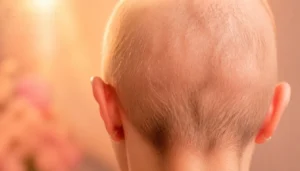
What you’re seeing is vellus hair — fine, soft strands that are lighter in color than your original hair. Follicles restart at different speeds, so patchy regrowth is normal, not a warning sign.
- Emerging hairs lie flat and feel softer than terminal hair
- Scattered coverage reflects follicles cycling back at their own pace
- Handle the scalp gently — sensitivity peaks during this phase
Texture and Color Changes

Those soft vellus strands often look lighter than your original hair — not because your color is gone, but because melanin production can shift during regrowth, and thinner strands scatter light differently than before.
Multi-tonal regrowth patterns are common. Some patches look ashy, others warmer. As strand diameter increases, the color usually deepens and evens out on its own.
Three-Month Growth Expectations

By the three-month mark, most people have clearly visible new growth — but it’s still short, often wispy, and uneven in density. Some follicles reset earlier than others, so patchy areas are normal.
Taking consistent scalp photos every two weeks helps you spot real progress that’s easy to miss day to day. You’re improving, just not finished yet.
Fullness Recovery Timeline
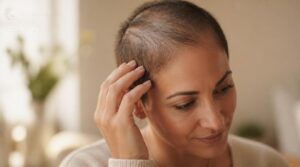
Visible growth and full density recovery aren’t the same thing. Most people reach coverage they feel comfortable with somewhere between months four and twelve — not all at once, but in gradual waves as follicle cycling rebounds and hair diameter increases.
- Patchy areas often fill in as follicles synchronize
- Hair looks thinner early because new strands are finer
- Texture and curl may shift before stabilizing
- Color can appear uneven during early regrowth
- Density trends keep improving well past the six-month mark
Gentle Scalp Care After Chemo

Your scalp has been through a lot, and how you treat it now really does make a difference. The good news is that gentle, consistent care doesn’t have to be complicated. Here’s what actually helps during this stage of recovery.
Mild Shampoo Choices
Your scalp after chemo is sensitive — treat it like newborn skin.
Look for shampoos built on gentle surfactants like decyl glucoside or coco betaine, which clean without stripping natural oils. Ingredients like glycerin, panthenol, and aloe vera help lock in moisture, while chamomile or calendula calm irritation. A balanced pH keeps the scalp stable and helps the early hair regrowth cycle.
Soft Brush Use
Reach for a soft-bristle brush — not your old paddle brush from before treatment. Fragile regrowth snaps easily, so light pressure matters as much as bristle type.
Work in small sections, moving from ends upward to avoid tugging the scalp. Brief, gentle strokes do the job. Keep the brush clean and dry between uses so oils don’t transfer back and irritate healing skin.
Satin Pillowcase Benefits
Switching to a satin pillowcase is one of the easiest overnight upgrades you can make. Its smooth surface specializes in reducing hair friction, letting fragile regrowth glide rather than snag. That matters when new strands break easily.
Satin also helps with retaining scalp moisture and minimizing morning knots — so you wake up to less damage and easier combing.
Sun Protection for Scalp
Your bare scalp has lost its natural shield. Without hair to block UV rays, sunburn happens faster than you’d expect — and repeated exposure raises the risk of long-term skin damage.
Keep it protected with:
- Broad-spectrum scalp sunscreen applied before heading outside
- A wide-brim hat for fuller, more consistent shade coverage
- Reapplication every two hours, especially when sweating outdoors
Avoiding Harsh Treatments
Your regrowth is fragile — treat it like new skin, not finished hair. Skip chemical dyes and bleach entirely until at least six months post-treatment.
Heat tools, tight clips, and rough towel-drying all stress follicles that are still rebuilding. Wash gently, pat dry, and let your scalp breathe. What you avoid right now matters as much as what you apply.
Proven Medical Regrowth Treatments

Once your treatment ends, there are real medical options that can help move regrowth along — not just hope and waiting. Your oncology team can guide you toward what’s safe and right for your situation. Here’s what’s currently available and worth knowing about.
Topical Minoxidil Use
Minoxidil is the most evidence-backed option for speeding up regrowth after chemotherapy. Applied twice daily to the scalp — not the hair — it works by stimulating follicles over months, not days. Expect an initial shedding phase first; that’s normal.
If the solution causes itching or redness (irritant contact dermatitis), the foam formulation is usually better tolerated since it skips the irritating propylene glycol.
Oncology Team Approval
Before starting minoxidil, check with your oncology care team first. Your oncologist and infusion nurses are part of a coordinated system — what’s safe six months post-treatment may not be appropriate mid-regimen.
Considering what you want matters here, but so does timing. A quick conversation ensures any regrowth support fits your overall treatment regimen without conflict.
Prescription Treatment Options
If minoxidil alone isn’t enough, your dermatologist may consider other prescription options. Topical prescription agents — like anti-inflammatory or keratolytic treatments — can help when scalp irritation or dermatitis is slowing regrowth.
For hormonal or autoimmune hair loss layered onto chemo effects, systemic oral medications exist, though they carry side effects and aren’t started without clear clinical reason. Your regimen gets individualized to you, not a template.
Eyebrow and Eyelash Support
Scalp hair isn’t the only thing chemotherapy takes. Many patients experience madarosis — loss of eyebrows and eyelashes — which also affects eye protection. Lashes catch debris and trigger a protective blink reflex; without them, eyes feel more exposed and dry.
Keep the lash line clean but handle it gently. During regrowth, brow makeup can restore symmetry, and conditioning lash serums support returning density.
Treatment Safety Considerations
Before adding any regrowth treatment to your routine, run it past your oncology team first.
Minoxidil can cause scalp irritation, redness, or itching — especially on chemosensitive skin. Some formulations contain alcohol that worsens dryness.
Watch for these warning signs:
- Burning or swelling after applying any topical product
- Crusting, pus, or spreading redness suggesting scalp infection
- Reactions in prior radiation treatment areas
- Hives or shortness of breath requiring urgent care
Supplements and Nutrition for Regrowth

What you eat during recovery can quietly work in your favor. Your body needs the right raw materials to rebuild hair from the inside out. Here’s what’s worth knowing about nutrition and supplements after chemo.
Protein for Hair Recovery
Your hair is mostly keratin — a protein your body builds from amino acids sourced through food. When intake drops too low, your body quietly redirects resources away from hair follicles toward more urgent needs.
Sulfur-containing amino acids like cysteine are especially important, forming the bonds that give keratin its structure. Marine protein supplements and hydrolyzed collagen peptides absorb efficiently, making them practical options during recovery.
| Protein Source | Key Benefit | Best Form |
|---|---|---|
| Eggs | Rich in cysteine | Whole food |
| Fish / poultry | Complete amino acid profile | Whole food |
| Marine protein supplements | Reduces shedding, aids regrowth | Supplement |
| Hydrolyzed collagen peptides | Easy absorption, peptide delivery | Supplement |
| Lentils / soy | Plant-based amino acids | Whole food |
Consistency matters more than quantity — daily protein adequacy helps ongoing keratin production rather than one big dose.
Vitamin D and Zinc
Both nutrients work as a team. Zinc acts as a cofactor for vitamin D to function properly — low zinc quietly undermines whatever vitamin D you’re taking. After chemotherapy, deficiencies in both are common and often overlap.
Zinc also helps immune and enzymatic pathways tied to follicle recovery. Think of it as the missing piece that lets the other nutrients do their job.
Supplements During Cancer Care
Before reaching for biotin, zinc, or vitamin D, check with your oncology team first. Some supplements interfere with how chemotherapy drugs are processed in the body — and antioxidants like coenzyme Q10 or turmeric may actually blunt treatment effectiveness.
Supplement labels won’t tell you that. Your care team will. What’s safe shifts depending on where you are in treatment.
Scalp Cooling for Future Treatments

If you’re facing more chemotherapy cycles ahead, scalp cooling is worth understanding before your next infusion. It’s not a perfect solution, but for many people it makes a real difference. Here’s what you need to know about how it works, who it helps most, and what to realistically expect.
How Cooling Caps Work
Cold caps work by chilling your scalp before, during, and after infusion. That temperature drop triggers vasoconstriction — blood vessels narrow, cutting blood flow to follicles by 20–40%. Less circulation means less chemotherapy reaching scalp tissue.
Three things keep this working:
- Pre-cooling begins 30 minutes before infusion
- Continuous coolant circulation maintains stable scalp temperature
- Post-infusion cooling covers drug clearance from the blood
Heat transfer efficiency determines how well the cap performs.
Best Candidates for Cooling
Not everyone benefits equally from cold caps. They work best for patients on taxane-based regimens — drugs like paclitaxel or docetaxel — where clinical data shows the strongest results.
High-dose intravenous drugs given every three weeks carry higher hair loss risk and tend to reduce cooling effectiveness. Your oncology team can assess whether your specific chemotherapy hair loss risk makes scalp cooling a practical option.
Before and After Timing
The cap goes on 30 minutes before your infusion, stays on throughout treatment, and comes off 90 minutes after it ends. Every minute of that window matters.
- Begin cooling 30 minutes before infusion starts
- Keep the cap on throughout treatment
- Continue wearing it 90 minutes post-infusion
- Track shedding onset triggers across each cycle
- Note regrowth phase transitions during monitoring windows
Success Rates and Limits
Scalp cooling can cut your risk of significant hair loss by more than half for taxane-based regimens — that’s a real difference.
Scalp cooling can cut your risk of significant hair loss by more than half for taxane-based regimens
Even so, it doesn’t work equally for everyone. Follicle recovery limits vary based on baseline thickness, age, and how intensive your regimen is. Some patients see strong regrowth; others hit a density plateau sooner. Results aren’t guaranteed.
Scalp Metastasis Concerns
One thing worth knowing before cooling: if you have a history of cancer that could spread to the scalp, your oncology team may advise against it.
Scalp metastases can appear as firm nodules or patchy localized loss — not the uniform shedding chemo causes. A new, fixed scalp lesion needs prompt evaluation, not assumed to be a treatment side effect.
Styling New Post-Chemo Hair

Your hair is coming back, and that calls for a whole new approach to how you care for it. Post-chemo regrowth is more delicate than it looks, so the way you style it in these early months really does matter. Here’s what to keep in mind as your hair finds its footing again.
Caring for Fragile Regrowth
Treating new growth gently isn’t optional. Those first fine strands are fragile — pulling or rubbing snaps them before they have a chance.
- Wash every 2–3 days to avoid stressing follicles
- Pat dry softly — never rub
- Hydrate your scalp with a fragrance-free moisturizer
Your new follicles need time to settle. Handle them like they matter — because they do.
Avoiding Heat Styling
Gentle handling doesn’t stop at how you wash or dry — it extends to what you keep away from your scalp entirely. Heat styling tools are off the table right now. Flat irons, curling wands, even a hot blow-dryer can weaken fragile new strands before they’ve had a real chance to thicken.
Give it time.
Safe Hair Dye Timing
Hair dye is a chemical process, and your post-chemo scalp is more reactive than it used to be. Most oncology teams recommend waiting at least six months after treatment ends before coloring.
When you’re ready, do a 48-hour patch test first — reactions can show up days later. Rinse thoroughly after processing, then hold off shampooing for 24 to 72 hours.
Short Hairstyle Ideas
Short styles work with your regrowth, not against it. The right cut can actually make thinning look intentional.
- Pixie with tapered sides — blends temples where regrowth speeds differ
- Layered bob — adds crown volume and hides patchy parting lines
- Textured curled crop — finger-defined curls build fullness without heat tools
- Side-swept bangs — shift attention away from a thinning hairline fast
Managing Chemo Curls
Regrowing curly hair after chemotherapy can catch you off guard — the texture is often softer and more unpredictable than before. Gentle detangling techniques matter most. Use fingers or a wide-tooth comb on damp, conditioned strands; skip the brush.
| Challenge | Why It Happens | What Helps |
|---|---|---|
| Frizz | Moisture loss in new growth | Moisturizing curly strands daily |
| Breakage | Brittle post-chemo hair | Low friction drying with a soft tee |
| Curl drop | Heat exposure | Avoiding heat damage entirely |
Air dry when you can. Less manipulation means stronger curls and better scalp health through cancer survivorship.
Wigs, Scarves, and Confidence

Hair loss during treatment doesn’t have to mean putting your confidence on hold. Wigs, scarves, and hats give you real options — ways to feel like yourself while your hair finds its way back. Here’s what to look for with each one.
Choosing Comfortable Wigs
A wig that fights you all day isn’t helping anyone. Look for these four features:
- Breathable cap panels to reduce heat buildup
- Adjustable fit straps for a secure, custom feel
- Lightweight construction to ease neck and shoulder strain
- Soft internal linings against your sensitive scalp
Lace front designs also create a natural-looking hairline, which can quietly do wonders for your confidence.
Breathable Scarf Fabrics
A scarf can become your most-reached-for item when your scalp feels raw and exposed. Not every fabric earns that spot.
| Fabric | Why It Works |
|---|---|
| Linen | Absorbs moisture fast, dries quickly |
| Bamboo | Lightweight, sweat-absorbent, gentle on skin |
| TENCEL | Moisture-wicking, airy in humid conditions |
| Matt weave | Open structure improves airflow |
| Modal | Soft, breathable, low heat retention |
Linen and bamboo handle sweat without leaving a clammy feel. TENCEL performs especially well in humidity. When shopping, check the weave — matt weave fabrics allow more air circulation than tighter constructions, which matters on warm days.
Hat Protection Tips
Hats earn their place when your scalp feels exposed and sensitive.
- Brim width: Aim for 7.5 cm minimum for real UV coverage
- Neck styles: Bucket or legionnaire hats cover ears and neck
- Breathable fabrics: Cotton or linen reduces scalp heat buildup
- Secure fit: Snug but not tight — avoids scalp pressure
- No thick layers: They shift the fit and reduce coverage
Eyebrow Makeup Options
Losing your eyebrows hits differently — it’s often what makes illness feel most visible in the mirror.
Tinted brow gels are the easiest starting point: one swipe adds color and shape together. For sparser areas, a fine-tip pencil lets you sketch in realistic strokes. Powders give a softer finish, while waterproof pomade holds all day.
When to Seek Specialist Help

Most hair grows back on its own, but sometimes it needs a little extra help. If something feels off — no growth, patchy spots, or a scalp that just isn’t behaving — that’s your cue to loop in a specialist. Here’s when it’s worth making that call.
No Growth After Six Months
Six months post-treatment with no visible regrowth isn’t something to wait out alone. Several factors can stall hair regrowth after chemotherapy:
- Telogen phase shifts keeping follicles locked in rest
- Nutrient deficiencies like low iron or vitamin D
- Scalp microenvironment disruption slowing follicle recovery
A dermatologist can identify what’s driving the delay and help you move forward.
Patchy or Painful Scalp
Patchy regrowth or scalp pain isn’t just uncomfortable — it’s a signal worth taking seriously. Conditions like scalp psoriasis, folliculitis, tinea capitis, or seborrheic dermatitis can all interfere with hair regrowth after chemotherapy. Trichodynia — that burning or aching sensation on the scalp — is also common and treatable.
Don’t scratch or self-treat. A dermatologist can identify the cause and get your follicles back on track.
Persistent Taxane Alopecia
Some chemotherapy hair loss doesn’t bounce back. If you received docetaxel exposure — a taxane-based drug — your follicle stem cells may have sustained lasting damage, which is why regrowth stalls well past the six-month mark.
- Nonscarring loss patterns that mirror female pattern thinning
- Postmenopausal hair loss increases this risk a lot
- Genetic risk factors can make certain patients more vulnerable
This isn’t failure — it’s a recognized condition called taxane alopecia, and specialists treat it.
Dermatologist Treatment Plans
When taxane alopecia is the culprit, a dermatologist becomes your go-to partner. They’ll assess your scalp and shedding pattern, review your full chemotherapy regimen, and rule out other causes like thyroid issues or iron deficiency before settling on a plan.
| Focus Area | What Dermatologists Do |
|---|---|
| Diagnostic Assessment | Examine scalp, hair pull, density |
| Medication Safety | Coordinate with your oncology team |
| Scalp Irritation | Address redness, crusting, discomfort |
| Regrowth Monitoring | Track texture and thickness over visits |
| Follow-up Schedule | Adjust the plan based on your response |
They won’t guess — they’ll document and track, then adapt.
PRP and Light Therapy
Two emerging options worth asking your dermatologist about are platelet-rich plasma (PRP) and light therapy.
PRP uses your own blood — concentrated with growth factors — and is injected into the scalp to signal dormant follicles. Light therapy, specifically red-light photobiomodulation, boosts cellular energy at the follicle level. Combined, they’re often scheduled in repeated sessions for cumulative effect.
Frequently Asked Questions (FAQs)
When Will Your Hair Grow back?
Most people see early regrowth within one to three months after treatment ends — starting as fine peach fuzz as hair follicles restart their cycle. Fuller density usually follows over six to twelve months.
When does hair stop shedding after chemo?
Shedding rarely stops when treatment ends. You may continue losing hair for 8 to 12 weeks after your last dose, even while early regrowth quietly starts — a disorienting overlap, but recovery is already underway.
How to cope with hair loss from chemo?
Losing your hair to chemo can shake your sense of self. Gentle scalp care, covering up with soft scarves, and leaning on your support network all help you move through it with more ease.
What Are The Causes of Hair Loss?
Hair loss stems from many sources — genetics, hormones, nutrient gaps, immune responses, and physical stress like surgery or illness.
Chemotherapy targets fast-dividing cells, making chemotherapy-induced alopecia one of the most recognized cancer treatment side effects.
Why Will I Lose My Hair During Cancer Treatment?
Chemotherapy targets rapidly dividing cells — and your hair follicles divide every 23 to 72 hours. That makes them vulnerable. The drugs can’t distinguish between cancer cells and follicle cells, so both take the hit.
When Will I Begin to Lose My hair?
Think of your follicles like a small factory hit by a sudden power cut — output slows, then stops altogether. Most people notice early shedding signs within two to four weeks of starting cancer treatment.
When Will My Hair Grow back?
Most people see first signs of regrowth one to three months after treatment ends — soft peach fuzz that gradually thickens. Full density recovery usually takes six to twelve months.
What to do when hair is falling out from chemo?
Gentle care is your best move right now. Use a mild shampoo, skip heat tools, and switch to a silk pillowcase. A soft cap at night catches loose hair without the mess.
What is the best treatment for hair growth after chemotherapy?
Topical minoxidil is the most evidence-based option for regrowth after chemotherapy-induced alopecia. Applied directly to the scalp, it can speed recovery. Your oncology team should approve any treatment before you start.
What vitamins are good for chemo hair loss?
Ironically, the supplement aisle has more opinions than your oncologist. Vitamin D, zinc, and biotin matter most — but only if you’re deficient. Protein for keratin synthesis and iron for oxygen transport quietly do the real work.
Conclusion
Your hair isn’t just growing back — it’s rebuilding itself from the inside out. That takes time, and no two scalps run on the same clock.
Hair loss treatment after chemotherapy works best when you pair medical guidance with daily consistency: gentle care, the right nutrients, and patience with your own biology. Trust the process without rushing it. Small, steady steps matter more than dramatic interventions.
Your hair is coming back. Give it the conditions to thrive.
- https://www.nature.com/articles/s41598-026-44772-2
- https://www.healio.com/news/dermatology/20251029/qa-evidencebased-strategies-for-preventing-treating-chemotherapyinduced-hair-loss
- https://www.mdanderson.org/cancerwise/scalp-cooling-and-chemotherapy-hair-loss-what-to-know.h00-159698334.html
- https://www.aetna.com/cpb/medical/data/200_299/0290.html
- https://pmc.ncbi.nlm.nih.gov/articles/PMC7563013