This site is supported by our readers. We may earn a commission, at no cost to you, if you purchase through links.
Waking up to a handful of beard hair on your pillow—or noticing a smooth, coin-sized bald patch on your chin—stops most men cold. It’s unsettling in a way that’s hard to explain, partly because the beard feels personal, and partly because nobody warns you it can just disappear.
What causes beard hair loss isn’t a single answer. Your immune system, hormone levels, a fungal infection picked up from livestock, even how much iron is in your blood—any of these can quietly sabotage follicles that were perfectly healthy weeks before.
The good news: most causes are identifiable, and most are treatable. Knowing where to look changes everything.
Table Of Contents
- Key Takeaways
- What Causes Beard Hair Loss?
- How Does Alopecia Barbae Affect The Beard?
- Can Infections Lead to Beard Hair Loss?
- How Do Hormones Impact Beard Growth?
- Do Nutritional Deficiencies Cause Beard Thinning?
- Does Stress Trigger Beard Hair Loss?
- Can Grooming Habits Lead to Beard Loss?
- How is Beard Hair Loss Diagnosed?
- What Are Effective Treatments for Beard Hair Loss?
- When Should You See a Dermatologist?
- Frequently Asked Questions (FAQs)
- Why am I losing hair from my beard?
- Does a lack of beard mean low testosterone?
- Can beard hair loss be completely reversed?
- How long does beard regrowth typically take?
- Are there genetic tests for beard loss?
- Do beard transplants work for patchy areas?
- Can medications cause permanent beard thinning?
- Is beard hair loss more common in certain ethnicities?
- Can medications cause or worsen beard hair loss?
- Does sleep quality influence beard hair growth?
- Conclusion
Key Takeaways
- Beard hair loss has multiple distinct causes — autoimmune attacks, hormonal shifts, nutritional gaps, infections, and even your grooming routine — and identifying the right one is what makes treatment actually work.
- Most non‑scarring causes, including alopecia barbae and telogen effluvium, are reversible, but scarring alopecia permanently destroys follicles, so catching it early is the difference between regrowth and lasting loss.
- DHT is the primary hormone driving beard density, but chronic stress quietly suppresses it by cutting testosterone production by up to 40% and reducing the enzyme that converts it — making stress management a real clinical concern, not just lifestyle advice.
- A dermatologist’s toolkit — dermoscopy, hormone panels, ferritin and vitamin D levels, and punch biopsies — can pinpoint your specific cause and match it to a proven treatment, from minoxidil and corticosteroids to JAK inhibitors for severe cases.
What Causes Beard Hair Loss?
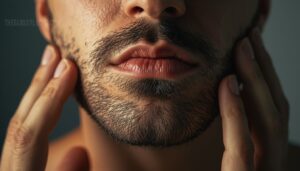
Beard hair loss can stem from several very different causes, and knowing which one you’re dealing with makes all the difference in how you treat it.
Whether it’s hormonal shifts, diet gaps, or stress, understanding the root cause is key — common beard shedding triggers and solutions vary more than most people realize.
Some causes are immune-related, others tied to hormones, infections, nutrition, or even your grooming routine.
Here’s a look at the main reasons your beard may be thinning or falling out in patches.
Autoimmune Beard Alopecia
When your immune system turns against your own beard follicles, the result is alopecia barbae — smooth, coin-sized patches of hair loss, usually appearing first along the jawline. Regulatory T-cells fail to contain the immune response, so T-cells continue attacking follicles unchecked.
The good news: follicles usually survive, and spontaneous remission often occurs within six to twelve months.
It’s classified as an autoimmune disorder of follicles.
Infectious Beard Disorders
Unlike autoimmune attacks, infections invade beard follicles. Tinea barbae, a fungal ringworm infection, spreads from livestock or shared razors, causing red, scaly patches treated with oral antifungal medication like terbinafine.
Bacterial folliculitis stems from staph reinfecting via nasal carriage or dirty razors. Hot tub exposure, viral shaving nicks, and syphilis’s moth-eaten patches round out the list—each diagnosed and treated differently.
Hormonal Imbalance
When infections aren’t the issue, your hormones may be. Testosterone converts to DHT via the 5-alpha reductase enzyme — roughly 10% of circulating testosterone undergoes this conversion.
If patchy growth persists alongside fatigue or other symptoms, it’s worth exploring the hormonal reasons some guys can’t grow a beard before assuming it’s just genetics.
DHT then binds to facial follicle receptors, gradually shrinking follicle diameter until hairs become finer, shorter, and eventually invisible.
Thyroid dysfunction compounds this, pushing follicles into dormancy and disrupting beard density.
Nutritional Deficiencies
Your diet does more for your beard than most people realize. Low levels of biotin, zinc, iron, and vitamin D impair the very processes that keep follicles healthy — keratin production, cell division, and oxygen delivery. When these falter, hairs shed faster than they regrow.
Mechanical Trauma
What you do to your beard every day matters more than you might expect.
Aggressive over-plucking, harsh shaving, and scrubbing wet beard hair can damage the cuticle layer and push follicles into premature shedding.
Even chronic scratching from irritation creates low-level follicular microtrauma that compounds over time.
How Does Alopecia Barbae Affect The Beard?
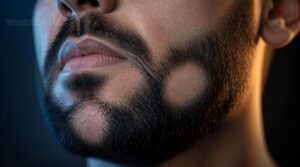
Alopecia barbae doesn’t just thin your beard evenly — it shows up in specific, recognizable ways that set it apart from other types of hair loss. Knowing what to look for helps you catch it early and take the right steps. Here’s what this condition usually does to your beard:
Patchy Beard Hair Loss
Alopecia barbae has a tendency to announce itself quietly — a smooth, coin-sized patch along your jawline or chin where hair has simply stopped growing.
- Circular patches roughly the size of a quarter
- Skin within the patch looks completely smooth and healthy
- Most common sites: jawline, chin, and cheeks
- Non-scarring, meaning follicles stay alive beneath
- Can appear alongside contact dermatitis or seborrheic dermatitis flares
Exclamation-mark Hairs
Look closely at the edge of a bald patch and you may spot them: tiny, stubby hairs no longer than 3–4 mm, thinner at the base than the tip.
These are exclamation-mark hairs — a hallmark sign of active alopecia areata and a red flag that your immune system is still attacking follicles right now.
Family History Risk Factors
If alopecia barbae runs in your family, your risk climbs measurably. Around 68% of men with beard hair loss report a positive family history — and paternal relatives are the stronger link, with nearly 63% of cases tracing back through the father’s side.
- Early onset (before age 30) signals a stronger genetic load
- Autoimmune conditions like lupus, psoriasis, and type 1 diabetes cluster in families
- Monozygotic twins share a 55% concordance rate for alopecia areata
Can Infections Lead to Beard Hair Loss?
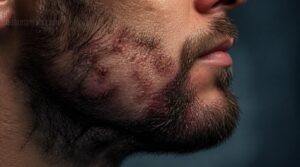
Yes, infections can absolutely cause beard hair loss — and unlike autoimmune conditions, they come with additional symptoms that make them easier to spot.
Several distinct infections affect beard follicles in different ways, each with its own pattern of damage and risk for permanent scarring.
The three most common infectious causes worth knowing are:
Tinea Barbae (fungal Infection)
Tinea barbae — a fungal infection of the beard area — is more aggressive than it looks. The culprit is a group of keratinophilic dermatophytes that invade fungal infection keratin structures deep within the hair shaft, not just the surface skin.
Livestock contact risks are significant. Trichophyton verrucosum spreads through cattle and horses; Trichophyton mentagrophytes through smaller animals like cats.
Folliculitis and Scarring
Folliculitis starts as a bacterial infection — Staphylococcus aureus is the most common culprit — that inflames individual hair follicles and produces pus-filled pustules around beard hairs.
Three reasons recurrent folliculitis becomes a serious problem:
- Each inflammatory episode pushes deeper into the follicle structure
- Scarring alopecia can develop when damaged follicles heal with scar tissue instead of healthy cells
- Post-inflammatory hyperpigmentation or hypopigmentation can leave lasting discoloration even after infection clears
Syphilitic Alopecia
Syphilitic alopecia works differently. Treponema pallidum disrupts beard follicles indirectly, producing a moth-eaten pattern of irregular patches — not the neat circular loss you see with alopecia barbae.
Serologic testing via VDRL or TPPA confirms the diagnosis.
A single dose of benzathine penicillin G usually restores regrowth within weeks, though HIV coinfection can slow that response considerably.
How Do Hormones Impact Beard Growth?
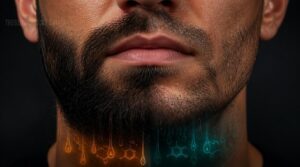
Hormones are the silent architects behind your beard’s thickness, growth rate, and even its vulnerability to shedding. When they’re balanced, your beard thrives — when they’re not, the effects can show up in patches, thinning, or stalled growth. Here’s how three key hormonal factors directly shape what’s happening in your follicles.
Testosterone and DHT Roles
Beard growth lives and dies by two androgenic hormones: testosterone and DHT. Testosterone prepares follicles during puberty, establishing androgen receptor expression and determining total follicle count. Then the enzyme 5-alpha reductase converts it into dihydrotestosterone (DHT) — roughly five times more potent at receptor sites.
Local DHT synthesis in facial skin can reach concentrations ten times higher than circulating blood levels, creating a powerful autocrine growth environment. That sustained local signal is why beard density correlates strongly with plasma DHT concentrations, not testosterone alone.
Five ways DHT drives beard development:
- Extends the anagen (active growth) phase
- Thickens vellus hairs into coarse terminal hairs
- Amplifies androgen receptor sensitivity in dermal papilla cells
- Overrides fluctuations in systemic hormone levels through local synthesis
- Maintains follicle size despite chronic DHT exposure — unlike scalp follicles, which miniaturize
Thyroid Hormone Imbalances
While DHT governs beard density, thyroid hormones play a quieter but equally disruptive role. Beard follicle dermal papilla cells contain TRα and TRβ receptors that directly regulate growth genes — when thyroid levels shift, those signals break down.
| Condition | Hair Change | Timeline |
|---|---|---|
| Hypothyroidism | Dry, coarse, brittle texture | 2–3 months post-onset |
| Hyperthyroidism | Fine, silky, easily shed | 2–3 months post-onset |
| Hashimoto’s thyroiditis | Patchy autoimmune loss | Variable |
| Levothyroxine therapy | Temporary shedding | 1–3 months after starting |
| Treated thyroid disorder | Regrowth begins | 2–3 months post-treatment |
Texture changes often appear first — before noticeable shedding — making your beard an early warning signal worth taking seriously.
Age-related Hormonal Decline
Starting around 40, testosterone drops 1–2% yearly. As levels fall, less is converted to DHT — the androgenic hormone that sustains beard density.
SHBG rises with age, binding free testosterone and shrinking the pool available to facial follicles. Meanwhile, 5-alpha reductase activity declines, making DHT conversion even less efficient.
The result: finer, slower-growing beard hairs.
Do Nutritional Deficiencies Cause Beard Thinning?

What you eat has a more direct impact on your beard than most people realize. Certain nutrients act as building blocks for healthy hair follicles, and when they’re missing, thinning and shedding can follow. Here are the key deficiencies worth knowing about:
Biotin and Keratin Synthesis
Think of biotin as the foreman on a construction site — without it, the crew can’t build anything. Biotin activates acetyl‑CoA carboxylase, the rate‑limiting enzyme in fatty acid synthesis, and drives the metabolic pathways that fuel keratin production in follicles.
A deficiency here doesn’t just slow growth; it visibly thins your beard.
Zinc and Iron Importance
Two minerals sit at the core of beard follicle function: zinc and iron. Zinc acts as a cofactor for DNA synthesis enzymes, and deficiency can slash thymidine kinase activity by roughly 50% within hours — enough to halt the cellular replication that new hair depends on. It also facilitates testosterone-to-DHT conversion, keeping androgen signaling intact.
Iron quietly does the oxygen work. Without sufficient hemoglobin, follicles starve for oxygen and shift into telogen effluvium, shedding prematurely. The good news: both deficiencies are reversible with targeted supplementation once blood tests confirm low ferritin or serum zinc levels.
Vitamin D Effects
Vitamin D plays a quieter role than zinc or iron, but its absence is felt. Vitamin D receptors sit directly inside beard follicles, regulating genes that control growth and differentiation.
When levels drop below 20 ng/mL, follicles stall in the telogen phase longer than normal, producing diffuse thinning. Aim for 30–50 ng/mL through D3 supplementation — ideally 2,000 IU taken with a fatty meal for best absorption.
Does Stress Trigger Beard Hair Loss?

Chronic stress does more damage to your beard than most people realize. The effects run deeper than surface-level shedding, touching the very hormones that keep your follicles active. Here’s how stress interferes with beard growth at each level.
Telogen Effluvium
Stress doesn’t just affect your mood — it can quietly shut down beard growth. When your body experiences severe physical or emotional stress, it forces a disproportionate number of hair follicles into the resting (telogen) phase simultaneously, triggering what dermatologists call telogen effluvium.
Four common triggers you should know:
- Major surgery or illness — high fever infections like pneumonia can initiate shedding 2–3 months afterward
- Nutrient deficiency — protein or iron shortfalls push follicles into early rest within 2–4 months
- Hormonal imbalance — postpartum hormonal shifts or thyroid disruption alter hair cycling noticeably
- Certain medications — retinoids and beta-blockers are documented culprits
The shedding itself often peaks around 200–300 hairs daily, a sharp jump from the normal 50–100. That delay between the trigger and visible loss is what confuses most people — your beard didn’t just decide to thin; something disrupted it weeks or months earlier.
The encouraging part: acute telogen effluvium usually resolves within six months once the underlying cause is addressed, with noticeable regrowth starting around months three to four.
Cortisol and Androgen Suppression
Chronic stress quietly dismantles the hormonal machinery your beard depends on. When cortisol stays elevated for weeks, it suppresses hypothalamic GnRH release, which reduces the signals your testes receive to produce testosterone — measurably by up to 40%.
| Mechanism | Effect | Timeline |
|---|---|---|
| HPA axis suppression | Reduced testosterone production | Hours to days |
| Elevated SHBG binding | Free androgen index drops ~30% | Days to weeks |
| Androgen receptor downregulation | Follicles respond less to DHT | Weeks to months |
That free testosterone loss matters. Higher SHBG levels bind more circulating testosterone, leaving beard follicles with less active androgen to sustain growth. Cortisol also reduces 5α-reductase activity, limiting DHT conversion — the primary androgen driving beard density. Over time, follicles miniaturize, shifting from thick terminal hairs to finer, vellus-like strands. The good news: follicle miniaturization is reversible once cortisol normalizes.
Chronic stress shrinks beard follicles — but once cortisol normalizes, that miniaturization reverses
Antioxidant Support
Your follicles aren’t just fighting cortisol — they’re also contending with the oxidative damage stress leaves behind. That’s where antioxidants earn their place.
- Vitamin C anchors collagen structure and boosts iron absorption for follicle oxygen delivery
- Vitamin E (400 IU daily) raised beard density by 34.5% in supplementation studies
- Zinc activates superoxide dismutase, your follicles’ primary antioxidant enzyme
- Selenium (55 mcg daily) shields follicle DNA from oxidative lesions via selenoproteins
Can Grooming Habits Lead to Beard Loss?
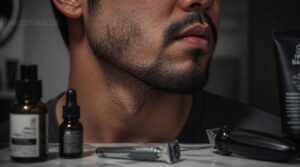
Your daily grooming routine might be doing more damage than you think. The way you shave, the products you reach for, and how you apply heat can all quietly work against your beard’s health. Here’s a closer look at the specific habits most likely to cause problems.
Over-plucking and Harsh Shaving
Every grooming session carries a cost your follicles quietly absorb. Overaggressive plucking extracts hairs directly from the root, triggering localized inflammation that disrupts normal hair cycling. Repeat the same trauma to the same spots, and those follicles become unreliable — producing thinner, weaker regrowth with each cycle.
Harsh shaving introduces its own set of problems. Shaving micro-cuts form even when skin appears undamaged, leaving follicle openings exposed to friction and bacteria. Pressing too hard or shaving against hair growth compounds this, creating a cycle of follicular microtrauma that’s easy to overlook until patchy thinning appears.
| Grooming Habit | Immediate Effect | Long-term Risk |
|---|---|---|
| Over-plucking | Root inflammation | Unreliable regrowth |
| Harsh shaving | Micro-cuts, irritation | Scarring alopecia risks |
| Ingrown hair irritation | Follicle inflammation | Chronic patchy thinning |
| Shaving against grain | Blade friction, redness | Persistent follicular damage |
| High-pressure shaving | Cuticle disruption | Mechanical follicle damage |
Scarring alopecia remains the most serious outcome. When repeated shaving irritation causes severe enough inflammation, healing tissue can replace the follicle entirely — making regrowth impossible even after you correct your grooming habits.
DHT-blocking Beard Products
Not all beard thinning comes from what you do to your face — some comes from what you put on it. Certain beard oils contain DHT-blocking ingredients like saw palmetto, rosemary oil, and pumpkin seed oil, which can suppress androgen signaling in follicles.
Used consistently, they may reduce the hormonal stimulation your beard follicles depend on.
Heat Styling and Traction Alopecia
What you apply matters, but so does how you style. Thermal hair damage from blow-dryers and heated brushes desiccates the hair shaft, making it brittle and far easier to snap under any pulling force.
- Heat weakens the cuticle layer
- Tension from tight styles amplifies breakage
- Repeated exposure accelerates shaft damage
- Traction-induced breakage mimics thinning
- Heat plus traction raises follicular microtrauma risk
How is Beard Hair Loss Diagnosed?
Getting the right diagnosis is the first step toward actually fixing the problem. A dermatologist has several reliable tools to figure out exactly what’s going on with your beard. Here’s what that diagnostic process usually looks like.
Visual Inspection and Dermoscopy
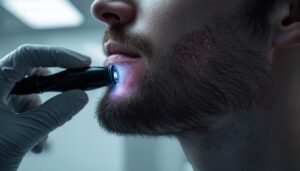
A dermoscope turns a guesswork glance into a precise clinical map.
During diagnostic dermoscopy, your dermatologist examines the affected skin at 10x to 70x magnification, revealing structures invisible to the naked eye — black dots (cadaverized hairs, present in 82.7% of cases), yellow dots, and classic exclamation-mark hairs — boosting diagnostic accuracy from 70% to over 95%.
Blood Tests for Hormones and Nutrients

Running blood tests alongside dermoscopy gives your diagnosis its full clinical picture. A hormone panel measures total testosterone, free testosterone, and DHT, while also checking prolactin and the estrogen-to-androgen ratio — imbalances in any of these can quietly drive beard thinning.
TSH, free T3, and T4 identify thyroid dysfunction.
Serum ferritin below 30 ng/mL signals iron deficiency; zinc, vitamin D, and B12 complete the micronutrient screen.
Skin Biopsy for Scarring Alopecia
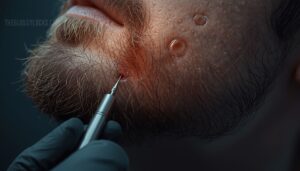
When other diagnostic tools leave the picture incomplete, a skin biopsy becomes essential. It’s the only way to confirm scarring alopecia with certainty.
A dermatologist takes two 4-millimeter punch biopsies from the active border — where inflammation is still present — not the scarred center.
The four things biopsy reveals:
- Whether follicles are destroyed or still viable
- Lymphocytic vs. neutrophilic infiltration patterns
- Fibrotic tissue depth
- Active vs. end-stage disease
What Are Effective Treatments for Beard Hair Loss?
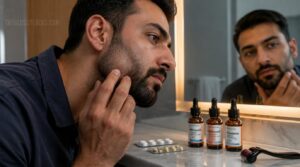
Treatment for beard hair loss depends on what’s driving it in the first place, so there’s no single fix that works for everyone.
The good news is that several effective, well‑studied options exist — ranging from simple topical applications to targeted therapies for more stubborn cases. Here’s a look at what’s currently available.
Topical and Intralesional Corticosteroids
Corticosteroids work by quieting the immune system’s misguided attack — specifically, reducing CD8+ T-cell activity that targets your hair follicles.
Topical steroid cream applied twice daily is the starting point, with intralesional corticosteroid injections every 4–6 weeks offering 60–75% efficacy for stubborn patches.
Don’t expect overnight results; meaningful regrowth usually takes three to six months.
Minoxidil for Beard Regrowth
Minoxidil works by extending the anagen (growth) phase, pulling dormant follicles back into active production.
Key protocol points:
- Use 5% concentration twice daily, roughly 12 hours apart
- Apply 1 mL to clean, slightly damp skin
- Foam causes less irritation than liquid formulations
- Microneedle 1–2 times weekly, then wait 24 hours before applying
Expect visible density changes around three to six months.
JAK Inhibitors for Severe Cases
When minoxidil alone isn’t enough, JAK inhibitors step in. These oral medications — baricitinib, ritlecitinib, and deuruxolitinib — block the immune signals attacking your follicles.
In clinical trials, up to 41% of patients achieved significant regrowth by six months. Expect meaningful beard density changes between three and six months, with full results closer to twelve.
Nutritional Supplements
Deficiencies in biotin, zinc, iron, and vitamin D are reversible contributors to beard thinning — but only if supplementation matches your actual lab results.
Zinc gluconate enhances follicular enzyme activity; iron corrects impaired oxygen delivery to follicles; vitamin D3 helps regulate cell-growth signaling.
Your body builds beard hair from dietary protein and keratin synthesis, so adequate daily protein intake matters equally.
When Should You See a Dermatologist?
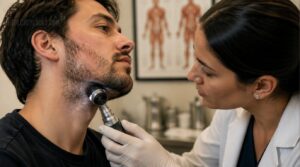
Some beard hair loss clears up on its own, but certain signs mean it’s time to stop waiting and get a professional set of eyes on it.
A dermatologist can identify what’s actually driving the loss — whether that’s an autoimmune response, an infection, or something else entirely — and map out a treatment plan that fits your situation.
Here are the key moments when booking that appointment makes sense.
Sudden or Rapid Beard Loss
When beard hair loss happens fast — patches appearing within days, shedding you can measure in handfuls — that’s your body sending an urgent signal. Rapid follicle shedding tied to alopecia areata, acute stress response, sudden hormonal shifts, or fungal infection onset can escalate quickly.
Don’t wait. See a dermatologist within one to two weeks.
Persistent Patchy Areas
Not every case demands an emergency appointment, but patches that linger beyond six to twelve months without regrowth deserve professional attention.
When autoimmune alopecia cycles through loss without recovery, patches can merge and expand.
If yours haven’t budged — no fuzz, no texture change — that stalled pattern is its own warning.
Signs of Infection or Scarring
Patches that won’t grow back and pustules that keep returning aren’t just cosmetic concerns — they’re signals your skin is losing the fight.
Folliculitis and tinea barbae both leave behind red, scaly patches and broken hairs. Left untreated, those infections destroy follicles permanently.
Once scarring alopecia sets in, no treatment restores what’s gone.
Frequently Asked Questions (FAQs)
Why am I losing hair from my beard?
Losing beard hair usually comes down to an immune system trigger, a hormonal shift, or a nutritional gap. A dermatologist can identify the exact cause and guide you toward effective hair regrowth.
Does a lack of beard mean low testosterone?
Not necessarily. A sparse beard often reflects genetic follicle sensitivity rather than low testosterone. Your follicles’ androgen receptor density determines how they respond to DHT — the hormone that actually drives beard growth.
Can beard hair loss be completely reversed?
The answer isn’t black and white. Non-scarring conditions like alopecia barbae often reverse fully — about 50% resolve within a year without treatment. Scarring alopecia does not.
How long does beard regrowth typically take?
Regrowth timelines vary. After a flare, fine vellus hairs usually emerge within 6–12 weeks, with noticeable coverage by three months. Full density can take 6–12 months, depending on severity and treatment.
Are there genetic tests for beard loss?
Genetic testing rarely pinpoints beard loss. Most commercial panels assess androgenetic alopecia risk rather than beard-specific conditions. Family history offers stronger diagnostic clues than any panel currently available.
Do beard transplants work for patchy areas?
Yes, beard transplants work well for patchy areas caused by stable density issues. Success depends on graft survival, healthy skin, and correct follicle angles — active inflammation or scarring can reduce results.
Can medications cause permanent beard thinning?
Most medications don’t destroy beard follicles — they disrupt the hair cycle. Scarring vs shedding is the key distinction. Non-scarring, drug-induced loss usually reverses once the medication stops.
Is beard hair loss more common in certain ethnicities?
Yes — ethnicity plays a real role. East Asian men show roughly 13% androgenetic alopecia prevalence, while Caucasian men reach around 50%, reflecting strong genetic predisposition variations across populations.
Can medications cause or worsen beard hair loss?
Yes, certain medications can trigger or worsen beard hair loss through telogen effluvium, anagen effluvium, or hormonal disruption — often reversibly, with regrowth beginning within one to three months after stopping the causative drug.
Does sleep quality influence beard hair growth?
Yes — sleep is one of the most underestimated drivers of beard growth. Men sleeping under five hours nightly can see testosterone drop by up to 15 percent, slowing follicle activity measurably.
Conclusion
Losing ground doesn’t mean losing the battle. Understanding what causes beard hair loss puts the diagnosis in your hands before a dermatologist even reaches for their dermoscope.
Whether your follicles are fighting your immune system, starved of zinc, or stressed into dormancy, every cause has a clear path forward.
Act early. Get tested.
Don’t let a patchy chin become a permanent story. The follicle isn’t finished—and neither are you.