This site is supported by our readers. We may earn a commission, at no cost to you, if you purchase through links. This content is for general informational and educational purposes only and is not a substitute for professional medical, dermatological, or nutritional advice.
Most guys grab whatever blades are on sale and wonder why their face feels like it lost an argument. The truth is, blade choice matters more than almost any other variable in your shaving routine—more than your brush, your soap, even your razor handle. A blade that’s too aggressive for your skin type leaves you red and raw by the third stroke. One that’s too mild drags instead of cuts, which causes its own kind of misery.
The sharp vs mild razor blades debate isn’t about which is better. It’s about which is better for you—your skin, your beard, your technique.
Table Of Contents
- Key Takeaways
- Sharp Vs Mild Razor Blades: Key Differences
- Razor Design and Blade Aggressiveness
- Shaving Comfort: Sharp Vs Mild Blades
- Choosing The Right Blade for Your Skin
- Shaving Techniques for Optimal Results
- Top Razor Products for Sharp and Mild Shaves
- Adjustable Razors: Customizing Blade Aggressiveness
- Blade Maintenance and Replacement Tips
- Frequently Asked Questions (FAQs)
- Are razors with less blades better?
- Can a razor blade be too sharp?
- Can mild blades work for thick coarse beards?
- Do sharp blades cause more ingrown hairs?
- How does water hardness affect blade performance?
- Are expensive blades always sharper than cheap ones?
- Can the same blade feel different across razor brands?
- Conclusion
Key Takeaways
- dull or overly mild blade actually causes more irritation than a sharp one — it drags instead of cuts, forcing extra passes that punish your skin.
- blade sharpness only matters alongside razor design — the blade gap and head geometry do just as much work in deciding how aggressive your shave feels.
- Matching your blade to your skin type and beard texture (not just grabbing whatever’s cheapest) is the single biggest lever you have for a comfortable shave.
- proper blade care — drying after each use, storing away from humidity, and replacing at the first sign of tugging — directly protects your skin and stretches your cost-per-shave.
Sharp Vs Mild Razor Blades: Key Differences
Not all razor blades are created equal, and understanding the difference between sharp and mild can save your skin — literally.
Choosing the right blade for your skin type is a game-changer, and these tips for achieving a close shave without redness make the whole process a lot less trial and error.
Before you grab whatever’s on the shelf, it helps to know what these terms actually mean and why they matter.
Here’s what you need to understand first.
Definition of Sharp and Mild Blades
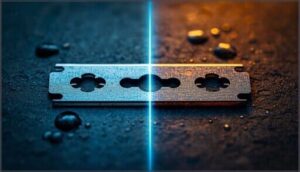
Think of blade sharpness as a spectrum, not a switch.
A sharp blade has an acute micro‑bevel angle and harder steel hardness, slicing hair cleanly with minimal passes.
A mild blade uses a softer edge geometry — forgiving, smooth, less “bitey.”
Coating impact matters too: PTFE layers can soften even sharp edges. User perception varies, but that’s the honest baseline. Blade durability impacts cost-per-shave and overall performance, as detailed in the DE razor blade guide.
| Feature | Sharp Blade | Mild Blade |
|---|---|---|
| Edge geometry | Acute bevel angle | Slightly obtuse bevel |
| Steel hardness | High carbon/harder steel | Softer or differently treated |
| Coating impact | Sometimes uncoated | Often PTFE-coated |
How Blade Sharpness Affects Shaving
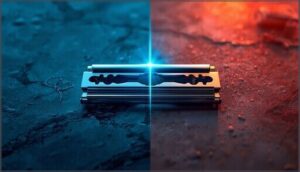
Blade sharpness directly drives cutting efficiency — sharper edges slice hair cleanly, reducing the tugging sensation that causes shaving irritation.
You’ll notice better skin feedback too: a sharp blade glides with a light, audible cut rather than dragging silently.
Less pressure application means fewer passes, and that gentler hair removal keeps skin sensitivity in check. Using a sharp razor blade reduces cuts for safer shaving.
| Factor | Sharp Blade |
|---|---|
| Pressure needed | Razor weight only |
| Passes required | Fewer |
| Tugging sensation | Minimal |
| Irritation risk | Low |
Common Misconceptions
Most people assume sharpness equals pain and mild means dull — neither holds up. A dull blade actually drags against skin, causing more shaving irritation than a sharp one ever would. And thinking blade gap irrelevant? That’s where razor aggressiveness really lives.
A dull blade drags and burns; sharpness cuts clean — and the blade gap, not the edge, drives true razor aggressiveness
| Misconception | Reality |
|---|---|
| More passes = better shave | More passes = more irritation |
| Aggressive razors suit pros only | Technique controls the outcome |
| Mild razors suit sensitive skin always | Skin sensitivity needs sharpness, not dullness |
Razor Design and Blade Aggressiveness
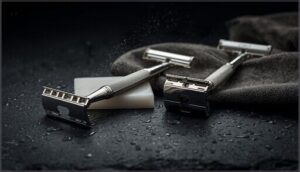
The blade is only half the story — the razor holding it does a lot of the heavy lifting.
How a razor is built, from blade gap to head shape, directly controls how aggressive or gentle each pass feels on your skin.
Here’s what to know before you pick up a razor.
Blade Gap and Exposure Explained
Two tiny measurements quietly run the show in every safety razor: blade gap and blade exposure. Together, their gap‑exposure interaction shapes how aggressive your shave feels.
- Blade gap — space between blade edge and safety bar; mild razors sit around 0.3 mm
- Positive exposure — blade protrudes past the shave plane, cutting efficiently with less pressure
- Negative exposure — blade recedes behind the plane, reducing exposure impact on skin sensitivity
- Effective gap — combines both specs, predicting real-world aggressiveness better than either number alone
Head Geometry and Safety Features
Beyond blade gap alone, head geometry quietly shapes everything. Your safety bar type — straight, scalloped, or open comb — controls how much blade edge actually contacts skin. Cap curvature effects tighten the blade angle, making sharp blades feel controlled.
blade clamping rigidity reduces chatter.
Smart lather drainage design clears buildup fast.
Built‑in guard mechanics and the skin guard together define your razor’s true personality.
Impact of Razor Type on Aggressiveness
Not all safety razor head designs are created equal — and that gap matters more than you’d think. Your razor type sets the baseline aggressiveness before you even touch your face.
If you want full control over that gap, adjustable safety razors let you dial in the perfect blade exposure for your skin type without swapping heads.
- Open comb tooth density lifts stubble directly to the blade, ideal for thicker beards
- Mild razors use closed combs and tighter blade exposure to protect sensitive skin
- Aggressive razors and adjustable razor settings reward controlled user pressure variance and precise handle grip angle
- Blade material hardness, combined with weight distribution, determines how much force actually reaches the skin
Shaving Comfort: Sharp Vs Mild Blades
sharp vs. mild debate gets personal — and a little complicated.
Your skin type, how often you shave, and even the blade’s lifespan all play into how good (or rough) that shave actually feels.
Here’s what you need to know before picking a side.
Skin Sensitivity and Irritation Risk
Sensitive skin doesn’t forgive mistakes — and blade choice is where irritation either starts or stops.
An aggressive razor with wide blade gap effects expose more edge to skin, increasing razor burn risk. A mild razor limits that contact. Barrier moisture loss worsens with repeated passes, so fewer strokes matter too.
| Factor | Mild Razor | Aggressive Razor |
|---|---|---|
| Blade Gap Effects | Minimal skin contact | High skin exposure |
| Comb Design Impact | Closed comb, gentler | Open comb, harsher |
| Irritation Risk | Low | Higher |
| Post‑Shave Recovery | Faster | Slower |
| Irritant-Free Products | Recommended | Essential |
Comfort and Smoothness of Shave
A sharp blade in a mild razor is often the sweet spot for shaving comfort. It glides cleanly — Glide Optimization at work — while gentle blade exposure keeps razor burn away.
Good Pre‑Shave Hydration and Lubrication Effects enhance that smoothness. Fewer passes mean less skin stress, and After‑Shave Calm follows naturally.
| Factor | Sharp Blade | Mild Blade |
|---|---|---|
| Glide Feel | Smooth, fluid | Slower, deliberate |
| Pass Count Impact | 2 passes typical | 3+ passes needed |
| After‑Shave Calm | Quick recovery | Lingering tightness |
Frequency of Shaving and Blade Lifespan
How often you shave matters more than most guys realize. Daily frequency with coarse hair accelerates the Blade Dulling Rate quickly — sometimes after just 3‑4 shaves. Sharp blades handle daily use better; mild blades stretch further with less frequent routines.
| Shaving Pattern | Sharp Blade Lifespan | Mild Blade Lifespan |
|---|---|---|
| Daily, coarse hair | 3–5 shaves | 4–6 shaves |
| 2–3x weekly | 8–12 shaves | 10–15 shaves |
Smart Replacement Scheduling and Moisture Management extend blade longevity noticeably.
Choosing The Right Blade for Your Skin
Finding the right blade isn’t one-size-fits-all — skin, beard, and experience level all play a role.
A few key factors will point you in the right direction before you ever open a blade wrapper.
Here’s what to think through first.
Assessing Skin Type and Sensitivity
Your skin tells you exactly what it needs — you just have to listen. Start with a simple Skin Barrier Test: wash your face, leave it bare for 30 minutes, then check for tightness or shine.
Notice your Redness Triggers and Temperature Sensitivity. Run a Patch Test Protocol before new products. Understanding your Moisture Levels and skin sensitivity helps you choose gentle shaving tools that prevent razor burn.
Beard Density and Hair Type Considerations
Your beard type matters just as much as your skin type. Coarse Beard Strategies lean toward higher blade sharpness ratings — wirelike whiskers resist mild razors and cause tugging. Sparse Beard Tips flip that logic: less resistance means mild razors shine.
- Hair Thickness Matching: Coarse hair needs sharper blades
- Curl Pattern Impact: Tight curls snag on dull edges
- Medium Density Balance: Moderate sharpness covers most men
- Beard Density: Dense growth clogs mild razors fast
Beginner-Friendly Blade Options
Once you’ve matched your beard type to the right razor, it’s time to pick your blade.
For newcomers, beginner-friendly blades like Astra Premium Platinum, Derby Extra, and Voskhod hit that sweet spot — low blade sharpness rating, smooth feel, fewer nicks.
Starter Blade Packs and Cost-Effective Brands make experimenting easy without overspending.
Blade Compatibility is universal across most double-edge razors, so swapping is simple.
Shaving Techniques for Optimal Results
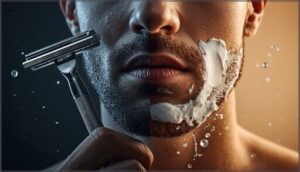
Even the best blade won’t save you if your technique is off.
How you hold the razor, the angle you use, and how much pressure you apply all make a bigger difference than most people expect.
Here’s what actually moves the needle in regard to getting a clean, comfortable shave.
Pressure Control and Blade Angle
Getting the blade angle right changes everything. Hold your razor at about 30 degrees to your skin — that’s roughly where the top cap rests flat. Then let the razor’s own weight do the work. No extra pressure needed.
- Keep angle between 25–35 degrees for consistent cuts
- Use weight distribution and grip using, not force
- Adjust tilt dynamics near sensitive curves like your jawline
Adjusting Technique for Sharp or Mild Blades
Once your blade angle is locked in, the real blade choice is your blade choice. Sharp blades reward short, 2–3 cm strokes with active skin stretching and a two-pass strategy.
Mild blades forgive longer strokes but need extra passes to compensate. For buffing technique, stick to mild blades—sharp edges overwork the skin fast. Adjustable safety razors let you dial both into one tool.
Tips for a Gentle Shaving Experience
Before your razor even touches your face, prep matters. Press a warm towel against your skin for 1–3 minutes, then work up an alcohol‑free lather and let it sit 30–60 seconds.
Use short, controlled strokes with the grain, rinsing the blade between passes. Finish with a cool water rinse and aloe aftercare to calm skin sensitivity and lock in comfort.
Top Razor Products for Sharp and Mild Shaves
Now that you know what to look for, picking the right razor comes down to finding one that actually matches your skin and shaving style.
There are solid options out there for both mild and sharp preferences, whether you’re just starting out or ready to upgrade your kit.
Here are six worth your attention.
1. Gillette SkinGuard Razor for Sensitive Skin
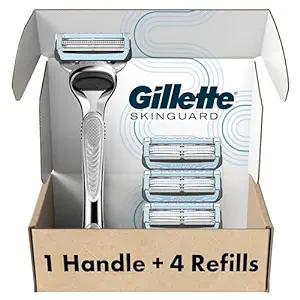
If your skin throws a fit after every shave, the Gillette SkinGuard was practically designed with you in mind. Its two-blade cartridge features a raised plastic guard between the blades that keeps them from digging below skin level — so you’re cutting hair, not irritating tissue. That’s a real difference for anyone dealing with razor bumps or ingrown hairs.
The aloe-infused lubrication strips add noticeable glide, and they’re dermatologist tested for sensitive skin. Expect a comfortable shave, though not the closest one.
| Best For | Anyone with sensitive skin, razor bumps, or ingrown hairs — including first-time shavers, seniors, and those managing facial hair from PCOS. |
|---|---|
| Blade Type | Twin cartridge blade |
| Skin Suitability | Sensitive skin |
| Handle Material | Plastic |
| Weight | 0.48 oz |
| Skill Level | Beginner |
| Eco Friendly | No |
| Additional Features |
|
- The patented skin guard sits between the blades and actually prevents them from digging into skin, which makes a real difference if you’re prone to irritation.
- Aloe-infused lubrication strips add smooth glide and are dermatologist tested — so it’s not just marketing fluff.
- The precision blade on the back of the cartridge lets you clean up edges and line up sharp, which is a handy bonus for one razor to have.
- Blades tend to dull out after 6–8 shaves, so replacement costs add up faster than you’d expect.
- If you want a super close shave, this isn’t your razor — the skin guard design trades closeness for comfort.
- It’s a fairly lightweight razor at under half an ounce, which some people find less sturdy than they’d like.
2. Merkur Mk34c Double Edge Razor

Merkur 34C is the razor that converts skeptics.
At $45, this German-made classic weighs around 80 grams — heavy enough that you barely need to press, which is exactly how double edge shaving should feel.
Its closed comb design and 0.71mm blade gap keep things mild-to-medium, so nicks are rare even on rough mornings.
The short handle sounds limiting, but it actually gives you precise control around your jaw and chin.
Pair it with a sharper blade when you want a closer result.
| Best For | Men who want a smooth, controlled shave and are ready to switch from cartridge razors to double edge safety razors. |
|---|---|
| Blade Type | Double edge blade |
| Skin Suitability | Sensitive skin |
| Handle Material | Brass chrome finish |
| Weight | 2.08 oz |
| Skill Level | Beginner to advanced |
| Eco Friendly | Replaceable blades |
| Additional Features |
|
- Heavy handle means less pressure and fewer nicks
- Closed comb design is gentle on sensitive skin
- Easy to clean and works with any standard double edge blade
- Takes some practice if you’re new to safety razors
- Handle might feel too short or heavy for some users
- Top plate may break after repeated use
3. Edwin Jagger Chrome Double Edge Razor
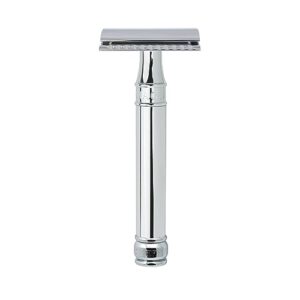
The Edwin Jagger DE89 Chrome is the razor beginners should probably start with. It’s built on solid brass with a triple-coated chrome finish — smooth, non-porous, and easy to rinse clean.
The closed comb head sits at a 0.71mm blade gap, landing squarely in mild-to-moderate territory. That means it’s forgiving without feeling toothless. The head geometry practically finds the right angle for you.
At 68 grams, it’s light enough to stay nimble through tricky spots like the jaw and upper lip.
| Best For | Beginners and men with sensitive skin who want a classic, forgiving shave without a steep learning curve. |
|---|---|
| Blade Type | Single double edge blade |
| Skin Suitability | Sensitive skin |
| Handle Material | Brass chrome finish |
| Weight | 2.65 oz |
| Skill Level | Beginner to advanced |
| Eco Friendly | Recyclable blades |
| Additional Features |
|
- The mild-to-moderate blade gap makes it easy to find the right angle, so you’re less likely to nick yourself while you’re still figuring things out.
- Solid brass with a triple-plated chrome finish means it feels premium, rinses clean easily, and holds up over time.
- Single-blade design cuts down on irritation, and swapping blades is cheap — so it saves you money in the long run.
- There’s still a learning curve if you’re switching from a cartridge razor — it takes a few shaves to get your technique dialed in.
- Not the best fit if you have very coarse or thick hair, since the mild blade gap may not cut it (literally).
- Blades need regular replacing, and if you’re not on top of that, the shave quality drops fast.
4. Mühle R41 Open Comb Safety Razor
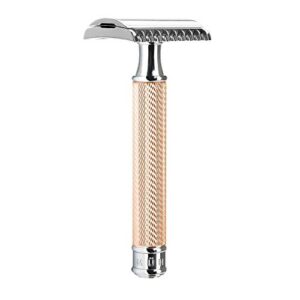
The Mühle R41 is the razor you reach for when mild just isn’t cutting it anymore — literally. This open comb safety razor is built for experienced shavers who want serious efficiency.
Those comb teeth channel lather away cleanly while exposing your stubble directly to the blade. Reviewers consistently rate it around 9 out of 10 for aggressiveness. It weighs about 64 grams and disassembles fully for easy cleaning.
If you’ve got coarse, dense beard growth, the R41 manages it in one or two passes.
| Best For | Experienced shavers with coarse or dense beard growth who want an aggressive, barbershop-close shave. |
|---|---|
| Blade Type | Double edge blade |
| Skin Suitability | Normal to coarse |
| Handle Material | Metal |
| Weight | 2.26 oz |
| Skill Level | Advanced |
| Eco Friendly | Replaceable blades |
| Additional Features |
|
- Open comb design clears lather fast and exposes stubble directly to the blade for a seriously close shave
- Works with popular double-edge blades like Derby and Feather, so you’ve got options
- Fully disassembles for easy cleaning and comes in great handle styles — chrome, rose-gold, black chrome, and more
- Too aggressive for beginners — technique really matters here or you’ll end up with nicks
- Not a great fit for sensitive skin or anyone prone to razor burn
- Needs regular cleaning and upkeep to stay at its best
5. Razor Blades Club Double Edge Sample
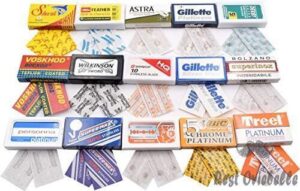
Before committing to 100 blades of something you might hate, try a sampler first.
The Razor Blades Club Double Edge Sample gives you 15 different blade brands — two blades each — so you can actually test how Feather, Astra, Shark, and others perform in your razor, on your skin.
Sharp blades like Nacet sit alongside milder options like Derby Extra in the same pack.
It’s a low-cost way to find your favorite before buying in bulk.
| Best For | Anyone new to double edge razors or curious to explore different blades before committing to a bulk buy. |
|---|---|
| Blade Type | Double edge sampler |
| Skin Suitability | All skin types |
| Handle Material | N/A |
| Weight | 0.71 oz |
| Skill Level | Beginner to advanced |
| Eco Friendly | Replaceable blades |
| Additional Features |
|
- 15 brands, 2 blades each — plenty of variety to find what works for your skin and razor
- Low-cost way to test sharp blades like Feather or Nacet against milder ones like Derby before buying 100 of the wrong kind
- Compact and lightweight, so it’s easy to stash in a dopp kit or travel bag
- Specific brands aren’t guaranteed, so you might not get every blade you were hoping to try
- Performance varies a lot between brands, which can make the testing process take a while
- Not much value if you’ve already found your go-to blade and just need to restock
6. Merkur Progress Adjustable Double Edge Razor
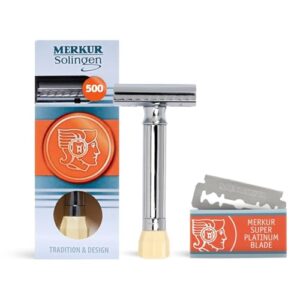
Once you’ve found your favorite blade from a sampler, the next step is a razor that grows with you.
The Merkur Progress lets you dial in your shave with settings from 1 to 5 — that’s a blade gap ranging from 0.38 mm up to 0.94 mm.
Mild on Monday, aggressive on Sunday.
Made in Germany from brass and chrome, it’s built to last.
Twist the knob at the base, find your number, and stay there.
| Best For | Wet shavers who want full control over their shave — especially those with sensitive skin or coarse hair who are ready to move beyond a basic fixed-blade razor. |
|---|---|
| Blade Type | Double edge blade |
| Skin Suitability | Sensitive to coarse |
| Handle Material | Brass chrome finish |
| Weight | 3.17 oz |
| Skill Level | Intermediate to advanced |
| Eco Friendly | Replaceable blades |
| Additional Features |
|
- Adjustable 1–5 settings mean you can go gentle on irritated skin or crank it up when you need a closer cut
- Built from brass and chrome in Germany — this thing is made to last decades, not months
- Works with any standard double-edge blade, so you’re never locked into a proprietary system
- The smooth metal handle can get slippery with wet hands and shaving cream — worth keeping in mind
- The plastic adjustment knob feels out of place on an otherwise premium razor
- The thick head design makes it tricky around tight spots like under the nose or along the jawline
Adjustable Razors: Customizing Blade Aggressiveness
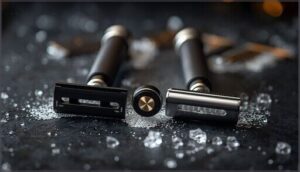
adjustable razors give you something fixed razors simply can’t — the ability to dial in exactly how aggressive your shave feels, from barely‑there mild to full‑on sharp.
Think of it like a volume knob for your razor.
Here’s what you need to know about how they work, who they’re best suited for, and how to match your blade choice to the right setting.
How Adjustable Razors Work
Turning a dial sounds simple — and honestly, it is.
Adjustable safety razor puts exposure calibration right in your hands.
Dial mechanics system shifts the base plate, changing blade exposure from around 0.05 mm up to 0.79 mm. That gap controls razor aggressiveness directly. Head geometry tuning and blade angle shift with each click, giving you real pressure feedback on every pass.
Benefits for Different Shaving Preferences
That one dial opens up more options than most shavers expect. Sensitive skin days call for mild razors dialed back low — reduced tugging, less redness.
When you’re handling longer growth after a few days off, crank it up for maximum closeness without extra passes.
Expert technique match matters too: aggressive razors reward sharp blades, faster shave routine included.
Matching Blades to Adjustable Settings
Blade-setting pairing is where adjustable razors really earn their keep. A simple rule guides most experienced shavers: match a sharp blade like a Feather with a lower setting — around 1 to 3 — for aggressiveness calibration that protects skin sensitivity.
Milder blades need that wider blade gap and greater blade exposure, roughly settings 3 to 5, for setting-based efficiency. Skin-blade compatibility and blade-gap optimization matter every time you load a fresh blade.
Blade Maintenance and Replacement Tips
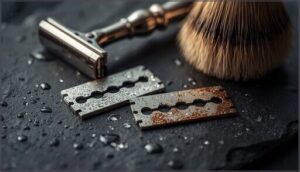
Even the sharpest blade becomes dull — and a dull blade is where nicks, tugs, and irritation start. Knowing when to swap it out, how to make it last, and what to do with it afterward makes a real difference in your shave.
Here’s what you need to know.
Signs Your Blade Needs Replacing
Your razor is telling you something — are you listening? A worn blade shows up in ways you can’t ignore:
- Tugging and pulling instead of clean slicing, even with light pressure
- Rust, discoloration, or visible nicks on the cutting edge
- Skin irritation, razor burn, or reduced closeness after your usual routine
Trust those signals. Blade sharpness drops fast, and your skin sensitivity pays the price.
Maximizing Blade Longevity
Want to squeeze more shaves out of every blade? Start with proper Drying Techniques — pat it dry after each shave, and even a quick pass with a hairdryer on low works wonders.
Smart Storage Solutions matter too: keep your razor out of the humid bathroom.
A drop of Oil Coatings or blade oil, some Silica Gel Use in your drawer, and Water Softening to cut mineral buildup all protect blade sharpness and consistency, dramatically extending blade lifespan.
Safe Disposal and Environmental Considerations
Tossing blades carelessly causes real harm — to people and the planet. Here’s how to do it right:
- Sharps Container Guidelines — Use hard plastic containers, filled to three-quarters, then drop them at a pharmacy.
- Metal Tin Recycling — Empty mint tins make perfect blade banks; take filled ones to scrap metal recycling.
- Wrapping Blade Disposal — Fold blades in thick cardboard, tape securely, label "SHARPS."
- Disposable Razor Impact — Two billion disposable razors hit US landfills yearly.
- Reusable Razor Benefits — Switching cuts plastic waste by over 90 percent.
Frequently Asked Questions (FAQs)
Are razors with less blades better?
Sometimes, less really is more.
Fewer blades mean less friction, lower risk of irritation, and better ingrown hair prevention — especially for sensitive skin. One sharp blade outperforms five dull ones for most people.
Can a razor blade be too sharp?
Technically, yes — but it’s rarely the blade’s fault. A sharp edge only causes skin barrier damage when you add too much pressure. Let the razor’s weight do the work.
Can mild blades work for thick coarse beards?
Mild razors can handle a coarse beard, but they’ll demand more passes and precise angle adjustment.
Beard density and skin prep matter just as much as the blade gap, head geometry, and blade exposure you’re working with.
Do sharp blades cause more ingrown hairs?
Sharp blades don’t cause ingrown hairs — poor technique does.
Sharp blade curling happens when you apply excess pressure or use aggressive razors without proper angle control, forcing hair below the skin surface.
How does water hardness affect blade performance?
Hard water acts like sandpaper on your blade’s edge.
Mineral buildup coats the cutting surface, lather thinning reduces glide, and edge corrosion shortens blade longevity — leaving skin dryness and irritation behind.
Are expensive blades always sharper than cheap ones?
Not even close. A 100-pack of Astra or Personna blades runs under $18 and scores 7–8 out of 10 for sharpness — matching blades that cost five times more per edge.
Can the same blade feel different across razor brands?
Yes — completely.
The same blade can feel totally different depending on blade gap variance, clamping tension, alignment tolerance, and head geometry impact.
Your razor’s design shapes the experience more than the blade itself.
Conclusion
The gentler blade sometimes causes more damage—drag, irritation, repeated passes that punish your skin more than a sharper edge ever would.
That’s the quiet truth buried inside the sharp vs mild razor blades conversation.
There’s no universal winner, just the right match for your face on any given day.
Know your skin, respect your beard’s texture, and treat blade selection like a tool choice—not a gamble.
Pick deliberately, and every shave gets easier from here.