This site is supported by our readers. We may earn a commission, at no cost to you, if you purchase through links. This content is for general informational and educational purposes only and is not a substitute for professional medical, dermatological, or nutritional advice.

A dull blade doesn’t happen overnight—it happens one ignored rinse, one humid drawer, one wrong angle at a time.
blame the steel when the real culprit is a routine that skips the small stuff.
Grime packed into pivot points, moisture hiding in blade mounts, a honing angle that’s just a few degrees off—these details compound fast.
Sharp blades demand more than occasional sharpening; they need consistent cleaning, controlled drying, smart storage, and precise technique to maintain a sharp blade smoothly across every use.
Table Of Contents
Key Takeaways
- Cleaning your blade right after every use — and drying it completely, hinge and all — stops rust and edge damage before they ever get started.
- Where you store a blade matters as much as how you clean it; keeping blades upright in a dry, non‑metal container with silica gel is what actually extends their life.
- Honing realigns your edge between sharpenings, but only works if you hold a consistent 15–20 degree angle every single pass — angle drift is what quietly kills a good edge.
- Small habits like using light pressure, avoiding hard cutting surfaces, and rinsing off hard‑water minerals compound over time into the difference between a blade that lasts and one that doesn’t.
Clean The Blade Immediately
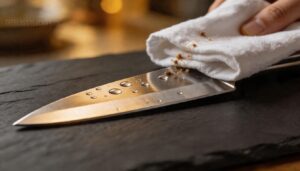
Cleaning your blade right after use is the simplest thing you can do to keep it sharp longer. Debris, mineral buildup, and bacteria don’t need much time to start breaking down a good edge.
A quick rinse and dry after every use makes a real difference, as covered in this microtouch solo blade care and maintenance guide.
Here’s what that process should look like every time you pick up your blade.
Rinse With Warm Water After Every Use
As soon as you finish shaving, hold the blade under a gentle flow of warm water — that’s your ideal temperature sweet spot.
A prompt rinse with hot running water loosens debris before it bonds to the metal. Rinsing the razor after each stroke keeps the edge cleaner throughout the shave. This simple habit is your first move in edge moisture control and corrosion prevention.
Remove Hair, Skin, Soap, and Mineral Residue
Warm water takes care of the loose debris, but hair, skin cells, soap film, and mineral buildup need a little more attention. Hard water leaves calcium and magnesium deposits that increase friction over time — a chelating rinse with citric acid or an acidic soak breaks that bond fast.
Watch for these four residue types:
- Hair and skin cells caught along the edge
- Soap scum and shaving cream film
- Mineral buildup from hard water causing sticky drag
- Shaving product residue that hardens between uses
Use a Soft Brush to Clear Tight Spaces
Once residue loosens, a slim brush head gets into the gaps your fingers can’t reach — pivot points, blade mounts, and tight seams collect debris fast. Bristle flexibility lets soft toothbrush cleaning follow contours without scratching.
Gentle surface contact means you’re lifting buildup, not grinding it deeper. Handle precision keeps every stroke controlled.
That’s your dust removal method done right.
Sanitize Weekly to Reduce Bacteria and Rust
Once the brush work is done, don’t skip the weekly sanitize step. Wipe the blade with 70% isopropyl alcohol disinfecting solution and respect the alcohol contact time — keep it visibly wet for the full contact period to enhance sanitizer effectiveness and bacterial load monitoring.
This cuts bacteria by up to 95% and kickstarts rust prevention before storage.
Remember to dry blades completely before storing them.
Dry The Edge Right Away

Rinsing your blade is only half the job — what you do in the next sixty seconds matters just as much. Leftover moisture is the real culprit behind rust pits and a degraded edge, and it works fast.
Here’s exactly how to dry your blade the right way.
Pat The Blade Dry With a Soft Towel
Reach for a soft cotton towel — towel fabric selection matters more than you’d think. Stiff or abrasive cloth can nick a finely honed edge.
Focus on patting pressure control: short, deliberate presses instead of hard wipes.
Moisture pocket removal means working into slots and blade mounts carefully. Keep blade grip stability firm, and use a dedicated towel for drying razors after each use only.
Prevent Rust Pits Caused by Leftover Moisture
Even a thin film of leftover moisture starts rust pits faster than most people expect — especially in a humid or wet environment where microclimate monitoring matters.
Blade coating selection and humidity indicator strips help you stay ahead of corrosion.
Use drying airflow techniques before dry storage.
- Pat completely dry before storing
- Use silica gel packets inside storage
- Choose temperature controlled storage away from steam
- Apply proper storage to prevent corrosion with a light oil barrier
Dry Hinges, Slots, and Blade Mounts Thoroughly
Hinges, slots, and blade mounts trap moisture long after the flat surfaces feel dry. Run a pipe cleaner or slim brush through each slot, then follow up with microfiber drying around every hinge knuckle and airflow channels where water collects.
Proper storage to prevent corrosion starts here — moisture indicator strips confirm everything is truly dry before blades go into airtight container storage or ventilated storage spots.
Avoid Air Drying in Humid Rooms
Bathroom air is already saturated with steam, so leaving a blade out to dry there barely works — moisture just lingers on the steel.
Skip closed cabinet drying and rapid heat drying with hair dryers, which accelerate wet-dry stress cycles.
Instead, move blades to a dry location with airflow fans, use humidity monitoring to stay below 40%, and rely on silica gel packets and smart desiccant usage for airtight container storage.
Store Blades in Low Humidity

Once the blade is dry, where you keep it matters just as much as how you dry it. Humidity is the quiet culprit behind rust and edge damage, so your storage setup needs to work against it.
Here’s what actually matters.
Keep Blades Upright in a Ventilated Spot
Upright storage is one of those small habits that pays off fast. When you stand blade vertical, water drips away from the edge instead of sitting against the steel. That’s vertical airflow doing its job — rapid drying, natural humidity control, and real rust prevention through simple blade exposure.
- Place blades in a breathable case or open holder
- Choose a dry location away from enclosed drawers
- Make sure air circulates on both sides of the blade
- Add silica gel packets nearby for extra humidity control
- Check that storing razors in dry places becomes your default habit
Move Storage Away From Bathroom Steam
Your bathroom is a blade’s worst enemy. Every shower fills the air with steam, and that moisture settles on metal edges, triggering rust within hours.
Steam-Free Zones — like a bedroom drawer or hallway cabinet — are your best room selection for humidity control and rust prevention.
Storing razors in dry places outside the bathroom can extend blade life by up to 30%.
Add Silica-gel Packets for Moisture Control
Even after moving your blades to a dry room, moisture still sneaks in. That’s where silica gel packets earn their place. Packet placement matters — tuck one directly into the storage container, not beside it.
- Seal containers tightly for effective humidity control for storage
- Recharge packets by heating them for silica recharging methods
- Monitor levels with a small hygrometer for humidity monitoring
- Follow container sealing tips to lock dryness in
- Practice safety disposal when packets reach full saturation
Silica gel packets cut internal humidity dramatically, slowing rust and boosting corrosion prevention for storing razors in dry places.
Use Non-metal Storage to Reduce Corrosion Risk
Silica gel manages humidity inside the container, but the container itself matters too. Metal racks and holders create galvanic reactions that speed up corrosion on steel blades.
Instead, reach for Nonmetal Rack Systems, Plastic Storage Trays, or Galvanic-Free Holders.
Polymer Blade Guards work well for drawer storage, keeping edges separated and dry.
For storing razors in dry places, non-reactive materials simply win.
Apply a Light Protective Oil for Long Storage
Once your blade sits in a non-metal container, a thin film coating of protective oil is your last line of defense. Choose a product with rust inhibitor additives — it creates moisture barrier properties that plain lubricating oil simply can’t match.
Wipe it on clean, dry steel only.
Reapplication timing matters: if the blade looks dull or dry, refresh the coat before long storage.
Hone and Sharpen Correctly
sharp blade isn’t just about how often you sharpen it — it’s about doing it right. Most people skip steps that make a real difference, and the edge suffers for it.
honing and sharpening correctly
Hone Regularly to Realign The Edge

Think of honing as a tune-up, not a repair.
Your edge drifts out of line with every use — blade edge alignment slips before you ever notice the drag.
Regular honing corrects those tiny micro-alignment shifts before they compound.
A solid Honing Frequency Guide keeps it simple:
- Hone every 2–3 uses for daily cooking
- Match your honing rod to your steel’s hardness (Steel Hardness Matching prevents unnecessary wear)
- Use consistent edge honing strokes for Drag Reduction Benefits
- Watch for Blade Vibration Feedback — tugging means it’s time
Edge micro-alignment work now means less sharpening later.
Use The Correct Angle for Smoother Cutting
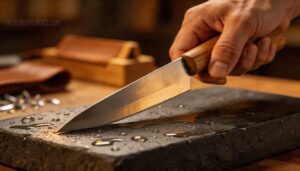
Angle is everything. Most kitchen knives work best at 15–20 degrees per side — that’s your sweet spot for Steep vs Shallow balance.
Harder steel accommodates lower honing angles; softer blades need more. Angle Consistency Techniques matter because wobbling creates a rounded edge that drags instead of cuts.
Angle Adjustment Guides to lock in Blade Material Matching and keep your blade edge alignment clean with every pass.
Strop Gently Between Full Sharpening Sessions

Between full sharpening sessions, stropping keeps your edge in working shape. Run the blade spine-first across a leather strop, using light Leather Pressure — heavy hands around the edge instead of refining it.
Match your Strop Direction to your sharpening angle. Five to ten alternating passes per side do it.
Compound Use adds polishing action, while consistent Strop Care and smart Material Selection make blade maintenance and sharpness retention last.
Sharpen Only When Honing Stops Restoring Sharpness
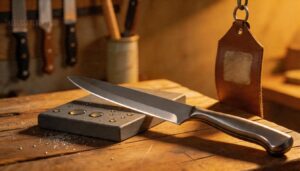
Regular honing keeps your edge aligned, but it can’t rebuild steel that’s worn away. When you notice Edge Wear Indicators — tearing instead of slicing, or failing a sharpness test right after honing — you’ve crossed the Metal Removal Threshold.
That’s your signal for Blade sharpening frequency to kick in. Sharpening removes just enough material to restore Sharpness retention without rushing Blade Thickness Monitoring cycles.
Know When to Seek a Professional Touch-up

Sometimes blade dullness goes beyond what honing or home sharpening can fix. If your edge chips, warps, or shows deep scratches along the bevel, a professional touch-up is the smarter call.
Trying to grind out serious damage at home risks gloss inconsistency along the edge geometry. A pro restores the correct angle cleanly — and at the right blade sharpening frequency — without over‑removing steel.
Avoid Habits That Dull Blades
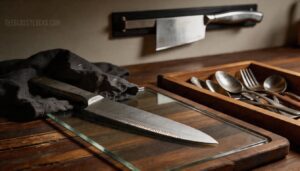
Sharp blades don’t dull on their own — most of the damage comes from small habits you might not even notice. The way you press, angle, and store a blade adds up faster than you’d think.
Here are the key habits worth breaking.
Use Light Pressure to Limit Edge Stress
Too much pressure is the quiet blade killer most people never suspect. Every heavy pass adds edge stress that builds into edge microchipping over time. Keep your touch light — let the blade do the work.
Every heavy pass builds edge stress — keep your touch light and let the blade do the work
- Gentle Contact: Soft surface interaction reduces friction heat and protects the cutting bevel.
- Minimal Force Honing: Light pressure during honing realigns without grinding away metal.
- Controlled Stroke Pressure: Consistent, light pressure limits micro-fractures along the edge.
Keep a Steady Angle During Every Pass
Angle drift is the silent enemy of a sharp edge. Lock your wrist, use body positioning to guide each stroke, and think of it as drawing a straight line from elbow to tip. Your angle reference — around 15–20 degrees depending on blade type — should stay fixed every pass.
Visual checks with a marker and steady stroke rhythm keep your bevel honest. Angle guide removes the guesswork entirely.
Avoid Hard Surfaces That Roll The Edge
Your cutting surface matters just as much as your technique. Glass, granite, and ceramic don’t give — they push back hard against your edge, causing rolling and micro-damage fast. Surface hardness impact is real: even one slice on a ceramic plate noticeably weakens your bevel.
For HDPE board choice or end-grain wood, both absorb contact and protect blade edge geometry far longer.
Do Not Leave Residue or Hard-water Film Behind
Hard water leaves calcium and magnesium deposits that quietly wreck your edge over time.
After blade cleaning, rinsing thoroughly with a Distilled Water Rinse eliminates hard water impact — minerals can’t evaporate away, they stay and corrode.
Mineral-Free Rinsing, using proper Final Rinse Technique, then drying completely with a towel, stops rust before it starts.
Silica Gel Storage manages whatever moisture lingers after.
Replace Blades When Tugging, Skipping, or Irritation Starts
Even with perfect rinsing and storage, every blade has a lifespan. When you notice tugging indicators like pulling instead of gliding, skipping symptoms on curved areas, or your irritation threshold rising with redness and razor burn, stop. That’s your signal.
Replacing dull blades every five to seven shaves keeps skin irritation low and sharpness consistent. Blade replacement and recycling beat fighting a worn edge.
Top 3 Blade Care Tools
Good technique only gets you so far — the right tools make everything easier and more consistent. Having a few reliable items in your kit means less guesswork and better results every time you pick up a blade.
Here are three worth keeping close.
1. Utopia Cotton Kitchen Bar Towels
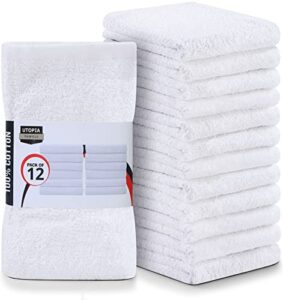
A good blade drying towel does more work than most people realize.
The Utopia Cotton Kitchen Bar Towels come in a 12-pack of 16×19-inch, 100% ring-spun cotton mops built to pull moisture fast without scratching your edge.
Their terry-loop weave grabs water from every surface — flats, spines, grips — without dragging across the steel.
They’re machine washable, so they stay clean and ready.
At $18.99 for 12, you won’t hesitate to grab a fresh one every single shave.
| Best For | Home cooks, bartenders, and wet shavers who want a reliable, no-fuss towel that gets the job done without babying. |
|---|---|
| Material | 100% ring-spun cotton |
| Color | White |
| Unit Count | 12 per pack |
| Price | $18.99 |
| Washable | Machine washable |
| Storage | Stack or fold |
| Additional Features |
|
- 100% ring-spun cotton soaks up spills and moisture fast — no dripping, no streaking
- 12 towels for $18.99 means you can toss one in the wash without overthinking it
- Machine washable and holds up after repeated cycles without losing softness
- Feel a bit thin compared to heavier-duty towels — not the most premium hand feel
- Bright white picks up stains easily, especially from cosmetics or colored sauces
- Plain and functional only — don’t expect these to look good hanging in a styled kitchen
2. OXO Good Grips Dual Bristle Bottle Brush
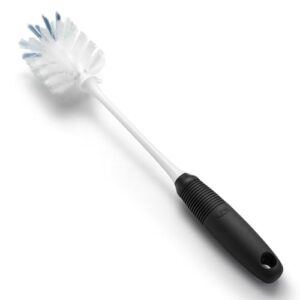
Cleaning inside a razor guard or narrow cartridge housing is where most people give up and just rinse. The OXO Good Grips Dual Bristle Bottle Brush fixes that.
Its flexible 13-inch neck bends into tight spaces, and the dual-bristle head — stiff nylon on one side, soft on the other — manages both stubborn residue and delicate surfaces.
The non-slip rubberized handle keeps your grip steady in soapy water. It’s dishwasher-safe, so the brush itself stays clean and ready.
| Best For | Anyone who regularly cleans narrow-neck bottles, wine glasses, or coffee carafes and wants one brush that handles all of it. |
|---|---|
| Material | Nylon bristles, plastic handle |
| Color | Black |
| Unit Count | 1 unit |
| Price | Not specified |
| Washable | Dishwasher safe |
| Storage | Caddy or hanging hole |
| Additional Features |
|
- Flexible neck bends into tight spots most brushes can’t reach
- Dual bristles mean you can scrub tough residue or clean delicate glassware without switching tools
- Dishwasher-safe, so keeping the brush itself clean is effortless
- Can feel stiff forcing it into very narrow openings until the bristles break in
- The flexible stem may not work with flip-top or oddly shaped bottle lids
- With heavy daily use, the bristles and handle will wear down over time
3. HXT Ceramic Sharpening Rod Angle Guides
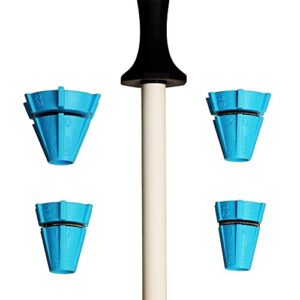
Honing is where most people lose consistency — not because they lack skill, but because they’re guessing the angle every single stroke. The HXT Ceramic Sharpening Rod fixes that with four interchangeable angle guide cones covering 12° to 30°, so you’re matching your blade’s actual geometry, not approximating it.
The 1500-grit Japanese ceramic rod manages fine edge maintenance without removing metal. Just 3–5 light strokes per side, and you’re done.
At $34.50, it earns its spot in any serious blade kit.
| Best For | Home cooks and culinary students who want consistent honing angles without guessing, especially those switching between European and Asian knives. |
|---|---|
| Material | Japanese ceramic, steel core |
| Color | White |
| Unit Count | 1 unit |
| Price | $34.50 |
| Washable | Soap/mild abrasive cleanable |
| Storage | Large metal hanging loop |
| Additional Features |
|
- Four angle guide cones (12°–30°) take the guesswork out of honing, so you get the right angle every single time
- 1500-grit Japanese ceramic rod is gentle on edges — maintains sharpness without chewing through metal
- Only 3–5 light strokes per side means the whole process takes under a minute
- The ceramic rod is brittle — one bad drop onto a hard floor and it could crack, steel core or not
- Plastic angle guides can shift or deform over time, and the rod slides around without a rubber end cap
- Not useful for dull or damaged blades; if your knife needs real work, you’ll need a sharpener first
Frequently Asked Questions (FAQs)
Is WD-40 good for sharpening knives?
WD-40 isn’t a good sharpening lubricant. It’s made to displace water, not carry away metal filings.
mineral oil or proper honing oil on your stone instead — you’ll get cleaner, sharper results.
What should I use to lubricate my knife?
Think of it like seasoning a pan — a little goes a long way. For kitchen blades, food-grade mineral oil or camellia oil works best.
Both protect against rust without leaving unsafe residue on your edge.
How does blade steel type affect sharpening frequency?
The steel your blade is made from directly shapes how often you’ll need to sharpen it.
Harder steels hold an edge longer, while softer ones dull faster and need more frequent attention.
Does shaving direction impact how fast blades dull?
Yes, it does. Shaving against the grain increases friction and edge stress, wearing blades 40% faster. With-the-grain strokes reduce that load substantially, keeping your blade sharper through more shaves.
Conclusion
Every blade you own is quietly telling you its future—and how you treat it today writes that story. The ones rinsed clean, dried at the hinge, stored away from steam, and honed at the right angle will still be cutting smoothly a year from now.
That’s how you maintain sharp blade smoothly: not with one dramatic fix, but with small, deliberate habits that add up. Stay consistent, and your blades will return the favor.