This site is supported by our readers. We may earn a commission, at no cost to you, if you purchase through links. This content is for general informational and educational purposes only and is not a substitute for professional medical, dermatological, or nutritional advice.
Most shaving problems trace back to one thing—and it’s not your razor, your blade, or even your technique. It’s the angle. A blade pressed too flat drags and burns. Too steep, and it scrapes instead of cuts, pulling hair before severing it. That gap between a comfortable shave and a face full of irritation often comes down to few degrees of tilt you can’t even see without a mirror.
Proper razor blade angle is the variable every experienced barber controls instinctively—and every beginner ignores. Once you understand what’s actually happening at skin level, how the blade edge interacts with hair growth and surface tension, the whole mechanics of shaving clicks into place.
Table Of Contents
- Key Takeaways
- What is The Proper Razor Blade Angle?
- Ideal Blade Angle for Safety Razors
- How to Find Your Starting Blade Angle
- Step-by-Step Guide to Holding The Razor Correctly
- Riding The Cap Vs. Riding The Guard
- Adjusting Blade Angle for Facial Contours
- Common Blade Angle Mistakes to Avoid
- How Different Razors Affect Blade Angle
- Blade Angle Tips for Different Hair and Skin Types
- How to Practice and Perfect Your Blade Angle
- Frequently Asked Questions (FAQs)
- Conclusion
Key Takeaways
- Blade angle — not your razor, blade brand, or pressure — is the single variable that determines whether you get a clean cut or irritated skin, with 30 degrees being the universal sweet spot for safety razors.
- Your grip, wrist lock, and stroke length work together to hold that angle steady; let the razor’s own weight do the cutting instead of pushing down.
- Every contour on your face — jaw, neck, upper lip — demands a small angle tweak of 5–10 degrees, because a fixed angle across uneven terrain is where most shaves fall apart.
- Blade thickness, razor head design, and even lather consistency all shift your effective angle, so dialing in your shave means accounting for your specific tools, not just copying a generic technique.
What is The Proper Razor Blade Angle?
Blade angle is the single most controllable variable in your shave — and most people never give it a second thought.
Especially in sensitive spots, a shallow 30-degree angle dramatically cuts irritation — something the folks at razor burn prevention after shaving break down really well.
Get it right, and the razor glides cleanly through hair without dragging or biting into skin.
Here’s what you need to understand about how angle works and why it changes everything.
Why Blade Angle Matters for a Close Shave
Blade angle is the single variable that determines whether your razor cuts hair or scrapes skin. Get it right, and the edge geometry does the work — clean cutting shear through each shaft, close to the surface. Here’s why angle consistency defines shave quality:
- Controls blade exposure against the skin
- Allows proper hair lift before severance
- Optimizes cutting shear efficiency
- Maintains edge geometry contact
- Drives overall shaving technique precision
Following the ideal 45 degree angle helps prevent split ends and maintain hair integrity.
How Angle Affects Skin Comfort and Irritation
Once you’ve got the angle working, comfort follows — or doesn’t. A wrong blade angle creates friction heat fast, especially on the neck.
If too shallow, the razor blade drags across follicles instead of cutting them, triggering follicle pull and localized stinging.
That pressure-angle interaction matters: even light pressure at a poor angle raises micro-cut risk and skin irritation, particularly for darker skin tones with higher sensitivity.
Studies show a high skin irritation risk when using metal blades on sensitive areas.
Difference Between Too Steep and Too Shallow
Angle extremes sit on opposite ends of the same problem.
Too steep — handle nearly parallel to your face — and the razor blade scrapes skin instead of slicing hair, flooding you with a harsh feedback sensation and killing contour control fast.
Too shallow lifts blade exposure away from follicles entirely, dropping pass count efficiency. Neither angle works.
The 30-degree sweet spot sits right between both.
Ideal Blade Angle for Safety Razors
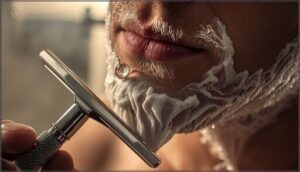
Safety razors aren’t forgiving when the angle is off — even a few degrees can mean the difference between a clean pass and raw skin.
Getting it right comes down to understanding a few specific principles that guide how the blade should sit against your face. Here’s what you need to know.
The 30-Degree Rule Explained
The 30-degree rule is your baseline — the angle between the blade edge and your skin that makes everything work.
In practice, your handle sits around 40 to 45 degrees, but the razor head bends the blade, landing it right in that sweet spot.
Use skin feedback to confirm: smooth cutting sound, no scraping.
That’s your error margin eliminated.
Why Safety Razors Require a Specific Angle
Unlike a cartridge razor that pivots to compensate for your technique, a safety razor demands deliberate blade angle control — and that’s by design.
The fixed head relies on precise Guard Bar Alignment and Cap Riding Dynamics to manage Skin Stretch Mechanics effectively:
- Guard contacts skin first, stretching it flat ahead of the blade
- Cap shields skin from direct exposure at the correct angle
- Angle Consistency Benefits every stroke by eliminating sporadic cutting
- Fixed geometry means you supply the compensation, not the razor
- Wrong angles instantly allow skin to bunch, causing nicks
How Razor Head Design Influences Optimal Angle
Your razor’s head geometry quietly dictates your best blade angle before you’ve taken a single stroke. Blade Gap Impact, Guard Bar Shape, and Cap Contour Effects all shift where that sweet spot actually lands.
Wider gaps expose more blade, requiring a more upright handle. Open-comb guards lift hair into the cutting plane. Adjustable Razors let you dial exposure settings precisely — giving you real control over blade geometry and angles.
How to Find Your Starting Blade Angle
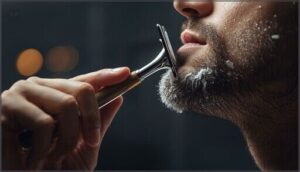
Finding your starting blade angle doesn’t have to be a guessing game. There’s a simple, repeatable process that gets you in the right position every single time.
Here’s how to get there.
Beginning With The Handle Perpendicular to Skin
Start every shave from the initial upright position — handle perpendicular to your skin, razor blade nearly vertical. This isn’t random; it’s a deliberate pressure release point that keeps the blade from contacting skin until you’re ready. Think of it as setting the safety before you aim.
- Cap contact cue: the cap rests flat, blade safely elevated
- Visual alignment check: use mirror angle confirmation to verify the head sits straight
- Control foundation: beginners especially benefit from this neutral starting posture
Gradually Lowering Until Blade Contacts Hair
Once your handle is upright, tilt slowly — roughly 1–2 degrees per second. That controlled tilt speed is everything.
You’re hunting for the catch sensation: a subtle tug where the shaving blade’s edge angle meets stubble without pulling skin. Listen for a faint snick — your audio feedback that contact is clean.
Minimal skin tenting confirms it. Wrist lock that position immediately.
Using The Cap and Guard as Visual Guides
Your razor’s cap and guard are built-in angle guides — use them. Cap‑Guard Alignment is your baseline: when the parallel cap‑guard lines sit flush against the skin in a mirror angle check, your blade angle is in the sweet spot.
Watch for the lather gap visual — a thin, even strip between cap and guard. That guard shadow indicator confirms consistent edge angle throughout every stroke.
Step-by-Step Guide to Holding The Razor Correctly
How you hold the razor matters just as much as the angle itself.
A bad grip throws everything off — your wrist, your pressure, your control.
Here’s exactly what to focus on.
Proper Grip for Angle Control
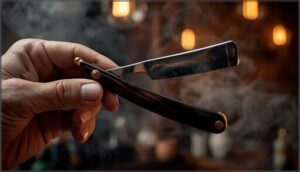
Your grip is the foundation of blade angle control. Use a thumb‑index pinch near the base knob — this is your primary angle guide.
Rest the handle on your middle finger to find the balance point grip, where small shifts naturally adjust bevel angle without forcing pressure. Finger‑pressure modulation keeps razor handling light, letting the razor’s own weight do the cutting.
Using Your Wrist to Set and Lock The Angle
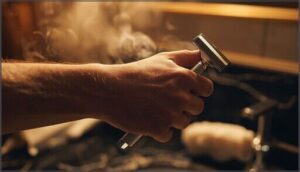
Once your grip is set, your wrist does the precision work.
Lock your wrist into a fixed position — this Wrist Lock Technique keeps the blade angle stable stroke after stroke. Start with the handle near perpendicular, then apply a small forward Wrist Tilt Range of 30–45 degrees until the blade bites cleanly.
- A locked wrist lets your shoulder drive each stroke, not your fingers.
- Wrist Feedback Cues tell you everything: clean gliding means correct angle, scraping means you’ve tilted too far.
- Keep your Wrist Pressure Control light — the razor’s weight does the work.
- Wrist Curve Coordination means your wrist stays fixed while your elbow guides contours.
- A consistent AnglePilot approach — same starting position every pass — builds reliable muscle memory fast.
Keeping Consistent Pressure Throughout Each Stroke
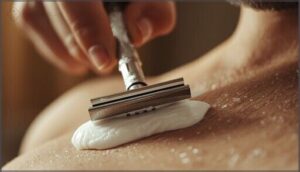
With your wrist locked, pressure becomes the next variable to control. Weight Utilization is your foundation — a heavier razor (90–110g) does most of the work, so you’re barely pushing. Grip Distance Adjustment matters here: hold 1–2 inches from the head for lighter, steadier contact.
| Stroke Variable | Correct Approach | Why It Matters |
|---|---|---|
| Stroke Length | 1–2 inches | Prevents pressure buildup |
| Glide Speed | 2–3 inches/second | Keeps force under 10g |
| Grip Position | 1–2 inches from head | Reduces applied pressure 50% |
| Lather Refresh | Every 3–5 strokes | Maintains Lather Lubrication and glide |
| Overlap | Half stroke length | Ensures even coverage |
Short Stroke Control and Smooth Gliding Motion work together — let momentum carry the blade without pushing.
Riding The Cap Vs. Riding The Guard
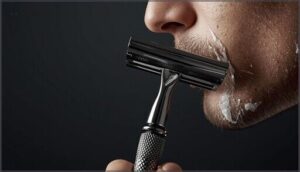
Once you’ve got your grip dialed in, the next thing to understand is where the razor actually makes contact with your skin.
Safety razor shaving has two distinct techniques — riding the cap and riding the guard — and knowing the difference changes everything about how your blade performs. Here’s what each one means and how to find the angle that works best for you.
What Riding The Cap Means and When to Use It
Riding the cap means keeping the top cap flush against your skin as you stroke — a technique that naturally holds the blade at a shallow angle, around 20 degrees. Cap Angle Adjustment delivers gentler Cap Skin Stretch across the surface, reducing aggression considerably.
| Scenario | Cap Pressure Control | Result |
|---|---|---|
| Daily shave | Light, consistent | Minimal irritation |
| Sensitive Area Cap (neck) | Feather-light | Fewer nicks |
| Cap Change from cartridge | Gradual tilt adjustment | Smoother learning curve |
| Jawline curves | Slight pressure increase | Better skin contact |
| Touch-up passes | Near-zero pressure | Clean finish |
Start perpendicular, lower slowly until the blade engages hair. It’s the safest entry point into proper Shaving Techniques and Tips — especially if you’re making a Cap Change from multi‑blade cartridges.
What Riding The Guard Means and When to Use It
Where riding the cap skims the surface, bringing the handle closer to parallel with the skin shifts everything — that’s guard territory.
Steeper Angle Benefits kick in here: the blade bites more directly into coarse hair, making it your go-to First Pass Technique for longer stubble.
Sensitive Skin Caution applies strongly, though — too steep invites nicks fast.
| Scenario | Guard Angle | Result |
|---|---|---|
| Coarse Hair Application | 20–25 degrees | Aggressive cut, close pass |
| First-pass on cheeks | Moderate steep | Bulk stubble removed cleanly |
| Jawline Adjustments | Slightly reduced | Controlled, nick-free strokes |
| Sensitive zones | Avoid or minimize | Reduces irritation risk |
| Dull blade warning | Skip entirely | Drag and redness guaranteed |
Finding Your Personal Sweet Spot Between Both
Finding the balance between cap and guard isn’t guesswork — it’s calibration. Your personal sweet spot usually lands around 30 degrees, splitting the difference between both extremes.
Post‑Shave Evaluation after each session reveals where Skin Sensitivity Mapping points you. Angle Memory Drills on your cheek build consistency fast.
| Feedback Signal | Angle Adjustment |
|---|---|
| Redness or nicks | Reduce toward cap |
| Tugging or dragging | Increase toward guard |
| Smooth, clean cut | Hold current angle |
| Neck irritation | Soften by 2–3 degrees |
| No stubble reduction | Steepen slightly |
Adjusting Blade Angle for Facial Contours

Your face isn’t flat, and your razor can’t pretend it is.
The jawline, upper lip, and neck all demand small but deliberate angle shifts to stay effective and safe.
Here’s how to handle each one.
Navigating The Jawline and Chin
The jaw and chin are where most shaves fall apart. Before any stroke, perform a Jawline Skin Stretch — pull the skin taut with your free hand to flatten the contour. Then:
- Jawbone Curve Stroke: Use short 1–2 inches across‑grain strokes, adjusting your wrist to keep the blade parallel to the bone
- Chin Point Tilt: Tilt your head back, exposing the chin tip for a clean 30‑degree approach
- Pressure‑Free Glide: Let razor weight alone do the work — no added force on bony curves
Shaving The Upper Lip and Nose Area
Shaving the upper lip and nose demands deliberate Lip Skin Tension and Muscle‑Driven Control. Pull your upper lip down over your teeth to flatten the philtrum, then work in Precision Lip Strokes — tiny 2–3 mm sweeps at 25–30 degrees. Nostril Clearance requires tilting your nose aside while Angle Fine‑Tuning keeps every stroke clean and irritation‑free.
| Area | Angle | Technique |
|---|---|---|
| Philtrum center | 25–30° | Short downward strokes |
| Under nostril | 30–35° | Sideways nose tilt |
| Corner of lip | 45° | Diagonal approach |
Handling The Neck and Curved Surfaces
The neck is where most shaves fall apart. Curved surfaces demand Skin Stretching, Short Stroke Control, and smart Grain Mapping before you touch the blade to the skin.
- Jawline Tilt — raise the handle slightly on rising contours
- Adams Apple Smoothing — swallow and hold to flatten the bulge
- Limit strokes to half-inch lengths on curves
- Map grain per 2-inch zone, adjusting Sharpening Angle accordingly
- Apply razor weight only — zero downward pressure
Common Blade Angle Mistakes to Avoid
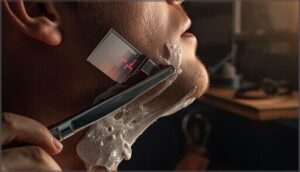
Even experienced shavers fall into habits that quietly sabotage an otherwise solid technique.
Most blade angle problems come down to three repeatable mistakes — the kind that are easy to fix once you know what to look for. Here’s where things commonly go wrong.
Applying Too Much Pressure at Wrong Angles
Pressure is where most shaving safety mistakes happen.
Steep angles over 30 degrees paired with heavy force are the top razor burn triggers — the blade digs in rather than glides, causing nicks from steep edges and micro-abrasion risks that linger for hours.
Steep angles and heavy pressure don’t shave skin — they punish it
Go too shallow with the same force, and you’re dragging across skin, inviting ingrown hair causes and jawline pressure mistakes. Let razor weight do the work.
Inconsistent Angling Across Shaving Passes
Most shavers don’t realize their angle drifts between passes — and that drift causes more irritation than a single bad stroke ever could.
- Grip fatigue after pass one causes a 5-degree upward angle drift
- Lather thinning forces a 6-degree steeper tilt on dry patches
- Technique drift from rushing hits 6-degree inconsistency by pass three
- Correction practice — slow strokes and mirror checks — limits variance to under 2 degrees
Failing to Adjust for Curves and Problem Areas
Angle drift between passes is only half the battle. The real trouble starts when you hit curves and don’t adjust.
Fixed blade geometry through jawline turns digs in — those 90-degree contours demand 5–10-degree tweaks. Chin contour mistakes mean snagging; upper lip skipping happens without a tongue-push.
Skin stretch neglect doubles drag. Adjust or bleed.
How Different Razors Affect Blade Angle

Not every razor behaves the same way, and that difference matters more than most people realize.
The tool in your hand — whether it’s adjustable, straight, or a standard safety razor — directly shapes how you find and hold your blade angle. Here’s how each type plays into that equation.
Adjustable Razors and Fine-Tuning Blade Exposure
Dialing in an adjustable razor is about more than convenience — it’s precision engineering in your hand. The numbered dial scale shifts both gap calibration and blade exposure simultaneously, letting you apply pass-by-pass adjustment with real control.
Use zone-specific tuning on sensitive areas like the neck.
Higher exposure settings demand a consistent 30-degree angle; blade geometry becomes less forgiving the moment you stray.
Straight Razors Vs. Safety Razors Angle Comparison
Straight razors give you full control over edge geometry impact — the entire blade rides directly on your skin, so every degree of adjustment matters. Safety razors constrain that through the guard, limiting blade exposure difference but making angle adjustment tools less critical.
Skin feedback signals differ too: skin feedback signals: straight razors hiss cleanly at the right angle; safety razors feel scratchy when too steep.
How Blade Brand and Thickness Change The Angle
Not all blades sit the same in your razor. Brand thickness impact is real — Astra’s 0.035-inch blade flexes more, while Nacet’s 0.045-inch stays rigid, shifting your angle sweet spot by up to 5 degrees.
- Thicker blades support shallower angles
- Thinner blades need steeper handle tilt
- Material rigidity effects change edge feedback
- Flexibility variance affects consistency stroke-to-stroke
- Thickness-driven angle tuning rewards patient experimentation
Blade Angle Tips for Different Hair and Skin Types

Not everyone shaves the same, and your blade angle shouldn’t be one-size-fits-all either.
Coarse hair, sensitive skin, and multi-pass routines each ask something a little different from your technique.
Here’s how to adjust your angle for each situation.
Coarse or Thick Hair Angle Adjustments
Coarse hair doesn’t respond to a standard 30-degree angle — it pushes back. Steepen to 32–35 degrees and the blade edge actually engages the shaft instead of deflecting off it. Hot towel prep for two minutes softens thick whiskers before you even pick up the razor. Blade-gap matching matters too: a 1.0 mm gap head manages steeper-angle benefits without skipping.
| Technique | Coarse Hair Recommendation |
|---|---|
| Starting blade angle | 32–35 degrees |
| Hot towel prep time | 2.5 minutes |
| Pass-direction strategy | With-grain first, cross-grain second |
Use light-pressure technique — let razor weight do the work.
Sensitive Skin and Reducing Irritation Through Angle
Sensitive skin demands a gentle angle — stay firmly within the 30‑degree sweet spot, never creeping past 32.
Think of it as a low‑pressure tilt: let blade weight do the cutting, not your hand.
Adjustable razor settings like R1–R2 reduce blade exposure, cutting bumps by nearly half.
Contour‑aware angling on the neck prevents trauma where skin folds unpredictably.
Multi-Pass Shaving and Angle Variation Per Pass
Multi-pass shaving isn’t just about repetition — it’s a deliberate angle strategy per pass.
- First Pass Angle: 30 degrees, with the grain, removes 90% of stubble
- Second Pass Tilt: Steepen 5–10 degrees across the grain for closer reduction
- Third Pass Shallow: Drop to 7–15 degrees against the grain to avoid scraping
- Grain Mapping Strategy: Map beard direction before starting — angles shift per zone
- Pressure Consistency: Light, wrist‑locked strokes maintain RazorSharp edges every pass
How to Practice and Perfect Your Blade Angle
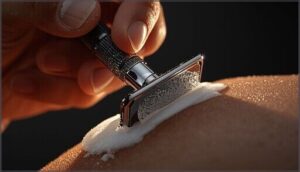
Getting your blade angle right takes more than just knowing the theory — it takes repetition with intention.
The good news is that a few focused habits will get you there faster than you’d expect.
Here’s what to work on.
Using a Mirror to Monitor Technique in Real Time
A mirror isn’t optional — it’s your best coaching tool.
Position it 18–24 inches away for accurate mirror distance and tilt it slightly downward toward your jawline.
Magnified angle checks with a 5x or 7x mirror catch subtle wrist drift instantly.
Use a swivel view for neck curves, and keep lighting consistency and control steady — shadows hide bad angles fast.
Slowing Down to Build Muscle Memory
Speed is the enemy of good technique. Use deliberate short strokes — about an inch at a time — with light pressure practice to let the blade’s geometry do the work.
A consistent stroke tempo and repetitive zone focus on one cheek builds real muscle memory fast.
These feedback‑driven angle adjustments happen naturally when you slow down enough to actually feel them.
Knowing When Your Angle is Dialed in Correctly
You’ll know your angle is dialed in when everything clicks at once — not just one signal, but four working together:
- Auditory cues shift to a clean, steady whisking sound
- Visual blade exposure shows the guard visible but the edge barely peeking through
- Tactile glide feels smooth — hair falling away, not dragging
- Lather disruption leaves a crisp, clean path behind each stroke
That’s your confirmation.
Frequently Asked Questions (FAQs)
Can blade angle affect razor longevity over time?
Yes — blade angle directly drives your Angle Wear Rate. Wrong angles accelerate Edge Fatigue and Microchipping Impact, flattening your Blade Dullness Curve fast.
Consistent 30-degree form is your best Blade Maintenance and Care strategy.
Does shaving cream thickness influence the optimal angle?
Shaving cream thickness directly shifts your effective blade angle. Thick lather cushions the blade slightly higher; thin lather brings it closer.
Adjust foam consistency as part of your angle-lather interaction for dialed-in results.
How does blade angle differ for head shaving?
Head shaving demands more angle adaptation than face work. Your scalp curvature shifts constantly — dome steepness requires a 30–35 degree crown pivot, while neck concave zones favor a shallower 25 degrees.
Can water temperature affect how blade angle performs?
Water temperature directly affects how your blade performs. Hot-water expansion softens hair 65% faster, allowing forgiving angles between 25–35 degrees. Cold-skin contraction tightens tolerance to exactly 30 degrees for irritation-free results.
Conclusion
Most shavers spend years blaming dull blades, cheap razors, or sensitive skin—when the real culprit was hiding in plain sight the whole time. Proper razor blade angle isn’t a minor detail; it’s the entire foundation the shave is built on.
Get it wrong, and nothing else compensates. Get it right, and every stroke becomes controlled, deliberate, and clean. That’s not technique—that’s craftsmanship. Now you have what it takes to actually use it.