This site is supported by our readers. We may earn a commission, at no cost to you, if you purchase through links.

Most guys grab whatever trimmer’s on sale, hack away for ten minutes, and wonder why their beard still looks rough. The problem isn’t effort—it’s the wrong tools doing the wrong jobs.
A trimmer controls length, but it can’t catch the stray hairs curling past your lip. A brush trains your beard to grow in one direction; a comb won’t do that.
Every tool in a solid beard kit has a specific role, and knowing which ones you actually need saves you money, frustration, and a lot of bad beard days.
Table Of Contents
Key Takeaways
- Your trimmer handles length, but you need scissors, a boar-bristle brush, and a wide-tooth comb to actually finish the job — each tool does something the others can’t.
- Matching your trimmer to your skin type and hair thickness matters more than brand or price — the wrong blade on sensitive skin will wreck your routine fast.
- Beard oil and balm aren’t optional extras; skipping them leads to itch, beardruff, and a beard that looks rough by midday no matter how well you trim it.
- A lean kit beats a loaded one — the tools worth owning are a trimmer, brush, scissors, and the right products, while gadgets like heated combs and UV sanitizers just take up space.
What Tools Do You Need for Beard Care?
Building a solid beard kit doesn’t have to be complicated, but starting with the right tools makes all the difference. Whether you’re just growing one out or trying to tighten up your routine, knowing what actually belongs in your kit saves you time and money.
If you’re just starting out, a beginner beard trimming kit guide can help you skip the guesswork and grab only what you actually need.
Here’s what you need to get started.
Must-have Tools for Beginners
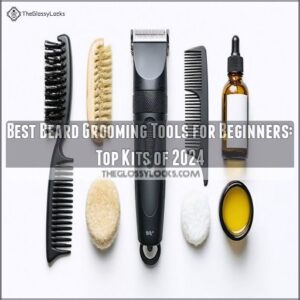
Starting out doesn’t mean buying everything at once. Your beginner beard grooming toolkit really comes down to four things: an electric beard trimmer, a beard comb, beard trimming scissors, and a boar-hair brush.
That’s your beginner tool checklist sorted. The trimmer manages length, the comb detangles, the scissors catch strays, and the brush keeps your skin healthy underneath.
Tools for Daily Grooming
Once you’ve got your beginner kit sorted, daily grooming is really about maintenance.
Your boar’s hair beard brush manages morning touch-ups — a few strokes align the hairs and move natural oils through. A microfiber towel dries everything gently post-wash.
Good mirror lighting helps you catch uneven spots fast.
A handheld spray bottle softens stubborn sections, and keeping a brush cleaning routine prevents buildup.
A dual‑purpose hairbrush for beard helps keep your facial hair tidy between trims.
Tools for Trimming and Styling
Daily maintenance keeps things tidy. But when it’s time to actually shape your beard, you need the right tools for the job.
- A beard trimmer with an Adjustable Guard Comb locks in consistent length every time.
- Detail Trimmer Heads clean up tight corners around your chin and mouth.
- A Tapered Edge Comb paired with Micro-tip Scissors and beard trimming scissors manages stray hairs that a trimmer can’t reach.
- A beard shaper template, Anti-Static Comb, and beard brush keep your lines clean and your style dialed in.
Which Beard Trimmer Should You Buy?
Picking the right trimmer isn’t just about grabbing whatever’s on sale — the wrong one can mean irritated skin, uneven lines, or a dead battery halfway through. A few key factors separate a trimmer that works for your beard from one that just looks good in the box.
Here’s what to look at before you buy.
Adjustable Length Settings
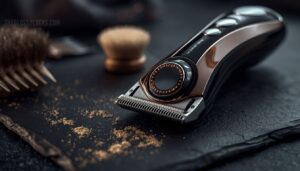
One wrong length setting can cost you two weeks of growth. That’s why adjustable cutting guides matter more than most guys realize.
Most trimmers use a dial increment precision system, moving in 0.5 mm steps from roughly 0.5 mm to 20 mm. Each tactile click feedback confirms your setting — no guesswork.
The guard snap mechanism locks firmly, and memory length lock returns you to your preferred setting automatically.
| Feature | What It Does | Why It Matters |
|---|---|---|
| Dial Increment Precision | Adjusts in 0.5 mm steps | Consistent, repeatable length |
| Tactile Click Feedback | Audible confirmation per setting | No accidental length changes |
| Memory Length Lock | Recalls preferred guard position | Saves time during calibration routine |
Skin Sensitivity and Blade Type

Your skin type should drive your blade choice — not the other way around.
Sensitive skin often calls for a single-blade razor, while coarser hair handles multi-blade cartridges well — and pairing the right blade with a precise beard shaping tool keeps both your skin and your lines looking clean.
For sensitive skin, look for:
- Platinum coated blades — smoother glide, less drag
- Reduced blade count — fewer edges, less irritation
- Low aggressiveness settings — gentle on reactive skin
- Sharp, high-quality blades — dull blades scrape; sharp ones cut clean
Replace blades before they tug. That alone addresses most irritation.
Corded Vs Cordless Models
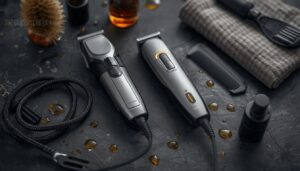
Corded trimmers win on Power Source Consistency — constant torque, no fade mid-session. If Torque Stability matters to you, plug‑in models deliver it every time.
Cordless offers real Portability Benefits: no outlet, no cord tangling around your arm. Modern Battery Runtime hits 60–180 minutes, plenty for most grooming sessions.
Just factor in Maintenance Requirements — batteries degrade over time. Pick based on where and how you trim.
Trimmer Features for Thick Beards
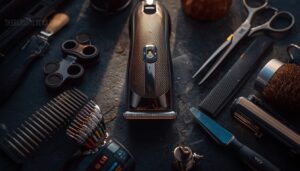
Thick, coarse hair is basically a stress test for your trimmer — and most budget models fail it.
You need a high torque motor that won’t stall mid-pass, titanium coated blades that stay cool and sharp, and a floating blade head that follows your jaw’s contours.
Anti-tugging mechanism features prevent painful grabs.
Color coded guards make adjustable cutting guides foolproof, giving your best beard trimmer for thick coarse hair clean, sharp lines every time.
What Beard Brush and Comb Work Best?

A trimmer manages length, but brush and comb are what keep your beard looking intentional every single day. The right combo depends on your beard’s texture, length, and what you’re actually trying to do with it.
Here’s what you need to know about each tool and when to reach for it.
Boar-bristle Brush Benefits
A boar bristle beard brush does more than just tame flyaways — it’s doing quiet work under the surface. The bristles handle oil distribution by pulling sebum from your skin and spreading it evenly through every strand. That means better shine enhancement, gentle detangling without yanking, and a real skin massage that keeps things comfortable.
5 reasons boar bristles earn their place:
- Sebum distribution — moves natural oils from roots to tips, so your beard stays soft
- Skin exfoliation — lifts dead cells under the beard, cutting down itch and beard-ruff
- Static reduction — natural bristles smooth the hair cuticle, keeping frizz calm
- Shine enhancement — aligned hairs reflect light evenly for a polished look
- Beard health — daily brushing prevents dry patches and builds consistent texture over time
Wide-tooth Comb for Detangling
Once your beard clears 1.5 inches, a wide tooth comb earns its spot in your beard grooming kit. Rounded teeth glide through knots without snapping strands — that’s hair health benefits working for you.
Wood and carbon fiber options add static reduction to the mix, while the ergonomic grip comfort keeps fatigue low. Detangling efficiency, shape versatility, and tangle-free results make it a beard care routine non‑negotiable.
Wood, Carbon Fiber, and Metal Combs
Not all beard combs are built the same.
A wood comb offers natural Oil Absorption and gentle Static Control — great for sensitive skin.
Carbon fiber wins on Material Durability, Heat Resistance, and easy cleaning guidelines.
A metal comb manages thick, coarse beards with precision.
Knowing your types of beard combs helps you pick the right beard comb for the job.
When to Use Each Tool
Knowing your comb material is half the battle. The other half is knowing when to reach for each tool.
- Use your beard brush daily on dry hair to spread natural oils evenly.
- Grab your beard comb for detangling before beard trimming scissors or beard trimmer work begins.
- Apply oil moisturization right after washing, then brush through.
- Use scissor detailing for stray hairs your trimmer misses.
- Follow brush‑comb timing — brush first, comb to smooth.
Why Do Beard Scissors Matter?
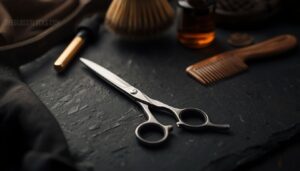
A trimmer takes care of the bulk work, but scissors handle the details, a trimmer simply can’t. Think of them as your finishing tool — the thing that separates a decent beard from a sharp one.
Here’s why they belong in your kit and how to use them right.
Precision Trimming Stray Hairs
Catching strays is where beard trimming scissors earn their keep.
Use the Micro Comb Guidance method — lift sections with your wide-tooth comb so longer hairs stand proud, then snip with precision tools using short passes. That’s your Snip Timing Strategy.
Apply Blade Angle Control with slight Angle Feathering Technique to avoid harsh lines.
Finish with Post-Trim Blending for clean, even results.
Mustache Shaping and Cleanup
The mustache is its own game. Use comb-guided trimming to lift hairs upward, then apply scissor edge finesse with small snips — never one big cut.
A guard detail pass keeps your base length consistent near the lip line.
Work in the product distribution method with mustache wax after shaping, then finish with post-shape cleaning.
Your beard comb confirms both sides match.
Choosing Sharp Stainless-steel Scissors
Not all scissors are built the same. For real trim accuracy, look for these three things:
- Convex Edge Geometry — smoother cuts, less snagging
- Blade Hardness Rating of 55–60 Rockwell C — holds a sharp edge longer
- Adjustable Tension System — fine‑tune blade feel as you work
An Ergonomic Handle Design reduces fatigue, and regular Sharpening Frequency keeps your beard trimming precision tools performing like new.
Scissors Vs Trimmer for Detailing
Both tools earn their place — the question is knowing when to reach for each.
Your electric beard trimmer nails Edge Consistency along necklines and cheek borders. Beard trimming scissors give you Control Precision around curves where a blade might overcut.
Thick hair? Use the best beard trimmer for detailing. Fine patches? Let scissors handle it.
Hybrid Techniques, combining both with proper Blade Maintenance, deliver the cleanest results.
Which Beard Products Belong in Your Kit?
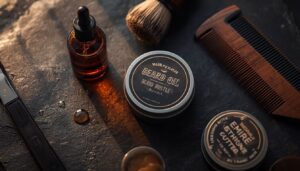
Tools get your beard shaped — products keep it healthy and looking good. Think of them as the second half of your kit, and skipping them shows.
Here’s what actually belongs in your rotation.
Beard Oil for Moisture and Itch
Beard oil is the unsung hero of your kit. It works on two levels — softening the hair and feeding the skin underneath. Skip it, and you get itch, beardruff, and a beard that looks rough by noon.
Skip beard oil, and you get itch, beardruff, and a rough-looking beard by noon
- Skin Moisturization: Jojoba benefits include mimicking your natural sebum, so it absorbs fast with a non-greasy formula
- Squalane Hydration: Lightweight and barrier-strengthening — great for daily wear
- Chamomile Soothing: Calms redness and irritation at the root level
- Sensitive Skin Options: Go fragrance-free if your skin reacts easily
Beard Balm for Light Hold
Think of beard balm as the middle ground between bare skin and full‑on wax.
It combines a beeswax blend with carrier oil benefits — jojoba, coconut — and butters for softness like shea, so you’re conditioning while you style.
Fragrance choices range from subtle to bold.
Scoop a pea-sized application amount, warm it between your fingers, then work it through with a brush.
Flyaways tamed. Done.
Beard Wax for Stronger Control
When balm just won’t cut it, beard wax steps in.
Beeswax hold is the backbone here — rigid, reliable, humidity resistance built in. Carnauba stiffness adds extra control without making things crunchy. Vitamin E protection keeps strands healthy while you style.
- Warm it between fingers first — application temperature matters
- Work through with a styling comb for clean edges
- Use a beard shaper for precise cheek lines
- Layer over beard balm for flexible, lasting hold
Beard Shampoo and Conditioner Basics
Your shampoo and conditioner aren’t an afterthought — your foundation.
Use a sulfate-free beard shampoo two to three times weekly, lathering root to tip, then rinse until water runs clear. Follow with beard conditioner for softness and manageability.
Post-wash, apply beard oil while skin is still slightly damp. That combo cuts itch and keeps your beard grooming essentials working properly.
What Optional Beard Tools Are Worth It?
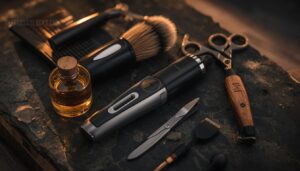
Once you’ve got the essentials locked in, it’s tempting to keep adding tools to your kit. Some extras actually earn their spot — others just collect dust on your shelf.
Here’s an honest look at what’s worth grabbing and what you can leave behind.
Blow Dryer and Round Brush Styling
A round brush and blow dryer can completely transform a wavy or coarse beard. Use an airflow nozzle to direct heat precisely, and always apply heat protection first.
Barrel size matters — larger barrels add volume, smaller ones tighten the shape.
Bristle grip keeps hair aligned as you pull and style.
Finish with the cool shot to lock everything in place.
Beard Templates for Lining Up Edges
Once your edges are styled, a beard shaper makes lining them up feel almost foolproof. Template size options vary, so pick one that covers your cheek line shaping and neckline together. Most include double-sided guides for flexibility.
Here’s how to use one right:
- Apply Template Adhesive Tips to hold it steady — no shifting mid‑trim.
- Use symmetry checking by tilting your head both ways before committing.
- Run your beard trimming scissors or trimmer along the edge using light, even strokes.
Material durability matters too — flimsy plastic warps fast.
Beard Bibs for Easier Cleanup
Templates keep your lines sharp — a beard bib keeps your sink clean.
Waterproof materials and a self-sealing pocket trap clippings before they scatter everywhere. Most attach via suction cup mounting, so setup takes seconds. Many models also offer a machine washable design and a travel pouch included for kits on the go.
| Feature | Benefit | Best For |
|---|---|---|
| Waterproof Materials | Resists oils and moisture | Daily grooming kit users |
| Suction Cup Mounting | Mirror-mounted, hands-free use | Small bathrooms |
| Machine Washable Design | Easy cleaning beard grooming tools | Regular beard maintenance |
Tools and Gadgets You Can Skip
Some gear sounds cool but solves problems you don’t actually have. Skip these unnecessary beard accessories:
- Vibrating massage gadget — your brush already moves product through the beard
- Heated comb — a regular comb detangles fine without cooking your skin
- UV sanitizer — just wash your tools
- Laser guided trimmer or makeup stencil — a steady hand and mirror beat both every time
Avoiding unnecessary beard gadgets keeps your kit lean and your results sharp.
Frequently Asked Questions (FAQs)
How often should you replace beard grooming tools?
Beard grooming tools don’t last forever.
Replace trimmer blades when they pull instead of cutting.
Watch for brush wear signs like shedding bristles.
Swap scissors showing scissor rust or misalignment.
Can beard tools help with patchy beard growth?
They can help, yes — but manage expectations.
A derma roller, beard brush, beard comb, and beard growth oil work together to improve appearance and support follicle health, but genetics still runs the show.
What grooming tools work best for short stubble?
stubble trimmer with a low profile blade and sensitive skin guard keeps your look sharp without the razor burn.
Quick pass trimmer runs make stubble guard sets simple for any routine.
How do you clean and maintain beard tools?
Clean tools last longer and perform better. After each use, brush away loose hair, wipe blades dry, and apply a quick oil lubrication routine to keep everything sharp and rust-free.
Conclusion
Picture a guy who spent years fighting a patchy, unkempt beard — until he stopped grabbing random products and built a proper kit.
Trimmer, boar brush, scissors, oil. Simple. Intentional.
Within weeks, his beard looked deliberate instead of accidental. That’s the real answer to what tools do you need for beard care: not everything on the shelf, just the right things used consistently.
Buy smart, learn each tool’s job, and your beard does the rest.