This site is supported by our readers. We may earn a commission, at no cost to you, if you purchase through links.

Most guys use too much wax. That’s the whole problem. They glob it on, wonder why their mustache looks like a crime scene by noon, and blame the product.
Applying mustache wax correctly comes down to three things: prep, amount, and heat. Get any one of those wrong and no amount of product quality saves you. Get them right and even a mid-range tin holds all day without the grease.
The difference between a sharp mustache and a clumpy one is a handful of small moves done in the right order.
Table Of Contents
- Key Takeaways
- Choose The Right Mustache Wax
- Prepare Your Mustache for Wax
- How Do You Apply Mustache Wax?
- Fix Common Mustache Wax Problems
- Remove Wax and Maintain Your Mustache
- Frequently Asked Questions (FAQs)
- Which way do you wax your mustache?
- How often should you apply mustache wax?
- Is mustache wax good for your mustache?
- Will my mustache get thicker if I wax it?
- Can you sleep with mustache wax in?
- How long does mustache wax typically last?
- Is mustache wax safe for sensitive skin?
- Can mustache wax expire or go bad?
- What mustache styles work best with wax?
- Conclusion
Key Takeaways
- Using too much wax is the root cause of nearly every common problem — start with less than a pea-sized amount and add only if the hold falls short.
- Match your wax’s hold strength to your hair type before blaming your technique — coarse hair needs strong hold, fine hair needs light to medium, or it just looks greasy.
- Warming the wax between your fingers for 5–15 seconds until it’s smooth and pliable — not crumbly, not stringy — is what determines whether it spreads cleanly or drags and clumps.
- Always apply to clean, completely dry hair starting from the center outward, since moisture, oils, or leftover product destroy the wax’s grip before it has a chance to set.
Choose The Right Mustache Wax

The wax you pick determines everything before you’ve touched your mustache. Beeswax-based formulas give flexible hold, great for daily shaping without stiffness. For a sculpted curl or a point that actually stays, you need something with pine resin or carnauba. Higher resin content means stronger hold but less forgiveness if you over-apply.
If you’re deciding between products, this guide on beard balm vs. mustache wax for beards and ‘staches breaks down exactly how resin content and butter-based formulas serve different grooming goals.
Choose the hold before you blame your technique. Thick, coarse hair needs mustache wax with strong hold (5+). Fine hair needs light to medium, or it just looks greasy and limp. Wax application frequency matters too. Daily use calls for lighter formulas that won’t build up. Get the right amount matched to your hair type, and you’ll naturally use less wax than feels necessary.
Match your wax hold to your hair type, or technique takes the blame for the product’s failure
Prepare Your Mustache for Wax

Once you’ve got the right formula, prep is what makes it work. Start clean. Wash with warm water and mild soap, then dry completely. Surface oils kill wax grip before you’ve started.
Exfoliate lightly one or two days out. Dead skin traps wax and causes uneven texture. If your skin runs oily, dust talc on the area before applying anything. A light-hold talcum powder for men does double duty—cutting surface oil while giving wax something dry to bond to.
Prepare your mustache for wax when hair is at least a centimeter long. Short hairs don’t hold. Comb the mustache and work each side separately from center to get a sense of the grain.
Skip moisturizer and beard oil that morning. When you warm the wax later, clean dry hair gives it something to grip. You’ll use less wax than feels necessary.
How Do You Apply Mustache Wax?
Application comes down to five steps, and most guys mess up at least one of them. Sequence and technique matter more than the wax itself. Get these right, and you’ll nail the hold every time.
Start With a Small Amount

Picture a grain of rice sitting on your fingertip. That’s still way too much. A pea-sized wax amount is your max starting point. Give me slightly less on the first try. You can always add more.
If your wax still won’t grip even with the right amount, common wax application mistakes and fixes can help you pinpoint whether heat, product buildup, or technique is to blame.
- Only apply once per day
- Work each side separately for control
- Add more only if hold’s weak
- Less beats too much, every time
Warm Wax Between Fingers
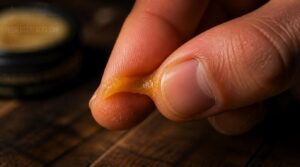
That small amount does nothing cold. Warm your wax by rubbing it between index finger and thumb. Heating wax between fingers for 5–15 seconds is the whole technique.
| Feel | Meaning |
|---|---|
| Crumbly | Still too cold |
| Smooth, pliable | Apply now |
| Stringy or sticky | Over-warmed |
| Too shiny | Past melting point of wax |
You’ve hit proper wax temperature when it yields without going oily. That’s workable wax consistency.
At that perfect, workable consistency, it spreads easily through your beard — browse quality beard balm options to find one with cedarwood and sandalwood that melts just right in your hands.
Work From Center Outward

The philtrum junction is your anchor. Place fingers at center, aligned with the midline, then push outward. Half a centimeter off-center and the whole shape goes lopsided.
Work from center outward in one smooth motion. Use a comb to guide if your hair’s dense. Train early, train often on this, especially while the wax is workable, not melted.
Coat The Entire Hair Shaft

Coating every strand from root to tip keeps hair hold and texture consistent, not patchy. You need to coat the entire hair shaft, not just skim the surface.
Start at the center and work outward for even hair product distribution. Run a finger along each section to find any dry spots, then press in a small dab wherever it’s needed.
Comb, Shape, and Set

The wax is in, now the real craft begins. Your mustache comb technique moves center outward with gentle, consistent pressure, pulling each side into shape. Check symmetry after every pass, not at the end.
Good wax application doesn’t stop with your fingers. Set the angle in vertical sections, not twisted tips, and let it cool between passes to avoid over-sculpting.
Fix Common Mustache Wax Problems

Even solid technique runs into problems. Wax behaves differently depending on your hair type, the product you’re using, and what the weather’s doing that day. Here’s what goes wrong and how to fix it.
Greasy or Clumpy Results
Too much wax is almost always the culprit. A greasy finish or clumps under the nose means you overdosed or skipped proper warming.
- Use far less than you think; excess wax creates product buildup, not hold
- Warm it fully; below its wax melting point, it just drags and clumps
- Apply to dry hair only; moisture drives hair clumping and flaking
Visible Wax Residue
That white residue on your skin isn’t random. It’s product buildup from too much wax, or from skipping the warm-up step.
Work it through the hair shaft, not just over the surface. Cold air cracks thick layers into visible flakes; heat turns them into a greasy finish along the lip edge.
Use less. Distribute better.
Weak or Uneven Hold
Weak hold traces back to two things. Dampness kills the grip, so if there’s moisture or aftershave residue on your mustache, nothing bonds. Start dry.
Give me slightly less wax to start. Cover every hair shaft before adding more. Wax should be workable, not melted. Overheating it during warm-up means temperature messes with all of it before you start shaping.
Hot and Cold Weather
Hot and cold both change everything. In summer, heat your wax less, not more, or it pools and looks greasy before it sets. Sweating adds dampness, and dampness kills the grip.
In winter, the wax stiffens, so warm it longer on your fingers. Seasonal grooming adjustments keep your hold strength and flexibility on track. Temperature messes with all of it.
Remove Wax and Maintain Your Mustache

Good technique gets you through the day. Removal is where most people cut corners, and it costs them over time.
Warm water first when you remove wax. Cold water won’t touch mustache wax. It’ll just push it around. The warmth loosens the film before you reach for a cleanser. Wash twice if you’ve been wearing a firm hold product. The first pass breaks it down; the second clears the hair product residue.
Condition after every wash. Repeated cleansing strips natural oils, and dry hair grabs the next application unevenly. A lightweight beard and mustache conditioner helps restore that moisture balance quickly, so your next application lays down smooth.
To maintain your mustache well, wash on days you wear wax, stay consistent with facial hair grooming, and check the skin underneath. Clogged pores show up fast when wax sits overnight.
Frequently Asked Questions (FAQs)
Which way do you wax your mustache?
From the center out, always. Apply wax in the direction you want each hair to sit, never against it. Warm a pea-sized amount between your fingers first, then work your way outward on each side.
How often should you apply mustache wax?
How often should you apply mustache wax? As needed, not on a rigid daily schedule. Reapply when the hold visibly drops. Hot, humid conditions demand more frequent touch-ups; cold, dry weather needs far fewer applications.
Is mustache wax good for your mustache?
Mustache wax is a grooming tool, not a hair treatment. It shapes and holds, nothing more. Use it right and it won’t damage your mustache at all. Overdo it and you’ll get buildup and grief.
Will my mustache get thicker if I wax it?
No. Wax can’t change hair follicle activity, so it won’t make your mustache actually thicker. The fuller look you get comes from better alignment and hair coverage. Genetics and hormones control real density, not product.
Can you sleep with mustache wax in?
Sure, if you enjoy clogged pores, wax on your pillowcase, and a mustache that simply won’t hold its shape by morning.
Always remove the mustache wax before bed. Your skin needs to breathe at night. In fact, sleeping with any wax product can lead to clogged pores and residue buildup that irritates the skin over time.
How long does mustache wax typically last?
Depends on the wax. Light hold gives you 4–6 hours. A stronger hold wax stretches that closer to 8–10 under ideal conditions. Humidity and sweat cut it short. Reapply when it stops holding its shape.
Is mustache wax safe for sensitive skin?
For sensitive skin, it comes down to the ingredients, not the wax form itself. Fragrance and essential oils are the usual culprits. Always patch test before fully committing. Redness or itching means switch formulas immediately.
Can mustache wax expire or go bad?
Yes, it does. Most formulations last 12 to 24 months unopened. Once you crack the tin, use it within six months. Crumbly texture, separation, or a changed scent means it’s done. Time to replace it.
What mustache styles work best with wax?
Want real control? Handlebar and chevron styles thrive with wax. Both reward precise hair direction control and clean, defined edges. Bushy or loose mustaches will always need strong hold to prevent drooping or curling tips.
Conclusion
Picture your mustache holding its shape from morning coffee to the last meeting of the day. Sharp. Clean. No grease, no clumping, no wax catching the light at the wrong angle.
That’s the result when the technique is right. Knowing how to apply mustache wax is the skill that separates a clean look from a clumpy mess. Prep, heat, and restraint do the heavy lifting. Get those right and the rest takes care of itself.