This site is supported by our readers. We may earn a commission, at no cost to you, if you purchase through links.
The skin under your eyes is up to ten times thinner than the skin on the rest of your face, yet most people expect one moisturizer to handle both. That mismatch fuels a decade-long debate: is under eye cream necessary for a skincare routine, or is it clever marketing in a smaller jar?
The honest answer depends on your skin, your concerns, and the formula you already use. Some people genuinely need targeted treatment for dark circles or puffiness. Others can skip it entirely.
Here’s how dermatologists separate fact from packaging, so you can decide what earns a spot on your shelf.
Table Of Contents
- Key Takeaways
- Is Under-Eye Cream Actually Necessary?
- Why Under-Eye Skin Needs Special Care
- Eye Cream Versus Regular Moisturizer
- Ingredients That Address Under-Eye Concerns
- Using Eye Cream Safely and Effectively
- Top 3 Under-Eye Products to Consider
- Frequently Asked Questions (FAQs)
- Do you actually need under eye cream?
- Can I just use moisturizer as eye cream?
- Do dermatologists recommend eye cream?
- How often should you use under eye cream?
- Can eye cream cause milia or clogged pores?
- How long until eye cream shows visible results?
- Can eye cream be used on eyelids safely?
- Do dark circles from genetics respond to eye creams?
- Should eye cream be applied before or after sunscreen?
- Conclusion
Key Takeaways
- Eye cream isn’t mandatory—if your fragrance-free moisturizer hydrates the under-eye area without stinging or irritation, you can skip the separate product entirely.
- Targeted eye creams earn their place when you’re addressing specific concerns: caffeine for puffiness, vitamin C or niacinamide for dark circles, and retinol or peptides for fine lines.
- The skin under your eyes is up to ten times thinner than the rest of your face, so apply products gently along the orbital bone with your ring finger and avoid the eyelid unless the label permits it.
- Expect hydration benefits within days, but fine lines and dark circles need 8 to 12 weeks of consistent use—and genetic dark circles won’t respond to topicals at all.
Is Under-Eye Cream Actually Necessary?
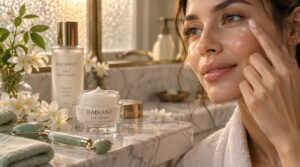
How necessary is eye cream, really? Most dermatologists agree the answer depends on your skin and your concerns, not on marketing claims. If your face moisturizer is fragrance-free and doesn’t irritate delicate skin around the eyes, you don’t need a separate product.
In fact, sticking to a simple routine built around a well-chosen moisturizer often beats adding a dedicated eye cream to the mix.
Eye cream earns its place when you’re targeting puffiness, dark circles, or fine lines with actives formulated for that area. For broader antiaging skincare goals, a gentle, non-irritating moisturizer that helps your skin barrier can be equally effective.
Why Under-Eye Skin Needs Special Care

The skin under your eyes is genuinely different from the rest of your face. It’s thinner, has less structural support, and loses moisture faster, which is why dryness and fine lines appear here first.
This area moves constantly, too. Blinking, squinting, and rubbing create mechanical stress that weakens the skin barrier over time. Add daily friction from makeup removal, and delicate skin around the eyes takes real wear. Hydration matters more here because the barrier simply retains moisture less efficiently.
This is also why harsh treatments backfire here—our guide to facial exfoliation explains how to resurface gently without stressing an already fragile barrier.
Eye Cream Versus Regular Moisturizer
Whether you need a dedicated eye cream comes down to what your skin is actually doing. A regular moisturizer can work perfectly well for some people, while others genuinely benefit from a targeted formula. Here’s how to figure out which side you’re on.
Use Eye Cream When
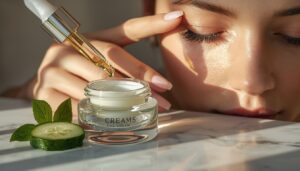
Think of eye cream like a specialist referral: you don’t need one for every concern, but the right cases call for it.
Eye cream is like a specialist referral—unnecessary for every concern, but exactly right for the right cases
A dermatologist would recommend adding eye cream to your consistent skincare routine when:
For those with sensitive skin, this guide to anti-aging eye care products emphasizes that less is always more when applying.
- Your undereye area feels tight, flaky, or persistently irritated after your regular moisturizer.
- You want targeted actives like caffeine or niacinamide specifically dosed for sensitive skin.
- Puffiness or fine lines are a specific concern your current face formula doesn’t address.
Skip Eye Cream When
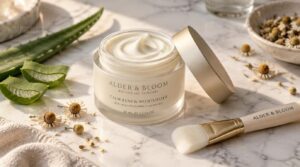
On the flip side, you can skip eye cream if your regular moisturizer reaches the under-eye area without stinging, redness, or watering. If hydration is your only concern and your current formula controls it, a separate product adds little beyond cost and irritation risk. Also skip it when marketing claims are the only reason you’re considering one.
If you have sensitive skin or a compromised skin barrier, fewer formulations mean fewer fragrance and preservative triggers. A fragrancefree, noncomedogenic moisturizer your dermatologist already approves is often enough.
Ingredients That Address Under-Eye Concerns
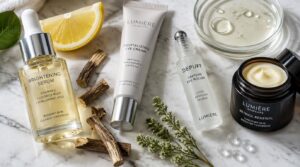
Match the ingredient to your concern. For dark circles, look for vitamin C (8–20%), niacinamide (2–5%), or licorice extract, which inhibit excess pigment. Puffiness works with caffeine (0.5–3%) and cooling metal applicators that constrict blood vessels. For fine lines, choose hyaluronic acid for hydration plus peptides (0.5–2%) or low-dose retinol (0.03–0.1%) to support collagen.
Consider these five when reading labels:
- Fragrance-free formulas protect thin under-eye skin from stinging.
- Multi-weight hyaluronic acid hydrates without heaviness.
- Squalane seals in moisture and reduces water loss.
- Encapsulated retinoids deliver results with less irritation.
- Alcohol-free bases prevent dryness and sensitivity.
Skip mineral oil if you’re prone to milia, and introduce retinol gradually.
Using Eye Cream Safely and Effectively
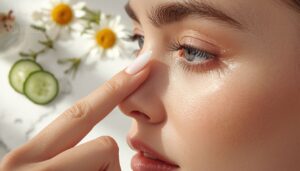
Apply eye cream along the orbital bone rather than directly on the lid. This keeps your topical application away from the eye’s surface and reduces the risk of stinging.
Use your ring finger and tap lightly around the orbital area. It’s your weakest finger, so it creates the least pressure and friction on delicate tissue.
For sensitive skin care, prioritize fragrancefree eye care and nonirritating formulas. Burning, redness, or watery eyes signal incompatibility. Discontinue immediately and switch to something gentler.
Top 3 Under-Eye Products to Consider
If you’ve decided your under-eye area deserves targeted care, the next question is which product to choose. The three options below each target a different concern, from fine lines to puffiness. You’ll find what each one does and who it suits best.
1. Beauty of Joseon Revive Eye Serum
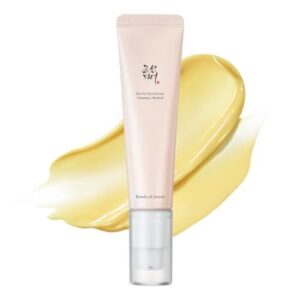
If one product earns its spot in a K-beauty routine, it’s this serum.
The Beauty of Joseon Revive Eye Serum pairs retinal liposomes with ginseng root extract, targeting fine lines while delivering deep hydration in a lightweight 30ml format.
It absorbs quickly without stickiness, and you can use it beyond your orbital bone on smile lines and crow’s feet.
Fair warning: results for dark circles are mixed, and some users report mild irritation, so patch test first.
| Best For | Anyone seeking a lightweight K-beauty eye serum to soften fine lines and hydrate the under-eye area with retinal and ginseng. |
|---|---|
| Net Volume | 30ml (1.01 fl.oz) |
| Key Ingredient | Retinal liposomes, ginseng |
| Dark Circles | Mixed results |
| Puffiness | Inconsistent results |
| Hydration | Deep hydration via ginseng |
| Irritation Risk | Some report burning sensations |
| Additional Features |
|
- Combines retinal liposomes and ginseng extract to target fine lines and wrinkles
- Absorbs quickly without leaving residue or stickiness
- Versatile enough for smile lines, crow’s feet, and dark spots
- Mixed reports on effectiveness for dark circles
- Some users experience irritation or burning sensations
- Results for puffiness reduction are inconsistent
2. Haruharu Wonder Black Rice Eye Cream
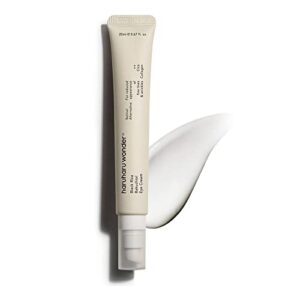
Consider a patient with fine lines but no real dark circles: what she needs is hydration plus gentle renewal, not a brightening miracle. That’s where the Haruharu Wonder Black Rice Eye Cream fits.
It pairs bakuchiol, a plant-based retinol alternative, with niacinamide and natto gum to smooth fine lines and hydrate. You can use it morning and night, though the 20 mL tube has a fragrance some find off-putting, and a few sensitive users report irritation. Patch test first.
| Best For | People with fine lines and dryness around the eyes who want gentle, plant-based renewal rather than a heavy-duty brightening treatment. |
|---|---|
| Net Volume | 20mL (0.67 fl.oz) |
| Key Ingredient | Bakuchiol, niacinamide, adenosine |
| Dark Circles | Mixed feedback |
| Puffiness | Reduces puffiness and sagging |
| Hydration | Hydrates and smooths |
| Irritation Risk | Some report irritation |
| Additional Features |
|
- Contains bakuchiol, a natural retinol alternative, for gentle smoothing of fine lines
- Hydrates and softens the under-eye area with niacinamide and natto gum
- Suitable for both morning and night use in a convenient 20 mL tube
- Some users report skin irritation despite claims of being suitable for sensitive skin
- Brightening and dark circle results receive mixed feedback
- The fragrance gets mixed reviews, with some finding the smell off-putting
3. Coco & Eve Depuff Eye Cream 0.71 fl oz
 View On Amazon
If you want a single product that does the most, this Swiss-made formula earns its spot. It combines White Flower Extracts, Lingonberry Stem Cells, and Peptides to target lifting, wrinkles, and dark circles.
The claims are bold: up to 80% dark circle reduction and 19% eyelid lifting in 14 days. It’s dermatologically and ophthalmologically tested, vegan, and layers cleanly under makeup.
Just know the pump can leave product behind, and results vary person to person.
| Best For | Anyone dealing with multiple under-eye concerns at once—dark circles, puffiness, and fine lines—who wants a vegan, dermatologically tested formula that layers well under makeup. |
|---|---|
| Net Volume | 21ml (0.71 fl.oz) |
| Key Ingredient | White Flower Extracts, Peptides |
| Dark Circles | Up to 80% reduction in 14 days |
| Puffiness | Up to 19% eyelid lift in 14 days |
| Hydration | Hydrates and smooths |
| Irritation Risk | Dermatologically tested; some report minimal effects |
| Additional Features |
|
- Targets lifting, wrinkles, and dark circles in one product with White Flower Extracts, Lingonberry Stem Cells, and Peptides
- Clinically backed claims, including up to 80% dark circle reduction and 19% eyelid lifting in 14 days
- Dermatologically and ophthalmologically tested, vegan, cruelty-free, and made in Switzerland
- Some users report minimal effect on dark circles and wrinkles
- Pump dispenser may not extract all product from the glass container
- No expiration date indicated on the packaging
Frequently Asked Questions (FAQs)
Do you actually need under eye cream?
Short answer: no, not everyone does. If your facial moisturizer hydrates the delicate eye area without irritation, you’re covered.
But for dark circles, puffiness, or fine lines, a targeted eye cream works better than a standard moisturizer. That’s because the skin around the eyes is thinner and more delicate than the rest of the face, making targeted hydration and anti-aging benefits especially valuable in that area.
Can I just use moisturizer as eye cream?
A thin silk curtain protects what lies behind it; your under-eye skin works the same way. You can use moisturizer as eye cream if it’s fragrance-free, doesn’t sting, and helps with barrier hydration.
Do dermatologists recommend eye cream?
Like a coin with two sides, the dermatologist recommendation splits: most say eye cream isn’t mandatory, since periorbital skin care can rely on your regular moisturizer, but targeted formulas earn their place.
How often should you use under eye cream?
For most people, once daily at night works well. If your eye cream is gentle and well tolerated, increase to twice daily. With retinol or acids, start every other night, and stop if sensitive skin reacts.
Can eye cream cause milia or clogged pores?
Think of your pores as tiny doorways: block them, and keratin builds up behind the lock. Yes, eye cream can cause milia or clogged pores, especially thick, occlusive textures. Choose a noncomedogenic formula and watch for fragrance sensitivity.
How long until eye cream shows visible results?
Expect hydration and brightness within days to two weeks. Fine lines and dark circles need 8 to 12 weeks of consistent use, since retinoids must stimulate collagen production and cell turnover before changes show.
Can eye cream be used on eyelids safely?
A patient once applied retinol eye cream to her lids and developed redness within days. You can use eye cream on eyelids only if the label explicitly allows it; otherwise, choose nonirritating, dermatologically tested formulas for sensitive skin eye care.
Do dark circles from genetics respond to eye creams?
Here’s the honest truth: genetic dark circles barely respond to eye cream. Topical application can lighten surface pigmentation slightly, but hereditary dark circles stem from skin structure, so complete removal is impossible without procedures.
Should eye cream be applied before or after sunscreen?
Eye cream goes on before sunscreen. Apply your moisturizer or eye cream first, let it fully absorb, then finish with sunscreen as your final leave-on step. This prevents pilling and keeps UV protection evenly distributed.
Conclusion
Think of your under-eye area as silk that demands a gentler hand than denim.
So, is under eye cream necessary for skincare routine? Only if your regular moisturizer can’t address dark circles, puffiness, or crepey texture. Match the ingredient to the concern, apply it with a light touch, and give it eight weeks. If nothing changes, skip the small jar and spend your budget where it works harder.