This site is supported by our readers. We may earn a commission, at no cost to you, if you purchase through links.
Your reflection stares back at you each morning, and you scan the same familiar face, searching for any sign of the beard you’re waiting to grow. You’re not alone in this journey—most teenage guys experience facial hair development gradually, and the process rarely follows a predictable timeline.
Your body’s unique genetic blueprint, combined with shifting hormone levels during puberty, determines when and how your beard will emerge.
The good news is that while you can’t override your DNA, you can create conditions that support healthy facial hair growth through specific skincare practices, proper nutrition, and lifestyle choices that work with your body’s natural development.
Table Of Contents
- Key Takeaways
- Key Factors Affecting Teenage Beard Growth
- Essential Beard Care Tips for Teenagers
- Nutrition and Lifestyle for Better Beard Growth
- Top 5 Products to Support Teenage Beard Growth
- Frequently Asked Questions (FAQs)
- Is it normal for a 16-year-old to have a beard?
- Can every teenager grow a beard?
- How long does it take a teenager to grow a beard?
- Should teenagers shave beards?
- Can a 17-year-old have a full beard?
- How can I encourage my beard growth as a teenager?
- Does the beard grow fuller with age?
- Can shaving more frequently make beard grow faster?
- Do beard growth supplements actually work for teens?
- When should I see a doctor about beard?
- Conclusion
Key Takeaways
- Your beard growth timeline is locked into your genetic blueprint and hormone levels, which means most guys won’t see full density until their mid-twenties, no matter what products they use.
- Building a simple skincare routine—cleansing twice daily, exfoliating weekly, and moisturizing—creates the healthiest foundation for facial hair by keeping follicles clear and your skin barrier intact.
- What you eat and how you live directly impacts testosterone production, so prioritize 8-9 hours of sleep, regular exercise, balanced meals with adequate protein, and managing stress to support natural beard development.
- Minoxidil and most “beard growth” supplements lack approval for teenage use and won’t override genetics, so focus on patience and healthy habits rather than quick fixes that promise faster results.
Key Factors Affecting Teenage Beard Growth
Growing a beard as a teenager isn’t just about waiting it out—several biological and lifestyle factors determine when and how your facial hair comes in. Your genes, hormones, and daily habits all play a role in shaping your beard’s growth pattern and thickness.
Let’s break down the key factors that influence whether you’re rocking a full beard or still waiting for those first whiskers to appear.
Genetics and Ethnicity
While you might dream of a full beard like your friends, your genetic blueprint—especially the androgen receptor gene (AR gene)—largely determines your facial hair destiny. Ethnic density patterns mean some teenagers of Middle Eastern or Scandinavian backgrounds naturally develop dense beards by mid-adolescence, while East Asian or Hispanic teens often see sparser growth.
Follicle distribution, androgen sensitivity, and beard maturation timelines vary widely across genetics, so don’t compare yourself to others during adolescence. Beard growth generally occurs between ages eighteen and thirty.
Hormonal Changes During Puberty
Your genes set the stage, but hormones write the script for beard growth during adolescence. Testosterone levels surge from under 1.2 nmol/L to 10–30 nmol/L through puberty, transforming fine facial hair into visible beard growth. Here’s how this hormonal shift unfolds:
- Testosterone rises sharply between ages 13–16, triggering facial follicles
- DHT conversion thickens and darkens emerging beard hairs
- Androgen sensitivity determines your follicles’ response to these hormonal signals
Your puberty timeline and individual androgen receptor sensitivity explain why some teenagers sprout beards early while others wait until their early twenties—both patterns reflect normal hormonal development. The enzyme 5-alpha-reductase aids testosterone to DHT conversion, impacting beard thickness.
Age and Stages of Facial Hair Development
Facial hair first appears around ages 11–12 as fine “peach fuzz” on your upper lip. By 14–16, visible hair spreads across the entire mustache area and sideburns emerge.
Between 17–21, growth intensifies—covering cheeks, chin, and neck as you progress through Puberty and Beards stages.
Your Growth Timeline varies by Ethnic Variations and genetics, with maximum density often arriving in your mid-twenties rather than Adolescence.
Impact of Diet, Exercise, and Sleep
Your daily habits shape hormone levels that drive beard growth more than you might expect. Consider these three pillars:
- Healthy Diet: Cutting calories by 40% can drop testosterone 10–20%, so eat balanced meals with lean protein, fruits, and whole grains to fuel follicles.
- Exercise Benefits: Regular movement fights obesity-related testosterone loss.
- Get Enough Sleep: Less than five hours nightly reduces androgens by 10–15%, slowing growth.
Lifestyle integration matters—your body needs quality rest and proper nutrition for hormone regulation that powers teenage beard growth.
Role of Stress, Smoking, and Alcohol
Stress disrupts the hormonal rhythms your follicles need—just 48 hours of poor sleep can cut beard growth 19%, while chronic anxiety raises cortisol that blocks testosterone.
Smoking starves roots of oxygen, and alcohol delays facial hair onset (hazard ratio 0.77). Combined substance use compounds these effects.
Healthy lifestyle choices—managing stress, avoiding tobacco, limiting alcohol—give your teenage beard the best mechanistic pathways to thrive.
Essential Beard Care Tips for Teenagers
Taking care of your facial hair early on sets the foundation for a healthier, fuller beard down the road. You don’t need a complicated routine, but a few simple habits can make a real difference in how your beard looks and feels.
Working a few drops of argan oil for beard growth and softness into your routine early on can help nourish follicles with vitamin E while taming stray hairs.
Here’s what you need to focus on to keep your teenage beard in its best shape.
Establishing a Proper Skincare Routine
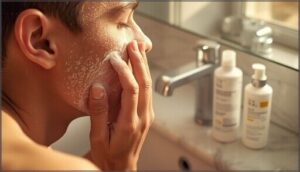
Think of your skin as the foundation for your beard—it needs care to support healthy growth. A proper skincare routine for teenagers starts with washing your face twice daily using a gentle, noncomedogenic cleanser. This simple habit removes oil and dirt without stripping your skin or clogging pores.
- Choose noncomedogenic products to prevent breakouts
- Wash with lukewarm water and fingertips, not harsh tools
- Apply lightweight moisturizer after cleansing
- Use broad-spectrum SPF 30 sunscreen daily
- Avoid layering too many active ingredients at once
Importance of Exfoliation and Moisturizing
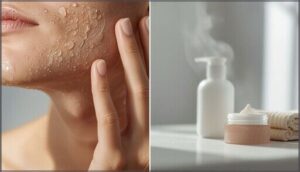
Beyond basic cleansing, exfoliation and moisturizing directly support follicle health and beard growth for teenagers.
When you exfoliate one to two times weekly with gentle techniques—using chemical exfoliants like salicylic acid—you clear away dead skin cells that block follicles and trigger acne prevention issues.
Follow with a lightweight moisturizer to restore your skin barrier, lock in hydration levels, and create a favorable environment for emerging facial hair.
Regular Beard Grooming and Trimming
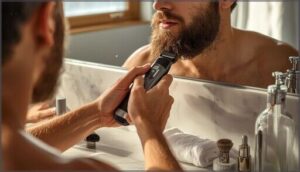
Once your whiskers fill in, you’ll need a consistent beard grooming routine. Wash 2–3 times weekly, and comb gently with a boar-bristle beard brush to distribute oils.
Use a sharp beard trimmer every one to two weeks to shape your beard style and prevent split ends.
Shave in the direction of growth if defining edges, and change blades every 5–7 shaves. Rinse daily after workouts to maintain hygiene practices.
Managing Patchy or Uneven Growth
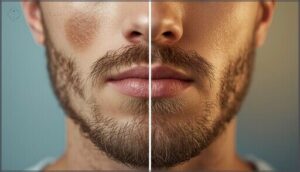
Patchy beard growth is common during your teenage years, often driven by genetics and uneven DHT sensitivity across follicles. Wait at least 4 months before judging density, as testosterone gradually fills gaps.
If patches persist, consult a dermatologist to rule out alopecia areata. Evidence shows minoxidil solution and microneedling therapy can thicken sparse areas under supervision, though lifestyle influences—sleep, stress, smoking—also shape results.
Choosing The Right Beard Style
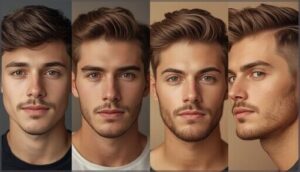
Your face shape determines which beard style works best: round faces suit goatees that add length, while square jaws benefit from short stubble that softens angles.
For teenagers, light stubble and chin straps remain age-appropriate favorites, requiring just 1–2 weeks’ growth. Popularity data shows short stubble scores highest in attractiveness, making it practical for patchy teenage beard growth.
Nutrition and Lifestyle for Better Beard Growth

What you eat and how you live your day-to-day life can make a real difference in how your beard grows. Your body needs the right fuel and healthy habits to support facial hair development, especially during the teenage years when everything is still changing.
Let’s look at the key nutrition and lifestyle factors that can help you grow a healthier, fuller beard.
Vitamins and Minerals for Facial Hair
To fuel your teenage beard growth, you’ll need specific vitamins and minerals working behind the scenes. Your diet should deliver:
- Biotin benefits hair follicles when you’re actually deficient, though most healthy teens get enough from eggs and nuts
- Vitamin D from sunlight or fortified milk aids follicle activity—low levels are linked to increased shedding
- Zinc absorption matters for growth, while iron deficiency can trigger hair loss
Balance Vitamin A intake carefully; too little or too much disrupts your beard’s natural cycle.
Protein-Rich Foods and Hydration
Your hair shafts are 90% protein, so you’ll need roughly 0.8–1.2 grams per kilogram of body weight daily—think chicken, fish, eggs, and beans. Deficiency impact shows up as brittle, slow-growing beard hair.
Hydration effects matter too: aim for 7.5–11 cups of water each day to keep your skin supple and follicles functioning well, since dehydrated skin creates a poor environment for healthy beard growth.
Natural Ways to Boost Testosterone
Beyond protein and water, testosterone levels respond to specific nutrients. You’ll get the biggest lift from adequate vitamin D (around 3,000–5,000 IU daily if you’re deficient), zinc intake of 15–30 mg, and magnesium levels near 450 mg.
Keep dietary fat at roughly 30–40% of calories and maintain a healthy weight—both support natural testosterone production during your teenage years.
Benefits of Regular Exercise and Rest
Getting your heart rate up three to five times a week increases testosterone by up to 15% in teenage boys, directly supporting beard growth. Exercise also strengthens immune function and disease defense, cutting infection risk by 23%.
Pair that with 8–9 hours of sleep for hormonal regulation, mental well-being, and physical health—your body repairs tissue and optimizes hormone production overnight.
Top 5 Products to Support Teenage Beard Growth
Growing a beard takes patience, but the right products can support healthier skin and hair follicles during your teenage years. You don’t need an entire shelf of grooming supplies—just a few well-chosen items that address cleansing, exfoliation, and targeted growth support.
Here are five products that can help you establish a solid routine while your facial hair develops naturally.
1. Nivea Men Deep Cleansing Face Wash
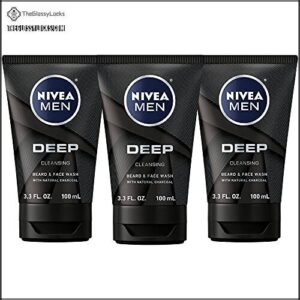
When you’re starting your beard growth journey, clean skin sets the foundation for healthy facial hair. Nivea Men Deep Cleansing Face Wash uses activated charcoal to pull out excess oil and dirt without over-drying your developing skin—97% of users in dermatological testing reported no excessive dryness.
It’s formulated without alcohol or harsh dyes, making it suitable for teenage skincare routines and sensitive skin alike. The mild surfactants cleanse both your face and emerging beard, helping prevent clogged pores that can stall facial hair progress.
Best For: Teenage guys starting their beard growth journey who need a deep clean that won’t dry out their skin or mess with their developing facial hair.
- Activated charcoal pulls out oil and dirt without leaving your face tight or stripped—97% of testers confirmed no excessive dryness
- Works for both your face and beard, keeping pores clear so hair can grow in healthy instead of getting blocked by buildup
- No alcohol or harsh dyes, plus it’s dermatologist-tested, so it’s gentle enough for younger or sensitive skin
- The menthol can tingle or irritate if your skin is really sensitive—not a dealbreaker for most, but worth knowing
- Some users say the seam quality on the tubes isn’t great, which can be annoying when you’re trying to squeeze out product
- The vanilla-bourbon scent is pretty strong, so if you’re not into fragrances, this might not be your thing
2. Exfoliating Charcoal Scrub With Collagen
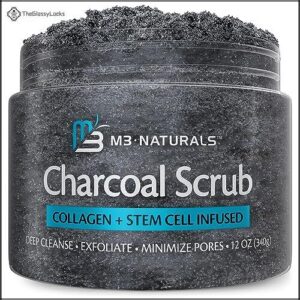
M3 Naturals Exfoliating Charcoal Scrub with collagen tackles two key skin care challenges during adolescence—excess sebum and dead cell buildup. The activated charcoal draws out oil and debris from your pores, while collagen provides surface-level hydration that counterbalances the drying effect of deep cleansing.
For teenage boys developing facial hair, this scrub helps clear follicular openings one to two times weekly, reducing ingrown hairs and smoothing the beard area without causing irritation. At $18.54, it combines exfoliation with moisture retention for healthier emerging facial hair.
Best For: Teenage boys with oily or acne-prone skin who want to manage excess sebum and prevent ingrown hairs as facial hair develops.
- Activated charcoal pulls oil and debris from pores while collagen keeps skin hydrated, so you get deep cleansing without the tight, dry feeling
- Works well on the beard area when used 1–2 times weekly, helping clear follicles and reduce ingrown hairs as facial hair comes in
- Combines natural ingredients like coconut oil and Himalayan salt for gentle exfoliation that smooths skin without harsh chemicals
- Can be messy to use and some users report the texture is crumbly, making it tricky to scoop and apply in the shower
- A few people experienced breakouts or oil leakage during shipping, so it may not suit every skin type or arrive in perfect condition
- At $18.54 it’s pricier than basic drugstore scrubs, and overuse beyond twice weekly can irritate young or sensitive skin
3. Mediheal Collagen Essential Lifting Firming Mask
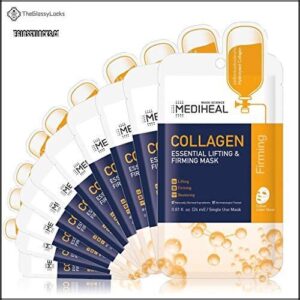
Although sheet masks aren’t usually linked to beard growth, Mediheal’s Collagen Essential Lifting & Firming Mask aids the skin beneath your emerging facial hair.
The 24ml formula combines hydrolyzed collagen, elastin, and peptides to boost skin elasticity and hydration—factors that create a healthier foundation for follicle function during your teenage years.
Apply it once weekly after cleansing, leave for 10–20 minutes, then pat in the remaining serum. At $1.99 per treatment, it’s an affordable way to maintain skin health while your testosterone levels naturally support beard development.
Best For: Guys who want to keep the skin under their beard healthy and hydrated while waiting for fuller growth to come in naturally.
- Affordable at $2 per mask, so you can use it weekly without breaking the bank
- Packed with collagen, elastin, and peptides that improve skin elasticity and create a better foundation for hair follicles
- Easy to use—just 10–20 minutes once a week after cleansing, then pat in the leftover serum
- Some users find the mask tricky to unfold and position correctly on the face
- Contains fragrance, which might irritate sensitive skin or cause reactions in people with allergies
- Won’t directly stimulate beard growth—it only supports the skin underneath while hormones do the real work
4. Kirkland Minoxidil Hair Regrowth Treatment Men
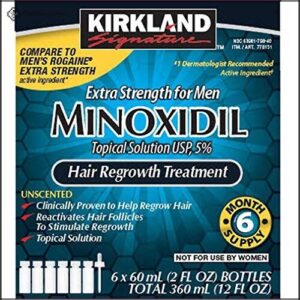
Kirkland’s Minoxidil Hair Regrowth Treatment contains 5% minoxidil, an FDA-approved ingredient for adult scalp hair loss. However, official labeling explicitly states this product mustn’t be used in children or teenagers.
Although roughly 47.8% of adult men find it effective for hair regrowth, minoxidil effectiveness in teenage beard growth lacks regulatory approval or clinical evidence.
Common treatment side-effects include scalp irritation, facial hypertrichosis, and increased shedding in 13.8–12.3% of users. Long-term adherence remains low—only 15.5% continue for six months.
Given these limitations, teenagers should consult a dermatologist before considering minoxidil for facial hair growth.
Best For: Adult men dealing with gradual hair thinning on the crown who want an affordable, FDA-approved treatment and can commit to long-term daily use.
- Contains 5% minoxidil, the same FDA-approved active ingredient as brand-name options, but costs significantly less for a 6-month supply
- Most men see some improvement—roughly 74% notice better hair density, and about half report effective results within the first few months
- Comes with child-resistant droppers and multiple application options (foam or liquid) to fit different preferences
- Side effects are pretty common—nearly half of users experience issues like scalp irritation, itching, or unwanted facial hair growth, and many end up quitting because of it
- Results take time and patience, with peak growth around the one-year mark, and you’ll lose any regrown hair if you stop using it
- Not approved for teenagers, frontal hairline loss, or beard growth, so it’s really only meant for adult male pattern baldness on the top of the head
5. Alpha Beard Growth Hair Vitamins
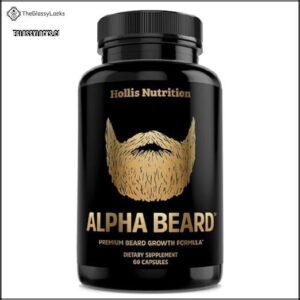
Alpha Beard Growth Hair Vitamins combine biotin, zinc, and saw palmetto to support hair follicle health. Clinical studies show similar formulas increase hair density by 10.1% over six months, though results vary widely among teenagers.
While this aligns with market trends favoring capsule-based supplements, ingredient interactions and safety profile concerns warrant caution. Vitamins work best when paired with a healthy diet rich in minerals, not as standalone solutions.
Your beard growth ultimately depends on genetics—supplements can’t override biology, but they may help if you’re deficient in key nutrients.
Supplements may help if you’re nutrient-deficient, but genetics ultimately determine your beard growth—no pill can override your biology
Best For: Guys dealing with patchy beard growth who want to support their hair health with a daily vitamin routine, especially if they might be low on biotin or zinc.
- Packs 10,000 MCG of biotin plus collagen, keratin, and saw palmetto to target multiple aspects of hair and follicle health
- Clinical research on similar formulas shows a 10% boost in hair density after six months of consistent use
- Affordable at $21.96 and easy to stick with—just two capsules a day
- Won’t work miracles if your genetics don’t support beard growth in the first place
- Results take time and vary a lot from person to person, so don’t expect a full beard overnight
- High biotin doses can mess with certain lab tests, and some ingredients might cause mild side effects like extra nail growth
Frequently Asked Questions (FAQs)
Is it normal for a 16-year-old to have a beard?
Like fingerprints on a hand, teenage facial hair arrives differently for everyone. Yes, it’s completely normal for a 16-year-old to have a beard—puberty variation, genetic factors, and ethnic differences mean some teenagers develop facial hair earlier than others.
Can every teenager grow a beard?
Not every teenager can grow a beard. Genetics, hormonal influence during puberty, and ethnic variations play major roles in beard growth potential. Some teens won’t see full facial hair until their twenties.
How long does it take a teenager to grow a beard?
You’ve probably heard the claim that beards sprout overnight—but here’s the reality: teenage beard growth takes anywhere from 2 to 6 months depending on your genetics, puberty stages, and overall health impact throughout development.
Should teenagers shave beards?
Teenagers can shave facial hair when it becomes visible, usually around ages 13–15, though timing depends on personal preference and skin sensitivity.
Shaving doesn’t affect beard growth rate—genetics and hormones do—so parental guidance helps navigate peer pressure and debunk common shaving myths.
Can a 17-year-old have a full beard?
Yes, some 17-year-olds can develop full beards, though it’s uncommon. Genetic predisposition, ethnic variations, and puberty timing determine hormonal influence on facial hair.
Most teenagers show patchy growth potential, with density continuing into their twenties.
How can I encourage my beard growth as a teenager?
Think of a beard like a garden—you can’t rush the harvest, but smart care helps. Focus on healthy diet, regular exercise, skin care, and patience.
Beard products support teenage beard care, not magic shortcuts.
Does the beard grow fuller with age?
Most men experience increased beard density through their twenties, with peak beard growth and fullness generally occurring between ages 25 and 30 as testosterone levels stabilize and genetic influences fully express themselves.
Can shaving more frequently make beard grow faster?
Despite popular beard growth myths, scientific evidence confirms shaving frequency doesn’t stimulate follicle activity or accelerate facial hair development.
Growth perception changes stem from blunt-cut hair thickness appearing coarser, not actual faster teenager beard growth rates.
Do beard growth supplements actually work for teens?
Most beard growth vitamins marketed to teenagers lack solid evidence and won’t accelerate facial hair in healthy adolescents. Supplement efficacy hinges on correcting actual deficiencies—otherwise, marketing claims outpace reality, and hormonal impact remains minimal without medical supervision.
When should I see a doctor about beard?
You might wonder if your beard concerns are minor, but sudden hair loss, excessive growth, persistent skin irritation, or hormonal imbalances warrant seeing a dermatologist—especially with family history of testosterone levels or genetics-related issues.
Conclusion
Your journey toward a fuller face won’t happen overnight, but you’re building the foundation now. By maintaining consistent skincare habits, fueling your body with proper nutrition, and giving your natural development time to unfold, you’re setting yourself up for success.
Learning how to grow a beard as a teenager means working with your biology, not against it. Stay patient with the process—your genetics are already writing the story, and you’re simply creating the best conditions for it to unfold naturally.
- https://www.healthline.com/health/parenting/stages-of-puberty
- https://www.keratin.com/hair-biology/beard-hair-development-an-in-depth-exploration/
- https://gillette.com/en-us/shaving-tips/how-to-shave/beard-growth-science
- https://www.jstor.org/stable/178824
- https://pmc.ncbi.nlm.nih.gov/articles/PMC5008732/