This site is supported by our readers. We may earn a commission, at no cost to you, if you purchase through links. This content is for general informational and educational purposes only and is not a substitute for professional medical, dermatological, or nutritional advice.
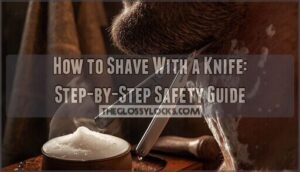
Over 2.5 million people end up in emergency rooms each year from facial trauma involving sharp objects, and a surprising number of those incidents happen during seemingly routine grooming. Shaving with a knife isn’t just an old-school technique from western movies—it’s a skill that demands respect, precision, and a solid understanding of what you’re doing. One wrong angle or too much pressure, and you’re dealing with more than just razor burn.
The appeal makes sense: knives are accessible, they’re what soldiers and outdoorsmen have relied on for generations, and there’s something undeniably self-reliant about it. But before you put a blade to your face, you need to know exactly how to prep your skin, hold that edge safely, and execute each stroke without turning your morning routine into a trip to urgent care.
Table Of Contents
- Key Takeaways
- Is It Safe to Shave With a Knife?
- What Types of Knives Can Be Used for Shaving?
- How to Prepare for Shaving With a Knife
- Step-by-Step Guide to Shaving With a Knife
- Essential Safety Tips and Aftercare
- Frequently Asked Questions (FAQs)
- Is Shaving with a Knife Dangerous?
- Is it Possible to Shave Using a Knife?
- Is a knife sharp if you can shave with it?
- Can you shave with a blade?
- How to make a knife sharp enough to shave with?
- Can you shave with a dull knife safely?
- How often should you sharpen a shaving knife?
- Whats the best knife angle for shaving curves?
- Do you need special soap for knife shaving?
- How long does a typical knife shave take?
- Conclusion
Key Takeaways
- Shaving with a knife is objectively dangerous—over 2.5 million facial trauma ER visits happen annually from sharp objects, with a 65% infection rate on visible nicks, making proper razors with built-in safety features the smarter choice for most people.
- If you’re going to attempt it anyway, your prep work is non-negotiable: hydrate your beard for 60-90 seconds with hot water or steam (cuts resistance by 30-65%), use pre-shave oil to reduce friction by 40%, and sharpen your blade to a 10-15 degree edge geometry—anything less is asking for trouble.
- Master the fundamentals before your first stroke: hold the knife with a firm but relaxed grip, maintain a 30-degree angle against your skin, shave with the grain using short 1-3 cm strokes, and stretch your skin taut with your free hand while applying feather-light pressure.
- Anyone on blood thinners, dealing with bleeding disorders like hemophilia or von Willebrand disease, managing diabetes, or working with sensitive skin should skip knife shaving entirely—the risks far outweigh any perceived benefits of self-reliance.
Is It Safe to Shave With a Knife?
Let’s cut through the hype: shaving with a knife is risky business, and you need to know what you’re getting into before you even think about putting a blade to your face. The injury stats don’t lie, and there’s a reason professional barbers spend years mastering straight razors before they’re let loose on clients.
We’ll break down the real dangers, why actual razors exist for a reason, and who should steer clear of this technique entirely.
Risks and Injury Statistics
Shaving with a knife is a gamble you’ll probably lose. Facial trauma from sharp objects sends over 2.5 million people to emergency departments, with lacerations accounting for 75% of visits. Even minor cuts can trigger skin infections—studies show 65% of visible shaving nicks become infected.
Shaving with a knife is a gamble you’ll probably lose—over 2.5 million emergency visits and a 65% infection rate prove it
Knife handling demands extreme precision; one slip transforms your morning routine into a surgical repair scenario requiring five or more emergency procedures.
Proper shaving hygiene practices are essential to prevent such complications.
Why Razors Are Safer Alternatives
Real razors win on design, not marketing hype. Safety features—blade guards, controlled geometry, and lubrication strips—cut injury prevention risks by physically limiting skin exposure. Cartridge systems set angles automatically, while traditional double-edge razors clamp blades tight, giving you far more control than any kitchen knife ever will.
Hospital protocols ditch bare blades for guarded clippers because skin protection isn’t negotiable when shaving safety matters. Understanding the pros and cons of safety razor options is essential for making an informed decision.
Who Should Avoid Knife Shaving
Bleeding disorders like hemophilia affect roughly 1 in 10,000 people, while von Willebrand disease impacts up to 1% of everyone—turning minor nicks into serious medical events.
If you’re on blood thinners, dealing with diabetes risks that slow healing, or working with sensitive skin prone to facial irritation, knife shaving isn’t rebellious—it’s reckless. Inexperienced users compound every danger tenfold.
What Types of Knives Can Be Used for Shaving?
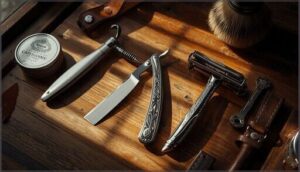
Look, you can technically shave with almost any sharp blade, but not all knives are created equal when it comes to putting steel to your face. Some work better than others, and understanding the differences can mean the gap between a decent shave and a trip to the ER.
Let’s break down the most common types people reach for when they’re thinking outside the razor box.
Pocket Knives
You’d think any sharp edge would work, but pocket knives rarely make the cut for shaving—literally. Budget models use 420-series stainless steel with low carbon content, sacrificing edge retention for rust resistance.
That soft blade geometry dulls fast, demanding constant resharpening to maintain shaving-level sharpness. Without the controlled blade exposure and precision bevels of razors, pocket knives heighten injury risk despite decent knife handling skills.
Kitchen Knives
That chef’s knife you trust for dicing onions? It’s engineered for cutting boards, not faces—blade geometry optimized for food prep usually sits around 30–40 degrees, demanding more pressure than a razor’s 20–30 degrees.
U.S. emergency rooms treat roughly 350,000 kitchen knife injuries annually, most being lacerations from everyday handling. Even with flawless sharpening technique and knife handling skills, using kitchen knives for shaving drastically amplifies injury risk beyond what sharpness levels alone predict.
Swiss Army Knives
Swiss Army knives pack X55CrMo14 martensitic steel—hardened to 56 HRC—with factory edges ground at 24 degrees and textured rubber grips that won’t quit when your hands are wet. But here’s the rub: they’re built for versatility, not face-mapping.
- Blade materials balance toughness over razor-thin sharpness
- Edge geometry demands more pressure than purpose-built shaving tools
- Handle design prioritizes multi-tool function, not precise stroke control
- Sharpening techniques restore edges, yet never match straight-razor finesse
Official guidance warns against unsafe activities—shaving with a knife tops that list, even with careful knife maintenance and solid knife handling skills.
Comparison to Straight Razors
Real straight razors own shaving with single-edge blades honed to 15–20 degrees, flex to follow your jaw, and demand stropping before every pass—blade geometry that knives can’t match. General-purpose blades sit at 30–40 degrees, push harder into skin, and skip the maintenance rituals that keep edges gliding.
Razor safety beats knife handling every time: guards, balance, and decades of shaving techniques baked into the design.
How to Prepare for Shaving With a Knife

Before you put a blade anywhere near your face, you need to set yourself up for success—not a trip to the emergency room. Proper prep work makes all the difference between a close shave and a close call.
Here’s what you need to do to get your skin, your blade, and your technique ready.
Softening Facial Hair and Skin
Before you even touch that knife to your face, you’ve got to prep your canvas—and that starts with hydration. Softening facial hair and skin isn’t just grooming theater; it’s your best defense against a bloody mess.
Your Pre-Shave Routine should include:
- Warm Water Benefits: Shave right after a hot shower—hydrated hair cuts up to 65% easier
- Facial Steaming: Apply a hot towel for 2–3 minutes to swell and soften stubborn whiskers
- Hair Hydration: Let water penetrate beard fibers, reducing cutting force by over 30%
- Skin Softening: Warm water (100–110°F) opens pores without stripping protective oils
- Shaving Safety and Precautions: Wash your face first—beards harbor more bacteria than dog fur
When you’re shaving with a knife, proper preparation separates a clean shave from a trip to urgent care. Hydrated facial hair requires fewer passes, meaning less blade-to-skin contact and dramatically lower injury risk. Think of it this way: you’re not just wetting your beard, you’re transforming coarse wire into something your blade can actually manage. Skip this step, and you’re forcing a general-purpose edge through dry, resistant hair—a recipe for nicks, razor burn, and ingrown hairs.
The science backs up what old-school barbers have known forever: moisture changes everything. Studies show fully saturated hair needs markedly less force to cut, and that translates directly to better control over your shaving technique. Whether you’re using steam, hot water, or both, give yourself at least 60–90 seconds of solid hydration time. Your skin will thank you, and so will that knife blade.
And here’s the kicker—properly hydrated skin maintains better barrier function for up to 24 hours after treatment. That means applying shaving cream to well-prepped skin creates a smoother, safer surface for your blade to glide across. You’re not just making the shave easier; you’re actively protecting yourself from the complications that come with dragging sharp steel across your face.
Applying Pre-Shave Oil and Lather
Once your skin’s primed, massage a few drops of pre-shave oil into damp whiskers—this hydrophobic layer cuts friction by up to 40% and keeps moisture locked in.
Then work your lather in circular motions for 60 seconds, letting it sit another minute before the first stroke. That combo—oil plus proper lather application—is your best insurance against dragging a knife across unprotected skin.
Sharpening and Cleaning The Knife
Your blade needs an edge geometry around 10–15 degrees per side—much finer than the 17–22 you’d use chopping vegetables. Steel hardness matters too; softer alloys won’t hold that shaving-sharp point.
After knife sharpening and maintenance on high-grit stones, strop the edge smooth, then soak it in 70% isopropyl alcohol for a full minute. Proper disinfection methods and knife care aren’t negotiable when steel meets skin.
Step-by-Step Guide to Shaving With a Knife
Alright, you’ve prepped your face and sharpened your blade—now comes the part where precision matters most. This isn’t about speed or showing off; it’s about control, awareness, and respecting the edge you’re working with.
Let’s break down the core techniques that’ll keep your skin intact and your shave effective.
Holding The Knife Safely
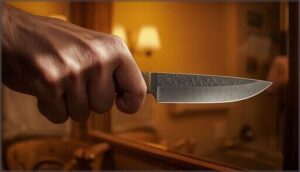
Your grip determines whether you walk away smooth or scarred. Kitchen and craft knife risk assessments classify cuts and lacerations as “high” likelihood and “high” severity hazards, making proper knife handling and safety precautions non-negotiable.
- Grip the handle firmly but not white-knuckled—think confident handshake, not death grip
- Position your fingers behind the blade edge, never above or in front where they’re exposed
- Keep your thumb on the side of the handle, out of the cutting path entirely
- Maintain dry hands and a textured handle to prevent slippage during shaving with a knife
Shaving Angle and Stroke Technique
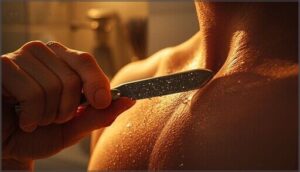
Once you’ve locked in your grip, nail the razor angle—about 30 degrees between blade and skin. Keep strokes short, 1–3 cm max, moving perpendicular to the cutting edge with minimal pressure. Let the knife’s weight do the work; forced strokes invite cuts.
Stretch skin with your free hand to flatten contours, then use slow, controlled motions. Rinse debris every few passes for consistent glide.
Shaving With The Grain Vs. Against
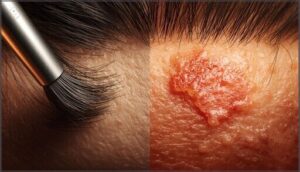
Your angle’s dialed in—now decide shave direction. Going with the grain (hair’s natural growth) slashes razor burn by 65–70% and halves ingrown hairs, especially critical when shaving with a knife. Against the grain delivers a closer result but spikes skin irritation and bumps.
Here’s how to navigate it:
- Map your hair growth patterns first—swirls on the neck complicate things
- Start with-the-grain for safety; add across-the-grain sparingly if your skin tolerates it
- Skip against-the-grain on coarse or curly hair—pseudofolliculitis barbae jumps to 60% incidence
- Save closeness tricks for straight razor work once you’ve mastered basics
Managing Skin Tension and Pressure

Once you’ve nailed direction, tension becomes everything. Stretch your skin taut with your free hand—pull upward on cheeks, downward on the neck—to flatten curves and prevent blade chatter. Loose skin invites nicks.
Keep pressure feather-light, around two newtons max; anything heavier drags and irritates. Proper tissue deformation through controlled skin stretching and minimal pressure distribution turns razor-sharp unconventional tools into workable shaving techniques, not ER visits.
Essential Safety Tips and Aftercare

You’ve got the technique down, but shaving with a knife isn’t over once the last stroke is done.
Keeping yourself safe and your skin in good shape requires vigilance before, during, and after the shave. Here’s how to minimize damage, handle mishaps, and keep everything clean for next time.
Avoiding Cuts and Lacerations
Sharpness control is your first line of defense—a razor-sharp blade actually reduces cut risk factors by minimizing tugging and pressure.
Pull your skin taut during each pass to prevent nicks on uneven surfaces, and maintain that critical 30-degree angle.
Master these laceration prevention basics before attempting shaving techniques and tips with any blade, because control beats speed every time.
Immediate Steps if Injured
Speed matters when blood appears—direct pressure stops most bleeding control problems within ten minutes. Rinse the cut with clean running water for wound cleaning, then apply firm pressure with a sterile dressing. Watch for emergency signs like rapid pulse, cold skin, or bleeding that won’t slow, all indicating you need medical attention. Keep your first aid kits stocked with gauze and antiseptic.
If you’re seeing:
- Spurting or pulsatile arterial blood flow
- Bleeding persisting beyond ten minutes of pressure
- Deep facial cuts penetrating multiple tissue layers
- Weakness, confusion, or other shock prevention indicators
- Contamination from non-sterile blade sharpness tools
Skip the home remedies and call emergency services immediately.
Post-Shave Skin Care and Hygiene
Restoration begins the moment your blade leaves skin—rinse thoroughly with cool water to clear debris and prep for recovery. Pat dry, then apply fragrance-free moisturizer containing shea butter or ceramides within minutes to lock in hydration and rebuild your barrier.
For antiseptic protection against skin irritation and razor burn, a 70% isopropyl alcohol solution eliminates bacteria in thirty seconds without excessive drying.
Maintaining The Knife After Use
Your blade deserves the same care you gave your face. Rinse under warm water within ten minutes, then hand-dry completely—air-dry for at least an hour to prevent rust.
Apply a thin coat of food-safe oil for rust prevention and peak blade sharpness.
Strop after each shave for edge honing, and sharpen monthly using proper sharpening techniques.
Store your shaving knife in a dry rack, never damp or enclosed.
Frequently Asked Questions (FAQs)
Is Shaving with a Knife Dangerous?
Yes, it’s extremely dangerous. Every year, hundreds of thousands of knife-related injuries hit emergency rooms—most are finger lacerations, but facial cuts from sharp object dangers demand urgent care and often leave permanent scars.
Is it Possible to Shave Using a Knife?
Technically, you can shave with any razor-sharp blade—pocket knives, kitchen knives, even Swiss Army blades work if properly sharpened. But just because it’s possible doesn’t mean it’s remotely wise.
Is a knife sharp if you can shave with it?
If your knife can shave hair, it’s definitely sharp—tip width under 100 nanometers, razor-sharp territory. But here’s the twist: sharpness for shaving doesn’t always mean sharpness for everything else.
Can you shave with a blade?
You can shave with any sharp blade—pocket knives, kitchen blades, straight razors—but blade safety and sharpness control matter tremendously.
Facial risks skyrocket without proper knife handling and shaving techniques designed for razor-sharp edges.
How to make a knife sharp enough to shave with?
Bringing a blade to shaving sharpness means working through progressively finer whetstones—start around 4000 grit, finish at 8000 or higher—then hone carefully until the edge geometry reaches that razor-sharp threshold where hair slices effortlessly.
Can you shave with a dull knife safely?
No. A dull blade drags and tears skin, causing up to 70% of shaving irritation, micro-cuts, and infections.
Blade sharpness is critical—safety razors with sharp, guarded edges vastly outperform any knife in blade safety features.
How often should you sharpen a shaving knife?
Most folks rehone their straight razor every three to six months with daily use, but stropping before each shave extends that window dramatically—sometimes months or even years when done right.
Whats the best knife angle for shaving curves?
For facial curves like your jawline or chin, aim for a 20 to 30-degree blade angle—just like you’d hold a straight razor—and adjust dynamically as contours shift to prevent nicks.
Do you need special soap for knife shaving?
You might think regular soap works fine, but dedicated shaving soap creates dense, long-lasting lather that cushions the blade and reduces friction—critical for skin protection and razor burn prevention when using any exposed edge.
How long does a typical knife shave take?
A typical knife shave takes 10-15 minutes if you’ve got the chops—20-25 when you’re learning the ropes.
Shaving techniques and knife sharpening directly impact your time management and overall shaving experience with unconventional tools.
Conclusion
A Navy SEAL instructor once told his class that mastering unconventional skills separates survivors from casualties. Learning how to shave with a knife fits that philosophy—it’s about control under pressure, not convenience.
You’ve now got the technique, safety protocols, and aftercare down. Whether you’re in the backcountry or just proving you can, respect the blade, trust your prep work, and never rush the process. Precision beats speed every time.