This site is supported by our readers. We may earn a commission, at no cost to you, if you purchase through links. This content is for general informational and educational purposes only and is not a substitute for professional medical, dermatological, or nutritional advice.
You walk into the salon with a vision in your head, but the words? They just won’t come out right. Your stylist nods politely while you fumble through “not too short, but like, shorter on the sides” and hope for the best.
Trust me, I’ve seen this dance a thousand times, and it doesn’t have to be this way. The gap between what you want and what you get often boils down to one thing: communication. Once you crack the code on how to ask for a haircut using the right terms and tools, you take control of your look. No more leaving the chair disappointed or spending weeks growing out a “mistake.
Table Of Contents
- Key Takeaways
- How to Clearly Describe Your Haircut
- Preparing for Your Haircut Appointment
- Communicating Effectively With Your Stylist
- Requesting Popular Haircut Styles
- Ensuring a Successful Haircut Experience
- Frequently Asked Questions (FAQs)
- What to say when asking for a haircut?
- How do you ask for a haircut at a salon?
- How to ask for a haircut?
- Can you get a haircut from a barber?
- How do you talk to a barber about a haircut?
- How do I get a good haircut?
- What do I say when asking for a haircut?
- How do I ask my hairdresser for a haircut?
- How do I ask for a trim haircut?
- How do I describe what haircut I want?
- Conclusion
Key Takeaways
- Clear communication with your stylist starts with bringing 5-7 reference photos from multiple angles, using specific measurements in inches, and knowing basic terms like fade, taper, and guard numbers to eliminate guesswork.
- Your haircut success depends on matching the style to your actual hair type, face shape, and realistic maintenance routine—a high-maintenance cut won’t work if you only spend 5-10 minutes styling daily.
- Speak up immediately during the cut if something feels off, asking for specific adjustments like “Could we keep a bit more length on top?” rather than waiting until checkout when it’s too late to fix.
- Building trust with your stylist means being honest about your hair history, past disappointments, problem areas like cowlicks or thinning spots, and scheduling regular follow-ups every 4-8 weeks depending on your cut’s growth pattern.
How to Clearly Describe Your Haircut
Walking into the salon with confidence starts with knowing how to describe exactly what you want. You don’t need to sound like a textbook—just clear enough that your stylist gets it.
If you’re going darker, choosing the best black hair dye can give you rich color without the damage.
Here’s how to speak their language without losing yours.
Using Haircut Terminology
Learning the right haircut terminology puts you in control. A fade blends hair seamlessly from short to long, while a taper keeps more length on top. A line up sharpens your hairline with crisp edges.
Investing in quality barber clippers makes all the difference when executing these cuts with precision and consistency.
Understanding these barber terms transforms vague requests into precise communication. Trust me—speaking your stylist’s language means you’ll finally walk out with exactly what you pictured.
Master barber terminology and you’ll finally walk out with the exact haircut you pictured
Explaining Length and Layers
Beyond knowing the lingo, you need to nail down length and layers. Specify exact measurements—two inches on top versus four—so your stylist knows your vision. Layering techniques create movement, but they work differently based on hair texture and type.
Here’s how to describe length and layers during your haircut consultation:
- Point to where you want the shortest and longest sections to fall
- Ask for gradual layers to add volume without losing weight distribution
- Mention how much hair you’re willing to lose in inches or centimeters
- Describe whether you want uniform length or shaped contouring
Length measurement starts at the scalp, not the ends. Your hairstyling goals depend on being this specific.
Describing Fades, Tapers, and Necklines
Fades and tapers trip up most people, so let’s clear it up. A fade blends from skin to longer length in smooth steps—low, mid, or high. Tapers keep things subtle with gradual guard changes. Your neckline shape? Straight, curved, or rounded.
| Feature | Description | Maintenance |
|---|---|---|
| Low Fade | Starts near skin level, gradual blend upward | Every 1-3 weeks |
| Taper | Shorter at ears/neck, smooth flow to crown | Every 2-4 weeks |
| Straight Neckline | Clean horizontal edge across neck | Touch-ups as needed |
| Mid Fade | Blend starts halfway up the sides | Every 1-2 weeks |
| Curved Neckline | Follows natural growth pattern | Minimal maintenance |
Tell your barber exactly where you want the blend to start.
If you’re dealing with damage from styling products, check out whether hairspray is harming your hair so you can keep your fresh cut looking sharp longer.
Sharing Problem Areas or Concerns
Now you need to speak up about the stuff that drives you crazy. Point out cowlicks at your crown or nape—they make sections flip out or refuse to part.
Mention thinning areas at your temples so your stylist adds coverage instead of cutting too short. Describe styling challenges like “the back sticks up after air-drying” or uneven growth patterns where one side gets shaggy faster.
Clear communication beats silent frustration. Open communication is key to building trust, so consider learning more with this guide on effective client/stylist communication.
Preparing for Your Haircut Appointment

Walking into a haircut appointment unprepared is like showing up to a test without studying—you might get lucky, but probably not.
A little prep work beforehand makes all the difference between walking out happy and walking out with regrets. Here’s what you need to do before you sit in that chair.
Start by browsing top-rated beard dyes that match your natural color and desired shade.
Researching Styles and Collecting Reference Photos
Think of reference photos as your haircut insurance policy—they eliminate guesswork. Start by browsing online galleries and style inspiration boards on Instagram or Pinterest to spot haircut trends that match your vibe.
Then use virtual tryons to test looks before you commit. Save your top picks so you can skip the haircut lingo and just show your stylist exactly what you want: For more ideas on finding virtual hairstyle options, explore online tools that showcase thousands of possibilities.
- Screenshot styles from salon lookbooks in natural lighting
- Save multiple angles of the same hairstyle
- Filter galleries by your actual hair texture
- Delete outdated photos that no longer fit your vision
Identifying Your Face Shape and Hair Type
Face shape analysis changes everything. Your hairstylist uses it to tailor cuts that accentuate your best features—heart-shaped faces rock volume at the chin, while square faces soften with textured layers.
Then there’s hair type: fine strands need strategic stacking, thick hair thrives with weight removal. Match your personal style consult with these haircare tips, and you’ll speak the haircut lingo fluently.
Considering Lifestyle and Maintenance Needs
Your daily routine dictates which cut actually works. If you’re spending only 5 to 10 minutes styling each morning, skip high-maintenance layers.
Hair texture and hair density matter too—thick hair needs different upkeep than fine strands. Factor in maintenance costs: trims every 6 to 8 weeks keep shape intact.
Honest haircare tips about your lifestyle help your stylist nail haircut maintenance that fits you.
Communicating Effectively With Your Stylist

Here’s the thing: the best haircut starts with clear communication. You’ve done the research and know what you want—now you need to make sure your stylist gets it too.
These strategies will help you speak the same language and walk out with exactly what you came for.
Using Visual Aids and Photos
A picture is worth a thousand words—especially when you’re sitting in that chair. Bring 5 to 7 reference photos showing your desired hairstyle from multiple angles: front, side, and back.
Choose images with your hair type and face shape for the most accurate visual guides. These photos become your style portfolio, giving your stylist a clear image consultation that eliminates guesswork and delivers haircut inspiration that actually works.
Being Honest About Hair History and Preferences
Your hairstylist isn’t a mind reader—they need honest feedback about your hair history. Tell them about past colorings, relaxers, or damage that affects how your hair behaves.
Share your personal style, hair texture, and lifestyle needs. If you hate blow-drying or wash weekly instead of daily, say so.
Open client communication about your hair type helps your hairstylist deliver a haircut you’ll actually maintain.
Asking for Clarification on Terms
Here’s the thing: your barber throws around terms like “taper”, “blunt cut”, or “guard 3”, but what do those actually mean? Don’t nod along if you’re confused.
Ask your hairstylist to clarify terminology before they start cutting. Request specific measurements—ask “How many inches?” or “Show me the clipper guard.” Clear haircut vocabulary prevents miscommunication and ensures you both picture the same style specifications.
Giving Constructive Feedback During The Cut
Once the cut’s underway, speak up right away if something feels off. Polite language works wonders—try “Could we keep a bit more length on top?” instead of staying silent.
Feedback timing matters: catch issues after the first side is done, not at checkout. Stylist collaboration means using the mirror together to check balance.
Clear communication and salon etiquette keep adjustments smooth and stress-free.
Requesting Popular Haircut Styles
You’ve got your photos ready and you know what you want. Now comes the moment where you actually have to say it out loud.
Here’s how to ask for some of the most popular men’s cuts—and make sure your barber nails exactly what you’re picturing.
Asking for an Undercut, Buzz Cut, or Crew Cut
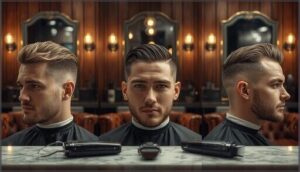
These three classic hairstyles share clipper-driven simplicity but differ in contrast. An undercut keeps your top longer—around 2 to 4 inches—while sides drop to a 1 or 2 guard, creating sharp definition.
A buzz cut uses one guard all over, like a number 3. A crew cut blends a tapered fade on sides with a slightly longer scissored top for tidy, textured control.
Explaining a Caesar Cut or French Crop
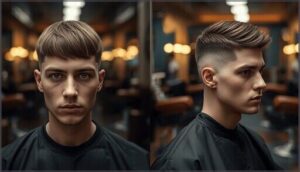
Both the Caesar cut and French crop push hair forward, but the Caesar keeps the top shorter—1 to 2 inches—with a blunt fringe sitting above your eyebrows.
The French crop runs slightly longer on top with a choppy, textured fringe. Tell your barber which style you want, mention your preferred fade height, and bring a photo to nail the details.
Specifying Adjustments and Personalization
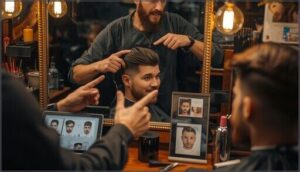
Standard styles become custom cuts when you add personal tweaks that fit your face shape, hair texture, and lifestyle needs. Communicating with your stylist about small adjustments transforms any hairstyle into something that actually works for you.
Here’s how to personalize common haircut techniques:
- Tell your barber what you liked or disliked last time – “Keep the top length but take the sides shorter” gives a clear starting point.
- Specify where you want texture or volume – “More lift at the front but flatter at the crown” guides exactly where to add movement.
- Mention your styling habits – “I air dry with no product” helps them adjust the cut so it looks intentional without extra work.
Discussing Maintenance and Upkeep

Before you leave the chair, ask your stylist about realistic maintenance schedules and product recommendations that match your hair care routine.
Fades and tight cuts need touch-ups every 2 to 4 weeks to stay sharp, while softer styles can stretch 6 to 10 weeks.
Understanding style longevity and daily upkeep routines helps you keep your haircut looking fresh between appointments.
Ensuring a Successful Haircut Experience
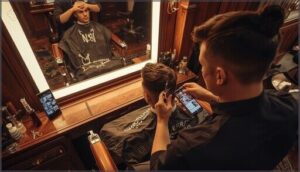
You’ve done the prep work, picked your style, and shown up ready—now it’s about making sure the actual appointment goes smoothly.
The difference between a good haircut and a great one often comes down to how you handle those pivotal moments in the chair.
Here’s how to take control of the experience from start to finish.
Confirming Details Before The Cut Begins
Before your barber touches a single strand, repeat back every detail you discussed—haircut length, fade details, neckline style, top texture, and cutting technique. This quick consultation cements your describing your desired haircut into a shared vision.
Solid barber–client communication at your haircut appointment prevents regret later. Think of it as your final checkpoint before the transformation begins.
Requesting Adjustments During The Appointment
Speak up the moment something feels off—mid cut feedback is your power move. Clear stylist communication during your haircut appointment keeps you in control of the salon experience.
Adjustment techniques you can request:
- Symmetry checks: Ask your hairstylist to compare both sides in the mirror after each pass
- Micro trims: Request removing less than ¼ inch to fine-tune shape without losing length
- Rebalancing: Point out uneven areas by describing which side appears longer
- Texture tweaks: Specify scissors or clippers for exact control over finish
- Quick mirror pauses: Confirm alignment before moving to the next section
Haircut revisions work best when you’re specific and timely. Trust me—barber–client communication during the cut prevents post-appointment regret.
Building Trust and Open Communication
Trust building starts the moment you walk in—and here’s the thing: your stylist reads your energy before you say a word. Open dialogue works when you mirror each other’s language and confirm details out loud.
Active Listening Foundations
| Barber-Client Communication | Mutual Respect Signal | Clear Expectations Check |
|---|---|---|
| Stylist repeats your requests back | Steady eye contact during the cut | Agreed length confirmed before cutting |
| You describe problem areas honestly | Both parties ask clarifying questions | Tolerance for change stated upfront |
| Nonverbal cues acknowledged | Boundaries about scalp sensitivity respected | Recap at session end |
Salon experience improves when communicating with stylist feels collaborative, not scripted. Ask questions. Share past disappointments. That’s how to communicate with your barber and walk out satisfied every time.
Scheduling Regular Follow-Ups for Consistency
Your haircut only looks crisp as long as your follow-up schedules match your hair growth rates. Book standing appointments every 4–6 weeks for short cuts, 6–8 for medium lengths, or 8–12 for long styles—matching trim frequencies to your haircare routine keeps style consistency sharp.
Pre-booking locks in your slot and makes haircut maintenance easier than scrambling last-minute during stylist consultation.
Frequently Asked Questions (FAQs)
What to say when asking for a haircut?
Like the old-school gentlemen who’d tip their hats and simply ask for the usual, start your haircut conversation with clarity: describe your overall goal, mention specific lengths, and share how you usually style your hair daily.
How do you ask for a haircut at a salon?
You need to bring clear reference photos, describe your desired length and texture, and discuss your lifestyle with your hairstylist.
Being specific about maintenance habits helps guarantee you both understand the goal.
How to ask for a haircut?
Start with a quick consultation: show photos for haircut inspiration, explain your personal style to your hairstylist, use specific terms with your barber, and set clear client expectations through open salon communication.
Can you get a haircut from a barber?
Yes, you absolutely can. Barber shops specialize in mens grooming and offer haircut options like fades, tapers, buzz cuts, and crew cuts using expert barber techniques.
Most accept walk-ins or online appointments.
How do you talk to a barber about a haircut?
Walk in ready to collaborate. Bring photos, name your style using clipper numbers or terms like “fade” or “taper,” and point out problem spots.
Ask questions. Most barbers appreciate clients who communicate clearly.
How do I get a good haircut?
Getting a good haircut starts with honest communication during your haircut consultation. Bring photos, know your face shape and hair type, and build trust with your stylist through clear client expectations and regular maintenance.
What do I say when asking for a haircut?
Tell your stylist the exact length you want in inches, describe where you’d like layers or texture, mention any problem areas like cowlicks, and bring reference photos for clarity.
How do I ask my hairdresser for a haircut?
Think of your hairdresser as a translator turning your vision into reality.
Show photos, point to exact lengths on your body, describe your styling routine, and speak up during the consultation about what you want changed.
How do I ask for a trim haircut?
Be specific with numbers: say “half an inch off the ends” instead of “just a little.”
Point to your face or neck for length reference, and ask your stylist to confirm before cutting.
How do I describe what haircut I want?
Bring photos showing angles you like, mention specific lengths in inches, and point out your face shape concerns.
Your hairstylist needs visuals plus honest details about your hair texture and daily styling routine.
Conclusion
Ready to shear away the guesswork? When you know how to ask haircut questions with confidence, you’re not just getting a trim—you’re shaping your own style story.
Every snip becomes a choice, not a compromise. Trust your gut, speak your truth, and lean into the tools you’ve learned.
The chair isn’t a place for crossed fingers; it’s where your vision takes root. So next time, walk in bold and leave with a cut that’s truly yours.