This site is supported by our readers. We may earn a commission, at no cost to you, if you purchase through links. This content is for general informational and educational purposes only and is not a substitute for professional medical, dermatological, or nutritional advice.
Your grandmother wasn’t wrong about the mayo jar in the fridge. Egg yolks carry lecithin, a natural emollient that binds oil and water together and seeps into the hair shaft when you give it enough time to work. That’s the catch, though: timing makes or breaks this treatment.
Leave it on too briefly, and you’re just smearing condiment on your scalp for nothing. Leave it on too long, and you risk protein overload, that stiff, straw-like texture stylists dread seeing in the chair.
So how long to leave mayo in hair for hair actually depends on what you’re working with, fine strands, damaged ends, or color-treated hair each play by different rules.
Table Of Contents
- Key Takeaways
- Leave Mayo in Your Hair for 20–30 Minutes
- How to Apply a Mayo Hair Treatment
- How to Rinse Mayonnaise From Hair
- What Happens During a Mayo Treatment?
- How Often Can You Use Mayo?
- Frequently Asked Questions (FAQs)
- How long should I let mayo sit in my hair?
- Do you apply mayonnaise to wet or dry hair?
- How long does it take for mayo to kill lice?
- Can I leave hair mayonnaise in my hair?
- How often should I use a mayonnaise hair treatment?
- Does mayonnaise really help with hair growth?
- What ingredients should I look for in store-bought mayonnaise?
- Can I use mayonnaise to lighten my hair color?
- Are there any other ingredients I can add to mayonnaise for maximum benefit?
- Can mayonnaise cause scalp irritation or allergic reactions?
- Conclusion
Key Takeaways
- Stick to 20-30 minutes for most hair types—fine or oily hair does best at 15-20 minutes, while dry, damaged, or color-treated hair can handle the full window.
- Leaving mayo on longer than 30 minutes won’t boost results and actually raises your risk of protein overload (stiff, straw-like strands) and bacterial growth.
- Use full-fat mayo on damp hair, focus on mid-lengths and ends while avoiding the scalp, and rinse with lukewarm water (shampooing twice if needed) to avoid greasy buildup.
- Mayo delivers real but temporary conditioning—smoother cuticles, less frizz, and short-term strength—but it has no proven effect on hair growth, so keep treatments to once a week at most.
Leave Mayo in Your Hair for 20–30 Minutes
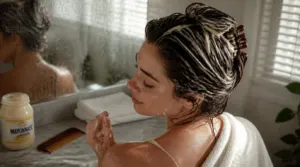
Timing isn’t one-size-fits-all for a mayo hair treatment. Your hair type, porosity, and even whether it’s color-treated all shift the sweet spot. Here’s how to dial in the right duration for your specific strands.
If you’re also curious about the styling side of things, this guide on how long a perm takes from start to finish breaks down what affects salon and at-home timing.
Fine or Oily Hair
If your hair leans fine or oily, cap it at 15-20 minutes. Thin strands carry sebum fast, so mayo speeds greasy buildup near roots.
- Keep application technique light on damp hair
- Skip scalp avoidance zones near roots
- Rinse thoroughly with a double shampoo
Watch for oily residue after rinsing. Weekly frequency limit prevents overuse signs like limp, heavy strands. A survey on student hair care practices found that most respondents used hair oil as a homemade remedy, underscoring how common oil-based treatments like mayo can leave residue if overused.
Dry or Damaged Hair
Now flip the script: dry or damaged strands can handle the full 20-30 minute window, no rushing needed.
Full-fat mayonnaise moisturizes dry hair while its egg-derived proteins work on split end prevention and cuticle smoothing. You’ll get real moisture retention, frizz reduction, and a quick moisture boost that genuinely strengthens hair, at least temporarily, without the greasy tax finer strands pay.
High-Porosity Hair
If your strands drink water fast then lose it just as quick, you’re dealing with porous hair, and the full 20-30 minutes helps here too. Curious about your porosity? Try the water test: drop a clean strand in a glass. It sinks fast, floats slow, either way you’ll know.
- Absorbs quickly
- Dries fast
- Frizzes easily
Color-Treated Hair
If you’ve colored your hair, you already know the cuticle’s been forced open to let dye settle in, which leaves it thirstier than virgin hair.
The same 20-30 minute window works here for moisture retention and cuticle sealing, but patch-test first since dyed strands react unpredictably.
Skip sulfates or heavy oils that speed mayo fade, and always aim for color-safe application.
Why Longer is Not Better
If you’re tempted to leave mayo on overnight for "extra" conditioning, don’t. Studies show no measurable difference past 30 minutes, just diminishing returns and real risk.
- Protein overload: brittle, crunchy strands
- Bacterial growth: egg proteins breaking down
- Greasy moisture balance disruption
- Messy application problems, harder rinsing
Rinse thoroughly and stop chasing time you don’t need.
How to Apply a Mayo Hair Treatment
Timing only gets you halfway to good results—application technique takes care of the rest. A few small choices, like what mayo you grab and where you smooth it on, make the difference between soft hair and a greasy mess. Here’s exactly how to do it right.
For an extra boost of moisture and shine, pair your mayo treatment with a chebe powder hair growth routine for deeper nourishment over time.
Choose Full-Fat Mayonnaise
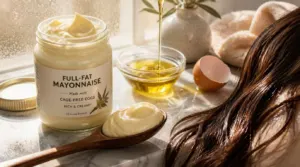
Not all mayo works the same. Grab the full-fat jar, since its 40-50% oil content and egg protein deliver real conditioning.
Low-fat versions swap oils for water and fillers, doing little for dry strands.
Full-fat blends olive or soybean oil with vinegar, creating a natural emulsion that balances pH and mimics your hair’s own lipid layer.
Start With Damp Hair
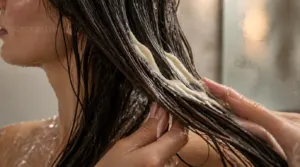
Before that jar even opens, rinse hair with lukewarm water to lift the cuticle and boost absorption.
- Skip towel-drying
- Wait 1-2 minutes after rinsing
- Keep hair damp, not soaked
- Section for even coverage
- Apply immediately for moisture retention
Damp strands let mayo bond with water molecules instead of clumping, so your hair mask application time actually counts toward real conditioning.
Focus on Mid-Lengths and Ends
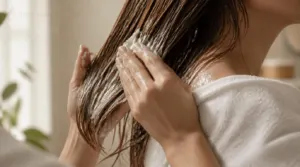
Ends carry the oldest, driest hair on your head, so that’s where the mask should work hardest.
| **Section | Focus** |
|---|---|
| Roots | Skip or light touch |
| Mid-lengths | Moisture balance |
| Ends | Damage repair, frizz control |
| Comb-through | Even distribution |
Work mayonnaise from mid-lengths to ends using sectioned application for full absorption and lasting repair.
Use Two to Four Tablespoons
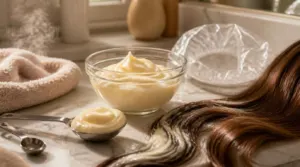
Guessing is where most mayo masks go wrong. Match the amount to your hair length: 2 tablespoons for short or fine strands, 3 for medium, 4 for long or thick hair.
- Adding egg yolk? Drop to 2-3 tablespoons.
- Mixing with conditioner? Just 2 tablespoons base.
- Curly or high-porosity? Use the full 4.
Work it through with fingers, once weekly, under a plastic shower cap.
Avoid Heavy Scalp Application
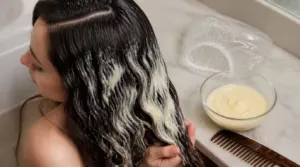
Your scalp isn’t the target here, your strands are. Working mayo into your roots invites clogged follicles and buildup, so smooth it onto mid-lengths and ends only.
| Zone | Apply? | Why |
|---|---|---|
| Roots | No | Prevents buildup |
| Mid-lengths | Yes | Absorbs moisture |
| Ends | Yes | Repairs damage |
Once weekly, under a plastic cap, patch test first. Minimize scalp contact, always.
How to Rinse Mayonnaise From Hair

Getting mayo into your hair is the easy part—getting it all back out is where most people slip up. Rinse it wrong, and you’re left with greasy strands and a scalp that feels weighed down for days. Here’s exactly how to do it right, step by step.
Rinse With Lukewarm Water
When your timer hits the mark, head to lukewarm water first, not hot. Heat above 100°F cooks egg proteins into a sticky film, while cool water lets oils stay soluble and rinse clean. Lukewarm also respects your scalp’s pH and seals the cuticle for shine.
Skip the shortcuts: patch test first, and stick to once weekly.
Shampoo Twice if Needed
One cool rinse won’t always clear a mayo treatment’s oil load, especially with the full two to four tablespoons.
If hair still feels slick, follow with a gentle shampoo, lather, rinse, then repeat. This double shampooing lifts surface oil first, then targets deeper residue, preventing buildup without stripping the moisture you just applied.
Check for Oily Residue
Run fingers through wet strands before reaching for a towel. If they come away slick or coated, keep shampooing.
Clean hair feels light and slightly textured, never uniformly slick. A greasy sheen near the scalp, or hair that flattens instead of falling naturally, means residue’s still clinging on.
Avoid Very Hot Water
Cranking the faucet hot feels satisfying, but it undoes half your work. Heat lifts cuticles further, stripping scalp oils and fading color faster, especially after all that mayo conditioning.
Stick with a cool water rinse instead:
- Seals cuticles for smoother strands
- Protects color from fading
- Preserves natural scalp oils
Lukewarm is your ceiling. Anything hotter risks protein denaturation and undoes the hair mask benefits you just built in.
Dry Hair Gently
Skip the rough towel rub, it roughs up the cuticle after all that conditioning work. Blot, don’t rub: press a microfiber towel against strands to wick water gently.
Twisting or scrunching hard invites breakage on wet hair. Air drying afterward, or gentle handling with minimal brushing, keeps your mayonnaise hair treatment results smooth instead of frizzy and undone.
What Happens During a Mayo Treatment?

So what’s actually going on under that mayo cap for those 20 to 30 minutes? It’s not magic—it’s chemistry doing quiet, specific work on your strands. Here’s what you can expect to happen, layer by layer.
Temporary Moisture Retention
Why does mayo feel so hydrating? It’s four mechanisms stacking at once: lecithin traps water in the shaft, oil forms a temporary barrier, egg protein fills porous gaps, and vinegar’s pH closes cuticles to seal it all in.
Mayo hydrates through four mechanisms at once: lecithin trapping water, oil barring evaporation, protein filling gaps, and vinegar sealing cuticles shut
- Lecithin binds moisture up to 48 hours
- Oil film blocks evaporation for hours
- Protein hydration reaches damaged strands
- Heat-activated sealing boosts retention 40%
Smoother-Looking Hair Cuticles
Under a microscope, hair cuticles look like roof shingles, and mayo’s oils coat each one to help scales lie flat.
Vinegar’s acidity (pH 4.5-5.5) helps cuticle sealing, while lecithin fills gaps.
The payoff? Light reflects evenly across smoother strands, giving you genuine hair shine and better manageability, not just a temporary illusion of softness.
Reduced Frizz and Flyaways
Ever notice how humid days turn smooth hair into a frizzy mess? That’s swelling from moisture, and mayo fights back.
Its oil coating creates a real humidity resistance barrier, cutting volume increase by roughly 40% in muggy conditions.
Combined with pH balancing that flattens cuticles, you get genuine flyaway reduction, not just smoothing spray tricks that fade by lunchtime.
Short-Term Protein Support
Egg yolk brings real protein-rich formulation to the table, not just filler ingredients.
- Protein filling effect smooths rough cuticle gaps
- L-cysteine helps keratin structure
- Strands gain a temporary strength boost
- Elasticity improves, resisting snapping
This hair repair is superficial and short-term, lasting until your next wash, so treat it as maintenance, not a miracle fix.
No Proven Hair Growth
If you’re hoping mayo will thicken your hair, let’s clear this up now.
No clinical evidence links topical mayo to follicle stimulation or density increase. L-cysteine only works through diet, not scalp contact. Genetic hair loss won’t budge either.
So enjoy the shine, skip the growth myths, and never leave mayo on past 30 minutes (bacterial contamination risk climbs fast).
How Often Can You Use Mayo?

Mayo can do a lot for your hair, but more isn’t always better—overdoing it works against you fast. Your scalp and strands need time to reset between treatments, or you’ll trade shine for greasy buildup. Here’s what to keep in mind before you reach for that jar again.
Limit Treatments to Weekly
Once a week is your sweet spot, plain and simple. Normal hair holds condition fine on that schedule; oily types should stretch it biweekly.
Curly or coily strands can handle weekly since moisture disappears fast. Adjust for humidity or skip during travel, then ease back in.
Think of it as monthly for maintenance, weekly when hair actually needs it.
Watch for Protein Overload
Weekly use is fine, but your hair will tell you if it’s had enough. Watch for stiff, crunchy strands that snap when stretched, lost curl definition, or sudden breakage.
- Straw-like texture
- Reduced elasticity
- Excessive shedding
Catch these early. Recovery means moisture-only products for 4-6 weeks before reintroducing mayo, restoring hair elasticity and strength.
Prevent Oil and Scalp Buildup
Protein overload isn’t the only risk with repeat mayo masks. All that oil clings to your scalp, and if rinsing isn’t thorough, you get greasy buildup fast.
Stick to lukewarm water, shampoo scalp-only, and skip heavy product between treatments. A weekly gentle exfoliation helps lift leftover residue, keeping your scalp healthy and your strands light instead of weighed down.
Patch Test Before Applying
Buildup isn’t the only thing to check for before you commit to a weekly mask. Patch test first, especially if you have egg allergies or scalp sensitivity.
Dab a quarter-sized amount behind your ear, wait 24 hours, and watch for redness or itching. If irritation shows up, skip the treatment and ask your dermatologist for alternatives.
Know When to Skip It
Sometimes the smartest move is closing the jar. Skip mayo entirely if you have an egg allergy, protein-sensitive hair, active scalp infection, or recently chemically treated strands. Oily fine hair often fares better with lighter alternatives too.
Always patch test first, since allergic reactions and scalp irritation can sneak up fast. When in doubt, sit this mayonnaise hair treatment out and protect the hair mask benefits for another week.
Frequently Asked Questions (FAQs)
How long should I let mayo sit in my hair?
Stick to 20 to 30 minutes for most hair types. Fine or oily strands do best around 15 to 20 minutes, while dry or damaged hair can handle up to Rinse thoroughly, longer never means better results.
Do you apply mayonnaise to wet or dry hair?
Damp hair, not dripping wet, works best. Slightly damp strands let full-fat mayonnaise distribute evenly and absorb into the cuticle. If your hair’s fine or oily, skip the scalp and stick to mid-lengths and ends.
How long does it take for mayo to kill lice?
Even at eight hours, mayo only kills about 20 percent of adult lice, since the egg shell barrier blocks nit removal entirely. Overnight risks outweigh the payoff, so patch test first before trying this natural lice treatment.
Can I leave hair mayonnaise in my hair?
Think of mayo like a face mask for your hair: yes, you can leave it in, but timing matters. Patch test first, then stick to 20-30 minutes based on your hair type for safe, effective conditioning.
How often should I use a mayonnaise hair treatment?
Frequency depends on hair type: normal hair does well weekly, oily hair biweekly, and dry or damaged strands can handle 1-2 sessions weekly. Watch for protein overload signs like stiffness before adjusting your homemade hair mask schedule.
Does mayonnaise really help with hair growth?
No, mayo won’t spark new growth at the follicle. Its egg-derived proteins strengthen strands and boost moisture, which helps overall scalp health and hair condition, but genuine growth still depends on genetics, nutrition, and evidence-based scalp care.
What ingredients should I look for in store-bought mayonnaise?
Skip the fancy jars, this is about your kitchen staple. Grab full-fat, store-bought conventional mayo with egg yolk, oil, and vinegar or lemon juice, plain ingredients delivering real conditioning power through lecithin and scalp-friendly acidity.
Can I use mayonnaise to lighten my hair color?
Plain mayo won’t lighten hair, it’s a conditioning treatment, not bleach. That "mayo-lemon" method relies on lemon’s citric acid plus sun exposure for subtle highlights, not the mayonnaise itself, and works best on already-light hair.
Are there any other ingredients I can add to mayonnaise for maximum benefit?
Yes, mix in egg for protein boost, honey for shine, coconut oil for moisture, or diluted apple cider vinegar for pH balance. Each ingredient targets a different hair need in your full-fat mayo base.
Can mayonnaise cause scalp irritation or allergic reactions?
Your scalp can absolutely react to mayonnaise. Egg allergy risk and soybean oil sensitivity often trigger contact dermatitis, showing up as redness, itching, or flaking. Always patch test first on your inner elbow, waiting 24 hours before applying it scalp-wide.
Conclusion
A kitchen staple and a salon-grade treatment sound worlds apart, yet mayo bridges that gap when you respect its clock.
Knowing how long to leave mayo in hair for hair isn’t guesswork, it’s chemistry: 20 to 30 minutes lets lecithin work without tipping into protein overload. Rinse well, condition lightly, and keep treatments weekly at most.
Your grandmother’s remedy still holds up, not because it’s magic, but because timing turns condiment into care.