This site is supported by our readers. We may earn a commission, at no cost to you, if you purchase through links. This content is for general informational and educational purposes only and is not a substitute for professional medical, dermatological, or nutritional advice.
Ginger has been rubbed into scalps for centuries, and social media has turned that old habit into a modern trend. If you’ve searched does ginger help with hair loss, you’ve likely found confident promises alongside cautious disclaimers, with little clarity on which to trust.
The science tells a more complicated story. The most studied compound in ginger, 6-gingerol, has actually shown signs of inhibiting hair growth cells in lab settings. That doesn’t make ginger useless for your scalp, but it does mean the popular claims deserve a closer look before you act on them.
Table Of Contents
- Key Takeaways
- Does Ginger Help With Hair Loss?
- Why Ginger May Support Scalp Health Without Regrowing Hair
- Can Ginger Treat Different Types of Hair Loss?
- Is Ginger Safe for Your Hair and Scalp?
- What Should You Do Instead for Persistent Hair Loss?
- Frequently Asked Questions (FAQs)
- What are the big 3 for thinning hair?
- What foods stop hair falling?
- What is the most powerful herb for hair growth?
- How to use ginger to regrow hair?
- Can ginger reverse genetic male pattern baldness?
- How long until ginger shows hair results?
- Is ginger effective for female hair loss?
- Can ginger be combined with minoxidil safely?
- Does cooking ginger reduce its hair benefits?
- How does ginger compare to proven hair loss treatments?
- Conclusion
Key Takeaways
- There’s no rigorous human trial evidence that ginger regrows hair; nearly all research comes from lab studies on isolated cells, so popular claims rest on weak ground.
- Ginger’s main active compound, 6-gingerol, has actually shown signs of inhibiting dermal papilla cells in lab settings, meaning it may work against hair growth rather than for it.
- Ginger may still support scalp health through anti-inflammatory, antioxidant, and antimicrobial effects, which can reduce shedding driven by irritation—but it can’t rebuild miniaturized or lost follicles.
- If shedding persists beyond three months, see a dermatologist for a proper diagnosis, since evidence-based treatments like minoxidil, finasteride, and ketoconazole outperform any herbal remedy.
Does Ginger Help With Hair Loss?

Ginger has been studied for its effects on scalp health, but the evidence is mixed. Some research looks at how its active compounds interact with hair follicles, while other studies focus on broader scalp benefits. Here’s what the science actually shows about human evidence and follicular activity.
For a deeper look at how these compounds translate into real-world results, volumizing shampoos that use ginger for fine hair offer a practical way to put the science to work on your scalp.
Human Evidence on Ginger
The clinical evidence for hair loss treatment with ginger is almost entirely absent in humans. Most research comes from in vitro studies using isolated cells, not human follicles or real scalp conditions.
No rigorous randomized controlled trial has tested topical application or dietary ginger against hair-loss outcomes. Without that data, you can’t reliably conclude that ginger promotes hair follicle stimulation.
6. Gingerol and Hair Growth
6-Gingerol is ginger’s most studied bioactive compound, and some in vitro studies suggest it may actually inhibit dermal papilla cells, which are central to follicle activity. That’s a link to hair growth inhibition, not stimulation.
This finding complicates the popular belief that ginger promotes growth, much like other common hair care myths worth rethinking before building a scalp routine around them.
For topical application, whether 6-gingerol reaches your follicles at sufficient concentrations remains unknown. The gap between lab findings and real scalp results is still considerable.
If you’re weighing your options, comparing ginger scalp serums for growth may help you spot formulations with higher gingerol concentrations or added penetration enhancers — variables that matter most given the absorption uncertainty.
Why Ginger May Support Scalp Health Without Regrowing Hair
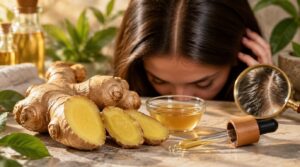
Even if ginger doesn’t regrow hair, it may still improve the conditions your scalp needs to retain the hair you have.
Gingerols, the main active compounds in ginger, have anti-inflammatory and antioxidant properties that can calm an irritated scalp. Chronic scalp inflammation is one driver of increased shedding, so reducing it may lower how much hair you lose day to day. Ginger also has some antimicrobial activity, which can reduce microbial imbalances that contribute to scalp irritation.
The distinction matters: shedding and follicle loss are different problems. Ginger’s benefits seem more relevant when inflammation is driving excess shedding, not when follicles are miniaturized or gone. It may help support your scalp’s environment, but it won’t rebuild what’s already been lost.
For a realistic picture of what these products can and can’t do, understanding how long hair growth shampoo takes to show results helps set expectations before committing to any routine.
Ginger may calm your scalp, but it cannot rebuild follicles that are already gone
Can Ginger Treat Different Types of Hair Loss?
That distinction carries weight when you consider the full range of hair loss diagnoses.
Pattern hair loss is hormonal and gradually shrinks follicles over years. Alopecia areata is autoimmune. Telogen effluvium is usually a temporary, stress-related shed. Scarring alopecias destroy follicles permanently. Each condition has a different root cause, and no available scientific evidence categorizes ginger for hair by any of these specific types.
Without trials that separate patients by diagnosis, you can’t verify whether ginger does anything meaningful for androgenetic alopecia compared to alopecia areata. That research simply doesn’t exist yet in any stratified, diagnosis-specific form. So if you’re building an alopecia treatment plan, you can’t position ginger as a reliable type-specific solution on the basis of current evidence.
Is Ginger Safe for Your Hair and Scalp?

Ginger is generally well-tolerated, but it’s not without risk. Whether you’re applying it to your scalp or taking it orally, specific precautions apply to each method. Here’s what you need to know before using it.
Topical Ginger Risks
Topical ginger application can cause scalp irritation, particularly at higher concentrations. Ginger may trigger contact dermatitis, causing redness, itching, or burning at the application site.
Do an allergic reaction test before regular use: apply a small amount to your inner arm and wait 24 hours.
If you’re mixing ginger with essential oils or exfoliants, your risk of adverse reactions increases.
Oral Ginger Precautions
For most people, ginger supplements sit well at low doses, but gastrointestinal side effects like heartburn can limit consistent use. Standardized extracts carry higher active-compound concentrations than culinary ginger, making adverse reactions more likely.
If you’re taking blood thinners or anticoagulants, ginger may raise your bleeding risk, so check with your doctor. Dietary supplement safety deserves extra attention during pregnancy.
Those already managing clotting conditions should review ginger blood thinner interaction risks before adding any standardized extract to their routine.
What Should You Do Instead for Persistent Hair Loss?

Around 50% of people experience noticeable hair loss by age 50, yet many wait years before seeking a formal evaluation.
If your shedding has lasted more than three months, dermatological assessment is the most productive next step. A clinician can identify the specific cause through your history, scalp examination, and blood work. Only then can hair loss management be matched to the actual driver rather than a guess.
For androgenetic alopecia, evidence-based hair treatments like minoxidil have solid clinical backing. Other conditions respond to completely different approaches. Without a proper diagnosis, you’re likely wasting time and money.
While you’re pursuing answers, basic scalp health maintenance, gentle handling, and tracking changes with regular photographs can help you measure what’s actually working.
Frequently Asked Questions (FAQs)
What are the big 3 for thinning hair?
If you’re dealing with androgenetic alopecia, the big 3 are finasteride, minoxidil, and ketoconazole shampoo. Each one targets hair thinning differently: finasteride blocks DHT, minoxidil keeps hair follicle cycling going, and ketoconazole adds some anti-androgenic effects.
Understanding androgenetic alopecia treatment options can help clarify how finasteride reduces scalp DHT by approximately 60% while dutasteride offers even greater suppression by targeting both type I and II 5-alpha reductase isoforms.
What foods stop hair falling?
Eggs, red meat, and oysters cover protein, zinc, and biotin. Pair spinach with citrus to improve your iron absorption. Fatty fish like salmon supplies omega-3s, which may reduce scalp inflammation and help to limit shedding.
What is the most powerful herb for hair growth?
No herb holds the title of "most powerful" for hair growth. Scientific evidence is thin for all of them, including ginger oil. Proven options like minoxidil outperform any herbal claim.
How to use ginger to regrow hair?
If you want to try ginger, dilute ginger oil in a carrier, apply it as a scalp treatment for 10–15 minutes, then rinse. Stop immediately if you notice burning, redness, or swelling.
Can ginger reverse genetic male pattern baldness?
No, ginger can’t reverse genetic male pattern baldness. It doesn’t block DHT, the hormone driving genetic hair loss. Worse, 6-gingerol may inhibit hair growth by disrupting the hair follicle cycle, not restoring it.
How long until ginger shows hair results?
One review found no controlled human trials testing ginger for hair loss, so timelines rely on hair-cycle biology. Expect 8–24 weeks of consistent use before visible changes; effects within 4 weeks are rarely documented.
Is ginger effective for female hair loss?
If you’re asking whether ginger works for female hair loss, the honest answer is no proof yet. No clinical trials confirm regrowth in women. Some in vitro studies even suggest 6-gingerol may inhibit hair follicles, so manage expectations.
Can ginger be combined with minoxidil safely?
Can you mix a kitchen remedy with an FDA-approved drug? Possibly, but there’s no clinical guidance. Separate topical application by 30–60 minutes, watch for scalp irritation, and consult your dermatologist before trying combination therapy.
Does cooking ginger reduce its hair benefits?
Here’s the catch: cooking ginger changes its chemistry. Heat drives thermal degradation of gingerol, converting 6-gingerol into shogaol, which alters the biological activity of ginger. No evidence shows whether this affects hair benefits.
How does ginger compare to proven hair loss treatments?
Compared to minoxidil, ginger is a slow boat without a paddle. Minoxidil has human trials behind it; a ginger hair mask rests on in vitro studies. Your ginger and hair routine may soothe, but it can’t match proven treatment.
Conclusion
You can rub it on your scalp. You can sip it in tea. You can follow every viral routine. But the question of does ginger help with hair loss still lacks strong human proof.
Some evidence suggests it may soothe your scalp, not regrow your hair. Treat it as a supportive habit, not a treatment.
If shedding continues, see a trichologist or dermatologist. Real answers come from diagnosis, not kitchen remedies.