This site is supported by our readers. We may earn a commission, at no cost to you, if you purchase through links. This content is for general informational and educational purposes only and is not a substitute for professional medical, dermatological, or nutritional advice.

A client sat in my chair last month, convinced her thinning edges meant dreads had ruined her hair. Here’s the truth: locs don’t damage hair. Habits do.
I’ve seen waist-length locs with thick, healthy roots and short locs destroyed by tight retwisting and sour, mildew-smelling buildup. The difference comes down to technique, not the style itself.
So if you’re asking are dreads bad for your hair, the honest answer deserves more than a yes or no. Your scalp, your moisture routine, and your retwist schedule hold the real answers, and I’ll walk you through every one of them.
Table Of Contents
- Key Takeaways
- Are Dreads Bad for Your Hair?
- How Can Dreadlocks Damage Your Hair and Scalp?
- What Increases The Risk of Loc Damage?
- How Can You Prevent Hair Damage With Dreadlocks?
- What Are The Warning Signs of Unhealthy Locs?
- Frequently Asked Questions (FAQs)
- Do dreadlocks permanently damage hair?
- What hairstyle is healthiest for your hair?
- Do dreadlocks get smelly?
- Can your hair go back to normal after dreads?
- Can you get dreadlocks with thin or fine hair?
- How long does it take to fully remove dreadlocks?
- Are dreadlocks suitable for all hair types and ethnicities?
- Do dreadlocks permanently change your natural hair texture?
- Can you swim or exercise regularly with dreadlocks?
- Do dreadlocks work for all hair types and textures?
- Conclusion
Key Takeaways
- Dreadlocks aren’t inherently damaging—hair loss and breakage come from habits like retwisting too tight or too often, which can cause traction alopecia if scarring sets in.
- The biggest hidden risks are moisture problems: damp roots invite mold, sour smells, and fungal infections, so rinse thoroughly, use residue-free shampoo, and dry your locs completely every time.
- Protect your follicles by spacing retwists 4–6 weeks, twisting only new growth, moisturizing with water first and light oils to seal, and trimming or thinning locs that get too heavy for your roots.
- Watch for warning signs like persistent itching, burning, mildew odor, hard scabs, or thinning in one spot—catching these early keeps damage reversible, since regrowth usually returns once tension and buildup are addressed.
Are Dreads Bad for Your Hair?

How you maintain your locs matters far more than having them at all. As a trichologist, I see this misunderstanding come up constantly. Dreadlocks aren’t inherently bad for your hair. They don’t automatically cause hair damage or threaten your scalp health. The style itself is neutral.
That said, keeping locs healthy does hinge on the right products, which is why I always point people toward a quality shampoo for dreads.
Dreadlocks aren’t inherently bad for your hair—how you maintain them matters far more than the style itself
What creates real problems is how locs are formed, maintained, and handled day to day. Traction alopecia, hair breakage, and hair follicle damage are genuine risks, but they come from specific habits, not from locs simply existing on your head.
Think of it this way: a strong, healthy loc routine can truly preserve your hair beautifully. A careless one can compromise it. The encouraging news? You have real control over which path you take.
How Can Dreadlocks Damage Your Hair and Scalp?

Locs can cause damage in a few distinct ways, and knowing what to watch for puts you ahead of most people. The damage doesn’t always show up overnight, which is exactly why it’s so easy to miss until things get serious. Here’s what you actually need to understand about the risks.
Breakage and Internal Dryness
Because locs don’t distribute moisture evenly, hair moisture retention suffers and scalp health declines over time. That dryness weakens hair fiber integrity, raising hair damage and breakage risk.
Five breakage triggers:
- Incomplete drying after washing
- Retwisting repeatedly on dry hair
- Friction from pillowcases at night
- Length and weight straining the shaft
- Product residue blocking hydration
Tension and Traction Alopecia
Dryness isn’t the only threat. Scalp tension from tight styling strains follicles directly.
Constant pulling from ponytails and buns can inflame the roots, so a soothing scalp treatment for itchy scalp helps calm irritation before it weakens growth.
| Style Habit | Risk |
|---|---|
| Tight roots | Follicular stress |
| Long wear | Traction alopecia |
| Heavy weight | Tension stress |
| Daily retwisting | Gradual hair loss |
These patterns can damage follicles over time. Early changes are subtle, but once scarring sets in, regrowth won’t come back easily. Loosen your roots well before that happens.
Buildup, Mold, and Infection
Tension isn’t the only concern here. Product buildup clings between strands, creating a sticky surface where bacteria and fungi thrive. Add slow drying after washing, and you’ve got perfect conditions for fungal infections and scalp inflammation.
Use a residue-free shampoo and dry your locs completely every single time. Good dreadlock hygiene is exactly what stops these problems before they start.
Dyes, Bleach, and Extensions
Chemical hair dye and bleach are the biggest threats I see to loc health. They weaken your cuticle and raise porosity, making hair breakage almost inevitable when you retwist.
If you’re coloring your locs while pregnant, it’s worth checking a guide on safe hair coloring during pregnancy first.
Synthetic dreads add extra pull and weight at attachment points. Chemical dyes from extension fibers can also transfer residue onto your natural hair, triggering scalp inflammation you might not notice immediately.
What Increases The Risk of Loc Damage?
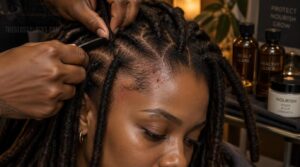
Retwist frequency is one of the biggest culprits I see in practice. Going back in too soon, before new growth stabilizes, creates shear stress at the root. That’s how roots pulled too tight quietly lead to traction alopecia over time.
A few habits that push the risk higher:
- Retwisting damp hair, which increases friction and encourages mat formation at the root
- Layering heavy creams and butters without thorough cleansing between applications
- Neglecting length management when locs are too heavy
- Using bleach or permanent color, which weakens shaft integrity before tension is even applied
Scalp inflammation often follows product residue buildup combined with sweat and moisture. When hair breakage appears near the roots, these overlapping factors are almost always the reason.
How Can You Prevent Hair Damage With Dreadlocks?

Good news: most loc damage is preventable. The habits you build around washing, moisturizing, retwisting, and managing length will do more for your hair than any product ever could. Here’s exactly what to focus on.
Washing and Drying Locs
Here’s the truth: dreadlock hygiene fails most often at rinsing and drying, not washing.
| Step | Do | Avoid |
|---|---|---|
| Saturate | Soak fully | Quick wetting |
| Shampoo | Residue-free shampoo | Creamy formulas |
| Rinse | Rinse between locs | Rushing |
| Dry | Squeeze, then airflow | Rubbing towels |
| Finish | Dry roots completely | Sleeping damp |
Damp roots invite trouble. Use these dreadlock drying techniques faithfully!
A microfiber hair dryer bonnet for dreadlocks speeds up airflow deep into your locs, so roots dry faster and never stay damp.
Moisturizing Without Buildup
Think of your locs like a sponge: water soaks in, oil just coats the outside. That’s why you should spritz with water first, then add a light, water-based leave-in. Heavy creams cause hair product buildup fast.
Use natural oils sparingly, only to seal. Keep scalp moisturizing gentle, cleanse monthly with a residuefree shampoo, and your scalp health stays solid!
Safe Retwisting and Styling
Here’s the hard part: most loc damage doesn’t come from washing. It comes from retwisting too tight, too often. Every twist pulls at your follicles, and repeated styling tension adds up. I tell clients this: if your scalp stings after a retwist, that’s a warning, not a badge of neatness. Space appointments 4 to 6 weeks, twist only the new growth, and skip heavy gels that harden at the root. Gentle hands prevent follicle damage.
Managing Length and Weight
Here’s something people miss: length is lovely, but it pulls. As dreadlock expansion continues, your loc weight distribution shifts, and every strand feels it.
If your locs are too heavy, your roots work overtime. I tell clients to trim gradually, thin dense sections, and watch how hair weight distribution changes after washing.
Lighter loc weight means less daily strain. Your scalp will thank you!
What Are The Warning Signs of Unhealthy Locs?
Prevention helps, but you still need to know what trouble looks like. I check my own scalp monthly, and you should too.
Scalp irritation that lingers is your first red flag. Persistent itch, burning, or tenderness when you touch your roots means inflammation, not adjustment. If washing hurts, stop and assess.
Trust your nose. A sour or mildew smell signals trapped moisture and buildup. Greasy, sticky flakes point to residue, while hard scabs, oozing, or tender bumps suggest infection. See a professional for those.
Watch your roots. Sudden stiffening, rope-like tightness, or localized hair thinning in one spot warns of traction injury. Increased shedding, brittle strands that won’t stretch, and new frizz signal hair breakage and weakened hair root health.
Heavy, uneven loc weight distribution strains fragile areas. Catch these signs early, and your locs will thank you!
Frequently Asked Questions (FAQs)
Do dreadlocks permanently damage hair?
I used to believe locs doomed your hair. Not true! Dreadlocks don’t cause permanent hair loss on their own. Damage happens when sustained scalp tension triggers traction alopecia, or scarring harms follicles. Manage loc weight and tension, and regrowth continues.
What hairstyle is healthiest for your hair?
Think of your hair as a rope: the looser the knot, the longer it lasts. The healthiest style is a loose, low-tension look that lets roots move freely.
If your ends are already damaged, pairing a low-tension style with one of the best haircuts for damaged hair can help it recover faster.
Loose braids, soft buns, or gentle locs reduce pulling and breakage. Rotate styles often, and keep your scalp health in locs a priority!
Do dreadlocks get smelly?
I used to believe locs smell bad on their own. Wrong! They only get a foul odor when sweat, sebum, and buildups linger. Prioritize scalp hygiene, adjust your dreadlock washing frequency, and dry roots fully for dreadlock odor control.
Can your hair go back to normal after dreads?
Yes, often! Once you cut off damaged strands, new growth comes in healthier. But if tension hurt your hair follicles, some hair thinning may stay. Watch your hairline, and be patient with hair regrowth.
Can you get dreadlocks with thin or fine hair?
My client Maria feared her fine hair couldn’t lock. It did! Thin hair works with larger sections, concentrating more strands per loc. This protects hair fiber strength, helps with hair retention, and prevents breakage.
How long does it take to fully remove dreadlocks?
Combing out dreadlock matting usually takes 4 to 24 hours. Newer, shorter locs come apart fastest, while older, thicker ones demand multiple sessions. I always tell clients: patience protects your hair integrity, so pace yourself!
Are dreadlocks suitable for all hair types and ethnicities?
Absolutely, every hair type can lock! Your genetic hair texture just changes the timeline. Coily and kinky hair locks in 6–12 months. Straighter hair needs specialized techniques and 24–36 months to mature.
Do dreadlocks permanently change your natural hair texture?
A client once panicked that her coils were "ruined" after combing out five-year locs. They weren’t. Your hair follicles keep their genetic shape, so regrowth restores your natural hair texture within 6–18 months. Temporary dryness or thinning fades as hair health returns.
Can you swim or exercise regularly with dreadlocks?
Picture chlorine-soaked locs drying stiff like rope. You can swim and exercise freely! Pre-soak your locs with clean water, seal with lightweight oil, then rinse and dry thoroughly after. That protects against scalp irritation and hair breakage.
Do dreadlocks work for all hair types and textures?
Locs are like plants: some soil grows them fast, some needs help. Type 4 coils lock quickest. Wavy hair needs interlocking, and straight hair resists knotting, often taking years for proper loc maturation.
If you’re wondering which hair type dreads up the fastest, coily hair can mature in as little as 6–12 months, while straight hair may take 24–36 months.
Conclusion
Picture two gardens side by side. Same soil, same sun. One thrives because someone waters it, prunes it, pays attention.
Your locs work the same way. So, are dreads bad for your hair? No. Neglect is.
Wash them properly, dry them fully, retwist gently, and listen when your scalp speaks. Healthy locs aren’t luck. They’re the result of small, consistent choices you make every week.
Your hair will show the difference.