This site is supported by our readers. We may earn a commission, at no cost to you, if you purchase through links. This content is for general informational and educational purposes only and is not a substitute for professional medical, dermatological, or nutritional advice.

Ayurvedic practitioners have used ghee on hair and scalp for centuries, long before the beauty industry started bottling "nourishing" treatments with ingredient lists, you need a chemistry degree to read. That history isn’t nostalgia—it reflects something real about how saturated fatty acids, fat-soluble vitamins, and short-chain lipids interact with hair fiber and scalp tissue.
The benefits of ghee for hair aren’t magic; they’re mostly physics and biochemistry working in your favor.
Knowing exactly what ghee does—and what it can’t do—puts you in control of how you use it.
Table Of Contents
- Key Takeaways
- What Makes Ghee Nourishing?
- Benefits of Ghee for Hair
- Scalp Benefits of Ghee
- How to Use Ghee on Hair
- Limits and Side Effects
- Frequently Asked Questions (FAQs)
- Can we apply ghee on hair every day?
- Which is better, ghee or coconut oil?
- How do you apply ghee to your hair?
- Do Indians put ghee in their hair?
- How to use ghee for hair growth?
- Why should you use ghee on your scalp?
- Does ghee help with hair loss?
- Is ghee good for hair overnight?
- Is ghee bad for your hair?
- How long should I leave ghee in my hair?
- Conclusion
Key Takeaways
- Ghee’s fatty acids and fat-soluble vitamins (A, D, E) work together to seal moisture into each strand, smooth the cuticle, and reduce frizz—making it a genuinely effective conditioner, not just kitchen folklore.
- Your scalp benefits too, since anti-inflammatory fatty acids calm irritation, support the skin barrier, and help keep dandruff-causing microbes in check.
- Don’t use it daily—buildup weighs hair down, clogs follicles, and can trigger scalp acne, so once or twice a week is the right rhythm for most people.
- Ghee won’t regrow hair or stop hair loss; no clinical evidence supports those claims, and its real value stays cosmetic—better texture, less breakage, and a healthier scalp environment.
What Makes Ghee Nourishing?
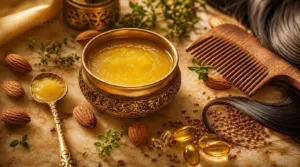
Ghee isn’t just cooking fat — it’s a concentrated source of nutrients that your hair and scalp can actually use. What’s inside it explains why it works so well as a topical treatment.
Those nutrients absorb directly into the follicle, much like how targeted hair treatments strengthen strands from the inside out.
Here’s a closer look at what makes ghee genuinely nourishing.
Clarified Butter Nutrient Profile
Ghee is almost entirely fat — around 100 g of fat per 100 g of product — which explains its impressive calorie density of roughly 900 calories.
Its fatty acid profile includes a saturated fat percentage near 63.7 g, plus short-chain fatty acids like butyric acid.
Protein content sits near zero, and carbs are practically absent, making ghee a concentrated, pure lipid source.
Like clarified butter, ghee is almost entirely 100% fat, which contributes to its high energy density.
Vitamins A, D, E, and K
Beyond the fat content, what really sets ghee apart is its lineup of fat-soluble vitamins.
Vitamin A promotes Vision Support and scalp health, vitamin D aids Bone Mineralization and immunity, and vitamin E delivers Antioxidant Protection by shielding hair fibers from oxidative damage.
Vitamin K manages Blood Clotting functions internally.
Because these vitamins require Fat-Soluble Absorption, ghee’s rich fat base actually helps your body use them efficiently.
Omega-3 and Omega-9 Fatty Acids
Vitamins aren’t the only players here. Ghee also delivers omega-3 and omega-9 fatty acids — two unsaturated fats that directly influence membrane lipid balance in your scalp tissue.
Omega-3 helps regulate inflammatory signaling, while oleic acid, ghee’s key omega-9, keeps the fatty acid ratio stable.
Together, they support healthier follicle environments, though EPA/DHA benefits for hair growth remain limited in topical form.
Why Organic Cow Ghee Matters
Not all ghee is equal. Pure organic cow ghee follows strict Organic Farming Standards — no synthetic pesticides, no routine antibiotics, and Hormone-Free Assurance you can trust.
Pasture-Based Nutrition shifts the fat profile meaningfully, delivering better Antioxidant Stability for your scalp health and hair mask results.
- Richer fat-soluble nutrients from grass-fed cows
- Cleaner inputs mean fewer unwanted scalp irritants
- Sustainable Production promotes dandruff control and hair loss prevention naturally
Benefits of Ghee for Hair
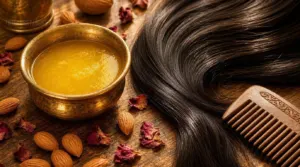
Ghee does more for your hair than most people expect from a kitchen staple. Once it’s on your strands, that rich lipid layer gets to work in several distinct ways.
Here’s what consistent use can actually do for your hair.
Deep Moisture Retention
When your hair loses moisture faster than it can hold it, dryness wins. Ghee forms an occlusive lipid film on each strand, acting as a water vapor barrier that slows evaporation and maintains a healthy moisture gradient.
Ghee seals each strand in a lipid film, locking moisture in before dryness can win
This hydration seal makes it an effective deep conditioning treatment for hair moisturization and scalp nourishment, especially as an overnight hair mask boosting cuticle hydration from root to tip.
Softer and Smoother Texture
When ghee melts into your strands, it works as a natural hair conditioner by depositing an emollient film that coats each fiber.
This slip enhancement reduces friction between strands, so combing feels less like a tug-of-war.
Warming ghee before use improves its warmer spreadability, allowing it to distribute evenly as a water emulsion, delivering real hair smoothness and hair texture improvement through consistent friction reduction.
Better Shine and Cuticle Support
When your cuticle lies flat, light bounces off evenly — and that’s exactly what ghee’s lipid coating encourages. The fat creates surface smoothness by settling into rough cuticle edges, boosting gloss enhancement through consistent light reflection.
- Cuticle flattening reduces scattered light
- Lipid coating enhances natural deep conditioning
- Oil penetration enhances hair texture
- Moisture sealing improves hair shine
- Surface smoothness amplifies gloss enhancement
Reduced Frizz and Easier Detangling
Frizz is really just friction in disguise. Ghee’s Anti-Frizz Film delivers a Slip Boost that coats each strand, enabling Friction Reduction that keeps hair softer and easier to manage.
That natural deep conditioning layer provides Humidity Resistance, so strands don’t puff up as quickly.
When tangled hair sections stay coated, Sectioning Control improves, and hair softening agents like ghee make detangling feels effortlessly smooth.
Less Breakage and Split Ends
Brittle strands don’t just break — they quietly accumulate damage until your ends look frayed and worn.
Ghee works on four levels to stop that cycle:
- Cuticle Sealing locks in moisture, preventing dryness that leads to split ends
- Moisture Backfill restores hair elasticity at the ends
- Friction Reduction lowers mechanical stress during detangling
- Environmental Barrier and strand flexibility keep conditioning intact longer
Scalp Benefits of Ghee
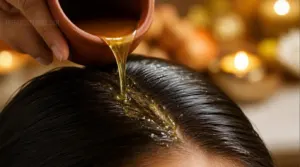
Your scalp is the foundation of healthy hair, and ghee works on it in more ways than most people expect. The fatty acids and vitamins it carries don’t just sit on the surface — they get to work where your hair actually starts.
Here’s what ghee can do for your scalp specifically.
Soothing Dry, Irritated Scalp
A dry scalp isn’t just uncomfortable — it’s your skin barrier waving a white flag. Ghee’s occlusive lipid layer seals in moisture, calming scalp inflammation much like an Oatmeal Soothing Mask or Chamomile Extract would. Pair it with Cooling Peppermint Oil for instant relief, or layer Aloe Vera Gel underneath for extra hydration before applying.
| Scalp Concern | Ghee-Based Solution |
|---|---|
| Dry scalp flaking | Ghee mask left on for 1–2 hours |
| Scalp inflammation | Ghee blended with Aloe Vera Gel |
| Persistent irritation | Ghee mixed with Cooling Peppermint Oil |
For stubborn dryness, a Niacinamide Serum applied before your ghee treatment strengthens the barrier further — think of it as building a foundation before painting the walls.
Anti-Inflammatory Fatty Acids
Ghee’s fatty acids do more than moisturize — they actively calm your scalp at a cellular level. They suppress NF‑κB signaling, which dials down inflammatory gene activity, while GPR120 signaling in immune cells reinforces those anti‑inflammatory effects.
Membrane raft disruption reduces leukocyte adhesion, limiting inflammatory cell buildup. Resolvins production then helps resolve lingering scalp inflammation, making ghee’s nutritional and antioxidant properties genuinely therapeutic for irritated scalps.
Dandruff and Flake Reduction
Calming inflammation is one piece of the puzzle — but keeping dandruff from coming back is another.
Ghee’s fatty acids offer natural antibacterial and anti-inflammatory action, which helps control Malassezia by creating a less hospitable scalp environment.
Think of it as a dry scalp remedy that works alongside a flake-reducing routine.
For stubborn cases, pairing ghee with anti-yeast ingredients like ketoconazole shampoo or zinc pyrithione use makes a real difference.
Scalp Massage and Blood Circulation
Keeping dandruff under control sets a healthier foundation — and massaging ghee into your scalp builds on that.
The pressure triggers vessel dilation, improving blood circulation and oxygen delivery to your follicles. Scalp massage also encourages lymphatic drainage, clearing metabolic waste, while muscle relaxation eases tension that can restrict local blood flow. Timing effects matter, though — the boost is temporary, not permanent.
Supporting Overall Scalp Barrier Health
All that improved circulation feeds directly into something bigger — your scalp’s barrier health.
Ghee promotes skin barrier protection through lipid barrier reinforcement, mimicking ceramide-mimic lipids that seal moisture between surface cells. This barrier hydration support helps maintain microbial homeostasis and pH balance maintenance, keeping irritation cycles from starting. Its anti-inflammatory and antioxidant fatty acids also calm the scalp condition, giving your skin layer a more stable, resilient foundation.
How to Use Ghee on Hair
Here’s what you need to know before you start.
Getting the results you want from ghee comes down to how you actually use it. Technique matters more than most people realize, and a few small habits can make a real difference in what your hair feels like afterward.
Warming Ghee Before Application

Temperature control is the first thing that separates a good application from a great one. Cold ghee drags, clumps, and misses spots. Warm it slightly before use — just 10 seconds in your palm or a quick microwave burst — and viscosity reduction kicks in, giving you better even distribution across every strand.
- Warm ghee flows easily into roots and dry patches
- Scalp comfort improves when the product isn’t cold on contact
- Massaging it into your scalp stays smooth when ghee stays workable
- Application timing matters — apply immediately after warming, before it resets
- Works well as a prewash treatment or under a warm towel wrap for deeper absorption
Using Ghee as a Hair Mask

Once you’ve warmed it, using ghee as a hair mask is straightforward. Apply 1–2 tablespoons evenly from scalp to ends, cover with a shower cap, and leave it on for one to two hours.
Always start with a patch test procedure to check your scalp pH balance and hair type suitability before committing fully — not every DIY hair mask works the same for everyone.
Pre-Wash Vs Overnight Treatments
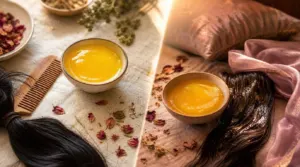
Choosing between pre-wash vs overnight ghee application really comes down to your scalp tolerance and how much conditioning depth you need.
- Pre-wash: shorter contact time, easier rinsing, less buildup risk
- Overnight: deeper conditioning, but heavier residue by morning
- Convenience tradeoff: pre-wash fits your wash day; overnight needs bedding protection
- Rinsing difficulty increases considerably with overnight use
- Sensitive scalps handle pre-wash better
Mixing Ghee With Carrier Oils
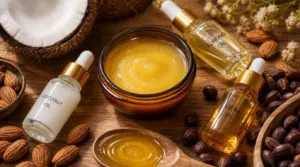
Ghee alone can feel like spreading cold peanut butter through your hair — thick, stubborn, and uneven. That’s why mixing it with natural hair oils transforms it into a smoother, more effective oil-based hair conditioner.
| Carrier Selection | Oil Ratio Guidelines | Texture Optimization |
|---|---|---|
| Mix it with coconut oil | 2 parts ghee: 1 part oil | Seals moisture effectively |
| Mix it with almond oil | 1 part ghee: 1 part oil | Lighter, softer finish |
| Jojoba oil | 1 part ghee: 2 parts oil | Fastest-absorbing DIY hair oil blend |
For shelf stability, store your blend in glass away from heat. Heat sensitivity matters too — warm it gently before use.
How Often to Apply Ghee
Once or twice a week is the sweet spot for most people. Your frequency guidelines should shift based on your hair type adjustments — fine hair needs less, while dry or coily hair tolerates more.
If you color your hair, go easy on clay formulas, and check whether L’Oréal’s clay shampoo is still available before stocking up on a gentler replacement.
Seasonal frequency tweaks matter too; winter calls for richer, more consistent topical application.
Always respect your patch test timing and watch your application interval closely to avoid potential side effects of ghee for hair.
Limits and Side Effects
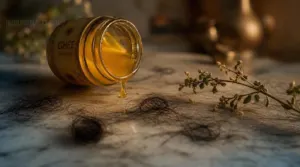
Ghee has real benefits, but it’s not without its drawbacks. Like most good things, using it too much or too often can turn a helpful habit into a problem.
Here’s what you should know before making it a regular part of your hair routine.
Greasy Residue and Heavy Hair
Too much of a good thing leaves its mark.
Lipid buildup from heavy coating can weigh fine strands down, causing volume reduction and greasy patches near the roots. Grease accumulation worsens with rinse inadequacy — if your shampoo doesn’t fully cut through the fat, oil buildup lingers.
Hair oily at the roots is one of the most common potential side effects of ghee for hair.
Clogged Pores and Folliculitis Risk
Greasy roots aren’t the only concern — clogged pores can follow close behind. Ghee’s occlusive film seals well, but that same barrier traps dead skin cells and sebum, creating prime conditions for oil buildup and scalp acne. Blocked follicles invite bacterial overgrowth, a key folliculitis trigger.
Among the side effects of topical ghee application, this safety consideration for ghee on scalp deserves real attention.
Why Daily Use May Backfire
Daily application compounds those clogged pores into a harder-to-break cycle. Oil buildup accelerates, hair flattening becomes noticeable, and scalp sensitivity can quietly worsen.
You’ll likely find yourself washing more often, which triggers washing fatigue and rebound oiliness.
Add heat tools into that routine, and heat damage risk climbs fast.
Among the side effects of topical ghee application, daily overuse ranks as a serious safety consideration for ghee on scalp.
No Proven Hair Growth Evidence
Beyond daily overuse risks, there’s a bigger truth worth knowing: ghee won’t regrow hair.
- Clinical Evidence Gap means no controlled trial has been conducted
- Regeneration Claims Unproven — follicles need hormonal, not fatty, signals
- Growth Claim Skepticism is warranted; anecdotal results only reflect cosmetic change
- clinical studies on hair confirm ghee improves shaft feel, not follicle output
- Potential benefits of ghee for hair stay cosmetic, not regenerative
Frequently Asked Questions (FAQs)
Can we apply ghee on hair every day?
Applying ghee daily isn’t ideal. Without proper Hair Weight Management, buildup affects Scalp Oil Balance.
Stick to 1–2 times weekly, adjusting for your hair type, to avoid greasiness and keep strands healthy.
Which is better, ghee or coconut oil?
Both have merit. Ghee wins on vitamins and scalp richness; coconut oil is lighter, more affordable in cost comparison, and neutral in aroma.
Your hair type, cultural preference, and shelf life needs decide the better fit.
How do you apply ghee to your hair?
Warm a tablespoon of ghee, then use the Hand Brush Method for Sectioned Application — working root to tip. Seal with a Shower Cap Seal, wait 30 minutes, then rinse thoroughly.
Do Indians put ghee in their hair?
Yes, many Indians do. Rooted in the Ayurvedic Champi Ritual, warm ghee — especially desi cow ghee — has been massaged into scalps for generations as a core family hair tradition.
How to use ghee for hair growth?
Ghee doesn’t directly grow hair, but root application with a scalp heat wrap and layered oil infusion can support follicle activation timing, improve scalp health, and reduce breakage — which helps retain length over time.
Why should you use ghee on your scalp?
Your scalp is the foundation of healthy hair. Using ghee delivers butyrate soothing, follicle nutrition, and microbial defense — all while supporting scalp pH balance through its natural anti-inflammatory fatty acids.
Does ghee help with hair loss?
Honestly, no clinical study confirms that ghee stops hair loss.
It can reduce breakage and soothe your scalp, but hormonal influence and follicle blockage sit outside what any topical oil can fix.
Is ghee good for hair overnight?
Overnight application works well for dry or frizzy hair, but hair type suitability matters. Oil-prone hair may feel weighed down. Use a shower cap to avoid pillowcase staining.
Is ghee bad for your hair?
Used carefully, ghee is generally safe, but it can cause scalp acne, clogged pores, or dairy sensitivity reactions in some people.
Always do a patch test first to avoid unwanted side effects.
How long should I leave ghee in my hair?
For most hair types, 30 to 60 minutes covers the ideal contact duration. Extremely dry hair can handle a prewash vs overnight ghee application, but watch for nighttime risks like clogged pores.
Conclusion
Ghee won’t transform your hair overnight—but that’s not the point. The benefits of ghee for hair build quietly: moisture that stays, a calmer scalp, strands that resist breaking instead of surrendering to it.
Used with intention and the right frequency, it earns its place in your routine. Used carelessly, it works against you.
The difference between a remedy and a problem is almost always how well you understand what you’re applying.