This site is supported by our readers. We may earn a commission, at no cost to you, if you purchase through links. This content is for general informational and educational purposes only and is not a substitute for professional medical, dermatological, or nutritional advice.
Most people know buckwheat as a pancake ingredient or a noodle base. Few think of it as a tool for stronger, fuller hair—but trichologists have been paying attention to its nutrient profile for good reason.
Buckwheat delivers complete protein, B vitamins, zinc, iron, and rutin, a flavonoid that boosts scalp circulation and fights oxidative stress on follicles. That’s a rare combination in a single plant food.
Whether your hair feels thin, breaks too easily, or lacks its old shine, buckwheat for hair is worth understanding from the inside out—and sometimes from the outside in.
Table Of Contents
- Key Takeaways
- Is Buckwheat Good for Hair?
- Buckwheat Nutrients That Support Hair
- 5 Benefits of Buckwheat for Hair
- Buckwheat for Hair Loss and Thinning
- How to Eat Buckwheat for Hair
- Topical Buckwheat Treatments and Safety
- Frequently Asked Questions (FAQs)
- Which juice stops hair fall?
- Is buckwheat good for anemia?
- What Other Health Benefits Does Buckwheat Provide?
- How Often Should I Use Buckwheat for My Hair?
- Are There Any Side Effects of Using Buckwheat for Hair?
- Are There Any Other Ways to Use Buckwheat for Hair?
- Does buckwheat help hair grow?
- What are the big 3 for hair regrowth?
- Which grain is best for hair growth?
- What are the pros and cons of buckwheat?
- Conclusion
Key Takeaways
- Buckwheat is one of the few plant foods that delivers complete protein, B vitamins, zinc, iron, and rutin all at once — a rare combo your follicles can actually use.
- Rutin, buckwheat’s standout flavonoid, boosts scalp circulation and shields follicles from oxidative damage, making it more than just a nutrition play.
- Eating buckwheat 2–4 times a week beats any single big serving — consistency is what keeps your hair fed and your results visible.
- Topical treatments like buckwheat flour paste or a groat water rinse add an extra layer of support, but always patch test first — natural doesn’t mean reaction-proof.
Is Buckwheat Good for Hair?
Buckwheat isn’t just a trendy grain — it’s packed with nutrients your hair actually needs. Whether you’re dealing with thinning, breakage, or dull strands, it’s worth understanding what this seed can realistically do.
Its vitamins work from the inside out, much like the nourishing properties explored in this guide to strengthening hair with natural ingredients.
Here’s a closer look at three things worth knowing before you add it to your routine.
Why Buckwheat is Linked to Healthier Hair
Buckwheat earns its place in a hair-supportive diet for good reason. It delivers protein, B vitamins, and minerals your follicles actually use.
Its antioxidant properties and anti-inflammatory effects help protect the scalp, while a blood circulation boost from rutin feeds roots more efficiently.
Add low glycemic impact, silica content, and gut microbiome support, and you have a genuinely well-rounded food for hair growth.
Research shows that zinc and magnesium support hair by strengthening follicles.
Who May Benefit Most From Adding It
Not everyone benefits equally. Those most likely to see a difference include:
- Pregnant individuals and vegetarian athletes with higher nutrient demands
- Older adults and gluten-free dieters replacing low-nutrient staples
- People managing stress-related shedding or hair thinning from poor diet
Its low glycemic index and essential minerals make buckwheat especially useful when nutritional gaps are quietly driving hair loss.
What Buckwheat Can and Cannot Do for Hair
Knowing its limits matters as much as knowing its strengths.
Buckwheat strengthens hair and delivers real nutritional benefits of buckwheat for hair health — protein, minerals, B vitamins — but Genetic Constraints and Hormonal Influence can drive hair loss beyond what diet alone can fix.
Think of it as a Medical Adjunct, not a cure.
Nutrient Timing and consistent intake matter more than any single Dosage Recommendations.
Its high-quality plant protein helps strengthen hair follicles.
Buckwheat Nutrients That Support Hair
Buckwheat brings a surprisingly dense lineup of nutrients to the table — and several of them work directly in favor of your hair. Each one plays a distinct role, from building the strand itself to keeping the follicle healthy and protected.
Here’s a closer look at the key nutrients and what they actually do.
Protein and Amino Acids for Keratin Production
Your hair is mostly keratin — and keratin is built from amino acids. Buckwheat delivers all eight essential ones, including cysteine, lysine, leucine, and methionine.
Buckwheat delivers all eight essential amino acids your hair needs to build keratin from the inside out
Cysteine supply alone accounts for roughly 17% of keratin’s structure. Lysine importance shows up in its role forming the protein’s core shape.
Leucine contribution and methionine balance round out amino acid completeness, supporting real protein quality and keratin synthesis for lasting hair strength.
B Vitamins for Scalp and Follicle Health
Your follicles run on B vitamins.
The Biotin Pathway drives keratin production at the cellular level, while Niacin Circulation keeps blood moving to your scalp so nutrients actually reach each root.
Pairing these pathways with the right topical ingredients—like honey’s humectant properties—makes a real difference, and exploring hair moisturizing ingredients that support scalp health can help you build a routine that works from the inside out.
Pantothenic Moisture prevents dry, flaky skin around follicles, and Riboflavin Energy fuels rapid cell turnover inside the bulb.
Pyridoxine Metabolism — vitamin B6 — converts dietary protein into usable building blocks.
Together, these B vitamins are the backbone of scalp health.
Zinc, Iron, Magnesium, and Copper for Stronger Strands
Minerals are the quiet architects behind every strand you grow. Buckwheat delivers a precise mineral synergy — zinc, iron, magnesium, and copper — that works as keratin cofactors, each playing a distinct role:
- Zinc drives keratin synthesis directly inside hair follicles
- Iron powers follicle oxygenation, keeping roots active
- Magnesium anchors protein assembly for resilient strands
- Copper builds collagen, boosting elasticity
Smart dietary ratios and absorption boosters enhance every milligram.
Rutin and Antioxidants for Follicle Protection
Buckwheat’s rutin acts as an anti-inflammatory compound that shields hair follicles from daily oxidative damage.
It activates the Nrf2 pathway, boosts scalp blood flow, and blocks follicle cell death through anti-apoptotic defense.
Quercetin works alongside it — a complementary action that neutralizes free radicals before they stall growth.
| Antioxidant | Key Action | Hair Benefit |
|---|---|---|
| Rutin | Free radical scavenging | Protects growing follicles |
| Quercetin | Oxidative stress defense | Slows follicle damage |
| Flavonoids | Immune support | Reduces scalp inflammation |
5 Benefits of Buckwheat for Hair
Buckwheat brings a surprising range of benefits to your hair, and most of them come down to its dense nutrient profile. Each benefit targets a different concern, from slow growth to dullness and damage.
Here’s what you can expect when buckwheat becomes a regular part of your routine.
Supports Healthier Hair Growth
Think of your hair like a growing plant — it needs the right soil.
Buckwheat for hair growth and nail health works from the inside out, delivering protein and B vitamins that fuel keratin production.
Its nutrients support blood circulation to the scalp, promote hormonal balance, and even benefit your gut microbiome, all of which quietly drive the nutritional benefits of buckwheat for hair health and hair growth promotion with buckwheat.
Helps Reduce Shedding and Breakage
Shedding more than 100 hairs daily? That’s often a sign that your follicles aren’t getting enough support.
Buckwheat targets this through several pathways:
- Keratin Synthesis Support — Protein and vitamin B6 strengthen the hair shaft, reducing split ends and snap-off breakage.
- Microcirculation Enhancement — Rutin improves scalp blood flow, cutting premature hair shedding.
- Gut-Scalp Axis — Fiber feeds beneficial bacteria, lowering inflammation and protecting follicles from oxidative damage.
Strengthens Weak, Brittle Strands
Brittle strands often signal a mineral gap, not just damage. Buckwheat targets this directly.
Its Silica Collagen Boost strengthens hair cuticles through enhanced collagen production, while Copper Enzyme Activation triggers lysyl oxidase — the enzyme that reinforces your hair’s inner matrix.
Magnesium Flexibility Aid prevents that dry, snap-off breakage. Rutin Vascular Support delivers steady nutrients to follicles.
Together, they rebuild protein and keratin production, restoring real Silica Strand Resilience and hair elasticity.
Improves Shine and Softness
Strong, resilient strands are only half the story — shine and softness are where hair health becomes visible.
Buckwheat provides both through:
- Cuticle Smoothing via amino acids that flatten the outer layer for better light reflection
- Silica Fortification that firms each strand’s surface
- Moisture Retention through magnesium-supported hydration
- Surface Hydration from rutin improving scalp microcirculation
- Hair Nourishment via buckwheat extract’s antioxidants for lasting hair conditioning and hair elasticity
Helps Reduce Split Ends Over Time
Shine gets you noticed — but preventing split ends keeps your progress intact.
Buckwheat’s protein feeds keratin production, while its antioxidants reduce cuticle wear from daily mechanical stress management. That helps healthier ends over time.
| What Buckwheat Helps | Why It Matters |
|---|---|
| Cuticle Hydration | Keeps hair cuticles sealed and smooth |
| Heat Styling Reduction | Less damage means fewer split ends |
Pair it with Gentle Brushing Techniques and a Regular Trimming Schedule for real results.
Buckwheat for Hair Loss and Thinning
Hair loss isn’t always about genetics — often, it starts with what your body is missing. Buckwheat targets several of those gaps in a surprisingly practical way.
Here’s how it works across the key factors that affect thinning hair.
How Nutrient Deficiencies Affect Hair Fall
Hair loss often comes down to what’s missing from your diet. Iron Deficiency, Zinc Deficiency, Vitamin D Deficiency, and Biotin Deficiency can all push follicles into early shedding.
Protein Malnutrition does the same — follicles are metabolically demanding and drop out quickly when fuel runs low.
Any nutrient deficiency and loss trigger diffuse thinning across the scalp, not just one patch.
Why Protein and B Vitamins Matter
Once you know deficiencies drive shedding, the fix becomes clearer: rebuild the foundation.
Protein feeds amino acid balance so your body can synthesize keratin continuously. B-vitamin cofactors handle metabolic support, DNA synthesis in fast-dividing follicle cells, and hair follicle energy. Buckwheat delivers both.
- Protein shortages push follicles into early rest phase
- Folate aids rapid cell division in the hair matrix
- Riboflavin activates other B vitamins your follicles depend on
- Niacin keeps scalp tissue healthy for better hair growth
- B6 directly influences hair health and strength at the shaft
The Role of Minerals in Follicle Function
Minerals do the heavy lifting inside each follicle — and buckwheat delivers several key ones.
| Mineral | Role in Follicle | Risk of Deficiency |
|---|---|---|
| Zinc | Facilitates zinc cell division and keratin synthesis | Shedding, brittle strands |
| Iron | Powers iron oxygen transport to matrix cells | Telogen effluvium |
| Copper | Maintains copper connective tissue integrity | Fragile, weak hair |
Selenium antioxidant defense shields fast-dividing follicle cells from oxidative damage.
Magnesium aids follicle repair by supporting protein synthesis.
Mineral balance interactions matter too — excess zinc can lower copper and disrupt iron, so food sources beat high-dose supplements every time.
When Buckwheat May Support a Hair-friendly Diet
Buckwheat fits naturally into your diet when specific conditions make other grains harder to tolerate or less effective.
If you’re managing gluten-free meal planning, low-FODMAP inclusion, postmenopausal support, or pregnancy nutrition, it delivers protein, B vitamins, and high antioxidant levels without the drawbacks.
Athletes can lean on it for post-workout recovery too.
As a nutrient-dense superfood, buckwheat promotes hair growth wherever nutritional gaps exist.
How to Eat Buckwheat for Hair

Getting buckwheat into your routine is easier than you might think. It comes in a few forms, and each one fits differently into your meals and schedule.
Here’s how to make it work for your hair and your life.
Buckwheat Groats, Flour, and Soba Options
You’ve got three solid forms to work with: buckwheat groats, flour, and soba noodles. Groats are the whole seeds — nutty, chewy, and packed with protein and high antioxidant levels. Toast them using kasha toasting techniques for deeper flavor.
Buckwheat flour works as an alternative flour for pancakes or crepes. For buckwheat pasta, check soba noodle texture and gluten‑free labeling carefully, since many brands blend in wheat.
Easy Buckwheat Breakfast Ideas
Starting your day with buckwheat is one of the easiest moves you can make for hair growth.
Simmer buckwheat groats into warm Buckwheat porridge and top with berries for Fruit‑Topped Porridge. Blend soaked groats into a No‑Cook Smoothie bowl. Flip a stack of Buckwheat Pancakes. Build Savory Breakfast Bowls with eggs and spinach. These buckwheat recipes fit a hair‑supporting diet effortlessly.
Hair-supporting Meal Pairings With Protein and Vitamin C
Pairing buckwheat with protein and vitamin C turns an ordinary meal into a hair-growth strategy.
Try Citrus Chicken Soba with lemon for iron absorption, a Berry Lentil Bowl for folate plus antioxidants, Pepper Tofu Stir with zinc-rich buckwheat, Lemon Shrimp Pilaf, or a Spinach Quinoa Mix.
Each combo targets hair health and strength from multiple angles.
How Often to Include Buckwheat in Your Diet
Aim for 2 to 4 servings a week — that’s your sweet spot for a Weekly Rotation that keeps meals varied. Portion Control matters too; one cooked cup per meal is plenty.
Consistency matters more than volume, so steady habits beat occasional large servings. Pair buckwheat within a Nutrient-Rich Diet for Strong Hair, and your follicles get reliable, ongoing support.
Topical Buckwheat Treatments and Safety
Eating buckwheat is a solid foundation, but you can take things further by applying it directly to your hair and scalp. A few simple DIY treatments let you target dryness, buildup, and weak strands from the outside in.
what you can try at home — and what to watch out for before you start.
DIY Buckwheat Flour Shampoo
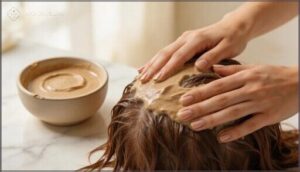
A simple buckwheat flour shampoo starts with three tablespoons of finely ground flour mixed with just enough water to form a smooth paste — your mixing ratio matters here.
Work it into wet hair, focusing on the scalp, using a gentle massage as your application technique.
Rinse after two to three minutes.
Don’t store it; make it fresh each time, since storage stability is poor without preservatives.
Buckwheat Water Rinse for Scalp Care

The flour paste manages cleansing, but buckwheat water targets your scalp differently. Soak groats overnight, strain the liquid, and you have a gentle rinse ready for topical buckwheat hair treatment.
- Rinse concentration: boil for stronger results
- Cold water application: seals follicles after use
- Scalp hydration: apply directly, not just lengths
- Usage frequency: two to three times weekly
Buckwheat extract delivers dietary antioxidants that calm irritation and support hair follicles and hair growth.
Using Buckwheat Honey in Hair Masks
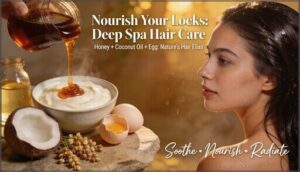
Buckwheat honey takes topical buckwheat hair treatments a step further. It works as a humectant moisture lock, drawing water into your strands, while its antimicrobial scalp properties help calm irritation.
Apply it alone or try ingredient pairings like coconut oil or egg for a deeper treatment. Leave it on for 15–20 minutes, then rinse with warm water for antioxidant protection and noticeable softness.
Patch Testing and Allergy Precautions

Natural doesn’t always mean reaction-free. Before committing to any topical buckwheat hair treatments, do a quick patch test — apply a small amount to your inner arm and wait 48 hours, then check again at 96 hours for delayed reactions.
This two-stage patch test timing catches most allergens. If redness or itching appears, allergen identification and avoidance strategies become your next priority.
Common Mistakes to Avoid With DIY Treatments
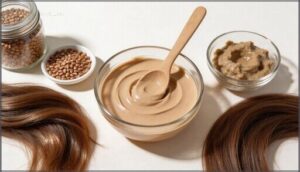
Even the best DIY deep treatment fails when the basics slip. Keep storage hygiene tight — use clean tools, dry containers, and never leave wet mixes sitting out. Mix consistency matters too: avoid overloading with honey or thick ingredients that won’t rinse thoroughly. Monitor shelf life closely, since homemade products spoil fast.
For hair thinning concerns, using buckwheat topically for hair and its protein benefits works best when preparation is done right.
Frequently Asked Questions (FAQs)
Which juice stops hair fall?
No single juice stops hair fall completely, but some come close.
Onion juice, amla juice, carrot juice, aloe vera juice, and prune juice each target hair loss differently through protein, vitamin E, and nutrient-dense superfood compounds that support hair growth.
Is buckwheat good for anemia?
Yes, it can help.
Buckwheat offers iron, copper, and folate anemia support in one nutrient-dense superfood. Pair it with vitamin C for an iron bioavailability boost, since phytic acid mitigation matters when ferritin runs low.
What Other Health Benefits Does Buckwheat Provide?
Buckwheat is a quiet workhorse for your whole body.
It promotes Heart Health Support, Blood Sugar Regulation, Digestive Health, Anti-Inflammatory Effects, and Bone Strength — delivering real, measurable results well beyond your scalp.
How Often Should I Use Buckwheat for My Hair?
For dietary frequency, aim for 2–3 meals per week. Adjust your shampoo cycle and mask application rate based on hair type adjustments and allergy watch signals your scalp sends.
Are There Any Side Effects of Using Buckwheat for Hair?
Most people tolerate buckwheat well, but side effects exist. Allergic Dermatitis, Respiratory Irritation, and Digestive Discomfort can occur.
Cross Reactivity with latex or rice is possible.
Pregnancy Uncertainty means caution is advised.
Are There Any Other Ways to Use Buckwheat for Hair?
Beyond the kitchen, buckwheat hull pillows support spinal alignment and reduce hair tangling overnight.
Buckwheat extract also appears in serums, scalp oils, and heat protectants—delivering hair growth nutrients topically for hair follicles as a natural remedy.
Does buckwheat help hair grow?
Yes, it can. The protein, B vitamins, and zinc in buckwheat feed your hair follicles directly, supporting stronger, faster growth — especially when your diet’s been missing these key nutrients.
What are the big 3 for hair regrowth?
The Big 3 are Minoxidil Therapy, Finasteride Blocker, and Ketoconazole Shampoo. This Combination Regimen follows a Treatment Timeline of 9–12 months for peak hair growth results.
Which grain is best for hair growth?
Think of grains like a team — each one brings something different. Quinoa protein leads the pack, delivering all nine amino acids your hair follicles need to build strong keratin.
What are the pros and cons of buckwheat?
Buckwheat brings solid wins — gluten‑free, rich in protein, antioxidants, and digestive fiber, with real heart health benefits.
The downsides? Allergy risks, a strong flavor, and a high glycemic load if you overdo it.
Conclusion
Think of buckwheat as a tiny powerhouse, quietly fueling your hair’s potential. Its unique blend of protein, vitamins, and minerals doesn’t just feed your body—it fortifies strands from root to tip.
Whether you eat it or use it topically, buckwheat for hair becomes a simple yet effective ally against thinning, breakage, and dullness.
Start small: swap your morning cereal for groats, or try a flour rinse.
Consistent use turns subtle shifts into visible results—stronger, shinier hair that reflects what you nourish it with. Your routine deserves this natural upgrade.