This site is supported by our readers. We may earn a commission, at no cost to you, if you purchase through links.
You won’t find bed bugs setting up camp in your hair, despite what late-night internet searches might suggest. These flat-bodied parasites lack the specialized claws and adaptations that lice use to cling to hair shafts. Their oval bodies and smooth legs can’t grip individual strands, and the constant movement, natural oils, and regular washing make your scalp an inhospitable environment.
While a bed bug might briefly crawl across your head during a nighttime feeding, it won’t stick around. Understanding this distinction matters because misidentifying the problem leads to ineffective treatments and wasted time. The real threat isn’t in your hair—it’s hiding in the cracks and crevices around your bed, waiting for darkness to feed.
Table Of Contents
- Key Takeaways
- Can Bed Bugs Live in Your Hair?
- How Bed Bugs Interact With The Human Body
- Signs of Bed Bugs in Hair
- Why Bed Bugs Rarely Stay in Hair
- What to Do if You Find a Bed Bug in Hair
- Preventing Bed Bugs From Reaching Your Hair
- Frequently Asked Questions (FAQs)
- How to tell if you have bed bugs in your hair?
- Do bed bugs wash off in the shower?
- Can bed bugs lay eggs in your hair?
- Where do bed bugs hide on your body?
- Can bedbugs live in hair?
- Can bed bug bites cause hives and welts?
- Do bed bugs cling to hair?
- Do bed bugs eat human hair?
- Can bed bugs lay eggs in human hair?
- Do bed bugs live on your head?
- Conclusion
Key Takeaways
- Bed bugs can’t live in your hair because their flat, oval bodies lack the specialized claws and adaptations needed to grip hair shafts, and your scalp’s constant movement, oils, and washing make it an inhospitable environment.
- While a bed bug might briefly crawl across your head during nighttime feeding, it will quickly retreat to its preferred hiding spots in mattress seams, bed frames, and furniture cracks rather than staying in your hair.
- The real threat lies in misidentifying bed bugs as lice, which leads to ineffective treatments—bed bugs feed every 5–10 days and leave your body immediately, while lice live continuously in hair and require different removal methods.
- Effective prevention focuses on washing bedding at 60°C weekly, using mattress encasements, vacuuming bed frames and seams, and monitoring for early signs like dark fecal spots and shed skins near sleeping areas.
Can Bed Bugs Live in Your Hair?
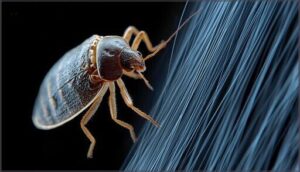
Here’s the good news: bed bugs can’t actually live in your hair. Their flat, oval bodies aren’t built for gripping onto hair strands the way lice are, and they strongly prefer cool, hidden cracks near your bed over the warm surface of your scalp.
Let’s break down exactly why your hair isn’t a viable home for these pests.
Bed Bug Biology and Adaptations
Bed bugs are parasites with specific adaptations that set them apart from other insect bites you might encounter. Understanding their biology helps you spot an infestation early:
- Flat bodies squeeze into cracks as thin as a credit card
- Piercing mouthparts deliver anesthetics while feeding on blood
- Five nymphal stages require blood meals to reach maturity
- Rapid reproduction produces hundreds of eggs per female
Recognizing can greatly improve your chances of early detection and proper management.
If you’ve already damaged your strands, learning how to fix burnt hair from a curling iron can help you restore moisture and prevent further breakage.
Why Hair is Not a Suitable Habitat
Your scalp environment creates conditions that actively deter bed bug ecology and insect adaptation. Hair lacks the stable microclimate these parasites need—it offers no continuous shelter, minimal humidity, and constant movement from grooming. Unlike lice, bed bugs can’t cling to hair shafts.
Your scalp’s constant movement, warmth, and lack of hiding spots make it impossible for bed bugs to establish a colony in your hair
Human hygiene routines, including washing and combing, quickly remove any stray bugs, preventing infestation before it starts.
Temporary Presence Vs. Infestation
Finding a single bug doesn’t mean you’ve got an infestation on your scalp. That stray bedbug likely wandered from bedding or furniture, not a colony in your hair. Real infestations show up as multiple sightings over days, clusters of bites, and dark fecal spots on sheets—not isolated hair inspection incidents.
Temporary infestation signs differ from true infestations:
- One bug appearance means accidental contact, not sustained habitat
- Lice cause persistent itching; bedbugs feed every 5–10 days then retreat
- Hair inspection reveals no eggs or exoskeletons in genuine bedbug cases
- Bug behavior favors mattress seams over scalp crevices for long-term survival
- Prevention methods target bedding and furniture, where infestations actually thrive
How Bed Bugs Interact With The Human Body
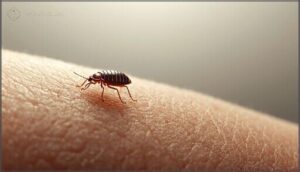
Bed bugs don’t live on people the way lice or fleas do. They approach the human body with one goal: feed quickly and retreat to safety.
Bites often resemble ingrown hair bumps, appearing as small red welts that can become infected if scratched or irritated.
Understanding how they interact with you reveals why your hair isn’t their home—and what they’re really after.
Feeding Habits and Biting Behavior
Unlike mosquitoes, that feed and flee, bedbugs settle in for a longer meal. These blood feeders pierce your skin with a beak-like structure, drawing blood for 5 to 10 minutes per feeding.
You won’t feel it happening—they inject a numbing agent during the bite. Most feeding occurs at night when you’re still, and bites appear as small red welts that may itch for days.
Preferred Hiding Spots on Humans
Your body doesn’t offer bed bugs the permanent shelter they crave. While they crawl across human skin briefly to feed, these pests avoid lingering on you. Instead, they favor:
- Folds in clothing seams pressed against your body during sleep
- Body crevices like underarms or behind knees where fabric gathers
- Hairline cracks in headbands or tight accessories worn overnight
- Gaps near waistbands or sock elastic offering temporary refuge
- Bedding edges touching exposed skin throughout the night
They retreat quickly after bites appear.
Differences From Hair-Adapted Parasites
True parasites like lice possess specialized adaptations for hair survival—bed bugs don’t. Lice cling to individual hair strands with hooked claws, feed continuously near the scalp, and complete their entire life cycle within hair. Bed bugs lack these adaptations entirely. Their flat bodies and smooth legs can’t grip hair shafts, and they require cracks for shelter, not follicles.
| Parasite Comparison | Lice (Hair-Adapted) | Bed Bugs |
|---|---|---|
| Bug Adaptations | Hooked claws grip hair | Smooth legs, can’t cling |
| Host Preferences | Lives continuously in hair | Hides in cracks, visits briefly |
| Infestation Dynamics | Feeds daily on scalp | Feeds every few days on skin |
| Hair Ecology | Completes lifecycle in hair | Requires crevices to survive |
Signs of Bed Bugs in Hair
Finding a bed bug in your hair can be unnerving, but knowing what to look for helps you respond quickly.
The signs aren’t always obvious, and it’s easy to confuse bed bugs with other pests like lice or fleas.
Here’s what you need to watch for to identify the real problem.
Recognizing Bed Bug Bites on The Scalp
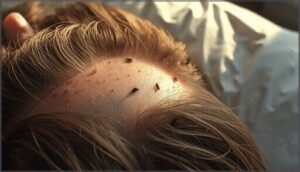
You may notice small red welts or raised bumps along your hairline and behind the ears, often forming linear or zigzag patterns from successive bites. Scalp bites from bedbugs cause intense itching, especially at night, and can take hours to days to appear. The discomfort may persist for weeks if untreated, leading to scratching and potential infection.
Bed bugs can be found in, not just in beds, making awareness and prevention essential.
Identifying Bed Bugs Vs. Lice or Fleas
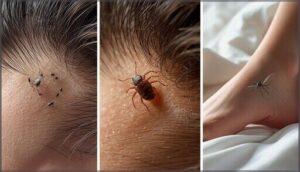
Distinguishing bedbugs from lice or fleas requires understanding their distinct behaviors and habitats. Each pest leaves unique evidence, helping you identify the real culprit behind bites and itching.
- Lice stay on your scalp constantly, attaching nits to hair shafts, while bedbugs retreat to furniture crevices after feeding.
- Fleas jump between hosts and leave clustered bites on ankles and legs.
- Bedbugs crawl slowly, producing linear bite patterns on exposed skin during sleep.
Physical Evidence to Watch For
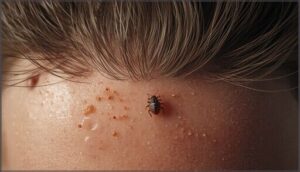
Spotting the signs early can save you weeks of stress. Check your scalp for dark fecal spots that smudge when wiped—these appear as tiny rust-colored stains on light hair. You might also find translucent bed bug shells from molting stages or dark hair debris near the hairline.
Unlike lice, bedbugs don’t attach to follicles, but their bites create raised skin lesions and scalp irritation in clustered patterns.
Why Bed Bugs Rarely Stay in Hair
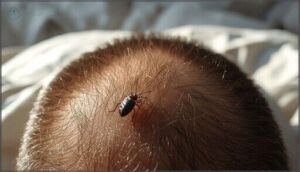
If you’ve spotted a bed bug in your hair, it’s natural to worry about an infestation taking hold there. The good news is that bed bugs aren’t built to survive in human hair for long. Their physical structure and survival needs make hair one of the least likely places they’ll stick around.
Limitations of Bed Bug Body Structure
Bed bugs’ anatomy works against hair colonization in multiple ways. Their tough exoskeletons, while protective on flat surfaces, limit body flexibility needed to navigate dense hair strands. The claw-based leg design grips fabric well but can’t anchor securely to smooth hair shafts.
After feeding, their expanded abdomens become too bulky to maneuver through tight follicle spaces, and their specialized mouthparts simply aren’t built for scalp attachment.
Hair Follicle Environment and Survival
Beyond body structure, your scalp ecosystem actively discourages bed bug adaptation. Hair follicles maintain a humid, sebum-coated microenvironment that’s vastly different from the cool, dry crevices these pests prefer.
The follicle’s immune surveillance, vascular network, and constant cell turnover create conditions inhospitable to bed bugs. Meanwhile, the hair shaft protection and tight cellular junctions physically bar entry—unlike lice, which evolved specifically for scalp colonization through millions of years.
Risks of Finding a Bed Bug in Hair
Finding a bedbug in your hair isn’t medically alarming, but it signals a nearby infestation you need to address. Here are the realistic risks:
- Scalp irritation from bites, not true hair infestation
- Secondary infection if you scratch bite sites aggressively
- Mistaking bedbugs for lice, delaying proper treatment
- Transmission to others through shared belongings, not hair-to-hair contact
The bug itself poses minimal direct threat—your environment does.
What to Do if You Find a Bed Bug in Hair
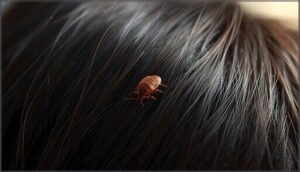
Finding a bed bug in your hair can feel alarming, but don’t panic. The bug is likely just passing through, not setting up camp.
Here’s what you should do right away: remove it, clean up properly, and decide if you need backup from the pros.
Immediate Steps for Removal
When you discover a bed bug crawling through your hair, don’t panic—swift action makes all the difference. First, gently inspect your scalp under bright light to confirm the presence of bugs. Collect any visible pests with a tissue and seal them in a bag for identification. This initial bug extraction prevents further spread.
| Action | Purpose |
|---|---|
| Inspect scalp carefully | Confirm bed bug presence |
| Seal bugs in bag | Enable proper identification |
| Vacuum headboard area | Remove loose eggs and pests |
Next, isolate your sleeping area by removing clutter and vacuuming around your bed frame and headboard. Dispose of the vacuum bag immediately in an outdoor trash can to prevent reentry. Place all potentially contaminated clothing, towels, and bedding in sealed plastic bags until you can treat them properly.
For hair treatment, use a gentle, non-conditioning shampoo and rinse thoroughly. Apply a fine-toothed lice comb to remove any remaining bugs or eggs from your hair strands. These removal techniques work because bed bugs can’t grip hair follicles effectively—they’ll wash out easily with proper infestation control methods.
Treat your scalp if itching persists. Apply a medicated anti-itch cream as directed, but avoid heavy oils or conditioners that could trap pests. Recheck your hair with a mirror and flashlight after 24 hours to verify complete removal.
Don’t forget your surroundings. Remove all headwear and accessories, then launder them at high heat or seal them in plastic bags. Vacuum upholstered furniture, focusing on cushions and seams where bugs hide during daylight hours. Encase your mattress and pillows with bed bug-proof covers for at least 12 months to prevent reinfestation.
Monitor your environment closely. Check sleeping areas with a flashlight every three days for signs of reappearance. If multiple bugs persist after these eradication methods, professional pest control becomes necessary—these experts can provide targeted treatment and follow-up inspections every two weeks during the critical early phase.
Effective Washing and Heat Methods
After removing visible bugs from your hair, laundry sanitizing becomes your most powerful weapon. Washing cycles set to 60°C kill bed bugs instantly on fabrics, pillowcases, and headwear.
Follow with heat treatment in the dryer—140°F for 30 minutes provides complete fabric protection. This drying method eliminates any remaining pests clinging to your scalp-adjacent items, giving you control over the infestation.
When to Seek Professional Help
Persistence signals the need for expert consultation. If your self-care efforts don’t resolve the problem within two weeks, contact pest control and management professionals for a thorough inspection and treatment plan.
Seek professional guidance when:
- Bites or infection worsen despite washing and heat methods
- You find multiple bugs, indicating widespread infestation
- Symptoms affect daily functioning or sleep quality
- DIY approaches fail to provide relief after consistent effort
Preventing Bed Bugs From Reaching Your Hair

You don’t need to wait until bed bugs show up in your hair to take action. The best defense is stopping them from ever getting that close in the first place.
Focus on three key areas: keeping your sleeping space clean, protecting your bedding, and catching infestations early.
Home Cleaning and Bed Hygiene
Regular hygiene keeps bedbugs away from your hair and sleeping area. Wash all bedding, including sheets and pillowcases, at 60°C or higher every one to two weeks to eliminate any hitchhikers.
Vacuum your mattress seams, bed frame, and surrounding floor weekly, focusing on cracks where bedbugs hide. Heat-dry everything thoroughly, since high temperatures kill bedbugs at all life stages, protecting both your scalp and sleep space.
Protective Measures for Bedding
You can shield your mattress and bed frame with specialized fabric treatments and mattress encasements that block bedbugs from reaching your hair. Zippered covers seal the entire mattress, while reinforced bedding barriers prevent entry through seams.
Laundry protocols at 60°C protect sheets and pillowcases. Apply bed frame seals to cracks, creating a fortress that keeps these parasites away from your scalp.
Monitoring and Early Detection Strategies
You can catch bed bugs before they reach your hair by using early warning systems like passive monitors and sticky traps along bed frames.
Surveillance methods that track infestation signs—dark droppings, shed skins, and musty odors—help you spot these pests fast.
Detection tools paired with weekly visual checks protect you from skin irritation and insect bites that signal growing problems.
Frequently Asked Questions (FAQs)
How to tell if you have bed bugs in your hair?
You probably won’t find bed bugs camping out in your hair—they’re terrible climbers and prefer mattress seams.
But if you notice itchy scalp bites, check for lice instead through careful Hair Inspection Tips and Scalp Examination.
Do bed bugs wash off in the shower?
Yes, bed bugs wash off in the shower. Hot water and shampoo effectively rinse them from your hair and skin, as their flat bodies can’t cling against water pressure and soap.
Can bed bugs lay eggs in your hair?
No. Bed bugs never deposit eggs in human hair. These insects rely on stable, hidden crevices near sleeping areas—like mattress seams and furniture joints—to lay eggs, not your scalp.
Where do bed bugs hide on your body?
Unlike hair-adapted parasites, these insects don’t establish body hideouts on human hosts. They briefly visit exposed skin—arms, neck, shoulders—to feed, then retreat to nearby furniture, leaving itchy bed bug bites as the only infestation signs.
Can bedbugs live in hair?
While lice thrive in human hair, bedbugs won’t establish an infestation on your scalp. They lack the adaptations to cling to hair shafts and prefer dark, flat hiding spots near your bed instead.
Can bed bug bites cause hives and welts?
These pests can trigger itchy red welts and, in sensitive individuals, allergic reactions that resemble hives.
Scratching increases the risk of skin infections, so managing itch and monitoring infestation signs matters.
Do bed bugs cling to hair?
No, bed bugs don’t cling to hair. Their flat oval bodies lack the specialized clawed legs and adaptations that parasites like lice use to grip hair shafts and navigate scalp environments effectively.
Do bed bugs eat human hair?
No, bed bugs don’t eat human hair. They feed exclusively on blood through your skin, using specialized mouthparts designed for piercing tissue. Hair follicles offer zero nutritional value for these parasites.
Can bed bugs lay eggs in human hair?
Your scalp seems safe from bedbugs, yet many worry about eggs hidden there. These insects lack parasite adaptations to anchor eggs in hair follicle environments, instead choosing secure cracks for bed bug reproduction cycles.
Do bed bugs live on your head?
No, bed bugs don’t live on your head. They bite your scalp or hairline during feeding but quickly return to hiding spots in mattresses, furniture, or bedding rather than staying in hair.
Conclusion
Your hair isn’t on their radar—bed bugs lack the biological toolkit to settle there like some prehistoric parasite. They’re evolved for fabric, not follicles. While the question “can bed bugs live in your hair” sparks anxiety, the answer brings relief: no, they can’t.
Focus your energy where it counts—inspecting mattress seams, box springs, and bed frames. That’s where infestations take root. Address the real hiding spots, and you’ll reclaim both your bed and your peace of mind.