This site is supported by our readers. We may earn a commission, at no cost to you, if you purchase through links. This content is for general informational and educational purposes only and is not a substitute for professional medical, dermatological, or nutritional advice.

That itch keeping you up at night could mean two very different things—and the wrong assumption leads to the wrong treatment. Scabies mites burrow invisibly into your skin, smaller than a grain of sand, while bed bugs leave their mark from the outside and scatter back into your mattress seams before dawn.
Both cause miserable, relentless itching, but they’re worlds apart in biology, behavior, and how you get rid of them.
Knowing the difference between scabies vs bed bugs isn’t just useful—it’s the first step toward actually getting better.
Table Of Contents
- Key Takeaways
- Scabies Vs Bed Bugs: Core Differences
- Skin Symptoms and Bite Patterns
- Where They Live and Spread
- How Doctors Diagnose Each One
- Treatment for Scabies and Bed Bug Bites
- Prevention, Cleaning, and When to Get Help
- Frequently Asked Questions (FAQs)
- Which is harder to get rid of scabies or bed bugs?
- How do I know if I have bed bugs or scabies?
- How do I know if I have scabies or bed bugs?
- Can you see scabies on bed sheets?
- What do scabie bites look like?
- Do scabies live in mattresses?
- Are scabies more common than bed bugs?
- What are scabies and what do they look like?
- What is the difference between bed bugs and scabies mites?
- Are bed bugs harder to get rid of than scabies?
- Conclusion
Key Takeaways
- Scabies mites burrow invisibly into your skin and can’t survive more than 72 hours off a human host, while bed bugs hide in mattress seams and can go months without feeding — so each pest needs a completely different cleanup strategy.
- Your itch pattern and bite location are your clearest early clues: scabies causes intense nighttime itching with tiny burrow lines on your wrists and finger webs, while bed bug bites show up as red welts in lines or clusters on exposed skin.
- Treating scabies means applying 5% permethrin cream from neck to toe for 8–14 hours, then repeating after one to two weeks — and every household member must be treated at the same time to break the transmission cycle.
- Bed bugs are harder to eliminate because they live in your environment, not on you, so effective treatment requires heat above 122°F, mattress encasements, crack sealing, and follow-up inspections — not just skin cream.
Scabies Vs Bed Bugs: Core Differences
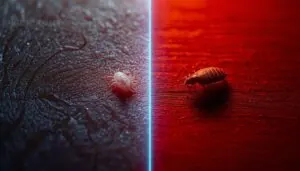
Scabies and bed bugs cause similar misery, but they’re completely different creatures with different habits. Knowing what sets them apart is the fastest way to figure out what you’re dealing with.
Here’s a look at the key differences.
Mite Vs Insect
Here’s the thing most people don’t realize: scabies and bed bugs aren’t even in the same biological category. Scabies is caused by a mite — an arachnid, like a spider or tick. Bed bugs are parasitic insects. That distinction matters clinically. Mites have two main body regions that differ from insects.
| Feature | Scabies Mite | Bed Bug |
|---|---|---|
| Classification | Arachnid (Acari) | Insect (Insecta) |
| Leg Count | 8 legs | 6 legs |
| Antennae Presence | None | Present |
| Wing Structures | None | None |
| Body Segmentation | 2 regions (fused) | 3 regions (head, thorax, abdomen) |
Their developmental stages differ too — and so does how each infestation spreads and hides.
Size and Visibility
Size sets these two apart immediately. Scabies mites are microscopic — you can’t see them without magnification. Bed bugs, though, are visible to the naked eye, roughly the size of an apple seed, with a flat oval body and small reddish-brown coloring.
| Feature | Scabies Mite | Bed Bug |
|---|---|---|
| Size | Under 0.5 mm | 5–7 mm |
| Contrast Visibility | Low — blends with skin | High — stands out clearly |
Where Each Lives
Where you find each pest tells you a lot. Scabies mites burrow into the skin itself — finger web burrows and wrists are classic spots, though scalp involvement can occur in infants.
Body lice, by contrast, live in clothing seams rather than on skin—a key distinction covered in this guide to how different skin invaders affect your barrier and moisture levels.
Bed bugs prefer dark and dry spaces: baseboard cracks, wall void hiding spots, seat cushion nests, and bedding seams.
| Location | Scabies Mite | Bed Bug |
|---|---|---|
| Primary habitat | Your skin | Cracks and crevices |
| Typical hotspot | Finger webs, wrists | Mattress seams, bedding |
How Each Spreads
Knowing where each pest lives shapes how it spreads.
Scabies travels through direct skin contact — prolonged contact during sleep or caregiving passes mites from person to person.
Bed bugs are classic hitchhiking pests, crawling into luggage or transmitting through clothing near infested areas.
| Spread Route | Scabies | Bed Bug |
|---|---|---|
| Primary path | Direct skin contact | Belongings and luggage |
| Key risk | Prolonged contact | Guest room migration |
| Home entry | Skin-to-skin | Fomite transmission |
| Hidden danger | Wall void harbors | Bedroom proximity |
How Long They Survive Off-host
Off-host survival tells you a lot about which pest you’re actually dealing with.
Scabies mites hit their contact dependency limits fast — without skin, they’re gone within 48 to 72 hours. Bed bugs are far more resilient hitchhikers. Adult bedbug starvation can take months, and even nymph feeding intervals stretch days.
Scabies mites die within 72 hours off skin, while bed bugs can survive for months without feeding
Temperature survival effect matters too — heat treatment above 122°F ends both.
| Factor | Scabies Mite | Bed Bug |
|---|---|---|
| Off-host survival | 48–72 hours | Months (adults) |
| Mite off-host longevity | Very short | Prolonged |
| Environmental decontamination | Wash and wait | Heat treatment required |
Skin Symptoms and Bite Patterns
Your skin tells the story before you even know what’s causing the problem. Scabies and bed bugs leave very different marks, and knowing what to look for makes all the difference.
Both pests can also worsen existing sensitivities, so if your skin stays inflamed long after treatment, these eczema relief strategies for itchy, inflamed skin might help restore your skin’s barrier.
Here’s what each one actually looks like on your skin.
Scabies Burrows and Papules
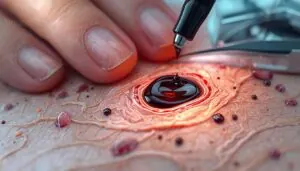
Scabies burrows a tunnel just beneath your skin’s surface — and that single clue changes everything. Here’s what to look for:
- Burrow Morphology: Short, wavy, grayish lines — classic scabies burrows — appear mainly between fingers and wrists.
- Papule Color Variants: Papules range from red to violet-brown nodules alongside the scabies rash.
- Clinical Signs of Scabies: Vesicles and pustules often accompany papules.
- Age-related Presentation: In elderly patients, scabies burrows spread to palms and soles.
- Diagnostic Ink Test: Rubbing ink over skin reveals hidden burrows — a simple, practical tool. Crusted Scabies Indicators include thick, hyperkeratotic plaques.
Bed Bug Bite Welts
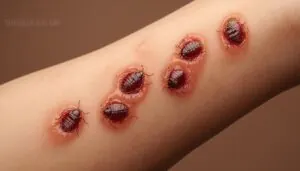
Unlike scabies burrows, bedbug bites sit right on the skin’s surface — and that distinction matters for identifying bedbug vs scabies bites quickly.
Red welts appear in clusters or zigzag lines on exposed skin. Welt morphology varies: some show a central punctum with a color halo around it. Swelling timeline ranges from hours to 14 days. Allergic sensitivity determines severity.
| Feature | Bed Bug Bites |
|---|---|
| Pattern | Lines or clusters |
| Look | Red welts, possible swelling |
Itch Severity and Timing

Itch isn’t just uncomfortable — its timing tells you a lot about what’s causing it.
- Nighttime itch intensity spikes with scabies because mite activity increases under warm bedding.
- Phasic itch patterns mean itching comes in waves, not constantly.
- The scratch-itch cycle worsens skin irritation fast.
- Bed bug bites cause localized, milder itching compared to scabies’ intense night itching.
Common Body Locations
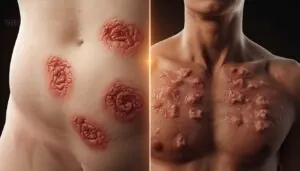
Where bites or rashes appear tells you almost everything.
Scabies mites burrow into the skin at very specific spots — finger webs, wrist creases, lower abdomen, and the buttocks region.
Bed bugs target exposed skin like your neck and torso during sleep.
Despite this preference for bare skin, whether bed bugs can actually live in your hair is a common worry worth understanding before you start hunting for the wrong kind of infestation.
Knowing these locations helps you tell them apart before your next doctor’s visit.
Rash Patterns in Clusters or Lines
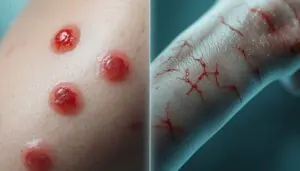
The pattern of a rash is one of your clearest diagnostic clues.
- Zigzag bite rows with raised red welts in rows of three point strongly to bed bugs
- Linear burrow traces and coalescing redness patches signal scabies mite activity beneath the skin
- Symmetric cluster distribution across both wrists or finger webs suggests scabies
- Temporal bump emergence — new bumps appearing near older ones — indicates ongoing mite egg-laying
These clusters or lines and burrow visibility differences drive the diagnostic differences between the two.
Where They Live and Spread
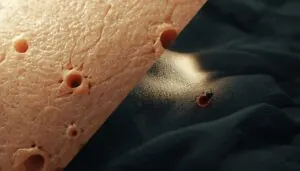
Knowing where scabies and bed bugs actually live changes how you approach treatment and prevention. These two pests operate in very different environments, and that matters more than most people realize.
Here’s what you need to know about where each one hides and how it spreads.
Scabies on Human Skin Only
Scabies mites — Sarcoptes scabiei var hominis — never wander far.
They spend their entire mite lifecycle on you, burrowing into the skin just deep enough to reach the stratum corneum.
That stratum corneum invasion triggers your immune response, causing the rash and relentless itch.
Burrow depth stays shallow, but the reaction runs deep.
This matters for differential diagnosis and choosing the right topical scabicide.
Bed Bugs in Mattresses and Furniture
Unlike scabies mites, bed bugs don’t live on you — they live near you. Their preferred address: your mattress seams, box springs, and upholstered furniture crevices.
Check these spots during any Mattress Seam Inspection:
- Mattress piping and folds hiding bedbug excrement
- Box Spring Harborage points along frame joints
- Upholstery Crevice Treatment zones in couches and chairs
- protective mattress covers to seal existing colonies
Night Feeding and Hiding Behavior
Bed bugs are true nighttime feeders — they track you using CO2 cue detection from your breath and heat attraction from your body.
Once fed, crevice sheltering kicks in: they retreat to mattress seams and frame joints.
Feeding cycle timing aligns with sleep, and host movement influences matters — stillness invites bites.
| Feature | Bed Bugs | Scabies Mites |
|---|---|---|
| Where they live | Bed bug habitat and behavior: mattresses, furniture | Scabies live in your skin |
| Night behavior | Feed actively (nighttime feeders) | Itch worsens, mites stay put |
| After feeding | Return to crevice sheltering | Remain in burrowing nature tunnels |
Travel and Luggage Exposure
Travel shifts the risk completely. Bed bugs are master hitchhikers — they slip into luggage crevice habitats, hide along zipper seams, and ride home in your carry-on.
Hotel bedding contact is a real concern, so place bags on hard surfaces, never on the bed.
Travel bag heat treatment after every trip, combined with smart storage protocols, breaks the cycle of travel-related risk of bed bug introduction into your home.
Risk Factors for Household Spread
Shared bedding and crowded sleeping spaces are the two biggest risk factors for household spread. Delayed recognition keeps both problems growing — scabies gets mistaken for allergies, while bed bugs multiply quietly.
Partial treatment leaves eggs and untreated contacts in the cycle. Cluttered rooms give bed bugs more hiding spots.
Transmission through clothing and personal hygiene lapses accelerate scabies spread between family members.
How Doctors Diagnose Each One
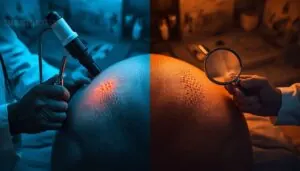
Getting the right diagnosis is the first step toward the right fix.
Doctors use a mix of what they see, what you tell them, and sometimes a quick lab test to tell scabies and bed bugs apart. Here’s how that process actually works.
Visual Clues for Bed Bugs
You don’t need a lab to spot a bed bug problem — your eyes do most of the work.
Check your mattress seams and bed frame for these definitive signs:
- Fecal Spot Patterns: Dark, pinpoint stains clustered along seams
- Blood Smear Stains: Rusty smears on sheets from crushed bugs
- Shed Skin Accumulation and Eggshell Remnants: Pale, papery husks near hiding spots
- Live Bug Sightings: Small reddish-brown insects roughly apple‑seed‑sized
A sweet musty odor often accompanies heavy infestations. Bed bug bite pattern recognition — identifying bed bug bites in lines or clusters on exposed skin — adds further visual signs of bed bug infestation confirmation.
Skin Scraping for Scabies
Unlike bed bugs, scabies can’t be confirmed by a visual scan of your room — it requires a skin scraping. Your doctor selects a non-excoriated papule for lesion selection, avoiding crusted lesions that lower yield.
The blade holds at a 90-degree scraping angle, collecting 5–10 samples. Slide preparation uses mineral oil for diagnostic microscopy, confirming medical diagnosis of scabies through mite, egg, or scybala identification.
Dermatoscopy and Burrow Signs
Dermatoscopy reveals burrows that the naked eye often miss. Think of it as a magnified map of the mite’s path.
You’ll see a Dermatoscopic Tunnel Path curving through the skin — the Sarcoptic Curve Shape — starting at a Burrow Entrance Scale and ending at a Blister End Lesion.
Triangular End Structures mark the burrow’s tip, making identifying scabies burrows and differentiating scabies and bed bugs straightforward.
History of Nocturnal Itching
Nighttime itching has been a diagnostic signal since ancient texts and Victorian descriptions of skin disease. 19th-century dermatology and WWII reports consistently noted it as a red flag.
Contemporary studies confirm it still matters: scabies causes intense nocturnal itching from mites burrowing into the skin, while symptoms of bedbug infestation peak at night too.
Differentiating scabies from bedbug bites often starts with this single question — when does it itch most?
When Lab Confirmation is Needed
Sometimes the skin just won’t tell the whole story. When differentiating scabies from bedbug bites stays unclear after a clinical exam, lab confirmation steps in.
Sample collection timing matters — scraping active lesions gives microscopic identification methods the best shot at accuracy.
Lab confirmation makes sense when:
- first-line treatment fails and false negative risks are high
- diagnostic sensitivity drops due to atypical rash patterns
- cost-benefit analysis favors confirming before treating entire households
- clinical symptoms overlap with allergic dermatitis or other conditions
Treatment for Scabies and Bed Bug Bites

Once you know what you’re dealing with, treatment is pretty straightforward. Scabies and bed bug bites each need a different approach, and using the right one makes all the difference.
Here’s what actually works.
Permethrin Cream for Scabies
When scabies strikes, permethrin cream is your first line of defense. This 5% permethrin cream works by killing the mites burrowing under your skin.
| Step | What You Do | Why It Matters |
|---|---|---|
| Application Duration | Leave on for 8–14 hours | Ensures full mite exposure |
| Dosage Frequency | Repeat after 7–14 days | Kills newly hatched eggs |
| Coverage | Neck to toes | No mites escape treatment |
| Side Effect Management | Rinse if burning persists | Reduces skin irritation |
| Pregnancy Safety | Consult your doctor first | Requires medical guidance |
Scabies treatment works best when you’re thorough.
Oral Ivermectin for Resistant Cases
When permethrin cream isn’t enough, oral ivermectin becomes a key option among prescription treatments for scabies. It’s a systemic medicine, meaning it works throughout your body.
Weight-based dosing determines your exact amount, and two doses spaced 7–14 days apart follow a structured treatment schedule.
Safety screening matters here — Loa loa caution applies in certain regions.
A follow-up assessment confirms the mites are gone.
Over-the-counter Itch Relief
prescription treatment clears the infestation, your skin still needs relief. Over-the-counter treatments can quiet the itch in the meantime.
Hydrocortisone cream reduces inflammation at bite sites. Cooling Menthol Creams and Calamine Barrier Lotion calm surface irritation. Moisturizing Emollients restore your skin barrier. Antihistamines like cetirizine help with overnight comfort. For sharper discomfort, Benzocaine Numbing Cream works on small, localized areas.
Preventing Secondary Skin Infection
Itching pushes you to scratch — and that’s where the real trouble starts. Broken skin becomes a doorway for bacteria.
Keep your nails trimmed short, apply a cold compress to calm flare-ups, and cover open spots with clean dressings. Monitor redness or warmth daily.
If you spot spreading redness or pus, prompt antibiotic use after medical consultation stops secondary bacterial infections from scratching before they deepen.
Treating Close Contacts and Household Members
When one person in a household has scabies, everyone needs treatment on the same day — that’s the Simultaneous Scabies Therapy rule. Mites spread before symptoms appear.
Follow this Contact Prophylaxis Protocol:
- Apply permethrin to all household members simultaneously
- Schedule Family Medication Scheduling for repeat doses one week later
- Use Item Isolation for unwashable fabrics — sealed bags for 72 hours
- Coordinate Household Treatment Timing to prevent reinfestation
Prevention, Cleaning, and When to Get Help

Getting rid of scabies or bed bugs isn’t just about treating your skin — your environment needs attention too. A few practical steps can stop reinfestation before it starts.
Here’s what you need to do.
Washing Bedding and Clothing
Laundry is your first line of defense. Wash all bedding, clothing, and towels using the hottest water the care label allows — hot water and high heat are non‑negotiable here.
Separate loads by fabric type for smart Load Separation.
Choose the right Detergent Selection for each fabric, address Pre‑treatment Stains before loading, and follow strict Drying Protocols.
Dry everything completely before storing.
Heat Treatment and Vacuuming
Heat finishes what laundry starts. For a steam dry heat infestation, steam dry heat is your most reliable weapon — a steam cleaner pushed slowly along every seam ensures Seam Heat Penetration reaches the 130°F bugs need to die. Vacuum living spaces thoroughly, then prioritize Vacuum Bag Disposal immediately after.
- Set your steam cleaner above 130°F
- Target seams slowly for full temperature treatment
- Use a crevice tool along baseboards
- Seal and discard the vacuum bag outside
- Conduct Post‑Treatment Inspection with Temperature Monitoring at multiple spots
Sealing Cracks and Encasing Mattresses
Think of your mattress encasement as a vault — only as secure as its seal. A proper Zipper Lock Mechanism keeps bed bugs trapped inside.
Use Box Spring Encasement too, ensuring Mattress Edge Overlap on both pieces. Apply Crack Filling Materials along bed frame joints.
This Continuous Barrier Design, combined with a bedspread encasement, forms the foundation of effective home decontamination and integrated pest management.
Preventing Reinfestation
Reinfestation is the part most people miss — and it undoes everything. Once you’ve treated, the real work is keeping the problem gone.
- Isolate Treated Rooms until cleaning is complete, to avoid recontamination.
- Bag Unwashed Items immediately and seal them for 72 hours.
- Place Bed Bug Traps under furniture legs to catch survivors.
- Schedule Follow-Up Checks at one and two weeks post-treatment.
- Educate Household Members on avoiding shared clothing and bedding during recovery.
When Itching Needs Urgent Care
Most itching from scabies or bed bugs stays manageable at home — but some signs mean you can’t wait.
Seek emergency care for anaphylaxis warning signs: sudden severe allergic swelling of the lips or throat, trouble breathing, or dizziness.
Watch for rapid skin infection, necrotic skin lesions, or mental status changes.
Secondary bacterial infections from scratching and systemic allergic signs also need same-day medical advice.
Frequently Asked Questions (FAQs)
Which is harder to get rid of scabies or bed bugs?
Both are stubborn — but for different reasons.
Bed bugs win on Environmental Persistence, hiding for months in seams and walls, while scabies challenges Treatment Compliance and Contact Tracing to stop reinfestation.
How do I know if I have bed bugs or scabies?
Check your skin for burrows and your mattress for fecal spot presence. Bite onset timing, lesion color variation, and household symptom reports all help separate the two conditions quickly.
How do I know if I have scabies or bed bugs?
Look at two things: your skin and your surroundings. Burrows on your wrists suggest scabies. Bites on exposed limbs after hotel stays point to bed bugs. Both itch at night.
Can you see scabies on bed sheets?
No, you can’t see scabies on bed sheets. The mites are microscopic — under 5 mm — so microscopic invisibility makes visual inspection pointless.
Bedding matters only for fabric transfer within 48–72 hours of contact.
What do scabie bites look like?
Subtle yet striking, scabies bites show as pink papules, thin threadlike burrows, and grayish-white lines weaving across the skin — serpentine tracks left by mites tunneling beneath the surface.
Do scabies live in mattresses?
Scabies mites can transfer to your mattress, but they won’t survive there long — usually 48 to 72 hours off-skin. Washing bedding promptly eliminates that short-lived bedding contamination risk.
Are scabies more common than bed bugs?
By sheer numbers, scabies wins — an estimated 622 million cases hit globally in 2021 alone. Bedbug infestation lacks that kind of standardized tracking, making scabies clearly more common worldwide.
What are scabies and what do they look like?
Caused by Sarcoptes scabiei, scabies mites burrow into your skin, leaving winding, grayish-white lines. You’ll notice intense itching, red bumps, and tiny blisters — especially between fingers and wrists.
What is the difference between bed bugs and scabies mites?
Both cause itching, yet one lives on you and the other lives near you. Scabies mites burrow into skin; bed bugs hide in mattresses and bite during sleep.
Are bed bugs harder to get rid of than scabies?
Yes — bed bugs are generally harder to eliminate. Unlike scabies, they live in your environment, requiring home elimination methods, professional pest control, and repeated treatments.
Scabies clears faster with permethrin cream.
Conclusion
Some cases won’t resolve cleanly on the first treatment—and that’s not a failure. Scabies sometimes needs a second round of permethrin, and bed bugs can survive one pesticide application.
What matters is staying consistent and treating your environment alongside your skin.
Understanding the difference between scabies and bed bugs puts you ahead of most people who guess wrong and wait too long.
Get the right diagnosis first, and the right treatment follows.