This site is supported by our readers. We may earn a commission, at no cost to you, if you purchase through links.

You notice it in the mirror one day—patches where your beard won’t fill in, hairs that seemed thicker just weeks ago looking thin and fragile. Stress leaves fingerprints across your life, sometimes in the last place you expect: your face. It’s not your imagination. High-pressure days and restless nights trigger a flood of cortisol, that notorious stress hormone, sabotaging testosterone and tipping the delicate balance your follicles rely on.
When stress hijacks your system, it can interrupt the very cycles that fuel beard growth. Understanding how stress affects your beard isn’t a vanity project—it’s a blueprint for healthier, stronger hair.
Table Of Contents
Key Takeaways
- Chronic stress disrupts hormonal balance and directly impairs beard growth by raising cortisol and lowering testosterone.
- Visible beard thinning, patchiness, and even sudden hair loss can all result from stress-driven hormonal changes and poor sleep.
- Managing stress with exercise, mindfulness, and better sleep routines can reverse most stress-related beard loss and restore growth.
- Key nutrients, hydration, and a balanced diet support hormonal health and beard resilience, especially under prolonged stress.
How Stress Affects Your Beard Growth
Your body’s response to stress isn’t just mental—it creates a hormonal cascade that directly impacts your facial hair follicles. When cortisol levels spike and stay elevated, they interfere with the testosterone production your beard needs to thrive.
Let’s examine the three main ways chronic stress disrupts your beard’s growth cycle and what’s actually happening beneath the surface.
The Role of Cortisol in Hair Development

When stress strikes, cortisol floods your system, and your beard pays the price. This stress hormone disrupts hair follicle stem cells, compromising their regenerative capacity. Here’s what happens inside your follicles:
- Cortisol binds to receptors in the dermal papilla, weakening follicle integrity
- The anagen growth phase shortens dramatically
- Follicles rush prematurely into the resting telogen phase
- Hair cortisol levels climb, reflecting chronic stress exposure
Elevated levels can even cause androgenetic alopecia. The impact of stress on hair becomes measurable and visible.
Stress Hormones Vs. Testosterone Production

Your body’s hormonal balance hinges on a delicate interplay. When chronic stress floods your system with cortisol and adrenaline, these stress hormones suppress the HPG axis—the command center for testosterone synthesis.
Cortisol’s impact is direct: it inhibits Leydig cells in your testes, preventing them from producing testosterone. Research shows a striking inverse relationship, with cortisol levels rising as testosterone plummets, starving your beard of the fuel it needs to thrive.
Managing stress can help maintain healthy testosterone production levels.
Physical Manifestations of Chronic Stress on Facial Hair
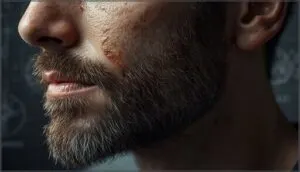
Beyond hormonal imbalances, your facial hair reveals chronic stress through visible changes. Elevated cortisol triggers follicle shedding—up to 70% of hair follicles can enter premature rest phases, causing telogen effluvium. You’ll notice:
- Patchiness alterations where inflammatory responses shut down localized follicles
- Accelerated greying as stress depletes melanocyte stem cells
- Autoimmune associations like alopecia areata, affecting up to 20% of stressed individuals
This stress impact fundamentally disrupts beard growth patterns.
The Science Behind Stress-Induced Beard Loss

When stress wreaks havoc on your body, your beard doesn’t escape unscathed. The physiological mechanisms behind stress-related beard loss are well-documented, involving hormonal shifts, disrupted hair cycles, and even autoimmune responses.
Let’s break down the three primary ways stress can cause your facial hair to thin or fall out.
Hormonal Disruption and DHT Levels
When chronic pressure hijacks your body’s chemistry, the culprit isn’t just cortisol—it’s the intricate Cortisol-DHT Interaction that wreaks havoc on Hormonal Balance. Elevated stress amplifies Androgen Receptors’ sensitivity in your follicles, even without raising circulating DHT. Meanwhile, depleted Neurotrophic Factors like BDNF starve your beard of growth signals, triggering Follicle Miniaturization. These Stress Feedback Loops create a vicious cycle, shrinking hair diameter and density while Testosterone production falters under cortisol’s dominance.
| Stress Impact | Mechanism | Effect on Beard |
|---|---|---|
| Elevated Cortisol | Suppresses testosterone synthesis | Reduced growth stimulation |
| Heightened Androgen Receptor Sensitivity | Amplifies DHT effects locally | Accelerated follicle shrinkage |
| Depleted BDNF/NGF | Loss of follicle support signals | Prolonged resting phase |
| Increased DHT Activity | Shortens anagen (growth) phase | Thinner, sparser hair |
| HPA Axis Dysregulation | Creates self-reinforcing hormonal loops | Progressive beard deterioration |
Telogen Effluvium and Beard Thinning
Sudden trauma or prolonged tension can trigger Telogen Effluvium, forcing hair follicles into an extended resting phase that causes diffuse beard thinning. Stress-related alopecia manifests when your beard enters this premature shutdown, leading to noticeable hair shedding two to three months after the stressor hits. The encouraging news? This represents reversible hair loss:
- Up to 50% of beard hair can shed during acute episodes
- Regrowth generally begins within 3 months once stress subsides
- Full density returns in 6–12 months for most men
- Nearly 95% of cases resolve completely without permanent hair loss
Alopecia Areata Triggered by Stress
When stress overwhelms your system, it can trigger Alopecia Areata, an autoimmune condition causing distinct circular patches of beard loss through immune privilege loss at the follicle. Autoreactive T-cells attack hair follicles after CRH signaling disrupts their protective barrier, with hair cortisol levels correlating with disease activity.
When stress overwhelms your body, it can trigger alopecia areata, causing your beard to develop sudden round patches of hair loss
Up to 80% of affected individuals report significant stress before onset, making stress-related hair issues a documented precipitating factor in scalp and facial hair loss.
Sleep Deprivation and Its Impact on Beards

When you’re not sleeping well, your body can’t maintain the biological processes that fuel beard growth. Poor sleep disrupts hormone production, weakens cellular repair mechanisms, and ultimately leaves your facial hair struggling to thrive.
Let’s examine how sleep deprivation interferes with the specific physiological functions your beard depends on.
Deep Sleep’s Role in Cellular Repair
Your body doesn’t just rest during deep sleep—it runs a full repair operation that directly impacts beard growth. This nocturnal maintenance window activates critical processes your facial hair depends on:
- DNA repair mechanisms fixing cellular damage accumulated during wakefulness
- Growth hormone release triggering tissue regeneration and protein synthesis
- Synaptic renormalization optimizing cellular communication pathways
- Autophagy function clearing damaged components and chemical stress
- Immune modulation reducing inflammation while supporting hormonal balance
Without adequate deep sleep, these restorative processes falter, compromising the cellular foundation your beard needs to thrive.
How Poor Sleep Lowers Testosterone
When you skimp on sleep, your testosterone levels take a direct hit, disrupting the hormonal balance your beard depends on. One week of five-hour nights slashes daytime testosterone by 10–15%, while even a single sleepless night measurably drops hormone levels compared to eight-hour rest.
This circadian rhythm disruption flattens your testosterone curve, starving follicles of the hormone signals they need for healthy beard growth.
Sleep Quality and Hair Follicle Health
Your beard’s health hinges on what happens while you sleep. Deep sleep triggers growth hormone surges that drive cellular repair in hair follicles, strengthening keratin synthesis and collagen production.
Poor sleep elevates cortisol, pushing follicles prematurely into their resting phase and creating an inflammatory scalp environment. Compromised microcirculation restricts nutrient delivery, while disrupted hormonal regulation shortens your growth cycle, leading to visible thinning and patchy beard development.
Managing Stress to Improve Beard Growth
Now that you understand how stress disrupts your beard’s hormonal foundation, you can take concrete steps to reverse the damage. The good news is that managing stress doesn’t require drastic lifestyle overhauls—targeted interventions can restore your body’s natural testosterone production and support healthier facial hair.
Let’s examine three evidence-based approaches that directly counteract stress-related beard thinning.
Exercise and Testosterone Optimization
When you’re serious about optimizing your testosterone for beard growth, exercise intensity matters more than you might think. Resistance training at 70–80% of your maximal effort triggers the most substantial hormonal response, with compound exercises like squats and deadlifts outperforming isolation movements. Here’s what actually works:
- Prioritize high-intensity strength training over mild activity, as moderate efforts show no significant testosterone elevation (p = 0.19).
- Focus on compound exercises rather than isolation movements for enhanced androgenic effects.
- Maintain consistent training duration—sporadic sessions won’t deliver measurable beard growth results.
- Structure weekly resistance routines to sustain elevated resting testosterone between sessions.
- Recognize individual variation: your age, baseline fitness, and genetic androgen receptor sensitivity influence your hormonal response and subsequent facial hair development.
Short bursts of vigorous exercise spike testosterone immediately, but sustained, repeated sessions drive the long-term hormonal balance your beard follicles need. This stress-reducing approach simultaneously lowers cortisol while boosting the androgens essential for hair growth.
Meditation and Relaxation Techniques
Mindfulness benefits your beard more than you’d expect—an eight-week meditation program dropped stress scores by 7.1 points and lowered cortisol from 381.9 to 306.4 nmol/L in clinical trials.
Breathing exercises, guided imagery, and various meditation types all reduce stress effectively, supporting the testosterone balance your follicles need.
Regular relaxation techniques increased hair density by 47% over 112 days, proving stress management directly influences beard growth.
Establishing Healthy Sleep Routines
Your relaxation practice sets the stage, but sleep seals the deal for beard growth. Aim for consistent sleep of 7–9 hours nightly—testosterone boost follows naturally. Just 48 hours of deprivation cuts growth by 19%, while deep sleep triggers growth hormone release for cellular repair. Men with insomnia report increased hair shedding that reverses when rest improves.
- Keep your bedroom dark, cool, and quiet for optimized environments
- Stick to regular bedtimes to support hormonal rhythms
- Prioritize sleep quality over quantity for better follicle health
- Track your rest patterns to identify stress management gaps
Nutrition and Lifestyle Changes for Healthier Beards

You can’t out-supplement a stress-fueled lifestyle, but you can stack the deck in your favor. What you eat, drink, and how you live directly influences your body’s ability to grow a healthy beard—even when stress tries to sabotage the process.
Let’s break down the specific nutrients, foods, and habits that support both hormonal balance and facial hair development.
Essential Vitamins and Minerals for Hair Growth
Your hair follicles depend on specific nutrients to thrive, particularly when stress already challenges beard growth. Vitamin D stimulates follicle activity—about 35% of Americans lack sufficient levels, directly impacting hair growth potential.
Iron deficiency impairs oxygen delivery to follicles, while biotin benefits structural integrity. Zinc’s role in cell proliferation and vitamin C’s collagen support, combined with adequate testosterone, create ideal conditions for strong facial hair development despite nutritional challenges.
Foods That Combat Stress and Support Hormones
A balanced diet does more than strengthen hair—it actively regulates stress hormones and bolsters healthy testosterone levels. Magnesium-rich foods like spinach and nuts help lower cortisol, while omega-3 fatty acids from fatty fish foster hormonal balance.
Antioxidant fruits, fermented foods, and complex carbohydrates all contribute to steady nutrition, fortifying your body’s natural foundation for healthy beard growth.
Hydration and Its Effect on Facial Hair
Think of hydration as the silent architect shaping your beard health. When you hit the daily water intake sweet spot, you’re giving every follicle the chance to thrive, with hydration density directly improving hair elasticity and beard density. Stay consistent—your beard responds by resisting breakage, maintaining strong follicle health, and keeping Beard Growth powered by peak DHT and testosterone activity.
- Aids nutrient delivery for follicle health
- Increases hair elasticity, reducing breakage
- Follows hydration recommendations for improved beard density
Frequently Asked Questions (FAQs)
Can anxiety medications influence beard growth patterns?
Imagine waking up to patchy stubble where your beard once thrived—sometimes, anxiety medications can stir up this surprise.
SSRIs rarely disrupt androgen levels, but telogen effluvium and abrupt hair loss reversal are documented in real-world case studies.
Is stress-related beard loss reversible over time?
Yes, stress-related beard loss is often reversible. Your regrowth timeline depends on influencing factors like stress duration, nutrition, and clinical interventions.
Addressing stress impact and supporting beard health usually restores growth, with long-term prognosis improving once reversal mechanisms kick in.
How does stress impact beard growth in teenagers?
Teen beard stress throws a wrench in natural growth, as rising cortisol levels disrupt hormone balance. This hormonal disruption stunts beard development, while poor sleep and stress beard disorders like telogen effluvium further weaken hair follicles and limit progress.
Can mindfulness training reduce patchy beard symptoms?
Often, it only takes a gentle shift—like mindful breathing or a few minutes of meditation—to ease cortisol, support hormonal balance, boost circulation, and improve sleep quality.
These mindfulness benefits promote noticeable beard growth and patch reduction over time.
Conclusion
Imagine looking back months from now, noticing your beard’s renewed strength—not by accident, but because you understood what was at stake. Science makes it clear: can stress affect beard growth? Absolutely, and you hold the levers of change.
Managing pressure, fueling your cells, and defending your hormones aren’t indulgences—they’re essentials for healthy growth. Each mindful choice today sets new roots for tomorrow, proving your face can be both a reflection of your life and your control over it.
- https://detroitgrooming.com/blogs/313-beard-blog/sleep-stress-and-your-beard-how-lifestyle-habits-impact-beard-growth
- https://hairgp.co.uk/how-cortisol-causes-stress-induced-hair-shedding/
- https://diggnit.com/blogs/the-secrets-of-the-arabian-beard/surprising-ways-stress-affects-your-beard
- https://pmc.ncbi.nlm.nih.gov/articles/PMC3381079/
- https://www.sciencedirect.com/science/article/abs/pii/S0006291X24000998