This site is supported by our readers. We may earn a commission, at no cost to you, if you purchase through links.
You’ve probably seen those biotin supplements marketed specifically for beard growth, often with bold claims about transforming a patchy beard into a thick, full mane. The shelves are lined with them, and online ads promise results that seem almost too good to be true.
But here’s the catch: biotin’s relationship with facial hair isn’t what most marketing would have you believe. This vitamin does play a legitimate role in hair health, acting as a coenzyme that aids keratin production, but its actual impact on your beard depends largely on whether you’re deficient in the first place. For most men with adequate biotin levels, popping extra pills won’t suddenly accelerate growth or fill in sparse patches.
Understanding what biotin actually does—and doesn’t do—for beard growth requires looking past the hype and examining the science behind this popular supplement.
Table Of Contents
Key Takeaways
- Biotin only improves beard growth if you have a confirmed deficiency—for men with normal biotin levels (which most already have through diet), supplementation won’t accelerate growth or fill in patchy areas.
- Your beard’s thickness and coverage depend primarily on genetics and androgen sensitivity, not biotin intake, since testosterone and DHT drive facial hair development through distinct follicle programming that differs completely from scalp hair.
- Most adults already consume 35-70 micrograms of biotin daily through common foods like eggs, nuts, and liver, easily meeting the 30 mcg recommended intake without needing supplements.
- High-dose biotin supplements (2,500-10,000 mcg) can cause acne breakouts and interfere with lab tests for thyroid and cardiac markers, creating health risks without proven beard growth benefits for non-deficient individuals.
What is Biotin and Its Role in Hair?
Before you can figure out whether biotin will actually help your beard grow, you need to know what it is and how it works in your body. Biotin isn’t some magic supplement—it’s a water-soluble vitamin that plays specific roles in your metabolism and cellular function.
Let’s break down what biotin does, why it matters for hair health, and how it connects to the keratin that makes up your beard.
Definition and Functions of Biotin (Vitamin B7)
Biotin—also called vitamin B7 or vitamin H—is a water-soluble nutrient your body relies on for energy metabolism and cellular function. This coenzyme powers critical biochemical reactions involving fatty-acid synthesis, gluconeogenesis role, and amino metabolism. Think of biotin chemistry as the spark plug in your metabolic engine. Biotin, a member of the B complex, is essential for growth.
Here’s what these coenzyme mechanisms actually do:
- Activates enzymes that build fatty acids for healthy cells
- Converts nutrients into usable energy throughout your body
- Aids amino acid breakdown for protein metabolism
- Helps maintain stable blood sugar through glucose production
- Promotes carbon transfer reactions essential for growth
Biotin’s Importance for Skin, Hair, and Nails
Your body needs this vitamin for more than just energy—it’s the foundation for healthy skin, strong hair, and resilient nails. When biotin levels drop, the deficiency impact shows up fast: thinning hair, scaly rashes, and brittle nails appear in every documented case.
Supplement efficacy shines brightest here. Studies show biotin boosted nail thickness by 25% and improved hair combability within months, proving its skin health and nail growth benefits aren’t just hype. Biotin is also known to support hair growth in individuals with a deficiency.
How Biotin Supports Keratin Production
Here’s what happens beneath the surface: biotin acts as an enzyme cofactor that powers carboxylase reactions, fueling fatty-acid synthesis and amino catabolism. These pathways deliver the raw materials your hair follicles need for keratin production—the structural protein forming every strand.
When biotin works optimally, you build stronger hair infrastructure:
- Keratin genes ramp up expression in follicle cells
- Amino acids recycle into keratin building blocks
- Lipids form protective hair shaft layers
That’s biotin’s role in beard growth at the molecular level.
How Does Biotin Affect Beard Growth?
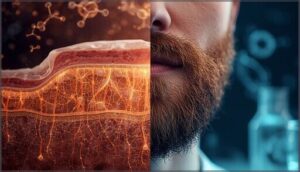
You’ve probably heard claims that biotin can turn a patchy beard into a thick one, but the science tells a more nuanced story. Biotin does support the cellular machinery behind hair production, yet its impact on your beard depends heavily on whether you’re actually deficient in the first place.
Let’s break down how biotin interacts with facial hair growth, what the research really shows, and why your beard might respond differently than the hair on your head.
Biotin’s Role in Hair Follicle Health
Your follicles rely on biotin as a cofactor for carboxylase enzymes that drive keratin synthesis—the structural protein forming each hair shaft. When biotin analogs were applied to follicles in lab studies, keratin gene expression jumped 36% and laminin 5 (which anchors follicle structure) rose 49%. Deficiency can have a dramatic impact: hair shaft integrity weakens, and follicles become fragile, noticeably slowing beard growth.
| Biotin’s Follicle Function | Measured Effect |
|---|---|
| Keratin gene expression boost | 36% increase |
| Laminin 5 synthesis rise | 49% increase |
| Hair shaft elongation | Enhanced in ex vivo cultures |
Scientific Evidence on Biotin and Facial Hair
When you dig into the clinical trial gaps, beard-specific data are largely nonexistent. No randomized studies have measured biotin supplementation’s effect on facial hair in healthy men.
The 2017 systematic review of 18 case reports found biotin benefits only emerged when confirmed deficiency existed—doses between 10,000–30,000 µg daily corrected inherited metabolic defects, but healthy individuals saw zero proven beard-growth advantage, highlighting critical dosage safety and overall implications.
Biotin only improved hair growth in confirmed deficiency cases—healthy individuals saw zero beard-growth benefit despite high supplemental doses
Differences Between Scalp Hair and Beard Growth
Your scalp and beard follicles respond oppositely to the same androgens. While DHT drives beard growth—converting vellus hairs to terminal hairs during pubertal timing and beyond—it simultaneously shrinks follicles on androgen-sensitive scalp regions, shortening the growth cycle.
This androgen sensitivity explains clinical patterns like thick beards coexisting with male pattern baldness, reflecting distinct follicle structure and programming at each site.
Does Biotin Help Beard Growth?
You’ve probably heard the buzz that biotin can transform a patchy beard into something fuller and thicker, but the science tells a more nuanced story.
The truth is, biotin’s impact on your facial hair depends largely on whether you’re starting with a deficiency or normal levels.
Let’s look at what the research actually shows about biotin and beard growth.
Research Findings on Biotin and Beard Thickness
You might expect clear proof that biotin supplements thicken beards, but the research tells a different story. Studies showing biotin benefits for beard growth simply don’t exist—every trial measured scalp hair, not facial hair.
A 2024 study found that biotin supplementation for facial hair, when combined with minoxidil, improved scalp thickness, yet biotin alone didn’t reach significance. Without deficiency effects present, sufficient individuals rarely see measurable beard thickness changes from biotin efficacy alone.
Impact of Biotin on Patchy or Slow Beard Growth
If you’re dealing with a patchy beard or slow growth, biotin supplements for beard growth probably won’t deliver the transformation you’re hoping for.
Research limits our understanding here—no controlled trials measure biotin efficacy specifically for managing patchy beard growth. Only biotin deficiency cases show restored density, and even then, outcomes focus on strength and breakage reduction rather than filling gaps or accelerating new growth.
Biotin’s Effectiveness for Individuals With Deficiency Vs. Normal Levels
Here’s where the science gets clear: if you have confirmed biotin deficiency—low serum levels documented through testing—supplementation often produces measurable hair regrowth within one to six months.
Yet if your biotin status is normal, studies show no significant hair outcomes from doses of 1,000 to 10,000 μg daily.
Biotin benefits and risks depend entirely on your baseline levels, not wishful thinking.
Signs and Risks of Biotin Deficiency

Biotin deficiency isn’t common, but when it happens, your body sends clear signals that something’s off. Recognizing these symptoms early can help you address the issue before it affects your beard, hair, and overall health.
Let’s look at the warning signs, who’s most at risk, and how low biotin levels specifically impact facial hair growth.
Common Symptoms Linked to Biotin Deficiency
When biotin deficiency symptoms appear, they’re hard to miss. Hair loss affects nearly everyone with significant deficiency, including thinning hair on your scalp, eyebrows, and beard.
You’ll also notice brittle nails that split easily—common in 50–75% of cases.
Skin rashes around your eyes, nose, and mouth show up frequently, while neurological effects like fatigue, depression, and even seizures can develop in more severe situations.
Risk Factors for Low Biotin Levels
Understanding who’s at risk helps you recognize whether your body might struggle to maintain adequate biotin levels. While true biotin deficiency symptoms remain uncommon, certain situations greatly increase your vulnerability:
- Chronic alcohol consumption disrupts intestinal absorption, reducing biotin uptake by up to 30% in documented cases
- Pregnancy risks intensify as accelerated biotin catabolism outpaces dietary intake
- Long-term anticonvulsant medications like valproic acid deplete biotin stores
Smoking effects accelerate biotin breakdown, while genetic conditions like biotinidase deficiency and malabsorption syndromes further compromise your body’s ability to utilize this essential vitamin.
Effects of Deficiency on Beard and Hair Health
When your biotin levels drop, your beard doesn’t just thin—it transforms. Hair quality changes dramatically: strands become brittle, dry, and prone to snapping off before reaching their full length. Diffuse alopecia extent spreads across facial regions, while perifollicular manifestations like scaly, red patches around your mouth and nose create an inhospitable environment for follicles.
Here’s the bright side: reversibility repletion works. Correct the vitamin deficiency, and you’ll usually see shedding slow within weeks, with progressive density returning over several months.
Best Sources of Biotin for Beard Health
If you want to support your beard health, getting enough biotin through your diet is the most straightforward approach. Most people can meet their daily biotin needs through common foods without turning to supplements.
Let’s look at which foods pack the most biotin, how much you actually need, and when supplements might make sense.
Biotin-rich Foods for Facial Hair Support
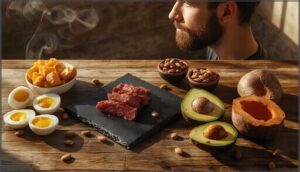
Your best move is to eat foods naturally loaded with biotin. This vitamin aids the keratin your beard relies on, so making smart food choices can strengthen follicles from within. Focus on three groups:
- Eggs and organ meats – One whole egg delivers around 10 mcg of biotin, while beef liver packs 27–35 mcg per three-ounce serving.
- Nuts and seeds – Sunflower seeds and almonds supply over 60 mcg per 100 grams.
- Vegetables and whole grains – Sweet potatoes, avocado, and fortified cereals add smaller but steady amounts to your daily intake.
Recommended Dietary Intake for Adults
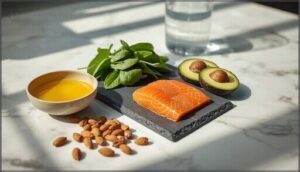
Now that you know which foods pack the most punch, how much do you actually need? For men over 19, official guidelines set the Daily Value at 30 micrograms per day—an amount most mixed diets already deliver through biotin-rich foods.
Here’s a quick reference:
| Life Stage | Recommended Intake (mcg/day) |
|---|---|
| Adult men | 30 |
| Pregnant women | 30 (Pregnancy Intake) |
| Lactating women | 35 (Lactation Needs) |
| Average U.S. diet | 35–50 |
| Deficiency prevalence |
- https://ecronicon.net/assets/ecnu/pdf/ECNU-14-00571.pdf
- https://pubmed.ncbi.nlm.nih.gov/28879195/
- https://jcadonline.com/biotin-for-hair-loss-evidence/
- https://pmc.ncbi.nlm.nih.gov/articles/PMC4989391/
- https://www.longdom.org/open-access/a-randomized-doubleblind-evaluation-of-a-novel-biotin-and-silicon-ingredient-complex-on-the-hair-and-skin-of-healthy-women-61185.html