This site is supported by our readers. We may earn a commission, at no cost to you, if you purchase through links. This content is for general informational and educational purposes only and is not a substitute for professional medical, dermatological, or nutritional advice.
Somewhere between a Hollywood red-carpet trick and a $4 drugstore purchase, face taping for wrinkles quietly became one of skincare’s most-searched topics. Celebrities have worn adhesive strips under stage makeup for decades—the rest of us just didn’t know it. The appeal makes sense: no needles, no prescriptions, results you can see before your morning coffee.
But there’s a gap between what taping actually does to your skin and what most tutorials imply. It physically holds tissue in place; it doesn’t retrain, rebuild, or repair anything underneath.
Here’s how to do it correctly, what it genuinely delivers, and when to reach for something stronger.
Table Of Contents
- Key Takeaways
- What is Face Taping?
- Does Face Taping Work?
- Best Wrinkles to Tape
- How to Tape Your Face
- Face Taping Safety Tips
- Top 5 Face-Taping Routine Products
- Better Wrinkle-Reduction Alternatives
- Frequently Asked Questions (FAQs)
- How do dermatologists feel about taping?
- How often should I tape my face for wrinkles?
- Does taping wrinkles really work?
- Do face strips work for wrinkles?
- What is the best overnight face tape for wrinkles?
- Does taping your face help wrinkles?
- Does facelift tape really work?
- How often should you use face tape?
- What is face taping for wrinkles?
- What are the ways to get rid of wrinkles on the face?
- Conclusion
Key Takeaways
- Face tape works like a compression bandage — it holds your skin in place while it’s on, but the moment you peel it off, your muscles pick up right where they left off and every line snaps back.
- Overnight taping earns its keep by limiting how much your skin folds against a pillow, but that’s about as far as the science goes — no collagen, no remodeling, no lasting structural change.
- If you want results that actually stick around, pair taping with daily SPF 30+ and a retinoid, because sunscreen blocks damage and retinoids repair it in ways no adhesive strip ever will.
- Use face tape strategically — a few sessions a week, capped at eight hours, with slow removal and patch-testing first — or you’re trading wrinkles for irritation.
What is Face Taping?

Face taping is exactly what it sounds like—sticking adhesive strips to your skin to lift, smooth, or hold certain areas in place.
Unlike facial massage techniques that boost circulation and lift contours, face taping works passively—no movement required.
It’s been around longer than most people realize, and today it covers a range of techniques and products. Here’s what you actually need to know.
Wrinkle Taping Basics
Face tape is exactly what it sounds like — adhesive strips placed on your skin to create a temporary facial lift or smooth out wrinkles. Think of it as a mechanical shortcut: no collagen stimulation, no facial muscle training.
Just three things matter for wrinkle reduction:
- Adhesive Selection — gentle, skin-safe materials only
- Strip Sizing — smaller cuts for precise placement
- Removal Technique — slow and deliberate, never a yank
The method provides only a temporary mechanical lift, without long-term skin benefits.
Instant Lifting Taping
Instant lifting taping takes things up a notch from basic wrinkle smoothing. Here, the anchoring system matters — strips attach to skin and connect via strings routed behind your head, creating upward tension control along the jawline or cheeks.
The ultra-thin material thickness (some at 0.02 mm) keeps the tape discreet. Waterproof performance helps maintain that temporary facial lift through a full event.
Overnight Expression-line Taping
Overnight tape works differently than the lifting method. You’re placing pre-cut strips directly on expression lines — forehead, crow’s feet, nasolabial folds — and wearing them six to eight hours while you sleep.
Strip layout design matters here because sleep posture impact can shift the tape. Look for breathable materials and reasonable adhesive strength.
Post-wear aftercare is simple: peel slowly, then cleanse the area.
Kinesiology Tape Origins
Before face taping went beauty-viral, it had serious clinical roots. Japanese chiropractor Kenzo Kase built the foundation in 1979 — designing elastic skin tape that moved with the body instead of restricting it.
- Kase identified rigid athletic tape as limiting natural movement
- He engineered a flexible adhesive tape therapy alternative
- Kinesio Taping Association formed in 1984 to standardize the method
- 1980s Kinesio expanded globally through regional operations
- Cosmetic applications — including face taping and facial muscle workout concepts — followed decades later
That Japanese chiropractic philosophy of supporting tissue without immobilizing it’s exactly what makes kinesiology taping adaptable to facial expression training today.
Modern Wrinkle Patches
Modern wrinkle patches have evolved significantly from basic adhesive tape therapy. Today’s options include silicone hydration barrier patches, which create an occlusive matrix to lock in moisture, and peptide-infused strips enriched with active carriers like hyaluronic acid and acetyl hexapeptide-8. Some advanced versions even utilize microneedle delivery to enhance ingredient absorption.
Brands like SiO Beauty Patches exemplify this innovation, offering anti-wrinkle taping solutions that prioritize efficacy and modern skincare science.
Does Face Taping Work?
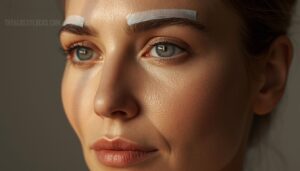
The honest answer is: it depends on what you’re expecting. Face tape can do something, just not everything the before-and-after photos suggest. Here’s what the evidence actually shows.
If scalp sensitivity is a concern, travel-friendly scalp massagers with adjustable pressure are worth considering before committing to tools with firmer, less forgiving prongs.
Temporary Smoothing Effects
Here’s the honest truth: face tape delivers a real but fleeting win. While it’s on, the duration of adhesion genuinely matters—longer wear means more sustained expression line masking. Think of it as a temporary facelift that evaporates the moment you peel it off.
What it actually does:
- Creates mechanical lift fade once removed
- Smooths lines through controlled skin tension release
- Works best on movement-driven wrinkles
- Delivers instant lifting taping results during wear
- Sleep position influences affect overnight antiwrinkle taping outcomes
No Collagen Stimulation
Face tape works purely through surface tension — unlike lasers or microneedling, it involves no controlled injury, heat, or internal remodeling. This mechanical smoothing relies on adhesive patches to hold skin in a lifted position, offering only a temporary solution rather than rebuilding tissue.
Gentle adhesives and barrier preservation ensure safety, but this comfort does not equate to collagen stimulation. Don’t mistake comfort for collagen; the method provides short-term results without long-term structural changes.
Dynamic Wrinkles Return
The moment you peel off that adhesive tape, your facial muscles pick up right where they left off—no negotiation. Post-tape rebound is real: expressive wrinkles snap back the same day because muscle memory runs deeper than any surface fix. Skin elasticity loss amplifies this, making a crease visibility spike common.
The moment face tape comes off, muscle memory wins and wrinkles snap right back
Adhesive lift fade doesn’t just end the smoothing—it can reveal more. The temporary effect highlights how muscle memory and elasticity loss create a cycle where wrinkles rebound aggressively, exposing the limits of quick fixes.
Sleep Crease Reduction
Sleep creases are where overnight taping actually earns some credit. Adhesive tape limits how much your skin folds against the pillow — a small but real win. Pair that with overnight skin hydration and moisture barrier support, and morning lines look noticeably softer.
Tape alignment technique matters here: place strips across the crease, not parallel to it.
Sleep position tweaks and pillow pressure reduction do the rest.
Dermatologist Perspective
Here’s the straight talk: face tape is a cosmetic workaround, not a treatment. As a dermatologist, I frame it as a short-term tool — nothing more.
- Barrier protection matters; skin barrier damage from daily adhesive use is real
- Allergy testing before full application prevents contact dermatitis
- Long-term safety depends on patient selection and medical-grade tape only
Clinical recommendations start with prevention, not tape.
Best Wrinkles to Tape

Face tape doesn’t work equally well everywhere — placement matters more than most people realize. Some areas respond noticeably better than others, especially when targeting movement-driven lines or sleep creases.
Here are the five spots where taping usually gives you the most visible payoff.
Forehead Lines
Horizontal lines across your forehead tell a specific story — one your frontalis muscle writes every time you raise your brows.
Through line pattern analysis and motion angle data, research shows wavy versus straight patterns actually map differently, influencing neuromodulator placement decisions.
Face tape works here as a temporary skin lift, a noninvasive cosmetic procedure that softens facial expression wrinkles through simple brow lifting mechanics.
Frown Lines
Frown lines are distinct—they run deeper, literally. The corrugator muscle pulls the brows inward, while procerus involvement bunches skin at the bridge, carving the stubborn "11s" between the brows.
Expression habits and stress furrowing accelerate elasticity loss over time. These repetitive movements and tension etch wrinkles more deeply into the skin.
Face taping offers a temporary skin lift, gently limiting muscle movement. This method is particularly useful for softening facial expression wrinkles overnight, providing a subtle smoothing effect.
Crow’s Feet
Unlike the ’11s,’ crow’s feet fan outward—driven by Orbital Muscle Dynamics from the orbicularis oculi contracting every time you smile or squint. Add age-related thinning, periorbital fat loss, and UV collagen damage, and eye-corner anatomy becomes surprisingly unforgiving.
Face tape acts as a gentle noninvasive facelift, temporarily smoothing expression wrinkles by limiting facial movements. Target them with:
- Clean, dry outer eye corners before applying
- Small silicone strips placed horizontally
- No more than 5% stretch tension
- Overnight wear for 6–8 hours
- Slow, careful morning removal
Nasolabial Folds
Crow’s feet fan outward; smile lines run straight down. Nasolabial folds form where fold anatomy meets muscle dynamics: the malar fat pad rotates downward over time, causing fat pad sagging that creates shadow-groove contrast, while dermal attachments anchor skin along a fixed line. Segmented depth explains why the upper fold often appears more pronounced than the lower one.
| What’s Happening | Face Taping Approach |
|---|---|
| Temporary facelift effect | Silicone strips with gentle lift |
| Skin elasticity loss | Overnight expression-line taping |
| Adhesive-related irritation risk | Patch-test first, limit wear |
Marionette Lines
Marionette lines go deeper than surface creasing — bone resorption in the jaw, mandibular ligament tethering, and depressor anguli muscle pull all drag tissue downward, compounding jowl sagging over time.
Cosmetic tape offers a temporary facelift effect here, but it can’t compete with filler placement for real volume correction.
Think of face tape as a nonsurgical facelift preview, not a fix.
How to Tape Your Face
Getting the technique right makes all the difference between a smooth result and irritated skin by morning. The process is simpler than it looks, but a few key steps keep it safe and effective.
Here’s exactly how to do it.
Clean and Dry Skin

Start with a gentle cleanser — not harsh soap, which strips your skin barrier and sets you up for adhesive-related irritation before you’ve even applied anything. Rinse, pat dry, and skip the moisturizer for now. Post-cleanse hydration comes later.
Medical-grade tape and adhesive skin patches bond best to clean, product-free skin. Avoiding over-washing is also important—once is enough.
Cut Small Strips

Precision here is everything. Your strip edge precision directly affects how well the tape holds and how natural it looks. Grab sharp scissors—sloppy cuts lift at the corners fast.
- Length measurement: match strip length to the wrinkle’s width, not the whole region
- Scissor technique: cut straight, clean edges — no jagged lines
- Material flexibility: choose skin-friendly adhesive or medical-grade tape that bends with your face
- Strip width: keep it narrow for better contouring
Apply Gentle Tension
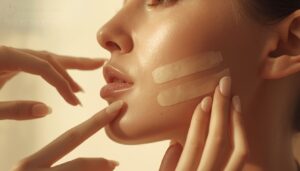
Think of tension like volume—you want just enough to smooth, not so much it distorts. For face taping, whether you’re doing instant lifting taping or overnight taping, apply adhesive tape strips with upward or lateral Tension Direction, using no more than 5% Stretch Percentage.
Watch your Comfort Feedback: blanching means too tight. Longer strips improve Distribution Length, easing Edge Pressure for better facial muscle relaxation.
Wear Six to Eight Hours

Six to eight hours is your sweet spot for face taping — long enough for real Adhesive Longevity without pushing into irritation territory. Whether you’re using facelift tape, medical-grade tape, or instant lifting taping strips, this window covers your day without taxing your skin.
Keep these in mind during wear:
- Do a Comfort Assessment at the two-hour mark
- Watch for stinging — that’s irritation, not support
- Check Makeup Compatibility before layering foundation over adhesive tape strips
- Build Removal Scheduling into your evening routine
- Prioritize Irritation Prevention by never exceeding eight hours
Remove Tape Slowly
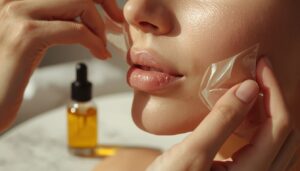
Ripping off facelift tape like a bandage is how you end up red and irritated. Instead, master Low Slow Peeling: anchor the skin beside the strip with one hand, then peel back using Pull Direction Control — always in the direction of hair growth.
A 180-degree peel angle works best; lower it if medical-grade tape resists.
Stubborn overnight tape? Oil-assisted removal dissolves the bond without the skin battle.
Face Taping Safety Tips
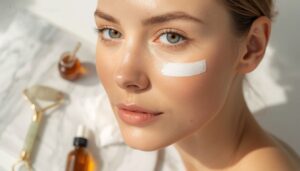
Face tape can do a lot, but it can also backfire fast if you’re not careful. Your sensitive territory, and a few wrong moves can leave you with redness, breakouts, or worse.
Here’s what you need to know before you press that strip down.
Patch Test First
Before applying any tape to your face, run a quick patch test first. Choose a discreet area—your inner arm works well—and press a small piece of your selected medical-grade or kinesiology tape there. Wait 24–48 hours.
Watch for skin irritation, itching, or raised bumps during this time. Any consistent reaction indicates that this tape type isn’t suitable for you.
Avoid Irritated Skin
Once you’ve passed the patch test, don’t push your luck on compromised skin. Taping over active breakouts, eczema, or rosacea is a fast track to adhesive-related irritation and skin barrier disruption.
Four situations where you should skip face taping entirely:
- Freshly exfoliated or retinoid-treated skin
- Humid conditions causing sweat buildup under tape
- Fragrance avoidance failures — fragranced products applied beforehand
- Residue-free removal isn’t possible due to skin sensitivity
Skip Strong Adhesives
The tape you choose matters as much as where you place it. Strong adhesives — think event tape or anything construction-grade — don’t belong on your face. Instead, opt for low-tack adhesives, silicone tape, or medical-grade tape with a silicone backing. These options prioritize skin safety and ease of removal.
Barrier-friendly tape and skin-friendly adhesive options minimize adhesive-related irritation and keep removal clean. A brief wear window also helps reduce risks. For most cases, kinesiology tape designed for sensitive skin is a solid default.
Limit Daily Use
Even the gentlest skin-friendly adhesive adds up when you’re using it daily. Cumulative wear time is the real culprit behind adhesive-related irritation — not any single session. Keep session frequency to a few days a week, and cap each wear at six to eight hours.
Your skin barrier recovery depends on those gaps. Watch your irritation thresholds: persistent redness means back off.
Remove Without Pulling
Ripping off face tape is where most people undo all their careful prep work.
- Edge Lifting — loosen perimeter edges first, never start center-pull
- Low Peel Angle — keep tape nearly parallel to skin
- Moisture Loosening — dampen or apply oil to weaken adhesive bond
- Friction-Free Peel — slow, smooth motion only
- Soothing Aftercare — finish with a gentle moisturizer
Top 5 Face-Taping Routine Products
Getting your face-taping routine right starts with having the right products in your corner. Not everything on the shelf is worth your skin’s time, so this list cuts straight to what actually earns a spot.
Here are five products worth building your routine around.
1. KT Sensitive Skin Tape
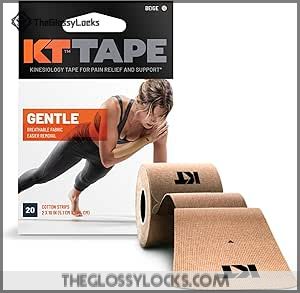
KT Tape Gentle is ideal for sensitive skin, offering a 100% cotton elastic core paired with a latex-free, acrylic heat-sensitive adhesive designed for easier removal — ensuring a hassle-free experience when taking it off.
Each box includes 20 pre-cut 10-inch strips with rounded corners, ready for immediate application straight from the pack. The tape withstands 1–3 days of wear, remaining secure through showers and workouts.
Priced at $12.47, it serves as a practical, irritation-free solution for those seeking reliable support without compromising skin comfort.
| Best For | Anyone with sensitive skin who needs reliable muscle or joint support without the irritation that comes with standard kinesiology tape. |
|---|---|
| Price | $12.47 |
| Pack Size | 20 strips |
| Skin Safe | Dermatologist-tested |
| Sensitive Skin | Gentle adhesive formula |
| Eco Credentials | None stated |
| Cruelty Free | Not stated |
| Additional Features |
|
- Gentle adhesive makes removal way less painful — no dreaded skin-ripping moments
- Pre-cut strips with rounded corners mean you’re ready to go straight out of the box
- Holds up through showers and workouts for 1–3 days, so it actually does its job
- Adhesive isn’t as strong as original KT Tape — some users report it peeling off within an hour
- Not fully hypoallergenic, so people with adhesive sensitivities might still run into issues
- Wear time tops out at 3 days, and heavy activity or moisture can cut that even shorter
2. Medik8 Crystal Retinal Serum
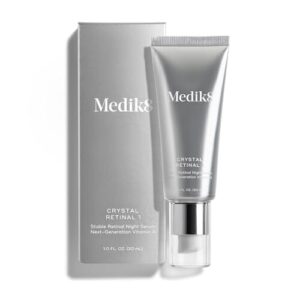
While face tape manages the mechanical lift, your skin still needs real repair underneath — and that’s where Medik8 Crystal Retinal earns its spot. This night serum uses retinaldehyde, a vitamin A form, which works up to 11 times faster than standard retinol, without the brutal irritation.
It’s gentle enough for sensitive skin, hydrating enough for dry types, and precise enough to apply around the eye area.
At $55 for 30 mL, it’s an investment — but the results show up.
| Best For | Anyone new to retinoids, sensitive or dry skin types, or people who want real anti-aging results without the harshness of prescription-strength products. |
|---|---|
| Price | $55.00 |
| Pack Size | 1 oz / 30 mL |
| Skin Safe | Dermatologist-formulated |
| Sensitive Skin | Low 0.01% retinaldehyde |
| Eco Credentials | None stated |
| Cruelty Free | Not stated |
| Additional Features |
|
- Retinaldehyde works up to 11x faster than regular retinol — you’re getting more with less irritation
- Hydrating formula with hyaluronic acid and vitamin E means your skin won’t feel stripped or tight in the morning
- Gentle enough to use around the eyes, which most retinoids just can’t claim
- At $55 for 1 oz, the tube goes fast — 2-3 pumps a night adds up, and so does the cost
- The bright yellow color is a bit of a surprise the first time you open it
- The 0.01% concentration is a starting point, not a finish line — sensitive skin will love it, but results-chasers may feel impatient
3. Drunk Elephant Vitamin C Day Serum
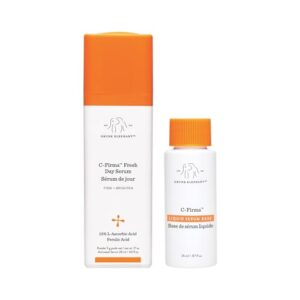
The Drunk Elephant C Firma Fresh Serum delivers daytime protection with a potent formula: 15% L-ascorbic acid, ferulic acid, and vitamin E. This trio neutralizes free radicals to prevent UV damage before it starts.
Its unique design requires you to mix the powder and liquid yourself before first use, ensuring vitamin C potency until activation.
Apply it every morning before sunscreen to actively defend against photoaging—the process that makes wrinkles permanent. At $79, it’s a serious investment in sun-season armor.
| Best For | Anyone who wants serious antioxidant protection and doesn’t mind a bit of DIY mixing — especially if you’re tackling fine lines, hyperpigmentation, or general sun damage. |
|---|---|
| Price | $79.00 |
| Pack Size | 4.97 oz / 141 g |
| Skin Safe | Free of ‘Suspicious 6’ |
| Sensitive Skin | May irritate sensitive skin |
| Eco Credentials | Clean ingredient list |
| Cruelty Free | Not stated |
| Additional Features |
|
- High-potency 15% vitamin C paired with ferulic acid and vitamin E — a well-researched combo that actually fights photoaging
- The powder-liquid mixing system keeps the vitamin C fresh and active until you’re ready to use it
- Fruit enzymes help the formula absorb deeper, so you’re not just layering it on the surface
- Some users notice a sticky texture, a smoky smell, and mild burning — not ideal if your skin runs sensitive
- The pump and twist-top have a reputation for clogging or cracking, which gets annoying fast at $79 a bottle
- Mixing it yourself sounds easy but if you get it wrong, you can throw off the texture or potency
4. Method Pink Grapefruit Foaming Hand Soap

Your hands do the work—so they deserve a little care too. The Method Pink Grapefruit Foaming Hand Soap keeps things simple: plant-based, paraben-free, and made with 100% post-consumer recycled plastic bottles.
The foam formula means using less product per wash, which matters when you’re washing up before applying serums or tape. At $11.97 for three 10 oz bottles, it’s genuinely affordable.
The bright citrus scent is a small but real mood shift in a routine that asks a lot of you.
| Best For | Anyone who washes their hands frequently throughout the day and wants a soap that’s gentle on skin, easy on the environment, and smells great doing it. |
|---|---|
| Price | $11.97 |
| Pack Size | 3 x 10 oz bottles |
| Skin Safe | Paraben & phthalate-free |
| Sensitive Skin | Non-drying formula |
| Eco Credentials | 100% PCR plastic bottle |
| Cruelty Free | Yes, certified |
| Additional Features |
|
- Foaming formula means you use less product per wash, so three bottles go further than you’d expect.
- Plant-based, paraben-free, and made with recycled plastic — solid eco credentials without a premium price tag.
- The pink grapefruit scent is fresh and uplifting without being overpowering for most people.
- A few users find it runs out faster than expected compared to thicker, non-foaming soaps.
- The strong citrus fragrance might be too much if you’re sensitive to scents.
- Caps can arrive loosely sealed, which occasionally means a sticky, leaky mess straight out of the box.
5. Method Sea Minerals Hand Soap
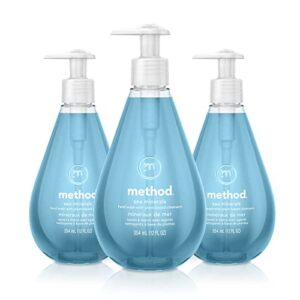
If the Pink Grapefruit version feels a bit much for your space, the Sea Minerals formula is its calmer sibling. Think crisp coastal air — bergamot, lemon, and a light oceanic finish that doesn’t compete with your skincare products.
It’s the same solid formula: plant-based cleansers, no parabens, and 100% recycled plastic bottles. Three 12-ounce bottles run $13.45.
Mild enough for frequent washing, it’s gentle enough to keep your skin barrier intact before you reach for your retinol or toner.
| Best For | Anyone who wants a clean, eco-friendly hand soap with a subtle scent that won’t clash with candles, diffusers, or skincare products. |
|---|---|
| Price | $13.45 |
| Pack Size | 3 x 12 oz bottles |
| Skin Safe | Paraben & phthalate-free |
| Sensitive Skin | Mild, non-irritating scent |
| Eco Credentials | 100% PCR plastic bottle |
| Cruelty Free | Yes, certified |
| Additional Features |
|
- Plant-based formula with no parabens — gentle enough for frequent washing without drying your skin out
- 100% recycled plastic bottles make it an easy win for eco-conscious households
- Three bottles for $13.45 is solid value, great for stocking multiple sinks at once
- Lather is pretty light — if you like a rich, foamy wash, this one might feel underwhelming
- A couple of reviewers ran into pump issues straight out of the box, which is frustrating at any price
- The sea minerals scent won’t be for everyone — it’s subtle, but scent is personal
Better Wrinkle-Reduction Alternatives

Face tape has its place, but it’s not the whole story. If you want results that actually stick around, there are proven options worth knowing about.
Dermatologists consistently point to these methods when the goal is real, lasting change.
Daily SPF 30+
Before you reach for the tape, the single most powerful anti-wrinkle move is applying daily sunscreen. SPF 30 broad spectrum photoprotection blocks UV rays responsible for up to 80% of visible aging.
Apply the correct amount—about a nickel-sized dollop—and mind your sun exposure timing. Water resistance matters too, so reapplication frequency every two hours ensures genuine protection.
This approach, unlike face taping’s fleeting fix, offers lasting defense against skin damage.
Retinol and Retinal
Sunscreen blocks damage; retinol and retinal actually repair it. Both follow the same conversion pathway — retinol takes two steps to become retinoic acid, while retinal needs just one.
That potency comparison matters: retinal acts up to 11 times faster on fine lines and wrinkles.
Just watch your application frequency and ingredient labeling carefully, because higher potency means real irritation risk — far less forgiving than adhesive-related irritation from face taping.
Vitamin C Serums
Retinoids rebuild; vitamin C protects the progress. A well-formulated serum — think L-ascorbic acid around pH 3.5, stabilized with ferulic acid through smart Antioxidant Pairings — actively enhances collagen synthesis while neutralizing daily environmental damage.
Derivative Variants like magnesium ascorbyl phosphate suit sensitive skin better. Mind your Serum Storage — oxidation kills efficacy quickly.
Unlike the adhesive-related irritation caused by face taping, vitamin C’s wrinkle prevention is cumulative and genuinely structural.
Botox and Neuromodulators
Where vitamin C guards the surface, Botox goes deeper — straight to the source. As a neuromodulator, it works by blocking nerve signals to targeted muscles, stopping the repeated contractions that carve wrinkles over time.
The onset timeline runs up to two weeks, and while side effects like drooping or headaches may occur, these are mitigated through dosage customization and smart treatment intervals. Quarterly Botox appointments help maintain consistent results, making face taping optional.
Lasers and Radiofrequency
When tape and sera hit their ceiling, laser therapy and radiofrequency therapy take over. These non-invasive treatments work at the structural level — not just the surface. Here’s what sets them apart:
- Laser resurfacing uses focal targeting to resurface specific skin layers
- RF Radio Frequency Skin Tightening Device delivers bulk heating through chromophore independence
- Device cooling mechanisms protect skin during energy penetration depth treatments
Frequently Asked Questions (FAQs)
How do dermatologists feel about taping?
Most dermatologists approach this with clinical skepticism. There’s a genuine evidence shortage around long-term results, so patient counseling usually steers toward proven alternative recommendations rather than relying on tape alone.
How often should I tape my face for wrinkles?
Most people do best with three to four sessions per week—never daily. Give your skin real rest intervals between uses.
Cap each session at eight hours, and lean on event-based use when possible.
Does taping wrinkles really work?
It works — but only while it’s on. Clinical evidence confirms the smoothing effect is mechanical, not structural.
No collagen production, no long-term results. Just a temporary non-invasive treatment that vanishes the moment you peel it off.
Do face strips work for wrinkles?
Yes, but only while they’re on. Face strips smooth wrinkles mechanically — no collagen boost, no muscle retraining. The moment you peel them off, those lines come right back.
What is the best overnight face tape for wrinkles?
Not all overnight face tape is equal. For skin sensitivity, silicone tape wins — offering better adhesion and less trauma upon removal.
Medical-grade tape, such as 3M Micropore, is also effective when breathability is a priority.
Does taping your face help wrinkles?
Face taping offers a temporary fix — silicone tape and medical-grade tape smooth expression wrinkles while worn, but don’t retrain muscles or boost collagen.
Think placebo perception over comparative efficacy. It’s low cost, but results vanish fast.
Does facelift tape really work?
Think of it as a smart smoke-and-mirrors trick. Facelift tape repositions skin temporarily — scientific evidence confirms zero lasting skin tightening.
The adhesive lifts wrinkles visually, but silicone tape can’t rewrite your biology.
How often should you use face tape?
Every other day is a solid starting point.
Give your skin at least one rest day between sessions. Monitor how it responds, and adjust your frequency schedule from there based on tolerance.
What is face taping for wrinkles?
Adhesive strips placed directly on skin to physically hold it smooth — that’s the short version. Face taping targets wrinkles by limiting movement, temporarily lifting problem areas while you wear it.
What are the ways to get rid of wrinkles on the face?
You’ve got options — from peptide creams and hydrating masks to chemical peels, microneedling therapy, facial exercises, and skin tightening procedures.
These genuinely boost collagen production through noninvasive treatment, reducing wrinkles over time.
Conclusion
Like a well-fitted compression bandage, face taping for wrinkles does exactly what it promises—holds things in place while you wear it, nothing more. That’s not a flaw; that’s the fine print most tutorials skip.
Use it strategically before an event, pair it with retinol and SPF for actual long-term change, and you’ve got a smart, layered approach.
Tape buys you time. Science builds the foundation. You decide how much of each you need.
- https://www.skingymco.com/blogs/skin-gym-blog/3-ways-to-use-face-tape-for-wrinkles-in-your-nightly-routine?srsltid=AfmBOoo7msTSvg_T_o3MKDGZM4WfEkayOfSv-EFJ03ydBV2iBeSwr60T
- https://www.baptisthealth.com/blog/primary-care/face-taping
- https://www.latimes.com/live-well/body/story/face-tape-wrinkles-tiktok-trend