This site is supported by our readers. We may earn a commission, at no cost to you, if you purchase through links. This content is for general informational and educational purposes only and is not a substitute for professional medical, dermatological, or nutritional advice.

About half of men notice thinning hair by age 50, and if you’ve watched your father’s hairline retreat, you probably expect yours to follow. That hunch has a basis in biology.
Genetic hair loss in men, the pattern most people call male pattern baldness, comes down to the genes you inherited and how your follicles respond to a hormone called DHT. Many genes contribute small amounts of risk, and some of them travel through your mother’s side of the family.
Understanding that chain helps you spot early signs, judge your own odds, and choose treatments that fit.
Table Of Contents
Key Takeaways
- Your hair loss risk comes from many inherited genes, including the AR gene on the X chromosome from your mother’s side, so your family’s age at onset and pattern of thinning tells you more than any single test.
- Your genes don’t cause baldness directly, but they decide how strongly your follicles react to DHT, which shrinks them over time until they grow thinner, shorter hairs.
- You can spot it early by checking for a receding M-shaped hairline or a widening crown under bright light, and a clinician can usually confirm it with a visual exam and scalp magnification rather than a lab test.
- Minoxidil and finasteride have the strongest evidence and need months of steady use, so starting sooner gives you more options, while transplants can last but don’t stop your native hair from thinning.
What is Genetic Male Pattern Hair Loss?

A gradual thinning of scalp hair in a set pattern is the main sign of androgenetic alopecia, the medical term for male pattern baldness. It affects roughly 50% of men by age 50, according to commonly cited estimates.
Because the condition affects both men and women, anyone noticing early thinning can explore proven hair growth strategies for thin hair before more noticeable loss sets in.
The condition rests on a genetic predisposition. Your follicles may react strongly to dihydrotestosterone (DHT), a hormone made from testosterone. Over time, this reaction triggers hair follicle miniaturization: each growth cycle produces a thinner, shorter strand.
It’s not the same as shedding. Telogen effluvium differentiation matters here, because that condition causes sudden, diffuse loss that often reverses once the trigger passes. Androgenetic alopecia doesn’t reverse by itself, so you’ll want to spot the difference early. Early recognition gives you more treatment options.
How is Male Pattern Baldness Inherited?

If you’re wondering where your hair loss came from, look at your family tree. Androgenetic alopecia runs in families, but it doesn’t follow a simple one-gene rule.
Instead, polygenic inheritance is thought to be at work. Many genes each add a small amount of risk, and your genetic predisposition is the sum. Here’s what to know:
- The AR gene sits on the X chromosome, so your mother’s side matters.
- Your father can pass on autosomal risk variants too.
- More risk variants usually mean earlier, more extensive loss.
- Not all sons of affected men lose hair the same way.
- Family history tells you more than any single test.
Ask your relatives when their hair thinned, and note how far it went. A simple family health history journal gives you one place to record each relative’s age at onset and pattern of loss.
Knowing your family’s pattern helps you tell inherited thinning apart from other causes of slow hair growth, like stress, diet, or hormonal changes.
How Do Genes and DHT Affect Hair Follicles?
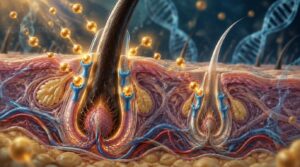
Your genes don’t cause baldness directly. They decide how strongly your follicles react to dihydrotestosterone (DHT), a hormone made from testosterone by an enzyme called 5-alpha-reductase.
Your genes don’t cause baldness directly; they decide how strongly your follicles react to DHT, a hormone made from testosterone
The AR gene you inherited builds the androgen receptor, the docking site DHT binds to. In androgenetic alopecia, sensitive follicles respond to that signal by shrinking. This is called follicular miniaturization, and it’s thought to build across each hair growth cycle.
Here’s what happens inside an affected follicle:
- DHT binds the androgen receptor inside the follicle cell.
- Gene activity shifts toward smaller, vellus-like hairs.
- Each anagen (growth) phase gets shorter.
- Regrown hairs come back thinner and finer.
- Sensitivity varies by scalp region, so your frontal hairline and vertex usually react well before the back.
What Does Male Pattern Hair Loss Look Like?
Because those follicles react region by region, male pattern baldness follows a recognizable map. Most men notice frontal hairline recession first, often as an M-shaped recession where the temples pull back. Others spot vertex thinning, a widening spot at the crown.
If your temples are already creeping back, this guide to why your hairline is receding explains the causes and what you can do about them.
| Area | What you’ll notice |
|---|---|
| Temples | Corners recede, forming an M |
| Crown | Scalp shows through the swirl |
| Hair shaft | Finer, shorter, paler strands |
Check under bright light, ideally with your hair short or wet, since scalp show-through is easier to see. Compare your sides and back, which usually keep thicker hairs. That contrast is a hallmark of androgenetic alopecia. In later stages, the thinning areas may eventually join into a horseshoe, leaving dense hair only around the sides and back.
If you’re unsure whether genetics or something else is behind the change, this guide on what makes your hair thin explains the common causes beyond pattern baldness.
How is Genetic Hair Loss Diagnosed?

Diagnosis of hereditary pattern baldness usually starts with a visual exam, not a lab test. Your clinician checks whether thinning follows the typical map: a receding frontotemporal hairline, a thinning vertex, or both.
Here’s what the process involves:
- Family history alopecia review, since relatives with early thinning raise suspicion.
- A trichoscopy evaluation, which magnifies your scalp to show hairs of uneven thickness.
- A hair density measurement of thinning and unaffected areas.
- Targeted blood work, only if shedding looks sudden, diffuse, or inflamed.
Uneven thickness matters most. It points to miniaturization, where follicles produce thinner, shorter hairs, likely linked to anagen phase shortening. Counting fewer hairs alone doesn’t confirm anything.
A scalp biopsy is rarely needed. It’s reserved for atypical cases.
What Treatments Help Male Pattern Hair Loss?

Once a doctor confirms male pattern hair loss, you have real options for managing it. Some treatments aim to slow further loss, while others restore hair in thinning areas. Here’s a look at the main approaches and what you can reasonably expect from each.
Minoxidil and Finasteride
Two drugs carry the strongest evidence for male pattern baldness, and they work in different ways.
Minoxidil is a topical treatment that widens blood vessels and may prolong the growth phase of hair. Finasteride is a daily pill that lowers dihydrotestosterone (DHT), the hormone driving androgenetic alopecia. Neither works fast. You’ll need months of steady use, and results often vary.
Hair Transplants and Long-term Care
You might worry a transplant just moves hair around and won’t last. It can last, though. In follicular unit transplantation, surgeons use follicular unit extraction to harvest grafts, and the hair transplant success rate is often 90–95% at reputable clinics. Success also depends on surgeon skill and clinic hygiene, since both affect graft survival and how natural the results look.
Your native hair keeps thinning, so long-term care matters. Protect your donor area, ask about PRP to support hair density.
Frequently Asked Questions (FAQs)
Is male pattern hair loss hereditary?
Your hairline is a family heirloom. Yes, hereditary pattern baldness is largely inherited from both parents. Androgenetic alopecia is a polygenic trait, so genetic hair loss draws on many genes, not just the Y chromosome.
Why is Gen Z balding so fast?
Think of thinning hair as a tide that’s been receding. Genetic studies suggest androgenetic alopecia starts early; Dihydrotestosterone (DHT) acts quietly, stress may add telogen effluvium, and a 5alpha reductase inhibitor can slow it down.
Which race is the least bald?
You may have heard that baldness skips some groups entirely. That’s mostly true. Native Americans show the lowest rates of male pattern baldness, and androgenetic alopecia is "almost unknown" in unmixed groups, while East Asian men see only 13-1%.
Do bald men have less sperm?
Your scalp isn’t a fertility gauge. Male pattern baldness, driven by dihydrotestosterone (DHT), isn’t proven to lower your sperm count. Finasteride (Propecia) can alter DHT. Ask your doctor about fertility. Telogen effluvium proves nothing either.
Is male pattern baldness linked to heart disease?
Does a bald crown signal a weak heart? Not reliably. Androgenetic alopecia and heart disease may share a genetic correlation through testosterone, dihydrotestosterone DHT and the androgen receptor gene, but risk is probabilistic, not diagnostic.
Can stress cause genetic hair loss in men?
Over 12 months, higher cortisol from stress is linked to faster progression of androgenetic alopecia. Stress alone doesn’t create it, since dihydrotestosterone (DHT) drives it, but genetic studies suggest it can also worsen hair shedding.
Why does male pattern baldness often begin in the 20s?
A seed waits for puberty’s rain.
Male pattern baldness often starts in your 20s because rising androgens meet an inherited androgen receptor gene, bringing DHT sensitivity, hormonal sensitivity, and a shorter anagen telogen ratio.
Conclusion
About 50% of men notice thinning by age 50, so you’re far from alone. Your genetic hair loss male pattern risk comes from many inherited genes and your follicles’ sensitivity to DHT, not from anything you did.
That knowledge gives you control. Watch your hairline for early changes, see a doctor for a proper diagnosis, and start minoxidil or finasteride sooner rather than later. Genes only set the starting point. You decide what happens next.