This site is supported by our readers. We may earn a commission, at no cost to you, if you purchase through links.

Your barber asks “high taper fade?” and suddenly you’re locked in—high skin, drop, burst, or temp? The question sounds simple until you’re sitting in that chair realizing there’s a whole spectrum of high taper fade options, each one shifting your entire look.
A high skin fade screams precision and clean lines. A burst fade follows your ear’s natural curve, adding movement. Drop fades angle down behind the ear for that modern edge. Temp fades carve sharp definition around your temples.
Your hair texture, face shape, and how much time you’ll spend maintaining it all determine which variation actually works. Most guys pick based on a photo they saw online, then wonder why it doesn’t hit the same. The difference between a fade that transforms your whole vibe and one that falls flat comes down to matching the right style to your specific features and lifestyle.
Table Of Contents
- Key Takeaways
- What is a High Taper Fade?
- Popular High Taper Fade Styles
- High Taper Fade With Different Hair Textures
- Choosing The Right High Taper Fade
- Styling Options for High Taper Fades
- Maintenance Tips for High Taper Fades
- High Taper Fade Vs. Other Fade Haircuts
- Frequently Asked Questions (FAQs)
- Conclusion
Key Takeaways
- High taper fades start the blend 2-3 inches above your ears, near the crown, creating a sharp contrast between longer top sections and skin-tight sides through precise clipper guard work from #3 or #4 down to zero.
- Your face shape determines which fade variation works best—round faces need vertical height from high tapers, square jaws benefit from blended sides, and oval shapes handle nearly any style due to balanced proportions.
- Maintenance demands barber visits every 2-4 weeks, depending on hair growth speed and desired sharpness, with skin fades requiring the most frequent touch-ups and drop or burst fades allowing slightly longer intervals.
- The right high taper fade matches your hair texture to the fade type—straight hair showcases clean lines perfectly, curly and coily textures create pronounced contrast with proper moisture balance, and fine hair benefits from reduced side weight that prevents flattening.
What is a High Taper Fade?
A high taper fade starts the blend high on your head—above the temples, near the crown—and drops down to skin at the neckline. It’s sharp, clean, and gives you that bold contrast between your longer top and tight sides.
If you want to see how a high taper fade fits into the full range of taper fade haircut styles, you’ll find variations that work for every face shape and vibe.
Let’s break down what makes this cut stand out, how it separates itself from other fades, and which hair types work best with it.
Key Features of High Taper Fades
A high taper fade starts the taper 2 to 3 inches above your ears, near the crown. You’ll get sharp contrast between your top length and clipped sides.
Barbers use blade guards from 3 or 4 down to skin, creating a clean gradient. This fade technique works with any hair texture and highlights your cheekbones and jawline through precise clipper work and consistent blending.
How It Differs From Other Fades
Fade techniques separate the high taper from low fade and mid taper options. Low fade starts below your ears with subtle contrast, while mid taper sits at temple level.
Your high fade begins 2 to 3 inches above the ears, delivering bold style distinctions through aggressive haircut comparisons. Taper variations also include undercuts with hard disconnects instead of gradual contrast methods that define your taper fade.
For further insight into the different types of fade haircuts, knowing the unique features of each style can help with your choice.
Suitability for Different Hair Types
Your hair texture determines how sharp your fade haircut appears and how you’ll style the top. Here’s what works:
- Straight hair highlights clean contrast between longer top sections and faded sides
- Wavy hair adds natural volume at the crown while keeping sides tight
- Curly hair showcases pronounced taper lines with proper maintenance to control frizz
- Coily hair creates strong contrast that makes curl patterns pop
- Fine hair stays light since short sides reduce weight and prevent flattening
Popular High Taper Fade Styles
The high taper fade isn’t a one-size-fits-all cut—it’s a framework you can customize based on how aggressive you want the fade and where it drops.
Your choice between skin, drop, burst, or temp will determine the overall vibe and boldness of the look. Let’s break down the most popular variations so you can pick the right one for your style.
High Taper Skin Fade
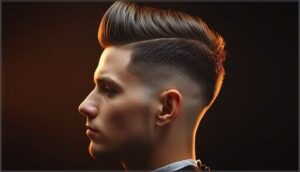
Want a bold statement? This fade haircut starts near your temples, creating a dramatic skin fade that drops straight to the scalp.
The high taper fade delivers clean hairline shaping and precise edge styling through skin fade techniques. Expect barber visits every two to four weeks for taper maintenance—your lineup stays razor-sharp, and the fade design remains crisp and unmistakably masculine.
You can learn more about the differences and history of these fade haircut styles explained.
High Taper Drop Fade
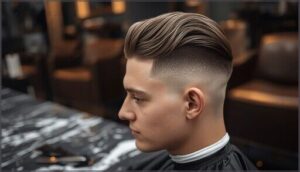
This drop fade styles technique curves down behind your ear instead of following a straight line. You’ll notice the taper shifts from near the crown and slopes naturally around the back, creating a rounded fade haircut silhouette.
Hair layering here feels softer than a strict high fade. Taper maintenance and edge control still matter—book your barber every two to three weeks.
High Taper Burst Fade
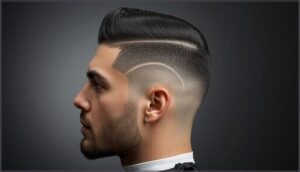
This circular pattern radiates around your ear in a sunburst effect. The burst fade anatomy creates concentric circles instead of a straight drop, starting high near the temples.
Your barber clips with precise guards to nail that curved pattern. Face shape suitability matters—square and oval faces handle tight bursts best.
Expect fade maintenance every two to four weeks to keep those edges sharp and clean.
High Taper Temp Fade
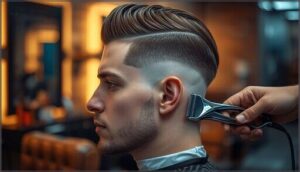
This temple-focused technique puts maximum contrast right at your hairline edges. The high taper temp fade blends rapidly from a crisp guideline near your crown down to skin around the temples and sideburns, leaving the top long and textured.
You’ll need touch-ups every two to four weeks to maintain that bold, defined look across all hair texture options.
High Taper Fade With Different Hair Textures
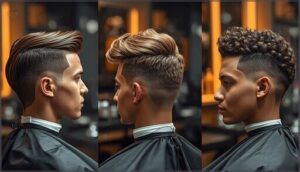
Your hair texture changes how a high taper fade sits and moves on your head.
Straight hair creates sharp lines, while curls and coils add natural volume and dimension to the fade.
Here’s how to work with what you’ve got.
Straight Hair Options
Straight hair is the perfect canvas for a high taper fade because the crisp lines really pop. The flat growth pattern makes every fade graduation visible, and you can rock slicked back styles or pompadours without fighting natural curl.
Use light-hold pomades or matte clays to keep that clean finish sharp. Blow dryers add volume up top while your sides stay tight and defined.
Wavy and Curly Hair Looks
Wavy and curly textures bring natural movement that makes the high taper fade even more vibrant. The S-shaped strands of type 2A to 2C waves create volume near the crown, while the tight sides enhance that contrast.
Use lightweight leave-in conditioners and sea salt sprays to keep definition without weighing down your curls. Diffuser drying locks in that pattern while your fade stays razor sharp.
Coily and Afro Hair Variations
Coily haircare demands precision because afro texture forms tight Z-shaped curl patterns from 4A to 4C that shrink up to 75 percent.
High taper fade haircuts work brilliantly here—the dramatic contrast showcases your natural volume while keeping edges clean. Focus on moisture balance with sulfate-free cleansers and rich leave-ins.
Hair porosity varies across your scalp, so target hydration where coils need it most. This fade haircut celebrates your hair type.
Choosing The Right High Taper Fade

Picking the right high taper fade isn’t about following trends—it’s about working with what you’ve got. Your face shape, hair density, and how much time you’re willing to spend at the barber all play a role in what’s going to look sharp on you.
The right high taper fade works with your face shape, hair density, and barber commitment—not trends
Let’s break down the key factors that’ll help you lock in the perfect fade.
Matching Fade to Face Shape
Face shape analysis determines everything when you’re choosing the right high taper fade. Taper techniques and fade customization work together to sharpen your features or soften hard angles, depending on what you’re working with.
Here’s your styling guidance for dialing in the perfect haircut style:
- Round faces: High taper fade adds vertical height, creates sharp angles that elongate your look
- Square or heart-shaped: Blended fade haircut softens strong jawlines, balances wider cheekbones
- Oval faces: Nearly any taper fade works due to naturally balanced proportions
- Diamond shapes: Hairline design adds width at forehead and temples, balances narrow chin
- Angular jaws: Pronounced top length with tight temple fades enhances chiseled definition
Considering Hair Density and Growth Patterns
Density and growth cycles shape how your high taper fade sits on your head. Scalp mapping reveals where follicle health favors tighter blends versus softer gradients.
Coarse hair maintains bulk even with fewer strands, while fine texture shows scalp faster in short zones. Texture analysis guides clipper guard choices so your haircut maintenance stays sharp as natural growth patterns shift over time.
Lifestyle and Maintenance Needs
Your daily routine sets the fade maintenance pace. Book cuts every 2 to 4 weeks to stay ahead of hair regrowth and keep lines crisp.
Between visits, light styling products and scalp care prevent buildup that dulls the blend. Haircut maintenance and care match your schedule—busy weeks favor longer intervals, while sharp looks demand tighter timing.
Grooming tips that fit real life keep your fade looking intentional.
Styling Options for High Taper Fades
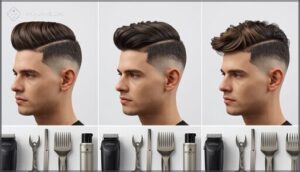
Once you’ve locked in the right high taper fade for your face and hair texture, the real fun starts with styling the top. The fade gives you a clean foundation, but what you do up top sets the entire vibe—whether that’s sharp and professional or bold and creative.
Here’s how you can style your high taper fade to match your personality and daily routine.
Slicked Back and Pompadour Styles
A high taper fade with a slicked back or pompadour top gives you that sharp, commanding edge—think vintage cool meets modern precision. These men’s haircut styles demand the right styling products and fade techniques to lock in that polished finish.
- Use medium to high hold pomade for slicked back looks that stay flat and controlled.
- Lift the pompadour with a comb and strong product to create height above your forehead.
- Apply product from scalp to ends for even distribution and lasting shine.
- Maintain crisp edges with regular trims to keep your fade haircut looking fresh.
Curls, Waves, and Textured Tops
Natural texture on top of a high taper fade creates rebellious dimension—your curls and waves own the spotlight while the skin-tight sides frame everything sharp.
Use leave-in conditioner for hair hydration and frizz control. Sea salt spray enhances wave styling without stiffness. Finger-comb for curl enhancement that keeps your hair texture alive.
This mens haircut styles approach transforms your haircut guide into pure confidence.
Designs, Hard Parts, and Edgars
Edge work separates good fades from legendary ones—your barber uses designs, hard parts, and Edgar cuts to transform a standard high taper fade into a personal statement.
- Hair designs: Patterns shaved into the fade last one to two weeks before blurring.
- Hard parts: Razor lines measuring one to three millimeters create bold separation between top and taper styles.
- Edgar cuts: Blunt fringe paired with high taper fade delivers structured rebellion.
- Fade details: Sharp edges need cleanup every ten to fourteen days.
This haircut guide puts you in control.
Maintenance Tips for High Taper Fades
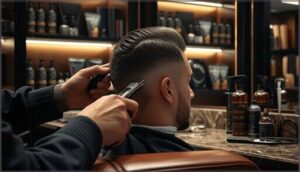
A high taper fade looks sharp when it’s fresh, but that crisp line doesn’t last forever without some effort on your part.
You’ll need a maintenance routine that keeps the fade clean and your hair healthy between appointments. Here’s what you need to know about barber visits, home care, and the right products to keep your cut looking tight.
Frequency of Barber Visits
Your high taper fade thrives on consistent barber intervals—plan on booking every 2 to 4 weeks for sharp lineups and smooth fade maintenance.
Fast hair growth means you’ll lean toward that 2-week mark, while normal growth lets you stretch to 3 or 4. Visit schedules depend on your style upkeep goals and how quickly your haircut loses definition.
At-Home Upkeep Between Cuts
Between barber visits, you’re the keeper of those crisp lines—touch up your edges with a clean trimmer every 1 to 2 weeks. Focus on hairline care and fade touchups using short, controlled passes.
Follow solid trim schedules, practice clipper hygiene by cleaning blades after each use, and apply these mens grooming tips to extend your cut’s lifespan and preserve that sharp finish.
Recommended Haircare Products
Your fade deserves the right fuel. Start with sulfate free shampoo options and lightweight conditioner tips—they clean without stripping oils.
Use hair masks weekly for repair, apply heat protectant styling products before tools, and don’t skip scalp care with gentle exfoliants.
Check mens grooming products and haircare product reviews to find what works. Smart mens haircare and grooming tips and advice keep that cut looking fresh daily.
High Taper Fade Vs. Other Fade Haircuts
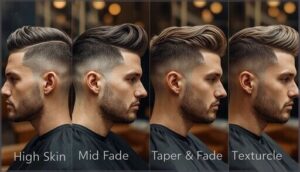
Not all fades are created equal, and knowing the difference can save you from walking out with the wrong cut.
The high taper sits in a league with other popular fades, but each one brings its own vibe and maintenance demands.
Here’s how the high taper stacks up against the rest so you can pick what actually works for your head.
High Taper Vs. Low and Mid Taper
You’ve probably stood in front of the mirror wondering which fade haircut actually fits your vibe. The fade comparison between high, mid, and low taper styles comes down to three game-changers: where the blend starts, how it plays with your face proportions, and what maintenance tips you’re willing to commit to.
| Feature | High Taper Fade | Mid Fade | Low Taper |
|---|---|---|---|
| Starting Point | Above temple area | Around temple level | Near ear level |
| Contrast Level | Sharp, dramatic | Balanced, moderate | Subtle, gradual |
| Best For | Thick, dense hair texture; round faces needing length | Most face shapes; adaptable hair texture | Fine hair; longer faces |
| Maintenance Frequency | Every 2 weeks for crisp edges | 2–3 week cycle | 3–4 weeks between cuts |
| Visual Effect | Elongates face, adds crown height | Neutral, cohesive look | Widens jawline appearance |
High fade haircut starts the taper above your temples, creating maximum contrast with longer tops. Mid taper fade begins right at temple height, offering that sweet spot for professional settings. Low taper sits below the ears, blending gradually for conservative styles that don’t scream for attention.
Your hair texture dictates which taper styles work best. Dense, straight hair benefits from the high taper’s sharp definition, while finer hair avoids the scalp-show problem with a lower fade. Round faces get elongated with high tapers, long faces gain width from low cuts, and square or oval shapes can rock the mid fade’s balanced approach.
Maintenance tips vary wildly. High taper fades demand barber visits every two weeks to keep that crisp edge. Mid fades give you a 2–3 week buffer, and low tapers stretch to nearly a month. Between cuts, trim your fade line at home and use light hold products without buildup.
The choice isn’t about trends—it’s about matching your natural proportions and lifestyle to the right fade comparison.
High Taper Vs. Undercut and Classic Fade
Choosing between these cuts means understanding their structural DNA. A high taper fade blends gradually from above the temples down, creating smooth blend gradation. The classic fade emphasizes smooth transitions with moderate contrast sharpness, while an undercut delivers maximum disconnect level—shaved sides with zero taper between top and bottom.
| Feature | High Taper Fade | Classic Fade | Undercut |
|---|---|---|---|
| Transition Style | Gradual temple-down blend | Smooth low-to-high flow | Abrupt two-tone disconnect |
| Silhouette Focus | Structured side definition | Cohesive head frame | Dramatic top emphasis |
| Versatility | Multiple top lengths | Short-medium compatibility | Frequent style changes |
Your silhouette focus shifts with each fade haircut—high fade haircut carves sharp angles, classic styles polish everyday looks, undercuts enhance rebellious edge.
Pros and Cons of Each Style
Every cut brings trade-offs. High taper fades offer bold personalization options and work across multiple face shapes, but you’ll spend more on maintenance costs—touch-ups every 2 to 4 weeks keep lines crisp. Classic fades deliver reliable haircut durability with moderate upkeep. Undercuts enhance style versatility for frequent changes but lack the gradual tapered hair flow.
| Aspect | High Taper Fade | Classic Fade | Undercut |
|---|---|---|---|
| Upkeep Frequency | Every 2-4 weeks | Every 3-5 weeks | Every 4-6 weeks |
| Cost Per Year | Higher premium visits | Moderate standard trims | Lower touch-up expense |
| Styling Range | Wide top compatibility | Medium length focus | Maximum contrast shifts |
Frequently Asked Questions (FAQs)
What types of taper fades are there?
You’ve got three main taper techniques to work with: high, mid, and low. Each one starts the fade at a different height on your head, creating distinct contrast levels and style options.
What are the different types of high fades?
High fade variations include skin fade for full exposure, drop fade with a curved finish behind the ear, burst fade circling the temple, and temp fade sharpening just the hairline area.
Can women pull off high taper fades?
Absolutely. Women rock high taper fades with pixie cuts, undercuts, and genderless styles that bring a feminine edge.
This bold haircut trend works beautifully on all textures, proving fade haircuts aren’t just for men anymore.
How much does a high taper fade cost?
You’ll usually pay between $30 and $60 at most barbershops, though price variations depend on your city, the barber’s skill level, and whether you want extras like designs or beard work.
What clippers do barbers use for tapers?
Most barbers reach for the Wahl Detailer, Andis Master Cordless, or BaByliss Pro FX.
These clipper brands deliver the motor power and sharp blade types you need for clean taper fades every time.
Does a high taper fade work with thinning hair?
Think of thinning hair like fabric—you don’t want sharp cuts exposing weak spots.
A high taper fade actually works beautifully by concentrating hair density up top, drawing eyes away from sparse temples while maintaining balanced volume.
How long does hair need to be initially?
You’ll want at least 5 to 2 inches on top for a clean fade shift. That initial cut guidance ensures your barber can build proper height, blend smoothly, and leave room for styling flexibility.
Conclusion
Think of high taper fade options like choosing the right blade—each one’s built for a specific purpose. The fade that works isn’t the one that looked sharp on someone else’s head.
It’s the one that matches your hair texture, complements your face shape, and fits how often you’ll maintain it. Your barber can execute any variation, but you’ve got to know which one actually suits your features and lifestyle before you commit.
- https://www.menshealth.com/
- https://www.gq.com/
- https://twitter.com/intent/tweet?text=High%20taper%20fade%20searches%20%E2%86%91320%25%20since%202018!%20Here%27s%20the%20ultimate%20guide%20with%2050%2B%20styles%2C%20barber%20tips%2C%20and%20maintenance%20hacks.%20%23MensHair%20%23BarberTips&url=https://taperfadehub.com/blog/articles/high-taper-fade.html
- https://www.instagram.com/p/BVdl57ggdjB/
- https://forteseries.com/blogs/hairstyles/high-taper-fade