This site is supported by our readers. We may earn a commission, at no cost to you, if you purchase through links. This content is for general informational and educational purposes only and is not a substitute for professional medical, dermatological, or nutritional advice.

Most store-bought toners contain more filler than function—long ingredient lists padded with alcohol, synthetic fragrance, and preservatives your skin never asked for. Meanwhile, a clean, effective toner costs less than a cup of coffee to make at home.
The catch? Knowing which ingredients actually do something for your specific skin type. Chamomile calms, witch hazel tightens, green tea protects—each one earns its place for a reason. These homemade face toner recipes cut through the noise, giving you targeted formulas built around what your skin genuinely needs.
Table Of Contents
- Key Takeaways
- Benefits of Homemade Face Toners
- Choosing Essential Oils for Face Toners
- DIY Toner Recipes for Normal Skin
- DIY Toner Recipes for Oily Skin
- DIY Toner Recipes for Dry Skin
- DIY Toner Recipes for Sensitive Skin
- DIY Toner Recipes for Mature Skin
- How to Store and Use DIY Face Toners
- Tips for Customizing DIY Face Toners
- Frequently Asked Questions (FAQs)
- What is the best DIY toner for face?
- Can toner reduce redness?
- What is the best homemade facial toner?
- Can we make a toner at home?
- How can I make my own toner at home?
- How to make a homemade face toner?
- What is the most natural toner for face?
- What essential oils are good for face toner?
- How often should you apply homemade toner?
- Can you use honey as a toner?
- Conclusion
Key Takeaways
- store-bought toners are loaded with fillers and alcohol you don’t need — making your own costs under $5 per batch and giving you full control over every ingredient.
- Match your base ingredient to your skin type: witch hazel for oily skin, rose water for sensitive skin, aloe or glycerin for dry, and green tea for mature skin needing antioxidant support.
- DIY toners skip preservatives, so always store them in the fridge and toss them after 2–3 days — and patch test any new ingredient on your inner forearm before putting it on your face.
- Essential oils aren’t just a scent — tea tree fights breakouts, lavender calms irritation, rosemary controls oil, and geranium balances combination skin, but all need to be diluted before use.
Benefits of Homemade Face Toners

your own toner puts you in control of what actually goes on your skin.
These natural skin toner recipes let you tailor every ingredient to exactly what your skin needs.
The benefits go beyond just saving money — they touch on ingredients, impact, and peace of mind.
Here’s what makes homemade toners worth the switch.
Natural Ingredients for Customization
One of the best things about making your own toner is that you get to choose exactly what goes on your skin. With DIY homemade face toner recipes, every ingredient earns its place — nothing filler, nothing unnecessary.
Botanical extract pairings like chamomile and aloe calm irritation, while astringent fruit acids from apple cider vinegar help clear and tighten oily skin. Hydrating plant polymers like aloe gel and glycerin seal in moisture for drier types.
Here’s why ingredient-based skincare customization matters:
- Skin type-specific toner formulations let you swap pH balancing herbs like witch hazel for rose water depending on your needs.
- Antioxidant rich additives such as green tea protect against daily environmental stress.
- Natural ingredients for skin toners give you real control over ingredient benefits for different skin types — season to season, concern to concern.
Cost-Effective Compared to Store-Bought
Knowing exactly what’s in your toner also means knowing what you’re paying for. Store-bought options often run $15–30 for a small bottle — and a good chunk of that covers branding, not ingredients.
DIY toner recipes flip that script:
- Bulk ingredient purchasing keeps cost per batch under $5
- Minimal packaging costs eliminate retail and distribution markups
- Ingredient shelf-life savings stretch one purchase across many batches
Simple formulation economics, real results.
Environmentally Friendly Packaging
Saving money is just one win — what you do with the packaging matters too.
Reusing a glass spray bottle or mason jar keeps plastic out of landfills.
If you do buy new containers, look for recycled cardboard boxes, biodegradable labels, or compostable films.
Minimalist design means less waste overall.
| Packaging Choice | Eco Benefit |
|---|---|
| Reusable bottles | Cuts single-use plastic |
| Recycled cardboard | Reduces virgin material use |
| Compostable films | Breaks down within 90 days |
No Harsh Chemicals or Preservatives
Going green with your packaging is a great start — but what actually goes on your skin matters even more. Many store-bought toners rely on high-percentage alcohols, synthetic fragrance blends, and preservatives that can strip your skin’s natural barrier.
DIY skincare safety starts with choosing pH-friendly ingredients like alcohol-free witch hazel and fragrance-free options such as rose water or chamomile. These preservative-free formulations do require refrigeration and a short 2–3 day shelf life, but your skin will thank you.
Choosing Essential Oils for Face Toners
The essential oil you pick can make or break your DIY toner — especially when your skin has strong opinions. Each oil brings something different to the table, from fighting breakouts to calming redness.
Here are four great options to explore based on what your skin actually needs.
Tea Tree Oil for Acne-Prone Skin
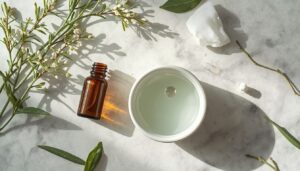
Tea tree essential oil is a go-to for oily and acne-prone skin toner solutions — and for good reason. Its terpinen-4-ol compound delivers real Antimicrobial Action against acne-causing bacteria while its Anti-Inflammatory Benefits calm redness around breakouts. It’s antibacterial, mildly astringent, and helps balance pH all at once.
Research shows clinical evidence for acne supporting its effectiveness in mild to moderate cases.
- Dilution Guidelines: Use 1–2 drops per 15mL of witch hazel base (roughly 0.5–1%).
- Spot Treatment Dilution: Increase to 2.5–5% for targeted blemishes only.
- Patch Test Protocol: Always test on a small area for 30 minutes before full application.
Lavender Oil for Sensitive Skin

Lavender essential oil is one of the gentlest options for sensitive skin — and it earns that reputation. Its key compound, linalool, delivers real anti‑inflammatory action, soothing irritated skin and calming redness without stripping your skin’s natural pH balance.
For safe use, always follow dilution guidelines: 1–2 drops per 15mL of base keep it effective but skin‑friendly. Aromatherapy relaxation is a bonus. Always patch test first.
| Lavender Calming Properties | Dilution & Safety |
|---|---|
| Soothes inflammation and redness | Use 0.5–1% concentration |
| Maintains skin pH balance | Patch test before full use |
| Reduces reactive skin sensitivity | Avoid sun after application |
Rosemary Oil for Oily Skin

Rosemary essential oil is a smart pick for oily skin — and the science backs it up. Its key compounds, alpha‑pinene and borneol, work through Anti‑Inflammatory Mechanisms and Sebum Regulation Pathways to calm redness and keep excess oil in check.
As a natural astringent, it provides Antimicrobial Action against acne‑causing bacteria while maintaining pH balancing. Use it in a rosemary mint toner for real oil control.
- Mix 3–5 drops into 1 tablespoon of carrier or toner base
- Always follow Safety Dilution Guidelines — never apply undiluted
- Follow the Patch Test Protocol: apply diluted oil to your inner elbow first
- Ideal for Oily and acne‑prone skin toner solutions paired with witch hazel
Geranium Oil for Balancing Skin PH

Combination skin can feel like two different people living on your face — and geranium essential oil helps bring them together.
It offers pH Stabilizing Benefits that keep skin pH in the 4.5–5.5 sweet spot, while Sebum Regulation prevents oily zones from overproducing.
You also get Antioxidant Protection, Anti-Inflammatory Comfort, and Skin Barrier Support in one gentle ingredient.
| Geranium Oil Benefit | What It Does |
|---|---|
| pH balancing | Normalizes skin pH after cleansing |
| Natural astringent | Tightens pores without stripping moisture |
| Sebum Regulation | Calms oily zones, hydrates dry areas |
| Anti-Inflammatory Comfort | Reduces redness and surface irritation |
Add 3–4 drops to your DIY toner base.
DIY Toner Recipes for Normal Skin

Normal skin is honestly the easiest to work with — it’s balanced, not too oily, not too dry, which means you have a lot of flexibility with ingredients. That said, you still want a toner that keeps things that way, not one that tips the scale.
Here are four recipes worth trying.
All-Purpose Toner With Witch Hazel
Witch hazel is a natural astringent that works quietly but effectively — tightening pores, lifting surface oils, and supporting your skin’s pH balance without stripping it bare. This all-purpose DIY toner is a solid starting point for normal skin.
- Mix 2 tsp witch hazel with 3 tbsp distilled water for a gentle, pH balancing and acid mantle support base.
- Add 3 tbsp rose water for hydration boost and antioxidant support.
- Blend in 6 drops lavender essential oil, checking ingredient compatibility before use.
Firming Frankincense Toner for Anti-Aging
Frankincense essential oil is one of skincare’s quiet overachievers — delivering astringent action, botanical antioxidants, and anti-photoaging benefits in one ingredient.
| Ingredient | Amount |
|---|---|
| Distilled water or hydrosol | 3 oz |
| Glycerin | 1 tsp |
| Frankincense essential oil | 6 drops |
Combine everything in a spray bottle. Glycerin promotes skin barrier support and moisture retention, while Frankincense drives collagen formation and skin elasticity enhancement — making this DIY toner a smart addition to any antiaging antioxidant toners lineup.
Vitamin C Toner for Brightening
If frankincense quietly firms, vitamin C loudly brightens — and this DIY facial toner preparation brings that glow without the guesswork.
The key to a good vitamin C toner is Stabilized Ascorbic Acid. It stays potent longer and delivers real antioxidant benefits where your skin needs them most. For best results, keep the concentration between 5% and 20% — that sweet spot is your Concentration Guidelines range.
Here’s what makes this toner work:
- Mix 1 tsp vitamin C powder with 3 oz rose water for a clean, effective base
- Target a pH of 3.5–4.5 for proper pH Optimization and skin pH balance
- Store in a dark amber bottle — light degrades ascorbic acid fast
- Use within 3–5 days for maximum brightening effect
- Always follow with sunscreen — Sun Protection Pairing isn’t optional here
That Antioxidant Synergy between vitamin C and rose water makes this worth trying.
Hibiscus Toner Mist for Hydration
Now that vitamin C has your glow covered, let’s talk about keeping your skin deeply hydrated.
Hibiscus contains mucilage — a natural mucilage humectant that draws moisture in and holds it there. This antioxidant protection-rich toner mist also manages pH balancing and leaves a gentle botanical fragrance behind.
Mix 1 cup hibiscus tea, 1 tbsp aloe vera, and 2 drops glycerin; then spray application makes daily use easy.
DIY Toner Recipes for Oily Skin

Oily skin needs a toner that actually does something — not just refreshes, but actively controls shine and keeps breakouts in check. The right ingredients make all the difference, and luckily, your kitchen and local health store have most of them.
Here are four recipes worth trying.
Astringent Witch Hazel Toner
Oily skin has a way of undoing your whole routine by midday — that’s where alcohol-free witch hazel earns its place. Its natural tannin astringency tightens pores and helps regulate skin pH without stripping moisture.
Mix:
- 2 tsp alcohol-free witch hazel
- 3 tbsp distilled water + 1 tbsp aloe vera gel
- 2 drops tea tree oil
Together, they deliver pore tightening, antioxidant enrichment, and acne prevention in one simple step.
Clarifying Apple Cider Vinegar Toner
Witch hazel manages pore control beautifully — but if you’re dealing with stubborn breakouts and dull, oily skin, apple cider vinegar brings something extra to your DIY toner lineup. As a natural astringent, it promotes pH balance and acne prevention without stripping your skin bare.
Dilution ratios matter here. Mix one part ACV with three parts distilled water — that’s roughly a 25% concentration, gentle enough for daily use.
safety precautions before making it part of your routine:
- Patch test first — some skin reacts with light tingling
- Apply with a cotton pad, avoiding the eye area
- Monitor application frequency — once daily works best to start
- Watch for ingredient interactions if layering with actives like retinol
- Store refrigerated and discard after three days
Rosemary Mint Toner for Oil Control
When your skin is constantly shiny by noon, rosemary and mint make a surprisingly effective team. This rosemary mint toner works through a simple Herb Infusion Technique — steep two sprigs of fresh rosemary and two tablespoons of mint leaves in half a cup of boiling water for 15 minutes, then strain and cool completely before adding two teaspoons of apple cider vinegar for pH balancing.
| Ingredient | Amount | Purpose |
|---|---|---|
| Fresh rosemary | 2 sprigs | Astringent Synergy, oil control |
| Fresh mint leaves | 2 tbsp | Cooling Sensation, pore tightening |
| Apple cider vinegar | 2 tsp | pH balancing, antibacterial |
Rosemary delivers an Antioxidant Boost while acting as a natural astringent. Mint’s Cooling Sensation helps calm visibly oily areas. You can also add two drops of tea tree essential oil for extra clarifying power.
Apply with a cotton pad after cleansing — once daily to start. Refrigerate and discard after three days.
Tomato Juice Toner for Balancing Skin PH
Tomatoes might surprise you as a toner ingredient — but their natural pH sits right around 4.3 to 4.9, making them ideal for skin pH regulation and Acid Mantle Support. That closeness to your skin’s own surface means pH Matching Benefits are real here. Plus, tomato juice delivers Lycopene Antioxidant protection and Tomato Enzyme Activity that help calm excess oil.
- Mix 1 tsp fresh tomato juice with 3 tbsp distilled water.
- Add ½ tsp alcohol-free witch hazel as a natural astringent.
- Apply with a cotton pad after cleansing — once daily.
Always patch test first — Irritation Risk is genuine for sensitive skin. Store this Homemade facial toner preparation refrigerated and discard after two days.
DIY Toner Recipes for Dry Skin
Dry skin needs a toner that adds moisture back — not one that strips what little it has. The right ingredients can calm tightness, plump your skin, and help everything else you layer on top absorb better.
Here are four recipes worth keeping in your rotation.
Neroli Hyaluronic Acid Toner for Hydration
Dry skin doesn’t just need moisture — it needs moisture that actually stays. This neroli hyaluronic acid DIY toner does exactly that.
Neroli essential oil brings floral antioxidants and natural pH balance, while hyaluronic acid works as a powerful humectant to lock hydration deep into the skin.
Together, they’re a smart layering strategy before your moisturizer. Store it refrigerated for shelf-life extension up to 72 hours.
Among hydrating toners for dry and sensitive skin, this one earns its place.
Rose Water Toner for Soothing
If your skin feels tight, reactive, or just plain angry after cleansing, rose water might be your new best friend. As a soothing toner for sensitive skin, it works quietly — restoring pH Balance, calming redness, and delivering Skin Barrier Support without overwhelming your complexion.
This DIY natural toner recipe is about as simple as it gets. Here’s how to use it:
- Mist lightly over a freshly cleansed face for an instant Cooling Sensation
- Pat with a cotton pad using gentle, upward strokes to avoid tugging
- Press between palms to warm the rose water before applying
- Layer twice for deeper absorption before moisturizer
- Chill the bottle beforehand for extra soothing relief on reactive skin
Add a drop of aloe vera for moisture or glycerin for a Botanical Aroma-meets-hydration boost. The natural ingredients also deliver a gentle Antioxidant Boost — keeping irritation in check all day.
Green Tea Toner for Anti-Inflammatory Benefits
Green tea’s catechin antioxidant power makes it one of the best natural ingredients for irritated, dry skin. These plant compounds work through inflammation pathway modulation — quietly calming redness at the source.
For your DIY facial toner preparation, steep two green tea bags in half a cup of hot water for five minutes, cool completely, then apply with a cotton pad. Think of it as a gentle anti-redness formula, your skin actually drinks in.
Cucumber Toner for Cooling and Hydrating
Cucumber is about 95% water — that’s a serious moisture boost for dry, parched skin. Its cooling sensation instantly calms tightness and redness, while supporting your skin barrier and helping with pH balancing after cleansing.
Here’s how to make it:
- Blend half a cucumber with ¼ cup distilled water
- Strain well through a fine cloth
- Pour into a spray bottle and refrigerate
- Apply to clean skin twice daily for a hydrating and cooling effect
DIY Toner Recipes for Sensitive Skin
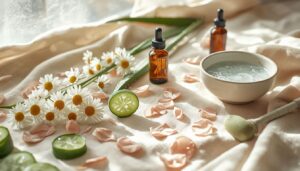
Sensitive skin needs ingredients that calm without causing a reaction — nothing harsh, nothing stripping. The good news is that nature gives us some genuinely gentle options that work well together.
Here are three DIY toner recipes worth trying.
Chamomile Toner for Soothing
If your skin flushes easily or feels tight after cleansing, a chamomile soothing toner might be exactly what it needs. Chamomile’s natural anti‑inflammatory compounds deliver real redness relief without harsh ingredients. Steep chamomile flowers for ten minutes, strain, cool, then apply with a cotton pad — simple as that.
| Feature | Chamomile Toner |
|---|---|
| pH Restoration | Gently rebalances skin |
| Redness Relief | Calms visible irritation |
| Skin Barrier Protection | Helps sensitive skin |
| Hydrating Mist | Revitalizing between routines |
| Allergy Safe | Patch test first |
Store your DIY toner refrigerated — it stays fresh for up to one week. Add aloe vera for extra calming botanicals and deeper hydration.
Parsley Water for Reducing Inflammation
Chamomile isn’t the only kitchen ingredient worth keeping in your toner lineup. Parsley water is a surprisingly effective anti-inflammatory DIY facial toner — especially for reactive skin types. Its flavonoid antioxidants and essential oil anti-inflammatory compounds work together through cytokine modulation to calm irritated tissue and deliver skin swelling relief.
Here’s make it:
- Steep ¼ cup fresh chopped parsley in 1 cup hot distilled water for 15 minutes.
- Strain thoroughly and cool completely before use.
- Apply as a cooling compress with a cotton pad after cleansing, and refrigerate up to three days.
These natural ingredients keep the formula gentle yet effective for sensitive skin type-specific toner formulations.
Fennel Toner for Anti-Aging Benefits
Fennel is a quiet powerhouse in anti-aging antioxidant toners — and it works beautifully for sensitive skin. Its antioxidant power helps fight free-radical damage, while its natural Vitamin C Enrichment enhances a Collagen Boost that improves Skin Elasticity over time.
For homemade facial toner preparation, steep two tablespoons of fennel seeds in one cup of hot water for 15 minutes, strain, and cool.
This antioxidant-rich toner delivers Plumping Hydration and real skin rejuvenation — gently.
DIY Toner Recipes for Mature Skin

Mature skin needs a little extra care — and the right toner can genuinely make a difference.
The recipes below are built around ingredients that target fine lines, dullness, and loss of firmness without overwhelming your skin. Here’s what to try.
Green Tea Toner for Anti-Aging Benefits
Green tea might be the most hardworking ingredient in your DIY facial toner preparation toolkit. Its polyphenol antioxidant compounds — especially EGCG — deliver serious ROS scavenging action, neutralizing the free radicals that break down collagen over time.
Brew one cup, cool it completely, then apply with a cotton pad after cleansing.
These anti‑aging antioxidant toners work because green tea targets multiple aging pathways at once:
- Collagen Synthesis Support helps maintain skin firmness improvement
- Antioxidant protection shields against daily environmental damage
- Anti‑inflammatory compounds calm redness and irritation
- Formulation Stability — store in a dark bottle for skin rejuvenation that lasts
White Tea Toner for Anti-Inflammatory Benefits
White tea works quietly but effectively — its polyphenol mechanisms help calm redness and reduce inflammation without irritating mature skin.
Steep two bags in hot water for five minutes, then cool completely before use. This gentle extraction method preserves the delicate antioxidants** that support your skin barrier.
Apply daily with a cotton pad. Refrigerate your DIY toner and use within two to three days.
Rice Water Toner for Hydration and Brightening
Rice water is one of the simplest, most rewarding additions to a mature skin routine. It delivers an Amino Acid Glow without harsh actives — and that gentle Starch Film Effect leaves skin feeling smoother, not stripped.
Here’s how to make and use it well:
- DIY facial toner preparation: Soak ¼ cup rice in filtered water for 30 minutes, then strain
- Application Techniques: Press into skin with a cotton pad after cleansing
- pH Balancing Action: Helps restore skin’s natural acidic range post-cleanse
- Hydrating toners for dry and sensitive skin: Lightweight and calming — no essential oils needed
- Shelf-life Challenges: Refrigerate immediately; discard after two to three days
Cranberry Toner for Antioxidant Benefits
Cranberry polyphenols — anthocyanins, flavonoids, and proanthocyanidins — make this one of the most effective antioxidant skin defense options for mature skin. The cranberry’s acidic pH provides free radical protection and skin elasticity enhancement.
To make your cranberry toner, combine 2 tablespoons cranberry juice, 3 tablespoons rose water, and 1 teaspoon witch hazel. Apply with a cotton pad after cleansing.
How to Store and Use DIY Face Toners

Making a great toner is only half the job — how you store and use it determines whether it actually works for your skin. DIY formulas don’t have preservatives, so a few simple habits go a long way.
Here’s what you need to know to get the most out of every batch.
Storing Toners in The Refrigerator
Your refrigerator is honestly one of the best tools in your skincare routine. Since homemade toners have no preservatives, cold storage is what keeps them fresh.
Aim for temperature stability between 36–46°F — the main shelf works better than the door. Light protection comes built-in.
Practice smart bottle positioning by keeping bottles upright, and check seal integrity before storing to block fridge odors.
Manage condensation by letting bottles warm slightly before opening so water doesn’t sneak inside.
Discarding Toners After 2-3 Days
Even refrigeration has its limits. Without preservatives, your homemade toner hits a safety timeframe of just 2–3 days before microbial growth risks become real.
Watch for spoilage indicators like a cloudy appearance, off smell, or unusual texture — any of those mean it’s done. Container hygiene matters too; a dirty cap or loose seal speeds things up.
Dispose of old batches promptly, then start fresh.
Conducting Skin Patch Tests for New Ingredients
Before trying any new toner on your face, a patch test is your first safety precaution. Apply a small amount to your inner forearm — that’s your ideal site selection guideline — cover it lightly, and leave it alone for 24 to 48 hours.
Watch for redness, itching, or swelling. That’s your reaction interpretation window.
Patch test timing matters because some sensitivities show up slowly. Don’t skip this step, no matter how gentle the recipe looks.
Applying Toners After Cleansing
Once patch test clears, applying your toner is straightforward. Pat your skin dry gently — no rubbing — then work within a 30-second to one-minute timing window while skin is still slightly receptive. Your cotton pad choice matters; soft cotton rounds glide without tugging. Use the patting technique across your face and neck, avoiding eyes.
- Apply after your second cleansing rinse to lift any leftover residue
- Follow the layering order: toner first, then serum, then moisturizer
- chilled toners count — chilled toners feel especially soothing on reactive skin
Tips for Customizing DIY Face Toners

Once you’ve nailed your storage routine, the real fun begins — making the formula yours.
Think of your toner as a living recipe. Small tweaks in ingredient ratios can shift everything. For pH adjustment, a few drops more or less of apple cider vinegar keep that 4.5–5.5 sweet spot without tipping into irritation territory. Seasonal ingredient swaps help too — lighter cucumber or green tea bases in summer, richer aloe and glycerin blends when winter hits.
Your toner is a living recipe — small tweaks in pH and seasonal swaps keep it perfectly yours
For customization for skin type, change one variable at a time. Swap the base first, then adjust the essential oils. That way, you actually know what’s working.
Here’s where to start experimenting:
- Texture modification — add a drop of vegetable glycerin for a silkier feel without heaviness
- Preservative alternatives — witch hazel extends shelf life naturally in water-based blends
- Essential oil benefits in toners — lavender calms, tea tree clarifies, rosemary controls oil
Your skin, your formula.
Frequently Asked Questions (FAQs)
What is the best DIY toner for face?
There’s no single "best" DIY toner — your skin type calls the shots. A witch hazel blend suits oily skin, while rose water wins for sensitive types.
Match the formula to your skin’s needs.
Can toner reduce redness?
Yes — the right toner can calm redness.
Alcohol-free formulas with soothing actives like chamomile, soothing botanicals, and aloe vera soothing compounds support anti‑inflammatory skin care, helping pH balancing and redness reduction with consistent routine use.
What is the best homemade facial toner?
The best DIY toner matches your skin type.
For most people, witch hazel plus rose water hits the sweet spot — it balances pH, hydrates, and keeps things calm without overwhelming sensitive skin.
Can we make a toner at home?
Absolutely — DIY facial toner preparation is simpler than it sounds.
Mix witch hazel, rose water, or green tea, bottle it up, patch test first, and apply after cleansing.
Your skin will thank you.
How can I make my own toner at home?
Making your own toner is surprisingly simple. Combine witch hazel, rose water, and distilled water, then add a drop or two of essential oil.
Always patch test first, and store it in the fridge.
How to make a homemade face toner?
Witch hazel, rose water, and distilled water — that’s your toner’s holy trinity. Mix equal parts, apply with a cotton pad after cleansing, and let your skin drink it in.
What is the most natural toner for face?
Rose water is one of the most natural toners you can use — it hydrates, balances pH, and calms irritation gently.
Apply it with a cotton pad after cleansing for soft, refreshed skin.
What essential oils are good for face toner?
The right essential oil can transform your toner from basic to radiant.
Tea tree targets breakouts, lavender calms irritation, rosemary controls oil, and geranium balances skin — just always dilute before applying.
How often should you apply homemade toner?
once or twice daily works for most skin types — apply right after cleansing, before your moisturizer.
sensitive or dry skin? Start at three times weekly and build up slowly if irritation stays away.
Can you use honey as a toner?
Yes — honey works surprisingly well as a toner. Its humectant properties draw moisture into the skin, while its antibacterial action calms breakouts.
Dilute with water, apply with a cotton pad, then rinse.
Always do an allergy patch test first.
Conclusion
Your skin isn’t a one-size-fits-all situation—and neither is your toner. These homemade face toner recipes hand you the keys to something store shelves rarely offer: a formula built specifically for your skin, not the average customer.
Like an old apothecary mixing remedies by hand, you now have that same precision. Pick your ingredients with purpose, patch test like a pro, and let your skin tell you what works.