This site is supported by our readers. We may earn a commission, at no cost to you, if you purchase through links. This content is for general informational and educational purposes only and is not a substitute for professional medical, dermatological, or nutritional advice.

Most men glide a trimmer across their jaw without a second thought—yet the engineering packed into those oscillating blades is doing something genuinely intricate at the skin’s surface. The blade gap, calibrated to a fraction of a millimeter, forces hair into a shear path while geometrically excluding skin from the cutting edge.
That precision is why a tool moving at thousands of strokes per minute doesn’t routinely carve up your face. Understanding how beard trimmers work on skin—the metallurgy, motor behavior, and guard geometry—puts you in control of choosing and using one that keeps irritation, redness, and contact dermatitis off the table entirely.
Table Of Contents
- Key Takeaways
- How Beard Trimmers Cut Hair
- How Trimmers Touch Skin
- Why Trimmers Usually Avoid Cuts
- Blade Materials and Skin Feel
- Motor Power and Tugging
- Guards, Gaps, and Length Control
- Wet Versus Dry Skin Trimming
- Safe Technique for Sensitive Skin
- Cleaning Blades for Healthier Skin
- Top 7 Beard Trimmers for Skin
- Frequently Asked Questions (FAQs)
- Conclusion
Key Takeaways
- The blade gap, calibrated to fractions of a millimeter, physically prevents skin from entering the cutting zone while allowing hair to shear cleanly — making trimmer safety a matter of engineering, not luck.
- Blade material directly affects skin comfort: DLC and ceramic coatings run cooler and last longer than bare stainless steel, reducing the friction‑induced redness that follows repeated passes on sensitive skin.
- Motor consistency matters as much as blade quality — when RPM drops or stutters, blades tug instead of shear, and that mechanical drag is the leading cause of post‑trim irritation and redness.
- Your technique is the variable the trimmer can’t control — light pressure, single passes per zone, and trimming against hair growth determine whether a precision instrument protects your skin or compounds irritation.
How Beard Trimmers Cut Hair
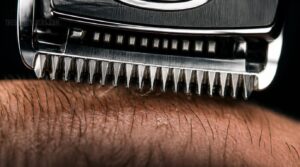
Understanding how a beard trimmer actually cuts hair makes it easier to use one confidently and safely. The mechanism is more precise than it looks, relying on a few key components working together to shear hair without touching your skin. Here’s how each part plays its role.
For a deeper look at how trimmers and scissors work together in practice, beard grooming techniques while growing your beard walk you through using each tool at the right stage.
Moving Blade Mechanism
At the heart of every beard trimmer lies a two-bladed oscillating system driven by a cam-and-lever interface that converts your motor’s rotary motion into rapid reciprocating blade travel.
A gear train reduces motor speed to increase torque, while damping features absorb abrupt stops — keeping the cutting action smooth and controlled rather than jarring against your skin.
The trimmer’s blade action mirrors the drive pinion gear engagement used in industrial cutting tools.
Stationary Comb Blade
Beneath the moving blade lies the stationary comb blade — a hardened, flat base plate whose symmetrically spaced teeth define every cut you make.
Tooth geometry and gap calibration determine exactly how close the blade sits to your skin, keeping hair in the cutting path while firm tissue simply can’t enter the narrow openings, preventing irritation before it starts.
Hair Enters Blade Gap
Once that stationary comb anchors against your skin, hair entry geometry takes over. Individual strands bend toward the blade gap — narrow openings calibrated precisely so hair slides in while skin can’t follow.
Blade gap mechanics dictate capture efficiency: correctly spaced teeth intercept hair at the follicle level, guiding it cleanly into the cutting path without pulling surrounding tissue.
Shearing Instead of Shaving
Shearing is fundamentally different from shaving. A razor scrapes across the skin surface; a trimmer’s oscillating upper blade shears hair perpendicularly at the shaft, producing a clean base cut without dragging the follicle.
This perpendicular contact prevents hair from bending or curling inward — protecting follicle integrity and dramatically reducing the inflammatory response that causes post-trim redness and irritation on sensitive skin.
Skin Stays Outside Teeth
By design, your skin simply can’t reach the cutting teeth.
The blade gap is engineered narrower than any skin contact point, and a 0.1–0.2 mm enamel-like guard layer keeps tissue safely outside. An air pocket between skin and teeth further cushions each pass, while rounded, hypoallergenic guard tips glide across even reactive skin without exposing the cutting edge beneath.
How Trimmers Touch Skin
Every time a trimmer glides across your face, there’s a precise mechanical relationship happening between the blade and your skin—one that’s engineered to cut hair while leaving skin untouched. Understanding that relationship helps you get a cleaner trim with far less irritation.
Here’s what’s actually going on at the point of contact.
Light Surface Contact

When a trimmer glides across your face, it never actually presses blades against skin. The device relies on light surface contact — a controlled glide where rounded blade tips and guards distribute pressure across a wider area, preventing skin from folding into the cutting zone.
Keeping your strokes slow and steady, with minimal downward pressure, greatly reduces friction and the micro‑irritation that triggers post‑trim redness.
Blade Gap Protection
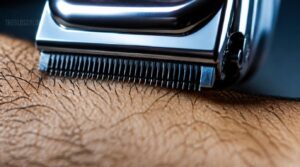
The blade gap is engineered to a dimension smaller than typical hair strands, allowing hair entry while physically preventing skin from reaching the cutting edge.
A zero-gap DLC blade keeps its cutting edge slightly recessed, so even firm downward pressure won’t force skin into the shear zone — dramatically reducing irritation at the source.
Guard-to-skin Barrier
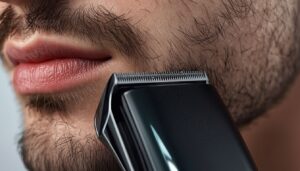
The guard acts as the primary physical interface between the trimmer and your skin — a precision‑engineered barrier built from rigid ABS or polycarbonate, sometimes finished with a rubberized lip that softens contact across skin folds.
Friction‑reducing coatings on guard edges lower drag, while the zero‑gap adjustable design keeps blade exposure minimal, actively preventing irritation before it starts.
Rounded Blade Tips
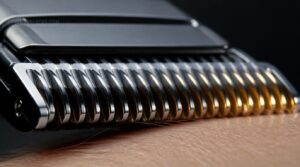
What separates a comfortable trim from an irritating one often comes down to geometry you can’t see. Rounded blade tips distribute contact forces across a broader surface area rather than concentrating pressure at a sharp point, which measurably reduces micro-abrasions on sensitive skin.
- Tip curvature glides over skin folds without catching
- Pressure distribution minimizes pinpoint irritation zones
- Laser-formed radii guarantee safety standard compliance
- Low-friction coatings paired with rounded tips reduce drag
- Hypoallergenic surfaces prevent contact dermatitis during repeated passes
Pressure and Nick Risk

Excessive trimming pressure is the single most preventable cause of nicks. When you press the trimmer firmly into skin, skin compression forces tissue into the blade gap, and even well-designed safety geometry can’t compensate. Keep contact light — let the blade do the work.
Light pressure is your best protection — let the blade work, not your hand
| Risk Factor | Consequence |
|---|---|
| Excessive pressure | Skin enters blade gap |
| Unpredictable jawline contact | Shallow nicks on contours |
| Blade gap snagging | Tugging and redness |
| Repeated directional passes | Cumulative irritation |
Why Trimmers Usually Avoid Cuts
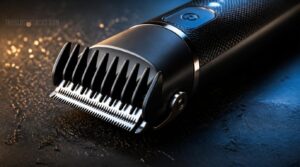
Beard trimmers are engineered with specific physical safeguards that make accidental cuts far less likely than most people expect. Understanding exactly why comes down to a handful of deliberate design features working together. Here’s what’s protecting your skin every time you trim.
Narrow Cutting Openings
The narrow cutting opening is engineering working in your favor. Measured in fractions of a millimeter, this calibrated gap allows hair fibers to enter and be sheared while keeping firm skin well outside the cutting zone.
Precision gap tolerances and smooth opening edges — often enhanced by DLC or titanium coatings — maintain that dimension consistently, so every pass stays controlled and irritation‑free.
Skin Cannot Easily Enter
Your skin’s own biology is working alongside the trimmer’s design. The stratum corneum—a dense, lipid-reinforced outer layer—resists mechanical intrusion naturally. These five structural defenses explain why skin stays outside the cutting zone:
- Intercellular lipid barriers maintain surface rigidity, preventing tissue from deforming into narrow blade openings
- Stratum corneum integrity keeps the epidermal surface firm enough to deflect instead of yield under light trimmer contact
- Mechanical stress resistance via desmosomes and adherens junctions distributes pressure, preventing micro-gaps from forming
- Follicle shielding mechanisms position hair upright, keeping surrounding skin tissue naturally distanced from the cutting edge
- Epidermal regeneration cycles (~28 days) continuously restore barrier function, reducing cumulative vulnerability from repeated passes
Hair enters the blade gap because it’s pliable and slender. Skin doesn’t—because it isn’t.
Guards Reduce Blade Exposure
The guard system acts as a silent gatekeeper between your skin and the blade. Automatic guard retraction pulls back only during active cutting, then returns immediately — keeping that critical micro buffer zone intact.
Rounded tooth geometry channels hair in while deflecting skin away.
Tactile locking mechanisms secure your chosen length, and hardened guard materials maintain this protection across hundreds of passes without degrading.
Zero-gap Safety Limits
The zero-gap adjustable blade design maintains a controlled minimum clearance between the moving and fixed blade components, ensuring your skin simply can’t enter the cutting zone under normal pressure. Sensor-based feedback and blade enclosure safety work together to keep gap tolerances within specification, even as battery voltage fluctuates during a trim.
Key mechanisms preventing skin penetration include:
- Blade enclosure geometry that physically constrains the cutting path to hair diameter only
- Guard geometry design channeling hair toward blades while deflecting broader tissue contact
- Real-time gap calibration through inertial cues that detect pressure shifts before blade contact occurs
For skin sensitivity concerns, this architecture is the cornerstone of blade safety — because precision at the micrometer level is what separates a clean trim from irritation.
Delicate Area Precautions
Delicate zones — the Adam’s apple, lip corners, and jaw creases — demand extra discipline. Use gentle, steady pressure and move slowly along the contour rather than across it.
Start with a longer guard, make no more than two passes per area, and stop immediately if stinging or redness appears. A hypoallergenic blade further reduces contact dermatitis risk here.
Blade Materials and Skin Feel
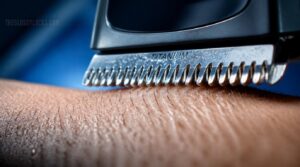
The blade material in your trimmer does more than cut hair—it directly influences how your skin feels during and after every pass. Different metals and coatings behave in measurably distinct ways when they meet sensitive skin, from heat transfer to surface friction. Here’s what each option actually means for your skin.
Stainless Steel Blades
Standard stainless steel blades perform reliably at first, but surface friction levels climb noticeably as the edge degrades—usually within 4–6 months of regular use. Unlike treated alternatives, untreated blade performance drops sharply once microscopic burrs develop, increasing tugging and skin irritation.
Build a replacement schedule now, before a dull blade makes your skin pay the price.
Ceramic Blade Cooling
Ceramic blades stand apart because of their low thermal conductivity—heat generated at the blade tip dissipates slowly into the blade body rather than transferring onto your skin.
This blade heat reduction translates directly into less post‑trim redness.
Combined with edge retention benefits lasting up to two years, ceramic remains one of the most reliable choices for sensitive skin.
Titanium-coated Blades
Titanium-coated blades achieve a hardness of approximately RC 85, making them substantially more resistant to micro-wear than uncoated stainless steel.
That hardness directly enhances edge retention for 6–9 months—fewer replacements, more consistent trims.
The titanium nitride layer also resists corrosion from moisture and sweat, while reduced surface friction means less heat transfer and lower risk of skin irritation during extended grooming sessions.
DLC Low-friction Coating
DLC — diamond-like carbon — earns its name honestly: deposited via vapor deposition, it achieves a nanoscale surface hardness rivaling diamond while keeping a friction coefficient as low as 0.05 against steel. That near-frictionless interface means less heat transfer to your skin during extended passes, reducing redness and irritation.
With proper adhesion interlayers, DLC blades retain this performance reliably for 12–18 months.
Hypoallergenic Blade Surfaces
For those with reactive skin, contact dermatitis from metal exposure is a real clinical concern — nickel being the most common culprit. Hypoallergenic blade surfaces, whether titanium alloy, nickel-free stainless steel, or PVD-coated, minimize nickel release and reduce allergenic contact.
Smooth edge geometries and corrosion-resistant coatings further prevent micro-tears and irritation, keeping your skin barrier intact across every trim.
Motor Power and Tugging
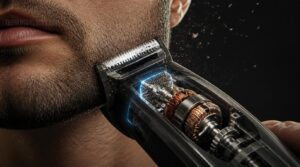
The motor inside your trimmer does more than spin blades — it determines whether each pass glides cleanly or drags uncomfortably across your skin. Everything from RPM stability to power output plays a direct role in how your skin feels during and after a trim. Here’s what to know about each factor.
Stable RPM Performance
Stable RPM performance is the quiet backbone of a comfortable shave. When your trimmer’s constant-RPM motor maintains speed through closed-loop feedback control, cutting stays smooth from first stroke to last.
Three things stable RPM actually protects you from:
- Mid-trim snagging from motor slowdown
- Uneven passes caused by speed fluctuations
- Skin irritation from blade stuttering
Torque for Coarse Hair
When your beard is dense and coarse, motor torque becomes the real differentiator. Brushless DC motors maintain precise, constant-speed cutting performance by adapting torque output in real time — so hair thickness handling stays consistent even through the thickest patches.
Torque-limiting algorithms prevent abrupt motor surges that tug hair rather than shear it cleanly, protecting reactive skin from unnecessary friction and redness.
Low-power Stuttering
When motor voltage drops during low-power stuttering, firmware throttling algorithms reduce drive current through PWM switching cycles, creating momentary torque fluctuations that interrupt the constant-RPM rhythm your trimmer depends on.
Those brief micro-pauses translate directly into snagging rather than clean shearing — and on sensitive skin, even a fraction-of-a-second interruption in motor speed control compounds friction and heat transfer.
Tugging and Redness
When motor stuttering forces hair to catch rather than shear cleanly, friction-induced redness follows almost immediately. A dull blade’s drag across coarse hair resists clean severance, triggering a plucking sensation that mechanically irritates the outer skin layer — dilating surface capillaries and producing visible redness.
Repeated passes over the same area compound this micro-injury, making tugging reduction your most effective skin irritation prevention strategy.
Noise and Comfort
Noise isn’t just an annoyance — it’s a clinical signal. Motor noise levels between 55 and 75 dB generate a midrange whine around 1–3 kHz that heightens sensory stress during grooming. Vibration dampening tech — balanced rotors, precision bearings, rubberized grips — reduces hand-transmitted microvibration meaningfully.
- Acoustic frequency impact determines perceived shrillness
- Tactile comfort factors include grip ergonomics and chassis softness
- Microvibration comfort improves with brushless motor designs
Guards, Gaps, and Length Control
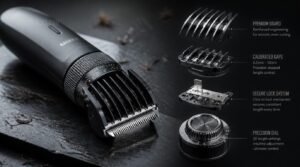
Getting the right length is where most trimming mistakes happen — and where the right guard system makes all the difference.
Your trimmer’s guard design, gap calibration, and dial lock all determine how precisely you can shape your beard without risking skin contact.
Here’s what you need to understand about each element before your next trim.
Comb Guard Spacing
The comb attachment acts as your first line of defense—guard spacing precision determines exactly how far the blade sits from your skin. A consistent 0.5 mm barrier keeps the cutting edge safely clear of shallow skin layers, preventing micro‑abrasions.
Rounded guard teeth and durable composite materials resist warping, ensuring that uniform skin contact barriers hold their geometry trim after trim.
Adjustable Length Settings
Adjustable length settings give you genuine command over your beard’s geometry. Micrometer precision increments spanning 0.5 mm to 10 mm—with some premium models stepping down to 0.25 mm—eliminate guesswork entirely.
For stubble fades, shorter settings below 2 mm produce controlled gradients, while mid-range selections maintain classic proportions. Guard wobble prevention through precision-engineered tolerances ensures length drift doesn’t compromise consistency across repeated passes.
Secure Dial Locks
Think of a dial-based guard lock as the backbone of precision length control — it anchors every adjustment with mechanical certainty.
The wheel pack alignment inside dial-based systems ensures each increment locks definitively, delivering tactile feedback mechanisms, you can both feel and trust.
That engineering reliability — hardened steel durability, tamper-evident housing, zero-gap adjustable blade retention — eliminates the drift that frustrates sensitive-skin users.
Rounded Guard Teeth
The geometry of guard teeth matters more than most people realize. Their convex, rounded profile creates a smooth barrier that glides across skin rather than dragging against it — channeling hair into the blade gap while keeping the cutting edge safely separated from your skin’s surface.
That subtle tip radius reduces micro-abrasions and skin irritation measurably, especially over reactive or post-inflammatory skin.
Even Trimming Passes
Uniform pass speed is the unsung variable in precision cutting. Moving the trimmer too fast or too slow disrupts blade gap harmony, letting hairs slip past unevenly:
- Keep consistent stroke direction — always against growth
- Maintain steady hand speed for even hair entry
- Let guard teeth alignment do the depth work
- Use adjustable length settings before changing angles
Wet Versus Dry Skin Trimming

Whether you trim on dry skin or step into the shower first makes a bigger difference than most people expect. Each approach carries its own set of tradeoffs for sensitive skin, motor performance, and post-trim recovery. Here’s what you need to know before you decide which method works best for you.
Dry Trimming Control
When you trim dry, blade sharpness is everything — dull stainless steel drags across skin rather than shearing cleanly, and that friction alone triggers irritation.
Controlling feed rate and batch flow prevents material jams that force the blade to stall and tug.
Monitor ambient humidity too; even slight moisture shifts compromise terpene preservation and precision cutting consistency.
Wet Trimming Softness
Wet trimming introduces a moisture glide benefit that dry trimming simply can’t replicate — hydrated skin lets blades pass with noticeably less resistance. That thin water layer keeps hair pliable, reducing tugging during each pass.
Post-trim skin recovery is faster too, with less redness, since moisturized tissue sustains fewer micro-abrasions than dry skin under a moving blade.
Waterproof Trimmer Safety
That moisture benefit from wet trimming only pays off if your trimmer is built to handle water safely. Any model you use in the shower must carry an IPX7 waterproof rating — meaning it withstands immersion up to one meter for 30 minutes. Never trim while plugged in near water; cordless operation is non-negotiable for electrical shock prevention.
- Sealed charging port with rubber cover blocks water entry
- Encapsulated internal electronics resist splash from every direction
- Rubberized non-slip grips maintain control on wet, soapy hands
- Inspect gaskets regularly — cracked seals expose the battery to moisture
- Dry the unit completely before storage after any wet use
Reactive Skin Considerations
Reactive skin raises the stakes for any trimming session. If your skin flares from heat or friction, wet trimming can reduce mechanical irritation — softened hair cuts with less drag, lowering the redness and tingling that reactive skin triggers so easily.
Opt for alcohol-free, hypoallergenic post-trim products; alcohol disrupts barrier recovery, inviting the very inflammation you’re working to prevent.
Post-trim Skin Rinsing
Once trimming ends, rinse with warm water first — it loosens and lifts clipped hair debris clinging to your skin before it settles and triggers itch. Follow immediately with a cool-water splash to calm post‑trim redness and tighten the skin surface.
Pat dry gently; never rub. Your skin is now primed for a light, alcohol‑free moisturizer.
Safe Technique for Sensitive Skin

Sensitive skin doesn’t forgive sloppy technique—even a well-engineered DLC-coated blade can trigger erythema if your approach is off. The good news is that a few deliberate adjustments to how you trim can dramatically reduce micro-abrasion, redness, and post-shave irritation. Here’s exactly what to do before, during, and after each pass.
Wash and Dry Skin
Before the blade ever touches your face, the condition of your skin and hair determines how the session goes. Warm water softens beard hair, reducing resistance during cutting and lowering mechanical friction against sensitive skin. Use a fragrance-free gentle cleanser to clear oils and debris without compromising your skin’s protective barrier. Pat—don’t rub—dry, then apply a fragrance-free moisturizer post-trim.
- Warm water reduces hair stiffness, easing blade passage
- Gentle cleansers preserve the skin’s lipid barrier
- Pat drying limits surface friction before trimming
- Allow skin to mostly dry before starting
- Post-trim moisturizer restores hydration and comfort
Trim Against Growth
Direction matters more than most users realize. Running the trimmer against hair growth captures hairs more cleanly, producing a closer, more uniform cut while keeping exposed blade teeth oriented across rather than along the follicle shaft.
Start with a longer guard setting and gradually decrease to prevent overcutting. Sharp blades are non‑negotiable here—dull edges drag and inflame sensitive skin.
Use Gentle Pressure
Think of your trimmer as a precision instrument, not a scraper—light, consistent pressure is the clinical standard for sensitive skin protection.
When you press too hard:
- Pressure-induced tugging increases as motor load rises
- Guard alignment shifts, exposing more blade
- Micro-abrasions accumulate, compromising your skin barrier
Let the blade-to-hair distance do the work.
Start With Longer Guards
Starting with the longest guard is your first line of defense—it maps your facial contours while keeping the cutting edge well back from sensitive skin. That distance, commonly 2–4 inches of guard length, acts as a calibrated barrier, reducing tugging on coarser neck hair and jawline stubble.
Switch to shorter guards progressively for gradual length reduction without overexposing delicate skin zones.
Avoid Repeated Passes
Each area of your face deserves one deliberate pass—returning over the same patch compounds friction and invites razor burn. Divide your face into zones—cheeks, jaw, neck—and complete each with a single, continuous stroke using light, even pressure.
Keep skin taut with your free hand to minimize drag, and if resistance builds, switch zones rather than forcing a second pass.
Cleaning Blades for Healthier Skin
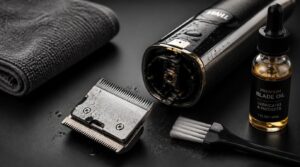
Dirty blades don’t just perform worse — they’re a direct path to skin irritation, bacterial buildup, and unnecessary redness after every trim. Keeping your trimmer clean is one of the simplest things you can do to protect your skin long-term. Here’s what that maintenance routine actually looks like.
Brush Out Trapped Hair
After each trim, loosen trapped hair before it compacts into a tightly woven mat.
Slide a cleaning pick underneath the accumulated clumps near the base, lifting with short, repeated strokes rather than one firm pull.
Use a beard brush or wire cleaner to dislodge embedded lint.
Removing the base buildup first means debris won’t anchor new shed hair between sessions.
Rinse Detachable Heads
Once you’ve cleared the loose hair, detaching the head is your next move. Quick-release heads click free in seconds — hold the body, press the release, and the head separates cleanly.
Rinse it under running water; internal drainage channels flush hair and residue through without stagnation. If your trimmer carries an IPX7 waterproof rating, full submersion is safe.
Oil Blades Regularly
With the head rinsed and reattached, a few drops of oil are all that stand between smooth gliding and blade drag. Ideal oiling intervals fall every 3–5 trims for standard use — more frequently in heavy-use environments to prevent overheating.
Follow these steps to lubricate your trimmers correctly:
- Apply one drop of clipper oil maintenance solution to the center of the moving blade while the trimmer runs.
- Let it distribute across the blade gap, then clean up any excess oil with a dry cloth to prevent residue buildup.
- Restoring post-wash lubrication is non-negotiable — always oil blades after rinsing before your next use.
For lubricant type selection, lightweight mineral or silicone-based oils outperform plant-based alternatives, which leave sticky residue that attracts hair clippings and accelerates blade wear. Preventing blade overheating depends on consistent, not excessive, application — over-oiling transfers residue to skin during trimming.
Dry Before Storage
Moisture is the quiet saboteur of blade coatings. After oiling, wipe all surfaces dry with a microfiber cloth before storage — microfiber lifts residual moisture without abrading DLC or ceramic coatings.
Let detachable heads air dry for at least one hour, then place your trimmer in an airtight case with silica gel to keep humidity below 60 percent and prevent corrosion.
Replace Dull Blades
A blade that drags rather than glides is telling you something. Dull blade signs include repeated passes, hair tugging, and post-trim redness — all indicators that replacement is overdue.
- Replace stainless steel blades every 4–6 months
- DLC-coated edges last 12–18 months
- Power off before removing any blade assembly
- Lubricate immediately after installing new blades
Top 7 Beard Trimmers for Skin
Not every trimmer works with sensitive skin, the same way, and the wrong pick can mean redness, tugging, or irritation after every session.
The seven options below are chosen for their blade materials, motor consistency, and skin-safe design features — the specifics that actually matter dermatologically. Here’s worth your attention.
1. Quiet Cordless T Shaper Trimmer
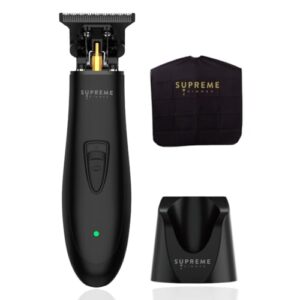
If you have sensitive skin, the leading T Shaper ST5206 deserves your attention. Its zero-gap DLC-coated blade reduces surface friction considerably, keeping the cutting edge cooler during prolonged sessions — which directly translates to less post‑trim redness.
You get 120 minutes of cordless runtime, corded backup capability, and a low‑noise motor that won’t startle noise‑sensitive users.
Four guide combs (1–4 mm) cover everyday shaping needs, and the included oil, brush, and travel pouch make maintenance straightforward.
| Best For | Anyone with sensitive skin, noise sensitivity, or on-the-go grooming needs who wants a reliable, long-lasting cordless trimmer for precise edging and detailing. |
|---|---|
| Battery Runtime | 120 minutes |
| Weight | 1.54 lb (700 g) |
| Blade Type | DLC-coated T-blade |
| Length Settings | 4 combs (1–4 mm) |
| Charging Method | USB cable or charging base |
| Included Accessories | 4 combs, brush, oil, pouch, cape |
| Additional Features |
|
- Low-noise motor and DLC-coated zero-gap blade make it gentle enough for sensitive skin, children, and noise-sensitive environments
- Up to 120 minutes of cordless runtime with the option to use while charging means zero downtime during longer sessions
- Compact, lightweight design with a travel pouch and full accessory kit makes it easy to take anywhere
- Blades may dull after around 20 uses, and replacements cost extra on top of the base price
- The zero-gap setting doesn’t guarantee a true zero-gap finish for every user
- Some users report an annoying high-frequency whine when the trimmer sits on its charging base
2. Braun Precision Beard Trimmer
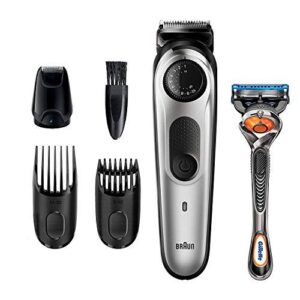
Where skin sensitivity and precision intersect, the Braun BT5265 stands on solid clinical ground. Its Lifetime Sharp ProBlade maintains consistent edge geometry without replacement, reducing the micro-abrasions that trigger contact dermatitis.
The 39 length settings in 0.5 mm increments give you granular control over beard density and contour. A 100‑minute cordless runtime with the included mini foil shaver attachment manages detailed edge work without repeated passes — a meaningful advantage when minimizing cumulative skin friction is your priority.
| Best For | Anyone with sensitive skin who wants precise beard control and a reliable all-in-one grooming kit without frequent blade replacements. |
|---|---|
| Battery Runtime | 100 minutes |
| Weight | 12.64 oz (358 g) |
| Blade Type | Lifetime sharp blades |
| Length Settings | 39 settings (1–20 mm) |
| Charging Method | 1-hour wall charger |
| Included Accessories | Combs, foil shaver, razor, brush |
| Additional Features |
|
- 39 length settings in 0.5 mm increments make it easy to dial in exactly the look you want
- Lifetime Sharp blades mean consistent cuts without the hassle or cost of replacements
- 100-minute cordless runtime plus a 1-hour charge keeps it travel-ready and low-maintenance
- No case or pouch included, which is a bit of an oversight for a travel-friendly trimmer
- The mini foil shaver is narrow, so shaving larger areas takes longer than with a full-size razor
- Heavier than some competitors, which can get tiring during longer grooming sessions
3. Gillette Pro Beard Trimmer
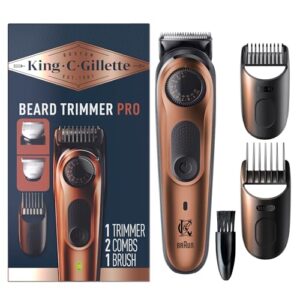
The Gillette Pro Beard Trimmer’s precision length wheel delivers 40 settings in 0.5 mm increments, giving you the kind of granular control that prevents over-trimming on reactive skin. That tactile click at each increment isn’t just satisfying — it’s a clinical safeguard against accidental length errors.
Its lifetime-sharp metal blades maintain consistent edge geometry, reducing friction-induced micro-abrasions. The fully washable design promotes post-trim hygiene, though note the proprietary USB connector and occasional reports of early battery capacity loss.
| Best For | Anyone who wants precise beard length control with minimal upkeep, especially those who groom infrequently and don’t want to worry about frequent charging. |
|---|---|
| Battery Runtime | Up to 45 days |
| Weight | 9.74 oz (277 g) |
| Blade Type | Replaceable metal T-blade |
| Length Settings | 40 settings (0.5–20 mm) |
| Charging Method | Proprietary USB cable |
| Included Accessories | T-blade, 2 combs, brush, charger |
| Additional Features |
|
- 40 length settings in 0.5 mm increments make it easy to dial in exactly the look you want without guesswork
- The metal T-blade is built to stay sharp long-term, reducing the need for replacements
- A fully washable, cordless design means you can rinse it clean or use it in the shower without hassle
- Battery life can degrade after just a few months of light use, which undercuts the "45-day" claim
- The proprietary USB connector is inconvenient — you’ll need to keep track of a specific cable
- Comb guides can loosen or clog over time, so they need regular cleaning to stay reliable
4. Panasonic Precision Beard Trimmer
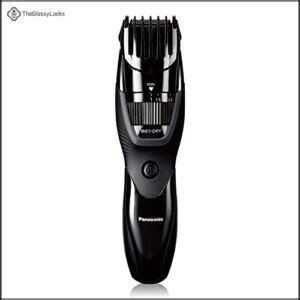
The Panasonic Precision Beard Trimmer runs a patented linear motor reaching up to 9,800 cuts per minute — sufficient torque to sever coarse, dense beard hair in a single pass, which directly reduces repeated blade-to-skin friction.
Its 19 hypoallergenic length settings span 0.5 mm to 20 mm, and the nano-polished stainless steel edges stay sharper longer, minimizing micro-abrasions.
The fully submersible, wet/dry design simplifies post-trim rinsing, supporting the consistent blade hygiene that reactive skin genuinely requires.
| Best For | Anyone with sensitive skin who wants precise, flexible beard or stubble control in a compact, shower-friendly trimmer. |
|---|---|
| Battery Runtime | 50 minutes |
| Weight | 5.28 oz (150 g) |
| Blade Type | 45° hypoallergenic stainless |
| Length Settings | 19-position dial |
| Charging Method | AC wall-mount base |
| Included Accessories | Wall-mount charging base |
| Additional Features |
|
- 19 adjustable length settings give you fine-tuned control from light stubble to a fuller beard
- Hypoallergenic blade design and wet/dry compatibility make it gentle and easy to clean
- Compact and cordless, so it travels well and works just as well in the shower as at the sink
- Pricier than most entry-level trimmers, which may be hard to justify for casual users
- The wall-mounted charging base plugs directly into an outlet, which can be awkward in tight spaces
- The plastic length-comb attachment has a reputation for breaking with heavy use
5. Philips Norelco 3000 Grooming Kit
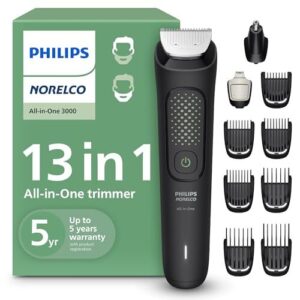
The Philips Norelco 3000 Grooming Kit earns its place here through versatility and skin-conscious engineering. Its self-sharpening steel blades maintain consistent edge geometry, reducing the micro-abrasions that accumulate when dull blades drag repeatedly across reactive skin. Eight comb settings span 0.5 mm to 16 mm, letting you dial in length without excessive passes.
The fully rinseable heads simplify post-trim hygiene, and 60 minutes of cordless runtime allows unhurried, low-pressure technique — exactly what sensitive skin demands.
| Best For | Anyone with sensitive skin who wants one versatile tool to handle beard, body, nose, and ear trimming without the hassle of multiple devices. |
|---|---|
| Battery Runtime | 60 minutes |
| Weight | 11.36 oz (322 g) |
| Blade Type | Self-sharpening full-metal |
| Length Settings | 8 combs (0.5–16 mm) |
| Charging Method | USB-A cable |
| Included Accessories | 13 attachments including nose/ear |
| Additional Features |
|
- Self-sharpening steel blades stay sharp over time, meaning fewer irritating passes across sensitive skin
- 13 attachments cover virtually every grooming need — beard, detail work, nose and ear hair — all in one kit
- Fully rinseable heads make cleanup quick and hygienic, with 60 minutes of cordless runtime to work at your own pace
- No wall adapter included, so you’ll need to supply your own USB charger plug
- Blades can get warm during longer grooming sessions, which may be uncomfortable for sensitive skin
- Managing 13 attachments with no dedicated storage solution means accessories can easily get lost or cluttered
6. Wahl Groomsman Rechargeable Beard Trimmer
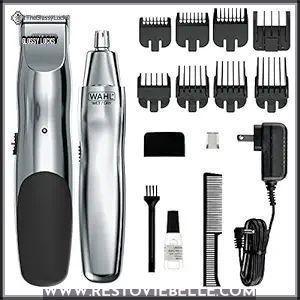
The Wahl Groomsman takes a more utilitarian approach than some premium competitors, but don’t mistake simplicity for compromise. Its self-sharpening precision blades maintain consistent edge geometry across medium-to-coarse hair, and rounded blade tips actively reduce micro-abrasions on reactive skin.
With 60 minutes of cordless runtime and NiCd rechargeable power, you can groom without rushing — a meaningful advantage when pressure control matters for sensitive skin.
| Best For | Travelers and everyday groomers who want a reliable, no-fuss trimmer with versatile length options and worldwide voltage compatibility. |
|---|---|
| Battery Runtime | 60 minutes |
| Weight | 15.52 oz (440 g) |
| Blade Type | High-carbon precision-ground |
| Length Settings | 14 lengths (1/16″–1/2″) |
| Charging Method | Wall charger |
| Included Accessories | 7 guide combs, 3 stubble combs, nose/ear head |
| Additional Features |
|
- 60 minutes of cordless runtime gives you plenty of time to groom without feeling rushed
- 14 cutting lengths plus a dedicated nose/ear trimmer attachment make this a genuinely versatile all-in-one tool
- Dual-voltage support (110V–220V) means you can take it anywhere in the world without an adapter
- NiCd battery is older technology — heavier, less efficient, and worse for the environment than modern Li-ion alternatives
- The nose/ear trimmer runs on a disposable AA battery, which is an annoying extra step
- Only the trimmer head is rinseable; the main body isn’t waterproof, so cleanup takes a bit more care
7. Manscaped Lawn Mower 3.0 Plus
 View On Amazon
Closing out this list with purpose: the Manscaped Lawn Mower 3.0 Plus is engineered specifically for below-the-waist grooming, where nick prevention isn’t a preference — it’s non-negotiable.
Its SkinSafe ceramic blade stays cooler than stainless steel, reducing inflammatory contact on sensitive genital and groin skin.
The constant-RPM motor prevents tugging as the battery drains, and IPX7 waterproof certification allows shower use, where hydrated hair cuts more cleanly with less traction force against delicate tissue.
| Best For | Anyone who wants a dedicated below-the-waist trimmer that prioritizes safety and comfort, especially those prone to nicks or who prefer grooming in the shower. |
|---|---|
| Battery Runtime | 60 minutes |
| Weight | 14.11 oz (400 g) |
| Blade Type | SkinSafe ceramic blade |
| Length Settings | 2 combs (2–12 mm) |
| Charging Method | USB-C cable or dock |
| Included Accessories | 2 comb attachments, USB-C, dock |
| Additional Features |
|
- SkinSafe ceramic blade runs cooler than steel, making it gentler on sensitive skin
- IPX7 waterproof rating means you can use it in the shower for a cleaner, more comfortable trim
- Constant-RPM motor keeps cutting performance steady from first use to low battery
- Battery life tends to degrade over time, so long-term runtime may fall short of the advertised 60 minutes
- The ceramic blade needs replacing every 2–3 months, which adds to the ongoing cost
- No phone support — if something goes wrong, you’re limited to email for help
Frequently Asked Questions (FAQs)
Can beard trimmers cause ingrown hairs over time?
Yes, beard trimmers can trigger ingrown hairs over time. Repeated close trimming leaves sharp hair tips near the skin surface, and curly or coarse beard hair is especially prone to curling back into the follicle.
How often should trimmer blades be replaced?
Replace standard stainless steel blades every 4–6 months. DLC-coated blades last 12–18 months, ceramic up to two years, and titanium-coated blades 6–9 months before performance and skin comfort decline.
Do beard trimmers work on all skin tones?
Beard trimmers work equally well on all skin tones. The cutting action targets hair, not pigmentation, and guard systems keep blades away from skin regardless of complexion.
Can trimmers be used on neck and chest hair?
Trimmers work just as well on neck and chest hair as they do on facial hair. Use a guard, keep pressure light, and move in short strokes to avoid irritation.
Are cordless trimmers as powerful as corded models?
Cordless trimmers today match corded models, delivering 5–7 W of consistent torque with constant-RPM motors that won’t bog down on coarse hair—even as battery voltage gradually drops.
Conclusion
A trimmer calibrated down to fractions of a millimeter is fundamentally a precision instrument operating at surgical tolerances against living tissue—yet mastering how beard trimmers work on skin reduces that complexity to three variables: blade quality, motor consistency, and technique. Choose ceramic or DLC-coated blades, maintain adequate RPM under load, and keep guards matched to your skin’s reactivity.
Clean the head after every session. That discipline, sustained consistently, is what separates chronic irritation from a genuinely damage-free grooming routine.