This site is supported by our readers. We may earn a commission, at no cost to you, if you purchase through links.
You’ve probably handled clippers dozens of times, but most people don’t realize the precision engineering happening in their hands. Inside that compact housing, a motor drives two opposing blades at speeds reaching 7,000 strokes per minute—one blade remains stationary while the other oscillates back and forth, creating the shearing action that cuts through hair.
This mechanical dance between components determines everything from how smoothly your clippers glide across the scalp to whether they’ll power through coarse hair or stall mid-cut. Understanding how these parts interact transforms clippers from mysterious tools into predictable instruments you can master, maintain, and troubleshoot with confidence.
Table Of Contents
Key Takeaways
- Hair clippers cut through a shearing action where one blade stays stationary while the other oscillates at 3,000 to 7,200 strokes per minute, creating rapid blade-to-blade contact that slices through hair efficiently.
- The motor type—magnetic, pivot, or rotary—determines cutting power and durability, with professional models built for higher torque, extended runtime, and the ability to handle coarse hair without stalling.
- Guards control final hair length by creating fixed cutting planes from 1/8 inch to over an inch, while the adjusting lever modifies blade gap for precision work like fades and detailed line work.
- Consistent cleaning after every use, proper oiling along blade teeth, and blade replacement every six to twelve months for professionals prevent overheating, uneven cuts, and premature motor failure.
What Are Hair Clippers?
Hair clippers are electric grooming tools designed to cut hair quickly and precisely using motorized blades. You’ll find them in barbershops, salons, and homes around the world for everything from buzz cuts to detailed fade work.
They’re built with powerful motors and wide blades that handle thick hair and large sections efficiently, making them ideal for fast, consistent cuts.
Before you understand how they operate, you need to know what makes them different from scissors, trimmers, and other cutting tools.
Definition and Purpose
Hair clippers are handheld electric grooming tools that trim and shape hair through rapid blade movement. Unlike scissors, these hair cutting tools deliver quick, even results with motor-driven precision. Their core purpose is simple:
- Control hair length using adjustable guards for consistent styling options
- Enable efficient hair cutting across large scalp areas
- Provide clipper basics for fades, buzz cuts, and line work
- Support diverse hair clipper operation on various textures
Common Uses in Grooming
Once you understand how clippers function, you’ll see why they’re the go-to tool for grooming versatility. Professional barbering and personal grooming both rely on clippers for quick haircuts, beard shaping, and facial styling. They handle body grooming tasks, pet trimming routines, and hair texturing work with equal efficiency.
Below are the most common applications:
| Grooming Task | Typical Guard Range | Session Time |
|---|---|---|
| Buzz Cuts | #1–#4 (3–13mm) | Under 5 minutes |
| Beard Shaping | #0.5–#3 (1.5–10mm) | 3–7 minutes |
| Body Grooming | #2–#5 (6–16mm) | 10–15 minutes |
| Pet Trimming | #3–#7 (10–22mm) | 15–30 minutes |
| Hair Styling Fades | Multiple guards | 20–40 minutes |
Haircutting with clippers delivers uniform length across large areas, while interchangeable guards let you switch from head to beard to body work without changing tools.
Differences From Other Haircutting Tools
While clippers and scissors belong in the same toolkit, they serve distinct roles in barbering equipment.
Learning proper beard shaping for beginners helps you understand when to reach for clippers versus scissors during your grooming routine.
Scissors rely on manual slicing with a pivoting action, giving you microscopic control for detailing around ears and necklines.
Clippers use oscillating blades to shear large sections at once, boosting cutting efficiency by up to 50 percent and making them ideal for buzz cuts, fades, and uniform grooming methods. Professional barbers often choose their tools based on features like adjustable taper levers and guards for maximum flexibility and precision.
Key Components of Hair Clippers
Understanding how hair clippers work starts with knowing what’s inside them. Each clipper relies on a handful of core components that work together to deliver clean, precise cuts.
Let’s break down the essential parts you need to know about.
Motor Types and Functions
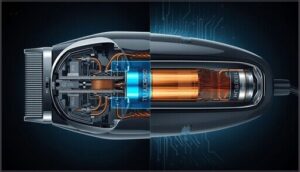
Think of the motor as the heart of your electric clippers, converting energy into the blade movement that delivers every cut. Magnetic motor designs use electromagnetic force to drive oscillation, while brushless design options with electronic commutation boost motor efficiency and extend lifespan.
Corded clippers maintain constant torque control, whereas cordless clippers rely on batteries that can affect speed regulation under heavy loads.
Blade Design and Materials
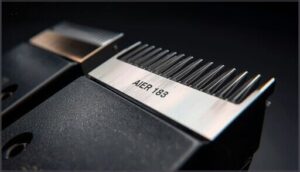
Steel dominates blade materials because it holds edge sharpness through hundreds of cuts. Stainless steel blades resist corrosion in wet conditions, while titanium blades run cooler and lighter for extended sessions. Ceramic blades stay sharper longer but require careful handling.
Coating options like diamond-like carbon reduce friction, and blade geometry—whether hollow-ground or beveled—determines how smoothly you’ll glide through different hair textures.
Manufacturers employ sophisticated to enhance performance and longevity in modern clipper blades.
Guards, Levers, and Controls
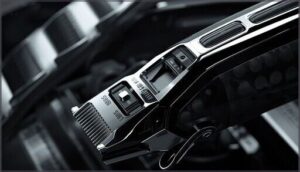
Mastering Guard Mechanics starts with understanding how detachable clipper attachments control your cut length through click positions—generally ranging from 1/8 inch to 1/16 inch increments. Three control essentials shape your precision:
- Adjusting lever modifies blade gap for close cuts or bulk trimming
- Guard numbers correspond to millimeter lengths that prevent direct blade-to-skin contact
- Safety Features include locking mechanisms and quick-release systems for secure operation
Ergonomic Design places controls within thumb reach, minimizing hand fatigue during detailed work.
Housing and Ergonomics
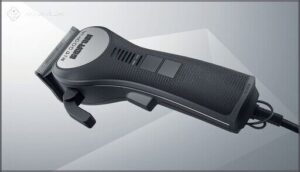
Your hand position determines fatigue levels during extended cuts, which is why clipper housing layout centers controls along the natural thumb arc. Ergonomic design balances weight distribution through the motor casing, reducing wrist strain after repeated passes. Housing materials range from impact-resistant polymer to rubberized grips that improve user experience and comfort factors. The clipper comb attachment aligns with this spatial efficiency principle.
| Design Element | Function |
|---|---|
| Contoured grip zones | Reduces hand slippage during wet conditions |
| Balanced weight placement | Minimizes wrist fatigue over 20+ minute sessions |
| Ventilation slots | Prevents motor overheating during continuous operation |
| Thumb-accessible levers | Allows quick guard adjustments mid-cut |
| Cord swivel points | Eliminates tangling during movement around client |
How Hair Clippers Work Mechanically
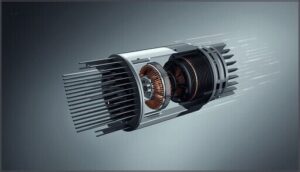
Understanding how clippers work mechanically gives you real control over your cuts. The magic happens through a combination of blade movement, power delivery, and guard attachments working together in precise rhythm.
Let’s break down the three key mechanical processes that turn a simple electric device into a reliable cutting tool.
Blade Oscillation and Cutting Action
Hair clippers cut through a shearing action created by blade oscillation—one blade stays put while the other moves back and forth in rapid arcs. Understanding this clipper mechanism helps you master cleaner fades and smoother lines.
- Blade movement occurs when the oscillating blade cycles at speeds ranging from 3,000 to 7,200 strokes per minute, creating continuous hair shearing between stationary and moving edges.
- Blade geometry determines how efficiently hair enters the teeth gap—ceramic blades maintain sharper angles longer than standard steel, reducing tugging on coarse textures.
- Oscillation speed directly impacts cutting action: higher frequencies deliver faster bulk removal, while controlled speeds prevent snagging on fine or damaged hair.
Power Sources: Corded Vs. Cordless
Choosing between corded clippers and cordless clippers shapes your workflow and power efficiency more than most barbers realize. Corded models pull continuous power from mains outlets, delivering unlimited runtime without voltage drop—critical for back-to-back clients.
Cordless clippers run on rechargeable batteries with 60 to 180 minutes per charge, but battery life decreases under blade resistance, making charging systems and cord management essential considerations.
The Role of Guards in Hair Length
Guards act as your precision blueprint for controlling final hair length, locking onto blades to create fixed cutting planes that leave anywhere from 1/8 inch to over an inch of hair.
Selecting the right guard size determines whether you’re buzzing a tight fade or maintaining moderate length, while proper guard placement techniques and clipper guard maintenance prevent length inconsistencies and blade contact with the scalp during your haircut.
Types of Hair Clippers Explained
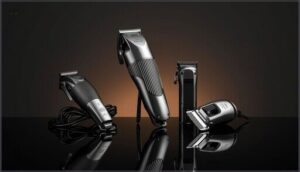
Not all hair clippers are built the same, and understanding the different types helps you choose the right tool for your needs. The main differences come down to how they’re powered, what kind of motor drives the blades, and whether they’re designed for professional or home use.
Let’s break down these categories so you know exactly what you’re working with.
Manual Vs. Electric Clippers
When you’re deciding between manual clippers and electric clippers, user preference often hinges on hair texture, clipper durability, and clipper noise levels. Manual clippers deliver direct control through hand pressure alone, while electric clippers rely on a motor to drive the hair clipper mechanism, offering speed and consistency.
Consider these practical differences:
- Blade sharpness: Manual models need frequent sharpening; electric units often self-sharpen
- Portability: Manual clippers work anywhere without charging
- Speed: Electric blades cut faster through bulk hair
- Noise: Manual operation stays nearly silent
Magnetic, Pivot, and Rotary Motors
Once you understand electric versus manual, motor types reveal how clippers deliver cutting power.
Magnetic motors use magnetic fields to drive blade oscillation—efficient for lighter work but limited in motor power. Pivot motors add torque through pivot mechanics, handling coarser hair with better motor durability. Rotary motors generate smooth rotary motion at high speeds, giving you consistent performance across all textures.
Professional Vs. Home-Use Models
Motor type matters, but professional clippers and home models differ in ways that directly affect your results. Professional features like higher torque, commercial-use durability, and ergonomic design handle salon volume. Cordless clippers offer mobility, while corded vs cordless clippers debates hinge on power consistency.
Key differences include:
- Motor efficiency rated for hours of daily cutting
- Metal housing and blade assemblies built for drops and impacts
- Replaceable components that extend clipper durability through years
- Precision tensioning systems for dialed-in fades
Professional clippers require regular hair clipper maintenance but deliver reliability when hair clipper mechanics meet real-world demand.
Maintenance and Safe Use of Hair Clippers
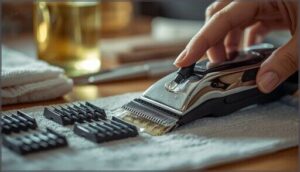
Keeping your clippers in top shape isn’t complicated, but it does require consistent attention to a few key practices. Proper maintenance extends the lifespan of your tools and ensures they cut cleanly every time you use them.
Let’s break down the essential steps for cleaning, upkeep, and safe operation that every clipper owner should know.
Cleaning and Oiling Blades
Blade care is the backbone of clipper maintenance. Skip it, and you’ll feel heat, hear noise, and see uneven cuts. After every haircut, remove debris with a brush, then apply a thin line of clipper oil along the blade teeth.
Blade sanitizing with isopropyl alcohol prevents buildup, while regular oiling guards against rust and friction, keeping your tools sharp and reliable.
Replacing and Adjusting Parts
When components fail, you’ll notice poor cuts or weak power. Here’s how to restore peak performance:
- Blade Replacement – Use manufacturer-recommended blades matching your model number, tighten screws to spec, and check alignment for even tooth contact across the cutting surface.
- Motor Repair – Confirm amperage and RPM match original ratings, secure leads with anti-spark connectors, and test-run at low speed.
- Guard Adjustment – Verify locking latches engage fully and guards don’t contact moving parts during operation.
Proper clipper calibration extends tool life and maintains cutting precision.
Safety Features and Best Practices
Beyond keeping blades sharp, you need to protect yourself and your clients. Always inspect power cords before each use to prevent electrical safety hazards, and never operate near water.
Proper clipper maintenance includes sanitization methods like disinfecting guards between clients and applying blade oil after cleaning.
Safe handling means letting the motor cool down, using cut-resistant gloves during blade changes, and following manufacturer guidelines for accident prevention.
Frequently Asked Questions (FAQs)
What does 8 4 0 mean on clippers?
A single millimeter separates confidence from disaster—those numbers represent exact blade guard lengths in millimeters.
Settings like 8, 4, and 0 control precision through lever settings and blade adjustments, enabling fine tuning beyond standard clipper guards.
Can hair clippers be used on wet hair?
Most clippers aren’t designed for wet hair. Moisture risks electric shock with non-water-resistant models, accelerates blade corrosion, and causes uneven cuts.
Always dry hair thoroughly before clipping for safer, cleaner results.
How often should clipper blades be replaced?
Think of blades like tires—constant friction eventually wears them down.
For professional barbers, expect replacement every six to twelve months; home users can stretch it closer to nine months with diligent clipper maintenance and care.
What causes clippers to overheat during use?
Heat buildup stems from friction causes like blade-to-blade contact, incorrect blade tension, trapped hair debris, motor overload from dense hair, and insufficient cooling.
Regular clipper maintenance and care prevents these issues in cordless clippers.
Are hair clippers suitable for all hair types?
You can use clippers on most hair types, but results vary. Thick haircuts demand stronger motors, while fine trimming needs gentler blade guards.
Curly hair requires careful clipper settings to prevent snagging across different hair texture and hair thickness levels.
How do you sharpen dull clipper blades?
You’ll need a specialized clipper blade hone to restore the hollow edge, maintaining a 10-20 degree angle. Clean blades first, sharpen gently, then oil and test for smooth cutting action.
Conclusion
Ever wonder why some clippers glide effortlessly while others snag and pull? That difference comes down to understanding how hair clippers work—explained through their motors, blade geometry, and mechanical timing. When you know what’s happening beneath the housing, you’re no longer guessing—you’re operating with precision.
Clean your blades after every use, oil them regularly, and respect the engineering that makes consistent cuts possible. Master the mechanics, and the tool becomes an extension of your skill.