This site is supported by our readers. We may earn a commission, at no cost to you, if you purchase through links. This content is for general informational and educational purposes only and is not a substitute for professional medical, dermatological, or nutritional advice.

Run out of henna halfway through your head and you’ll end up with roots that match and ends that don’t. Too much, and you’ve wasted powder that cost you good money. The sweet spot for shoulder-length hair sits around 2 oz (100g) for most people, but that number shifts with your hair’s density and texture. Fine hair can drop to 1.5 oz, while thick, layered hair may swallow 3 oz or more. Guessing with spoons throws you off by up to 30%, so precision matters.
Here’s how to nail your exact amount, mix the right paste, and never come up short.
Table Of Contents
- Key Takeaways
- How Many Ounces for Shoulder-Length Hair?
- Adjust Henna Quantity for Hair Type
- Measure Henna Powder Accurately
- How Much Water Should You Add?
- Apply Henna Without Running Short
- Store Extra Henna for Future Use
- Frequently Asked Questions (FAQs)
- How much dye is needed for shoulder length hair?
- Is 4 oz of hair dye enough for short hair?
- Is 2 hours long enough for henna?
- How do I mix henna powder for hair?
- How long does henna last on shoulder-length hair?
- Is henna safe for all hair types?
- How often should henna be applied to shoulder-length hair?
- Will henna damage my hair?
- Can henna permanently stain my skin or scalp?
- How long should henna paste sit before applying?
- Conclusion
Key Takeaways
- Shoulder-length hair typically needs 2 oz (100g) of henna powder, but fine hair can drop to 1.5 oz and thick or dense hair may require up to 3 oz or more.
- Always weigh your powder on a kitchen scale rather than using spoons, since spoon measurements can be off by 15–30%, leading to patchy or wasted results.
- Mix your paste to a thick yogurt or pancake batter consistency using a 2:1 to 4:1 powder-to-water ratio, adjusting based on your hair’s density and porosity.
- Mix 10% more paste than you think you need, reserve a small emergency portion, and freeze any leftover paste in airtight sachets for up to six months.
How Many Ounces for Shoulder-Length Hair?
Most people with shoulder length hair need 2 oz of henna powder, which is roughly 100g of henna powder by weight. That’s the sweet spot for medium-density hair, and it covers a full application without waste.
If you’re pairing your henna routine with gentler products, an organic shampoo and conditioner set helps lock in that rich color while keeping your scalp happy.
Shoulder-length hair typically needs 2 oz (about 100g) of henna powder—the sweet spot for full coverage without waste
Think of it like paint: you want enough to coat every strand, not so much that half drips down your neck. If your hair sits on the finer side, start with 1.5 oz. If it’s dense or heavily layered, budget up to 3 oz.
Here’s my rule: weigh it, don’t eyeball it. A kitchen scale costs $10 and saves you from mid-application panic. Once you know your number, write it down. Hair thickness and texture don’t change much, so that measurement becomes your repeatable baseline every single time.
Adjust Henna Quantity for Hair Type
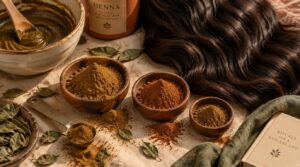
So you know the baseline is 3.5 to 5 ounces. But your hair isn’t a baseline, is it? Here’s how to tweak that number based on your hair type, so you mix the right amount the first time.
Fine or Low-Density Hair
needs less henna powder than you’d think. Shoulder length hair usually takes 1.5–1.75 oz (roughly 45–50 grams, under half of a 100 grams block). Your hair thickness and texture decide the rest.
- Start at 2 oz, then trim 15–25% for sparse strands
- Section into 4 quadrants, apply thin coats
- Add 0.25 oz only where coverage looks patchy
- Skip oils; they weigh fine hair down
- Mix to a pudding-like paste that falls in 1–2 seconds
Thick or High-Density Hair
Thick hair texture flips the math. Shoulder length hair here eats henna powder, so start at 2.5 oz and scale up.
Pair that amount with a balanced formula from this guide to organic hair treatments for scalp health so your mix stays in the pH range henna loves.
| Density | Powder | Water |
|---|---|---|
| Medium-thick | 2–2.5 oz | 250ml |
| High-density | 2.5–3 oz | 300ml of water or tea |
| Very dense | 3 oz+ | 300–350ml |
Section into 6–8 parts, apply generously, and watch for crusted patches.
Texture and Porosity
Density tells you how much, but hair porosity tells you how long. High porosity hair drinks henna fast, so 2 hours often suffices. Low porosity with fine hair texture? Plan on 4–6 hours.
Not sure where you fall? These visual signs of hair porosity levels can help you figure it out before you commit to a timing.
Coarse strands absorb deeper than fine ones, so adjust your henna to water ratio slightly wetter for easier spread. Always strand test first, and match paste consistency to your porosity class.
Measure Henna Powder Accurately
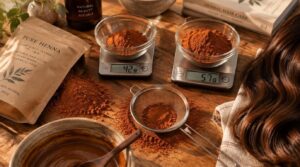
Most home colorists eyeball henna powder with a spoon, and that’s where the trouble starts. Spoon measurements run 15 to 30% off for powders, so your "half cup" could be 40 grams one day and 60 the next. Grab a kitchen scale instead. For shoulder-length hair, you’ll usually weigh out 1.5 to 2 ounces, or roughly 42 to 57 grams. If your hair is very dense, plan on 3.5 to 5 ounces to avoid patchy coverage.
Sift the powder first. Clumps skew the reading, and you want accuracy within ±1 gram. Tap the container gently to settle it into a consistent loose pack. Aim within ±2 grams of your target, confirm the total on the display, and you’re set.
How Much Water Should You Add?
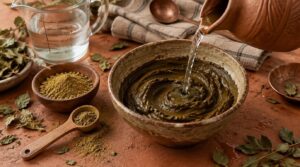
Getting the water ratio right is just as important as measuring your powder. Too much liquid ruins the paste, and too little makes it impossible to spread. Here’s what you need to know about mixing it correctly.
Henna-to-Liquid Ratio
Getting the ratio right is the foundation. For shoulder-length hair with 100g of henna powder, the henna to water ratio ranges from 2:1 to 4:1 using lukewarm water:
- Fine hair: 2:1 for easy spread
- Medium hair: 2.5:1 to 3:1
- Thick hair: 3:1 to 4:1
- High porosity: add 10ml extra water
Aim for a pancake batter-like consistency before you move on.
Ideal Paste Consistency
Think of your henna paste preparation like pancake batter, only slightly stiffer.
For shoulder-length hair, aim for a thick yogurt consistency that ribbons off a spatula in 8 to 12 seconds. Your henna to water ratio controls this: if it pours like sauce, add powder in 0.5 teaspoon increments; if it sits stiff on your finger, loosen with small water additions.
Liquid and Herbal Additions
Picture your henna paste as a canvas: the liquid you choose paints the final shade. Stick to a henna to water ratio of about 2:1, using 40–60 ml of liquid per 100 grams of henna powder.
For shoulder-length hair, swap in lemon juice or apple cider vinegar for warmth, or brewed black tea for roughly 12% deeper pigment. Amla (1–2 tsp) boosts copper tones; 1–2 tsp olive oil adds slip.
Apply Henna Without Running Short
Nothing kills the henna application process faster than running out of paste at the crown. You want a buffer, not a gamble.
Here’s how to stay covered:
- Mix 10% extra beyond your 2–3 oz estimate for shoulder-length hair.
- Section hair in four quadrants so paste spreads evenly, not front-loaded.
- Apply thin layers rather than one thick slab; thin coats boost color saturation.
- Reserve 0.5 oz of mixed paste untouched as your emergency stash.
- Check roots last, since they drink the most product.
If your strand test showed heavy uptake, bump your ounces of henna powder by another 0.5 oz before mixing. Running short mid-application means patchy coverage, and patchy means redoing the whole head. A little extra paste costs pennies. A redo costs an afternoon.
Store Extra Henna for Future Use
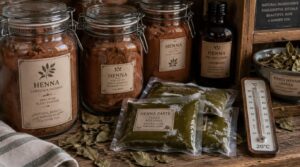
Got leftover paste or powder? Don’t toss it. Proper henna storage saves you money and keeps your color punchy for the next round.
For unused powder, pour it into airtight storage containers, glass or BPA-free plastic only. Metal reacts with the lawsone, so skip it. Keep the container in a dark pantry at 15–25°C, humidity under 40%. Label it with the batch and date. You’ll get 6 to 12 months of solid dye release.
Already mixed your measurement of henna into paste? Freeze it. Scoop 2 to 4 oz portions into sachets, squeeze out the air, and stash them in the freezer for up to 6 months. Thaw, apply, done. Your shoulder-length hair won’t know the difference.
Frequently Asked Questions (FAQs)
How much dye is needed for shoulder length hair?
Dye release depends on your mix, but coverage starts with quantity. For shoulder-length hair, plan on 100 grams, roughly 5 ounces of henna powder. Fine hair works with 75 grams; thick hair wants
Is 4 oz of hair dye enough for short hair?
You might worry 4 oz is overkill for short hair, but it’s plenty. Short hair needs 2 oz of henna powder, maybe 5 oz if it’s thick. Save the extra powder, sealed, for touch-ups.
Is 2 hours long enough for henna?
Yes, usually. Two hours hits the common 1–3 hour window, though deeper color needs longer. After your 25-gram mix shows dye release time, apply generously; expect your shade to keep developing gradually over 48 hours.
How do I mix henna powder for hair?
Want that paste to actually stain, not slide off? Mix henna powder with warm water, starting around two tablespoons per batch, until you reach a pancake batterlike consistency. Rest it 1–2 hours before your henna application process.
How long does henna last on shoulder-length hair?
Expect vibrant color for 4–6 weeks on shoulder-length hair, then gradual fading. Henna stays detectable up to 3–5 months.
Wash less, use sulfate-free shampoo, and wait 48 hours after application to get the most out of your color.
Since henna only deposits color and can’t lift what’s already there, it helps to know the drawbacks of using henna on hair before committing.
Many women wondering how long henna hair dye lasts find that leaving the paste on longer than recommended deepens penetration and extends color life.
Is henna safe for all hair types?
For most people, natural henna is safe as houses on every hair type, including shoulder-length hair. The catch: adulterated "henna" causes problems. Buy pure Lawsonia powder, and chemically treated hair needs a strand test first.
How often should henna be applied to shoulder-length hair?
Plan on every 4–6 weeks for henna hair dye on shoulder-length hair. Roots showing sooner? Stretch to 46 weeks max between sessions. Frequent washing speeds up color fading, so treat each application as a scheduled hair treatment, not a rescue mission.
Will henna damage my hair?
Think of henna as a gentle rain, not a storm. Pure henna hair dye rarely causes hair damage; breakage usually comes from rough rinsing, buildup, or dryness. Follow with hair conditioning, skip sulfate shampoos, and your hair treatment stays safe.
Can henna permanently stain my skin or scalp?
A client once panicked over orange temples. Good news: henna stains aren’t permanent. Lawsone binds to keratin in your outer skin cells, so color fades as those cells shed, usually within two to three weeks.
How long should henna paste sit before applying?
Like wine deepening in the barrel, your henna paste earns its color through patience. Rest it 2–4 hours minimum, overnight if possible. Warmer rooms naturally speed the dye release period; cooler spaces need more time.
Conclusion
Getting the math right before you mix means no frantic scraping at the bottom of an empty bowl mid-application. For most people, knowing how many ounces of henna powder you need for shoulder-length hair comes down to one honest look at your density and texture, not guesswork.
Start at 2 oz, adjust by feel, and measure every time. A little upfront precision is what separates a clean, consistent result from a patchy, expensive lesson.