This site is supported by our readers. We may earn a commission, at no cost to you, if you purchase through links. This content is for general informational and educational purposes only and is not a substitute for professional medical, dermatological, or nutritional advice.
You mixed the perfect bleach, lifted to a clean pale yellow, and then your toner ran out halfway through your head. Sound familiar? Running short is the most common toning mistake, and it shows up as patchy, half-brassy results.
Here’s the good news: the answer to how many ounces of toner do i need for bleached hair comes down to three things, length, density, and porosity. Short hair needs as little as 0.5 ounces, while long manes can demand 3 or more.
Below, you’ll find exact measurements, mixing ratios, and timing so you tone once, and tone right.
Table Of Contents
- Key Takeaways
- How Many Ounces of Toner Do You Need?
- How Do You Choose The Right Toner?
- What Toner-to-Developer Ratio Should You Use?
- Which Developer Strength is Safest?
- How Do You Tone Bleached Hair Evenly?
- How Do You Maintain Toned Bleached Hair?
- Frequently Asked Questions (FAQs)
- What toner do I need for my bleached hair?
- How much hair toner should you use?
- How much developer for 2 oz of bleach?
- Will 20 volume toner lighten hair?
- Will toner damage bleached hair?
- How often should toner be applied to bleached hair?
- Can I apply toner to hair that has not been bleached?
- Is toner safe to use on colored hair?
- What is the best way to apply toner to bleached hair?
- Can I mix different toner brands together?
- Conclusion
Key Takeaways
- Toner needs depend mainly on hair length: roughly 0.5–1 ounce for short hair, 1.5–2.5 ounces for medium, and 2–3+ ounces for long, with high-density hair requiring 10–20% more.
- Always mix at a 1:2 toner-to-developer ratio (measured by volume), and stick with 10-volume developer—capped at 20—for bleached hair to avoid breakage.
- Match your toner to your hair’s underlying pigment (violet for orange, blue for brassy gold, violet-ash for yellow), and adjust processing time for porosity: high-porosity hair absorbs toner 25–40% faster.
- Maintain your tone by washing two to three times weekly with sulfate-free shampoo, using purple shampoo weekly, limiting heat and sun exposure, and re-toning every 3–6 weeks when brass returns.
How Many Ounces of Toner Do You Need?
Getting the toner amount right starts with your hair length. A pixie cut and waist-length mane don’t need anywhere near the same amount of product, and guessing wrong means patchy results or wasted money. Here’s a quick breakdown by length, plus how to adjust for hair density.
If you’re unsure where to start, this guide to shampoo and conditioner for bleached hair breaks down product amounts by length and density.
Short Bleached Hair
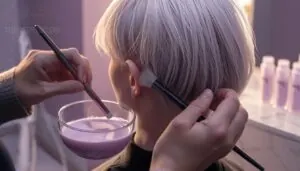
Short bleached hair is forgiving, but it still needs precision. Plan on 0.5 to 1 ounce of toner for a 2–3 inch hairline area, or about 1 ounce total for a full head. Mix at 1:2 toner to developer to keep intensity controlled. Saturate evenly from roots to midlength, and skip previously toned spots. Patchiness? That’s overlap, not under-application.
Medium Bleached Hair

Moving up from short cuts, medium bleached hair needs more product and more control. Plan on 1.5 to 2.5 ounces of toner for a full head, bumping to 3 ounces if your density runs thick.
Section into 4 to 6 parts, map them before mixing, and use a 1:1.5 mixing ratio for stronger toning. Check every 5 minutes; 15 to 25 minutes usually does it.
Long Bleached Hair

Long hair eats toner. You’ll need 2 to 3 ounces of toner minimum, sometimes 1.5× to 2× what shorter lengths demand. Why so much? Consider:
- Ends drink product fast
- Mid-lengths hide brass
- Thin saturation means patchy results
- Re-toning costs more time
- Even coverage builds true confidence
Use a 1:2 mixing ratio, section root-to-end, and check every 5 minutes after 15.
If you’re unsure how long to leave toner on brassy hair, this guide breaks down timing by hair type and porosity.
Adjusting for Hair Density
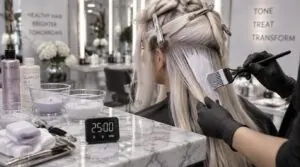
Density changes everything. High-density hair (over 80%) needs 10–20% more toner than your hair length alone suggests. Take thinner subsections, overlap saturation zones, and pre-dry slightly, since low porosity slows uptake.
Check every 2–3 minutes, stop when mid-lengths hit your target shade, and budget 5–15% extra product for waste. Your developer strength stays the same.
How Do You Choose The Right Toner?
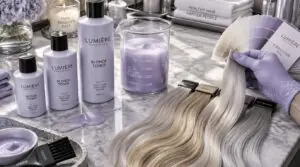
You’ve measured your toner, but grabbing the wrong bottle wastes both product and your blonde. The right choice comes down to two things: matching your natural pigment and deciding between ammonia-free versus ammonia formulas. Get these right, and your toner works with your hair instead of against it.
Match The Underlying Pigment
Here’s the golden rule: neutralize the opposite. Your bleached hair reveals an root pigment, and your toner must cancel it. Yellow base? Reach for ash or violet- ash or violet-ash. Orange showing through? Violet is your fix. Brassy gold? Blue-based toners win. Not sure what’s lurking under there? Do a strand test first and check it under natural light. Guessing wastes toner and hair length you worked hard to protect.
Neutralize the opposite: match your toner to your hair’s underlying pigment—violet for orange, blue for brass
Ammonia-Free Versus Ammonia Toner
Because ammonia-based toner lifts the cuticle faster, it neutralizes brass quickly but can shift your toner amount needs if hair is porous. Ammonia-free toner works slower, using gentler acids, so allow 10 extra minutes of processing. Consider these differences:
- Faster neutralization with ammonia
- Gentler on fragile bleach
- Longer processing, ammonia-free
- Stronger smell, ammonia-based
- Same ounces of toner either way
What Toner-to-Developer Ratio Should You Use?
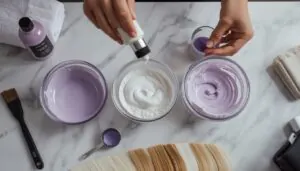
Mixing toner isn’t a free-for-all. The ratio you choose changes your pigment density, spreadability, and how much product you waste. Here’s how to get your toner-to-developer mix right, whether you’re toning a pixie cut or waist-length lengths.
And if uneven sections or patchy brass show up mid-process, these hair color correction techniques walk you through fixing banding without frying your strands.
Standard 1:2 Mixing Ratio
Here’s the good news: the 1:2 ratio never changes. One part toner, two parts developer, every time. So 2 ounces of toner means 4 ounces of developer. Measure by volume, not weight, and mix to a mousse-like consistency.
Once you know your toner amount for your hair length, the math stays simple. Consistency is everything here.
Ratios by Hair Length
Think of toner as your final brushstroke: too little leaves streaks, too much drowns the canvas. Match your toner amount to hair length:
- Short (up to 6 inches): 0.25–1 ounce
- Medium (6–12 inches): 1.5–2.5 ounces
- Long (12–18+ inches): 3–6 ounces
Pair each with a 1 toner to developer ratio of 1:2, then sectioning hair keeps saturation even.
Which Developer Strength is Safest?
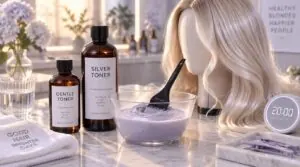
Here’s the truth: stronger isn’t better. For most bleached hair, 10-volume developer is your safest bet. It processes gently, minimizes heat damage, and still lifts tone where you need it.
If your hair feels fragile, porous, or previously over-processed, stay in the 10–20 volume range. Anything higher raises your breakage risk and can irritate your scalp. Cap your processing time at 20–30 minutes, and rinse the moment you hit your target tone.
Remember, brands calibrate differently. Some toners work with developers as low as 5–7 volume. Always run a strand test with your exact toner to developer ratio before committing, and do a patch test for every new mix. If you feel burning, rinse immediately.
How Do You Tone Bleached Hair Evenly?
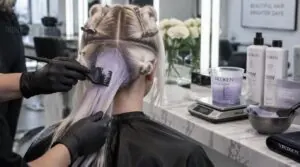
Even toner comes down to technique, not luck. You’ll need to mix accurately, section properly, and watch your porosity. Here’s how to get every strand covered.
Mix Toner Accurately
Accuracy starts in your mixing bowl. Use a level measurement, not a eyeballed pour, because even a half-ounce error shifts your toner to developer ratio and your final color. For a 1:2 mix, that’s 1 ounce of toner to 2 ounces of developer. Stir with a tint brush for a full 30 seconds until the formula’s completely smooth and streak-free.
Section and Saturate Hair
Your mix is ready, so now work in 1 to 1.5 inch subsections. Your hair sectioning technique determines whether every strand gets coated.
- Part hair into 4 to 6 vertical sections.
- Clip all but one subsection away.
- Start toner at midshaft, then crown and ends.
- Saturate root to midshaft fully before moving on.
- Recheck each section for dry patches.
Keep subsections smooth and unknotted so your toner application technique delivers even coverage across any hair length.
Monitor Hair Porosity
Saturated every section? Good. Now watch the clock, because hair porosity sets your pace.
High porosity strands drink toner 25 to 40% faster, so check at 5 minutes and rinse by 10.
Medium porosity controls the standard 15 to 20 minutes.
Low porosity may need extra time, but closed cuticles risk patchy uptake.
Quick float test a strand beforehand and adjust your toner amount accordingly.
How Do You Maintain Toned Bleached Hair?

Your toner application is only half the story. What you do afterward decides how long that fresh tone lasts.
- Wash less often. Two to three times weekly with sulfate-free shampoo keeps pigment locked in.
- Use purple shampoo once a week to fight brass between salon visits.
- Cut the heat. Always apply heat protectant; hot tools fade toner fast.
- Shield from sun. UV exposure strips cool tones, so cover up or use UV-protectant sprays.
Expect toner reapplication every 3–6 weeks. Porous or brass-prone hair may need it sooner. Your toner amount stays roughly the same as your first session, since hair length doesn’t change, though porous ends may grab pigment faster. Consistent color maintenance means less toning over time, and that’s something to smile about.
Frequently Asked Questions (FAQs)
What toner do I need for my bleached hair?
What toner do I need for my bleached hair? Match your root pigment first: orange bases need a blue-based toner, yellow bases need violet. Choose ammonia-free formulas for fine or damaged strands.
How much hair toner should you use?
How much hair toner should you use? It depends on hair length: 5–1 ounce for short, 1–2 ounces for medium, and 2–3 ounces for long bleached hair, adjusted for density.
How much developer for 2 oz of bleach?
4 ounces of developer for 2 oz of bleach gives you the standard 1:2 ratio. Use 20-volume developer for safe lift, or drop to 3 oz total if your scalp’s sensitive.
Will 20 volume toner lighten hair?
Will 20 volume toner lighten hair? Barely, and that’s the irony: the developer promises lift, but toner only neutralizes. On bleached hair, expect brass gone, not levels raised. For real lightening, use peroxide-based color instead.
Will toner damage bleached hair?
Will toner damage bleached hair? It can, if you overdo it. Ammonia formulas and repeated sessions raise porosity and weaken strands. Choose low-volume developer, shorten processing time, condition before and after, and your color stays safe.
How often should toner be applied to bleached hair?
How often should toner be applied to bleached hair? Take my client Dana: she re-tones every 4 to 6 weeks. Watch your color, not the calendar. When brassiness creeps back, reapply. Over-toning damages porous, over-bleached hair.
Can I apply toner to hair that has not been bleached?
You can, but don’t expect miracles. Toner needs a lightened base to neutralize undertones. On unbleached hair, deposit is minimal and uneven. Stick to glosses or color-depositing conditioners instead, and always strand test first.
Is toner safe to use on colored hair?
Is toner safe to use on colored hair? Think of toner as a topcoat, not a repaint. If it’s labeled color-safe and ammonia-free, yes. Always patch test and check hair porosity testing first.
What is the best way to apply toner to bleached hair?
You’ll get even coverage by sectioning bleached hair into 8–12 parts, applying toner with a tint brush in 1–2 cm segments, nape first, then checking hair porosity every 5–10 minutes.
Can I mix different toner brands together?
Can I mix different toner brands together? Think of toners as paint from different artists: each toner formulation is its own recipe. Brand compatibility matters, so stick to one brand and its recommended developer.
Conclusion
Here’s a number worth remembering: colorists estimate that running out of toner mid-application causes roughly half of all patchy blonde results.
That’s why knowing how many ounces of toner do i need for bleached hair before you mix matters more than any fancy technique.
Measure by length, adjust for density and porosity, and mix at a precise 1:2 ratio.
Do that, and you’ll tone once, tone evenly, and never gamble with your blonde again.