This site is supported by our readers. We may earn a commission, at no cost to you, if you purchase through links. This content is for general informational and educational purposes only and is not a substitute for professional medical, dermatological, or nutritional advice.
Most people blame their shampoo when their hair starts thinning, breaking, or losing its shine.
The real culprit is often sitting on their plate—or missing from it entirely.
Your follicles consume oxygen, amino acids, and micronutrients around the clock, and when that supply runs short, the strand you see is the last thing you know about it.
Hair food covers both sides of that equation: what you eat and what you apply.
Getting both right is the difference between hair that survives and hair that thrives.
Here’s exactly what your strands need—and how to give it to them.
Table Of Contents
- Key Takeaways
- What Does Hair Food Mean?
- Nutrients That Feed Healthy Hair
- Best Foods for Hair Growth
- Can Supplements Act as Hair Food?
- Topical Hair Food Products Explained
- Building a Hair Food Routine
- Ingredients to Limit or Avoid
- When Hair Food Isn’t Enough
- Frequently Asked Questions (FAQs)
- Why was hair food discontinued?
- Which foods are good for hair?
- How often can I use Hair Food?
- What role does vitamin D play in hair growth?
- How does protein deficiency affect hair texture and strength?
- Are there specific seeds that enhance hair health?
- What is the connection between thyroid health and hair loss?
- Does menopause affect how hair absorbs nutrients?
- Can collagen peptides improve hair strength clinically?
- How soon do hair supplements show results?
- Conclusion
Key Takeaways
- Your follicles need a steady supply of protein, iron, omega-3s, zinc, and B vitamins — and when even one runs short, shedding and breakage follow.
- Topical products like sulfate-free shampoos and heat protectants work the outside in, but they can’t replace what a nutrient-rich diet builds from within.
- Supplements can fill real gaps — especially after pregnancy, with thyroid issues, or on a plant-based diet — but stacking too many quietly pushes zinc, vitamin A, and biotin into harmful territory.
- If shedding runs past six months despite solid nutrition and a consistent routine, hormonal shifts, scalp conditions, or a hidden deficiency likely need a dermatologist and blood panel — not another supplement.
What Does Hair Food Mean?
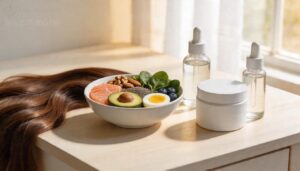
"Hair food" sounds simple, but it covers more ground than most people expect. The term spans everything from what you eat to what you put on your strands — and knowing the difference changes how you approach your routine.
Whether you’re focused on diet or topical care, both play a role in regrowing hair on a receding hairline — and the approach is simpler than most people think.
what the phrase actually means, and what it looks like in practice.
Dietary Hair Nourishment Vs Topical Hair Products
Think of it this way: what you eat works from the inside out, while what you apply works from the outside in.
- Dietary hair food — like dietary collagen peptides — fuels protein synthesis systemically through your bloodstream
- Topical products — sulfate‑free shampoos, serums — deliver immediate, surface‑level results
- Nutrient bioavailability determines how much your follicles actually receive
Long‑term vs. immediate. That’s the real difference.
A daily routine that includes regular scalp massage improves circulation can boost nutrient delivery to follicles.
How Hair Follicles Use Nutrients
Your bloodstream is the delivery system. Once nutrients are absorbed, they travel to follicle cells where mitochondrial energy drives cellular metabolism — powering protein synthesis, collagen synthesis, and keratin production.
| Nutrient | Follicle Role | Key Process |
|---|---|---|
| Biotin | Keratin support | Protein synthesis |
| Iron | Oxygen delivery | Follicle blood flow |
| Zinc | Cell regulation | Signal transduction |
Nutrient transporters move these building blocks directly into follicle tissue, keeping hair follicle health on track.
Why “hair Food” Matters for Strength and Shine
All that nutrient delivery matters because it shows up in how your hair actually looks and feels. Micronutrient synergy — where iron, zinc, and vitamins work together — drives collagen synthesis and keratin formation.
Blood flow enhancement feeds follicles, while oxidative stress reduction keeps the hair shaft intact.
Support the gut-hair axis and hormonal balance, and nutrient absorption improves.
That’s when hair strength and shine follow.
Common Goals Behind Hair Food Searches
Most people searching "hair food" share a short list of real concerns: they want to reduce shedding, boost shine, and feel less dread every time they brush. Others are chasing hair elasticity, scalp moisture, or simply stronger strands that don’t snap mid-style.
Hormonal balance, hair growth, hair loss prevention, hair hydration, and overall hair health — those are the targets.
Your goal shapes everything you choose next.
Nutrients That Feed Healthy Hair
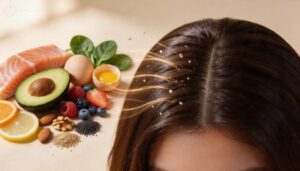
Your hair doesn’t grow in a vacuum — it needs a steady supply of the right nutrients to stay strong, thick, and healthy. Think of it like fueling a machine: what you put in directly shapes what comes out.
Here are the key nutrients your follicles rely on most.
Protein for Keratin Production
Keratin is basically a protein your body builds from scratch — and it can only do that if you’re eating enough of the right stuff. Cysteine supply matters most here; it forms the disulfide bonds that give hair its strength.
Focus on these three foundations:
- Complete Protein Sources — eggs, fish, dairy
- Essential Amino Balance — combine plant proteins to fill gaps
- Protein Digestibility — eat consistently; meal timing helps steady keratin synthesis
Iron for Follicle Oxygen Delivery
Iron doesn’t get enough credit for hair health. Without it, follicles basically starve for oxygen — and that’s when shedding starts.
Without enough iron, hair follicles starve for oxygen — and that’s when shedding begins
Here’s how the system breaks down:
| Stage | What Happens | Hair Impact |
|---|---|---|
| Hemoglobin Synthesis | Iron builds oxygen-carrying red blood cells | Follicles stay active and fed |
| Transferrin Transport | Iron travels through blood to tissues | Consistent follicle delivery |
| Hepcidin Regulation | Liver hormone controls iron availability | Low hepcidin = more iron absorbed |
| Iron Enzyme Cofactors | Iron drives DNA synthesis in dividing cells | Facilitates growth-phase activity |
| Cellular Hypoxia | Low iron triggers stress signaling | Follicles shift out of growth |
Iron deficiency impact on hair is well-documented — it’s one of the most common causes of hair loss in women. Getting iron and zinc sources for preventing hair loss properly means your follicles can do their actual job.
Omega-3 Fats for Scalp Support
Your scalp has a lipid layer that depends on what you eat — and omega-3 fatty acids are a big part of that equation. EPA/DHA metabolism helps cell membrane health in follicle tissue, while scalp inflammation reduction happens gradually as these fats shift your body’s signaling environment.
Fatty fish like salmon and sardines are your best sources. Think weeks, not days, for lipid layer restoration.
Zinc and Selenium for Hair Strength
Zinc and selenium work like a two-person crew for your hair. Zinc drives follicle enzyme support and keratin production — without enough, you’ll notice shedding before anything else.
Selenium steps in as the antioxidant partner, protecting follicles from oxidative stress — and if you’re seeing both shed and scalp issues, poor scalp health and nutrient gaps often go hand in hand.
Selenium backs antioxidant protection at the cellular level. Together, mineral ratio balance matters: excess zinc blocks copper absorption.
Focus on nutrient-rich foods like pumpkin seeds and Brazil nuts before stacking supplements.
Vitamins A, C, D, and E
Think of vitamins A, C, D, and E as your hair’s behind-the-scenes support team.
Vitamin A manages epithelial maintenance, keeping scalp tissue healthy. Vitamin C drives collagen synthesis — structure your follicles actually depend on.
Vitamin D facilitates bone mineralization and cell signaling. Vitamin E delivers oxidative protection at the cellular level. Together, they make Hair Food work from the inside out.
Biotin, Folate, and B Vitamins
B vitamins don’t work solo — they rely on B Vitamin Synergy to do their best work.
Biotin keeps Biotin Metabolic Pathways running, supporting keratin production. Folate drives the Folate One-Carbon Cycle, fueling rapid cell division in follicles. B12 keeps red blood cells healthy, so your scalp gets the oxygen it needs.
Absorption Influencing Factors, like medications and food processing, can quietly deplete these nutrients, making nutrient-rich foods for hair health — eggs, legumes, leafy greens — your first line of defense.
Best Foods for Hair Growth
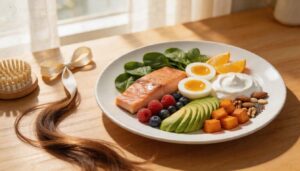
Your plate is one of the most powerful tools you have for stronger, healthier hair. Certain foods consistently deliver the nutrients your follicles actually need to thrive.
Here’s where to start.
Eggs and Lean Proteins
Few foods work as hard as eggs for hair. Each large egg delivers 6 grams of complete protein — every essential amino acid your follicles need for keratin production. Lean meat protein and grass-fed beef raise protein bioavailability even further. Timing intake throughout the day keeps amino acids consistently available.
- Egg protein complete: all essential amino acids in one food
- Biotin naturally present in whole eggs
- Lean red meat supplies iron alongside protein
- Cooking protein improves digestibility and absorption
- Grass-fed beef offers a cleaner lean meat protein option
Fatty Fish for Omega-3s
Protein covers keratin. Omega-3s cover everything underneath — the scalp environment where hair actually grows.
Fatty fish like salmon, sardines, and mackerel deliver EPA and DHA directly. Aim for 2–3 servings weekly. Watch mercury levels with larger species like albacore tuna; skipjack is the smarter pick.
| Fish Species Comparison | Weekly Intake Guidelines |
|---|---|
| Salmon | 2–3 times per week |
| Sardines | 2–3 times per week |
| Mackerel | 2–3 times per week |
| Skipjack Tuna | 2–3 times per week |
Baking and grilling are the best cooking methods — they preserve omega‑3 content without loading calories. Pair consistent fish intake with collagen supplementation for skin and hair to support both follicle health and hair strength from the inside out. Sustainable sourcing matters too; wild‑caught options generally deliver cleaner nutritional profiles.
Beans, Lentils, and Plant Proteins
Not everyone eats fish — and your follicles don’t care where protein comes from, only that it arrives.
Lentils deliver about 18g of protein per cup, plus roughly 37% of your daily iron and 90% of folate needs. That’s serious Lentil Iron Bioavailability and Bean Folate Synergy in one bowl.
- Legume Amino Profiles supply keratin-building blocks without animal protein
- Black beans contribute zinc and iron alongside steady protein
- Chickpeas offer folate that helps rapid scalp cell turnover
- Fiber for Scalp health works by improving nutrient absorption through the gut
- Plant based formulas and Phytoestrogen Effects may support hormonal hair balance
Leafy Greens for Iron
Dark leafy greens — spinach, kale, Swiss chard, collard greens — are among the best plant-based iron sources for hair health. Iron deficiency is a well-documented cause of increased shedding.
Raw vs cooked matters here: cooked spinach packs more iron per cup. Pair these greens with a Vitamin C boost — citrus works well — to sharpen iron absorption and get more from every bite.
Nuts and Seeds for Minerals
Grab a small handful of mixed nuts and seeds, and you’re quietly stacking your mineral intake without much effort. Pumpkin seeds alone deliver around 150 mg of magnesium per 20 g serving — that’s real follicle support in a snack.
- Magnesium-rich seeds like pumpkin seeds fuel the protein synthesis that your hair follicles depend on
- Selenium boost nuts like Brazil nuts cover trace mineral needs in just a few pieces daily
- Calcium-packed nuts like almonds and sesame-based tahini quietly support scalp tissue health
- Phosphorus sources like hemp seeds and pumpkin seeds work alongside zinc for trace mineral synergy
Walnuts, pine nuts, and Brazil nuts round out what pumpkin seeds start — each bringing something different to the table.
Berries and Citrus for Antioxidants
Berries and citrus pull double duty for your hair.
Blueberries, raspberries, and blackberries deliver anthocyanin benefits and polyphenol variety that fight oxidative stress around your follicles.
Citrus flavonoid power adds another layer — and the vitamin C role in collagen synthesis for hair is well established.
That antioxidant synergy means these nutrient-rich foods that promote hair growth work better together than either does alone.
Can Supplements Act as Hair Food?

Food covers a lot of ground, but it doesn’t always cover everything your hair needs. Busy schedules, dietary restrictions, and shifting hormones can leave real gaps in your nutrient intake.
Here’s what to know about using supplements to fill them.
When Diet Alone May Not Be Enough
Even a clean, protein-rich diet can fall short. Medical underlying causes like thyroid dysfunction, postpartum shifts, or gut absorption issues mean nutrients don’t always reach your follicles.
Rapid weight loss, sleep deprivation, and medication interactions can quietly drain your reserves too. That’s where targeted hair food and collagen supplementation for skin and hair can fill the gaps your plate can’t.
Common Ingredients in Hair Supplements
Most quality hair supplements pull from the same core toolkit. Here’s what you’ll commonly find inside:
- Hydrolyzed Collagen — delivers amino acids directly for keratin rebuilding
- Biotin + Vitamin C — promotes metabolism and boosts iron absorption
- MSM (Methylsulfonylmethane) — provides sulfur for structural protein bonds
- Zinc and Silica Powder — regulate hair-cycle function and strengthen strands
- Saw Palmetto Extract — used to help manage DHT-related shedding
How to Read Supplement Labels
The Supplement Facts panel is your first stop — it shows exactly what you’re getting per serving, including the Daily Value percentage for each nutrient.
Check the Ingredient Order next; heavier ingredients come first.
Look for an Allergen Warning and Batch Traceability number for safety.
Always verify that clinical claims are actually backed by supplement clinical trial outcomes, not just front-label marketing.
Who Should Consider Deficiency Testing
Not everyone needs testing — but certain groups really shouldn’t skip it. Postpartum mothers, vegans and vegetarians, celiac disease patients, bariatric surgery patients, and Metformin users all face higher risks of hidden deficiencies that quietly drive hair thinning and loss.
If shedding persists despite solid dietary recommendations for hair health, a simple blood panel can reveal exactly what’s missing.
Risks of Excessive Biotin, Zinc, and Vitamins
Testing catches deficiencies — but more isn’t always better once you start supplementing.
High-dose biotin causes biotin lab interference, skewing thyroid and cardiac test results. Too much zinc triggers zinc copper deficiency by blocking absorption. Vitamin A toxicity builds silently through fat-soluble accumulation in the liver.
Since biotin is water-soluble and doesn’t linger in the body like vitamin A, understanding how long biotin takes to work can help you gauge the right dose before it starts interfering with lab results.
Supplement stacking dangers are real: combining products quietly pushes zinc, vitamin D, and vitamin A past safe limits.
Topical Hair Food Products Explained
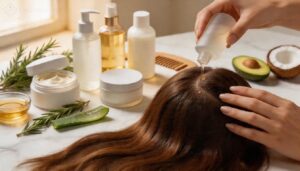
What you eat feeds your hair from the inside, but what you apply works from the outside in. Topical products are just as much a part of your hair food routine as your diet is.
Here’s what belongs in your lineup.
Oils, Masks, and Repair Serums
Think of oils, masks, and serums as three different tools in your repair kit — each targeting damage at a different depth.
Coconut oil wins on oil penetration, actually entering the shaft to cut protein loss.
Mask deep conditioning goes further, blending emulsion-based conditioning agents with hydrolyzed proteins for real structural support.
Serum peptide delivery and lightweight repair formulas like Hair Food Repair Serum seal the cuticle without heaviness.
Leave-in Conditioners for Dry Hair
Where serums seal, leave‑in conditioners keep moisture locked in all day. Dry hair needs that humectant balance — ingredients like glycerin and panthenol pull water toward the strand while emollients smooth the cuticle down. Detangling polymers reduce friction so you’re not snapping strands when you comb through. A few things to keep in mind:
- Apply to damp hair for best absorption
- Focus on lengths and ends, not roots
- Choose lightweight milks or sprays to avoid residue management issues on fine hair
The Hair Food Hemp Extract Manuka Honey Leave in Conditioner Repair Serum does this well — repairing dry, split ends without heaviness. Smart application techniques and consistent frizz control make a real difference over time.
Sulfate-free Shampoo and Conditioner
Once your leave-in is doing its job, your cleanser becomes the next decision. Hair Food Sulfate Free Shampoo swaps harsh detergents for a gentler surfactant blend — sodium cocoyl isethionate, cocamidopropyl betaine — that cleans without stripping. Viscosity builders and pH level management keep the formula scalp-friendly.
Hair Food Sulfate Free Conditioner follows with moisture-locking agents.
Clean beauty that actually works.
Heat Protectants for Styling Damage
Every pass of a flat iron pushes your hair past 175°C — and repeated heat exposure roughens the cuticle fast. That’s where barrier mechanisms matter. Hair Food Coconut Argan Oil Heat Protectant Leave-In Spray delivers thermal styling protection up to 450°F using film-forming polymers as silicone alternatives.
Smart heat protection for styling tools means:
- Apply to damp hair before blow-drying
- Make sure hair is fully dry before flat iron use
- Spray 6–8 inches away for even coating
- Respect temperature limits — above 200°C causes visible damage
- Choose texture selection based on your hair type — lighter sprays for fine hair
Scalp-focused Products for Flaking and Irritation
A flaky, irritated scalp needs a targeted strategy — not just any shampoo.
Anti-dandruff actives like zinc pyrithione and tea tree oil tackle the root cause, while barrier repair ingredients such as glycerin and aloe vera restore comfort.
Pair these with gentle cleansing formats — sulfate-free hair cleansing products work well here — and soothing botanicals like argan oil for natural botanical hair care solutions that calm irritation without stripping.
Building a Hair Food Routine
Knowing what your hair needs is one thing — actually building a routine around it is another. good news is it doesn’t have to be complicated.
put it all together, from your daily basics to tracking real progress over time.
Daily, Weekly, and Wash-day Basics
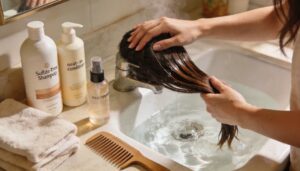
Think of your routine as a recipe — the right steps in the right order make all the difference.
- Daily hair care: Scalp Massage with fingertip pressure boosts circulation without irritation.
- Water Temperature: Lukewarm loosens buildup; hot dries out your scalp.
- Sulfate‑free shampoo + leave‑in conditioner: gentler cleanse, better moisture retention. Pair that routine with the best hair dryers for Black hair to keep heat styling smooth, controlled, and kinder to your moisture-rich strands.
- Detangling Technique: Work conditioner through first, then detangle.
- Heat protectant + Product Layering: Apply before any hot tool, every time.
Rinse Timing matters too — rinse until water runs completely clear. That’s your Hair Food routine foundation.
Pairing Nutrition With Topical Care

Your topical routine and your diet don’t work in silos — they work as a team.
Nutrient-rich foods and hair health supplements lay the internal groundwork: collagen rebuilds structure, iron fuels follicle oxygen delivery, and B vitamins drive keratin synthesis.
Topical Vitamin Boosters and Nutrient-Infused Sprays then reinforce that foundation from the outside.
Stack both consistently, and your hair care regimen finally has something real to build on.
Adjusting for Curls, Color, or Heat Use
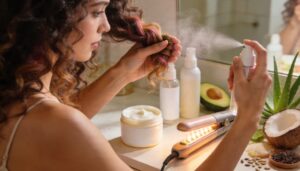
Your hair type changes the game. Curly hair needs curl-friendly heat settings — lower temps, longer sections, less re-heating — plus moisture lock techniques like a leave-in conditioner before any tool touches your strands.
Color-safe styling means going sulfate-free and cutting heat exposure timing right down.
Always apply heat protectant spray first. That’s your frontline for thermal damage prevention and curly hair frizz control.
Consistency for Visible Results
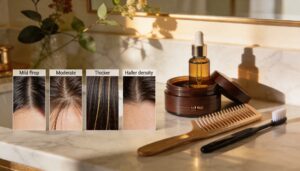
Results don’t come overnight — but they do come. Most people notice less shedding around the 2–3 month mark, with real density changes showing closer to 6–8 months. Your consistency calendar is the difference between progress and starting over.
One thing worth checking along the way is your iron levels, since iron delivers oxygen to follicle cells so they can sustain the rapid division that hair growth demands — this guide to essential minerals for healthy hair explains what to look for.
- Habit stacking works: pair daily ritual timing with brushing your teeth
- Use daily hair masks and serums without skipping
- A progress photo schedule every 4 weeks keeps you honest
- Patience timeline matters — salon-quality results at home take months, not weeks
Tracking Shedding, Breakage, and Texture

Numbers tell the truth your mirror can’t. Use the Shed Count Method on wash days — same schedule, same routine — so you’re comparing apples to apples.
Breakage Length Check spots short, jagged pieces that signal damage repair is needed.
Root Bulb Identification tells you whether you’re shedding or snapping.
Texture Slip Analysis and Hair Diagram Consistency photos track hair health improvements over time.
Ingredients to Limit or Avoid
Not everything labeled "nourishing" actually delivers on that promise. Some ingredients quietly work against your hair — stripping moisture, clogging follicles, or throwing your body’s nutrient balance off track.
Here’s what to watch out for.
Harsh Sulfates and Drying Alcohols
Check your shampoo label — if SLS or SLES sit near the top, you’re washing with a formula designed to strip everything, including the moisture your hair actually needs.
These sulfates trigger scalp barrier disruption and accelerate moisture loss mechanisms that leave strands dry and brittle.
Switching to sulfate free shampoo and sulfate free conditioner reduces cumulative irritation effects considerably, supporting healthier, better-hydrated hair long-term.
Heavy Buildup From Oils and Silicones
Sulfates aren’t the only culprit. Silicone film residue from ingredients like dimethicone coats each strand, and waxy oil buildup from heavy pomades traps sebum against your scalp — creating a scalp clogging risk that slows healthy growth.
Plant-derived cleansers and sulfate free shampoo with sulfate free conditioner are your best buildup removal tips, supporting natural botanical hair care solutions without stripping what your hair needs.
Irritating Fragrance on Sensitive Scalps
Silicone buildup isn’t the only hidden irritant. Fragrance allergens like linalool, limonene, and cinnamal can quietly wreck your scalp barrier disruption long before you notice symptoms.
- Burning or stinging starts within minutes of washing
- Redness and bumps appear along your hairline
- Persistent itching lingers even after rinsing
- Sensitization timeline can stretch months before full reactions show
- Symptoms ease fast when switching to fragrance-free alternatives
Patch testing behind your ear for 48 hours before committing to any new product is a simple step that saves your scalp. Choose sulfate free, plant-based ingredients in hair products and natural botanical hair care solutions for real scalp soothing and lasting irritation relief.
Over-supplementation and Nutrient Imbalance
More isn’t always better with supplements.
Zinc copper competition is real — too much zinc blocks copper absorption, quietly triggering anemia.
Vitamin A toxicity strains your liver. Iron overload risks include organ damage. Selenium excess effects range from hair loss to brittle nails. Vitamin D hypercalcemia raises calcium dangerously.
Nutrient-dense foods offer safer nutrient bioavailability than stacking multiple supplements daily.
Misleading Claims on Hair Food Products
The words "clinically proven" and "Voted Best Hair Supplement 2025" sound reassuring — but dig deeper.
Clinical Study Misuse is common: small, cherry-picked trials rarely reflect your results. Ingredient Quantity Exaggeration hides key actives near the bottom of labels. Regulatory Claim Traps blur cosmetics and medicine. Before-After Photo Manipulation distorts lighting and angles. Even Influencer Endorsement Bias can dress paid promotions as genuine opinions.
When Hair Food Isn’t Enough
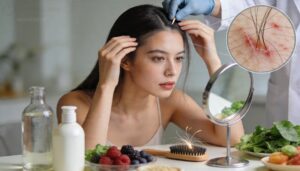
Hair food — whether from your plate or your product shelf — does a lot of heavy lifting.
But sometimes, no amount of good nutrition or the right shampoo can fully explain what’s going on with your hair. Here’s when it’s time to look deeper.
Signs of Nutrient Deficiency
Your body rarely stays quiet when something’s missing. Nutrient deficiency shows up in layers — and hair is often the first place you’ll notice it.
Watch for:
- Fatigue, weakness, or dizziness pointing to iron deficiency or low B12
- Hair thinning, hair shedding, or brittle nails from low protein or biotin
- Bleeding gums, numbness, tingling, or night blindness signaling deeper gaps
Hormonal and Stress-related Hair Shedding
Sometimes, no amount of nutrient-rich foods for hair health will stop the shedding — because the root cause isn’t your diet.
| Trigger | What Happens | Timeline |
|---|---|---|
| Telogen effluvium | Stress pushes follicles into rest phase | Sheds 2–3 months later |
| Cortisol impact | Chronic stress disrupts follicle stem cells | Gradual, ongoing shedding |
| Thyroid imbalance | Disrupts hair cycle body-wide | Diffuse thinning persists |
| Menopause shedding | Shifting androgens miniaturize follicles | Progressive thinning over time |
| Postpartum hair loss | Estrogen drop triggers mass shedding | Peaks weeks after delivery |
These are hair loss reduction strategies territory — not a supplement fix. Menopause-related hair thinning solutions and nutrient deficiency and hair shedding overlap, but hormonal triggers need targeted attention.
Scalp Conditions That Need Treatment
scalp conditions go far beyond what any shampoo or supplement can fix. Psoriasis management, seborrheic dermatitis care, tinea capitis therapy, folliculitis treatment, and lichen planus strategies each require targeted medical intervention.
Left untreated, scalp inflammation quietly destroys follicles — sometimes permanently. Scalp soothing and irritation relief matter here, but they’re just one piece.
Proper diagnosis drives real hair loss reduction strategies.
When to See a Dermatologist
Don’t wait until your part doubles in width. If persistent shedding signs stretch past six months, or sudden hair loss arrives with fatigue and weight changes, book a dermatologist visit.
Scalp inflammation symptoms, failed OTC treatments, and systemic health indicators all signal that hair food alone won’t cut it. Early evaluation is your strongest hair loss reduction strategy.
Useful Tests for Persistent Hair Loss
Once your dermatologist confirms something deeper is going on, the right tests tell the real story.
A Complete Blood Count checks for anemia, a Thyroid Function Test flags hormonal disruption, and a Serum Ferritin Level reveals stored iron — a key driver of nutrient deficiency and hair loss. A Scalp Dermoscopy Exam and Hair Pull Test can confirm telogen effluvium and guide hair shedding prevention strategies.
Frequently Asked Questions (FAQs)
Why was hair food discontinued?
Sales dropped, ingredients dried up, and brands restructured. Sales Volume Decline, Ingredient Shortage, Regulatory Rebranding, Channel Realignment, and Portfolio Streamlining all played a role — sometimes together.
Which foods are good for hair?
Eggs, salmon, spinach, berries, walnuts, and lentils top the list.
These nutrient-rich foods for hair health deliver protein, omega-3 fatty acids, iron, zinc, and vitamin C — everything your follicles actually need.
How often can I use Hair Food?
Frequency depends on your hair type. Dry or damaged hair benefits from 2–3 times weekly. Normal hair needs once weekly.
Always adjust based on results — less if buildup appears, more if dryness persists.
What role does vitamin D play in hair growth?
Vitamin D regulates your follicle cycle regulation, promotes new follicle formation, and maintains immune balance around each strand. Low levels link to shedding.
A clinical evidence gap remains, so treat it as one piece, not a cure.
How does protein deficiency affect hair texture and strength?
Without enough protein, your hair is a house built on sand. Amino acid shortage weakens keratin, causing brittle hair, increased breakage, dull texture, and thinner strands over time.
Are there specific seeds that enhance hair health?
Yes.
Flaxseed omega-3, pumpkin seed zinc, sunflower seed vitamin E, chia seed hydration, and sesame seed minerals each targets different follicle needs — making seeds a compact, nutrient-dense addition to your daily routine.
What is the connection between thyroid health and hair loss?
Thyroid troubles silently steal hair density. Thyroid hormone imbalance pushes follicles into early shedding — hypothyroidism shedding and hyperthyroidism thinning both disrupt growth cycles.
Autoimmune thyroid impact and thyroid antibody testing help pinpoint the root cause.
Does menopause affect how hair absorbs nutrients?
Menopause absolutely affects nutrient absorption.
Hormonal microcirculation shifts reduce follicle blood flow, gut microbiome impact alters nutrient bioavailability, and iron transport changes weaken delivery — making menopause-related hair thinning solutions and hair health supplements for menopause especially worth considering.
Can collagen peptides improve hair strength clinically?
Oral collagen peptides — around 5 g daily for 90 days — are clinically proven to improve hair strength by 13%, confirmed through mechanical testing and placebo trials with a clean safety profile.
How soon do hair supplements show results?
Most people don’t see visible changes in the first week. One month may bring less breakage.
Three month growth shifts become clearer. Six month results reflect true hair growth progress with consistent use.
Conclusion
Think of your hair as a garden—it needs nourishment to flourish. By feeding it the right nutrients and using suitable products, you can transform lackluster locks into vibrant tresses.
Embracing the concept of hair food enables you to take control of your hair’s health.
With a balanced diet, suitable supplements, and targeted care, you can realize your hair’s full potential.
Make informed choices and enjoy the beauty of healthy, thriving hair that radiates from within.