This site is supported by our readers. We may earn a commission, at no cost to you, if you purchase through links. This content is for general informational and educational purposes only and is not a substitute for professional medical, dermatological, or nutritional advice.

West African women have used plantain peel ash and cocoa pod ash to cleanse their hair for centuries—long before the beauty industry decided to bottle the formula and call it a trend.
The science behind it is straightforward: those ashes produce potassium hydroxide, pushing the soap’s pH to somewhere between 9 and 10.5, which is aggressive enough to strip sebum, product buildup, and scalp debris in a single wash.
That alkalinity is both the magic and the risk. Used correctly, African black soap can reset a congested scalp and restore the kind of clean that most commercial shampoos never fully deliver. Used carelessly, it’ll leave your strands dry, frizzy, and fighting you.
The difference comes down to understanding what this soap actually does—and matching that to how your hair needs it.
Table Of Contents
- Key Takeaways
- What is African Black Soap?
- African Black Soap Hair Benefits
- Best Hair Types for Black Soap
- How to Use It on Hair
- Side Effects and Mistakes to Avoid
- Frequently Asked Questions (FAQs)
- Can African black soap treat psoriasis?
- Who should not use African black soap?
- How to use black soap for hair shampoo?
- Does hair blackening soap work?
- What does leaving soap in your hair do?
- What are the Benefits of African Black Soap on Hair?
- What Types of African Black Soap are Available?
- What Should I Avoid When Using African Black Soap?
- How Often Should I Use African Black Soap on Hair?
- How Should I Store African Black Soap?
- Conclusion
Key Takeaways
- African black soap’s pH of 9–10.5, driven by potassium hydroxide from plantain and cocoa ash, delivers a deep scalp reset that most commercial shampoos simply can’t match.
- That same alkalinity is a double-edged sword — always follow your wash with an acidic conditioner or ACV rinse to reseal the cuticle and prevent dryness, frizz, and breakage.
- Dilute before you apply: a 1:3 soap-to-water ratio keeps the formula effective without being harsh, especially for curly, coily, fine, or chemically treated hair.
- once weekly with frequency — once weekly suits most scalps, but color-treated, relaxed, or high-porosity hair needs extra caution and immediate moisture replenishment after every use.
What is African Black Soap?
African black soap has been used in West Africa for centuries, and its reputation for deep cleansing is well-earned. But to understand what makes it work — and whether it’s right for your hair — you need to know exactly what goes into it.
Its centuries-old formula also makes it one of the best body washes for Black skin, thanks to naturally sourced West African ingredients that work gently without stripping moisture.
Here’s a closer look at the key things that define authentic African black soap.
Traditional West African Ingredients Used in Black Soap
What goes into authentic African black soap — Ose Dudu, as it’s called in Yoruba — is simpler than you’d expect.
Plantain peel ash and cocoa pod ash form the cleansing base, while palm leaf ash adds alkaline depth.
Shea butter and coconut oil then balance the formula, contributing softness and conditioning.
Every ingredient is plant-derived, regionally sourced, and purposeful.
Cocoa pod ash supplies antioxidant polyphenols from cocoa.
Why The Ash-based Formula Creates a High PH
Those plant ashes aren’t just traditional filler — they’re the engine behind the formula’s chemistry.
When plantain peel ash and cocoa pod ash meet water, potassium hydroxide formation begins immediately, pulling African Black Soap’s pH toward 9–10.5.
Calcium mineral contribution and ash mineral solubility enhance this pH shift mechanism, creating a genuinely alkaline cleanser — not a pH balanced formula.
The process also generates calcium hydroxide formation, which contributes to the solution’s high alkalinity.
Here’s what that ash chemistry actually does:
- Potassium oxide dissolves on contact with water, rapidly raising pH.
- Calcium compounds release hydroxide ions slowly, extending alkalinity through your wash.
- Higher ash concentration increases the pH shift mechanism’s intensity.
- The resulting alkaline ash chemistry lifts oils and buildup conventional shampoos miss.
- This high pH environment is what gives African Black Soap its deep-clean reputation.
How Authentic Black Soap Differs From Commercial Versions
That high pH you just read about? It only shows up reliably in genuine African Black Soap.
Real black soap is handcrafted by local cooperatives using minimal additives — no synthetic preservatives, no added dyes, no eco-unfriendly shortcuts.
Mass-produced versions often fake the look with standard soap bases. Handcrafted variability, local cooperative sourcing, and that rustic mottled texture are your clearest signals that you’re holding the real thing.
Bar Soap Vs Black Soap Shampoo for Hair Use
Raw black soap bars are traditional cleansers — not engineered as hair shampoos. A black soap shampoo formulation adds conditioning agents, delivers pH balanced cleansing for healthy scalp, and rinses more predictably.
Key differences worth knowing:
- User experience: Bars can tangle hair; shampoos include slip.
- Sulfate-free hair cleansing solution: Most formulated versions skip harsh detergents.
- Ingredient transparency: Shampoos list exact concentrations.
- Clarifying shampoo benefits stay consistent batch-to-batch.
Signs of Genuine African Black Soap
Genuine African Black Soap never looks perfectly uniform — natural color variation from light to dark brown is a good sign, not a flaw. You’re looking for a crumbly texture, an earthy aroma, and clear ingredient transparency on the packaging origin label.
Distinguishing genuine vs fake African Black Soap comes down to this: authentic bars contain recognizable natural ingredients, never synthetic dyes or artificial fragrance.
African Black Soap Hair Benefits

African black soap does more for your hair than just cleaning it. The right formula hits several pressure points at once — from scalp health to strand strength.
By gently exfoliating away buildup and balancing oil production, this traditional soap’s benefits for hair growth start right at the follicle, where healthy strands begin.
Here’s what it actually brings to the table.
Removes Oil, Dirt, and Product Buildup
Think of African black soap as your scalp’s reset button.
Its natural antibacterial properties gently remove buildup without stripping moisture — a key step in any dry colored hair care routine focused on long-term scalp health.
Through alkaline saponification and surfactant lift, it breaks down sebum, dissolves styling product film, and emulsifies trapped oils — the oil dissolution mechanism effectively turns greasy buildup into water-rinsable droplets.
This sulfate-free hair cleansing solution clarifies scalp product buildup without aggressive detergents, making it a genuinely effective detoxifying shampoo with charcoal for deep cleansing and scalp health.
Supports a Cleaner, Healthier Scalp
When your balanced scalp is balanced, everything else follows.
African black soap helps microbiome balance by clearing the debris — excess sebum, buildup, dead skin — that throws your scalp’s natural ecosystem off.
Charcoal detox for hair and scalp goes deeper, drawing out impurities while natural antioxidants from turmeric and plantain ash work quietly underneath.
The result? Better sebum regulation, genuine scalp hydration, and a foundation your follicles can actually work with.
Helps Soothe Itchiness and Scalp Irritation
That persistent itch isn’t just annoying — it’s your scalp telling you something’s off.
African black soap‘ soothing ingredients, including anti-inflammatory tea tree, peppermint oil, and shea butter, work together as a natural anti-inflammatory scalp treatment, calming irritation at the source.
Proper pH balancing with a conditioner pairing restores your acid mantle afterward, improving moisture retention.
Always perform an allergy patch test first.
May Improve Shine, Softness, and Manageability
When buildup coats each strand, shine and manageability are the first casualties.
African Black Soap Shampoo removes that film, enabling cuticle smoothing so light reflects more evenly, giving you a visible hair shine and hydration boost.
The moisturizing formula with shea and cocoa butter helps moisture retention, while deep conditioning for hair softness restores flexibility. The result: genuine frizz control, detangling ease, and a natural volume boost.
Creates a Better Scalp Environment for Growth
Your follicles need more than just clean hair — they need a thriving ecosystem. African black soap promotes microbiome balance, scalp hydration, and follicle activation through its anti‑inflammatory scalp treatment approach:
- Charcoal detox for hair and scalp clears pore‑blocking debris
- Antioxidant protection shields follicles from free radical stress
- Nutrient delivery improves via enhanced scalp circulation
- Anti‑inflammatory oils reduce shedding‑linked swelling
- pH rebalancing with leave‑in conditioner seals and promotes growth
Why It Works Best as a Clarifying Cleanser
Think of African black soap shampoo as your hair’s reset button. Its alkaline surfactant action and ash mineral cleansing lift oils and residue that regular sulfate-free hair cleansing solutions leave behind. That high pH oil lifting temporarily opens the cuticle — useful for a clarifying reset wash, but always follow with an acidic conditioner for pH balance and scalp detoxification.
African black soap resets your hair, but always chase its alkaline cleanse with an acidic conditioner
| Cleansing Step | What It Does |
|---|---|
| Alkaline lather | Dissolves product buildup and sebum |
| Acidic rinse | Reseals cuticle, restores pH balance |
Best Hair Types for Black Soap
African black soap doesn’t work the same way for every hair type, and that distinction matters. Your scalp’s oil production, your hair’s porosity, and how it’s been chemically treated all shape how it reacts to a high-pH cleanser like this one.
Here’s a closer look at which hair types tend to get the most out of it — and which ones need a little extra caution.
Oily Scalp and Buildup-prone Hair
If your scalp is prone to getting oily quickly or you’re dealing with heavy product buildup, African black soap might be your reset button. Its charcoal detox for hair and scalp pulls out residue that regular sulfate‑free hair cleansing solutions sometimes miss.
A pre‑wash scalp massage boosts circulation before cleansing, while post‑wash moisture lock and pH rebalancing with leave‑in conditioner keep oil control from tipping into dryness.
Curly and Coily Hair Considerations
Curly and coily hair can absolutely benefit from an African black soap shampoo, but moisture retention and curl definition require your attention here. The alkaline pH lifts your cuticle, so frizz happens fast.
A moisturizing formula with shea and cocoa butter helps restore hair elasticity and flexibility, enhancement after cleansing. For detangling tips, dilute first — your coils will thank you.
Low-porosity Vs High-porosity Hair Response
Porosity is the real deciding factor here. Low porosity hair has tightly sealed cuticles that resist moisture, so African black soap’s alkaline pH actually helps by opening the cuticle and clearing buildup, sensitivity. High porosity hair absorbs everything fast — including moisture loss.
- Low porosity hair: benefits from cuticle swelling, easier buildup removal
- High porosity hair: higher frizz propensity after alkaline cleansing
- Moisture retention drops faster in high porosity strands
- Conditioner timing matters — apply immediately after rinsing
pH balancing techniques for hair cleansing help both types recover.
Fine Hair and Fragile Strands
Fine hair — strands measuring under 60 micrometers — has fewer cuticle layers, making sulfate‑free hair cleansing solutions like diluted black soap a smarter choice than raw bar soap. The alkaline pH lifts the cuticle fast, so moisture retention drops quickly without immediate pH rebalancing, with leave‑in conditioner.
| Factor | Fine Hair Response | Recommended Action |
|---|---|---|
| Alkaline pH exposure | Cuticle lifts rapidly, increasing frizz | Follow with acidic rinse |
| Moisture retention | Loses hydration faster post‑cleanse | Apply moisturizing formula with shea and cocoa butter immediately |
| Hair elasticity and flexibility enhancement | Fragile strands break under friction | Prioritize gentle detangling before rinsing |
| Heat styling caution | Already‑stressed cuticles worsen with heat | Air‑dry when possible |
| Porosity management | Low porosity tolerates it better | Dilute thoroughly; limit to monthly use |
Lightweight conditioning afterward restores hair manageability and frizz control without weighing fine strands down.
Color-treated, Relaxed, and Damaged Hair Cautions
If your hair is color-treated, relaxed, or already damaged, alkaline exposure caution isn’t optional — it’s essential. The high pH lifts cuticles aggressively, accelerating color fade risk and worsening relaxed hair fragility.
Damaged hair moisture depletes faster under repeated alkaline cleansing, leaving strands brittle and prone to breakage. Post-cleanse conditioning with a pH-balanced formula isn’t just helpful here — it’s necessary.
Sensitive Scalp and Patch Testing Needs
If your scalp reacts to nearly everything, African Black Soap deserves a careful introduction. Before committing to a full wash, run a Patch Test Procedure — apply a diluted amount behind your ear for 24 hours, and keep an Allergy Symptom Log noting any scalp irritation triggers like redness or burning.
Sensitive scalps do best with:
- Fragrance-Free Formulas over raw bars
- Mild Scalp Cleansers with anti-inflammatory scalp treatment properties
- Diluted applications for gentle, scalp soothing and detoxifying hair care
How to Use It on Hair
Getting the most out of African black soap really comes down to how you use it, not just whether you use it.
A few small adjustments — like diluting it first or focusing on your scalp instead of your ends — can make a big difference in how your hair feels afterward.
Here’s exactly how to apply it the right way.
Diluting Black Soap Before Application

Applying raw African black soap directly is like pouring undiluted bleach on a shirt — effective, but way too aggressive. Always dilute first.
Grate a small amount, dissolve it in warm water using a 1:3 soap-to-water ratio, then shake until the solution texture turns thin and sudsy.
This mixing technique preserves the pH-balancing benefits of your natural black‑soap‑based shampoo for hair while delivering scalp soothing and detoxifying hair care with instant lather — minus the harshness.
| Step | Detail |
|---|---|
| Water temperature | Use warm water to dissolve soap fully |
| Grating method | Grate small pieces for faster dissolving |
| Dilution ratio | Start at 1 part soap to 3 parts water |
| Solution texture | Thin, sudsy — never thick or grainy |
| Mixing technique | Shake bottle until evenly distributed |
Applying to The Scalp Without Over-drying Ends

Your ends don’t need what your scalp does — treat them differently.
- Use a Scalp Sectioning Technique to direct Targeted Lather Application only to roots.
- Mist ends with a Pre-wash Moisture Spray before washing as an End Protection Buffer.
- Work in a Gentle Scalp Massage to activate African Black Soap’s Anti-inflammatory Scalp Treatment.
- Let the Moisturizing Formula with Shea and Cocoa Butter support Scalp Health and Dandruff Control.
- Rinse ends passively, then restore with pH Rebalancing Leave-in Conditioner.
How Much to Use for One Wash

Less is genuinely more here.
For one wash, start with about 1 tablespoon of your diluted natural black soap based shampoo for hair if you have short hair — longer hair may need slightly more to cover the scalp fully.
This Soap Quantity Guidance keeps the pH-alkaline formula from over-cleansing.
A well-diluted 16.5oz bottle stretches further than you’d expect with consistent Dilution Ratio Tips applied each session.
How Often to Wash With Black Soap

Frequency matters as much as technique. Think of black soap as your Oil Reset Timing tool — not an everyday shampoo.
A smart Ramp-Up Schedule looks like this:
- Start once every 2–3 days
- Adjust based on your Scalp Sensitivity Threshold
- Reduce to weekly during cold, dry seasons (Seasonal Wash Frequency)
Protective Style Intervals need less frequent deep cleansing overall.
Rinsing Thoroughly to Prevent Residue
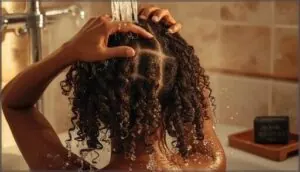
Once you’ve nailed your wash frequency, the rinse makes or breaks your results. Water temperature matters — lukewarm to cool water prevents soap residue from re-depositing.
Use Hair Sectioning to make sure every curl gets direct water contact, then spend one to three minutes on a gentle Scalp Massage under running water.
Finish with a No-Suds Check: if lather’s gone, your scalp detoxification is complete.
Following With Conditioner or Deep Conditioner
After rinsing, deep conditioner timing matters — apply immediately while hair is still wet.
Focus from ears down, not the scalp, using a Scalp-Only Conditioning approach to avoid product buildup at the roots.
Consider these pairings:
- Protein-Free Conditioner for post-clarifying softness
- Plumping Deep Conditioner with a shower cap for 15–20 minutes
- Cationic Surfactant Benefits, smooth cuticles lifted by alkalinity
- MultiUse Softening Leave-In Conditioner sealed over the ends for lasting moisture
Using an Acidic Rinse to Rebalance PH

After conditioning, a quick acidic rinse pulls everything together. African black soap sits around pH 9–10, and your scalp thrives closer to 4.5–5.5 — that gap is where frizz and dryness sneak in. pH rebalancing with a leave‑in conditioner or acidic conditioner bridges it well.
| Rinse Type | Vinegar Dilution Ratios / Citric Acid Concentration | Lactic Acid Benefits |
|---|---|---|
| Apple Cider Vinegar | 1 part to 3 parts water | Mild, accessible |
| Citric Acid Powder | Per label concentration | Low odor, precise |
| Lactic Acid Rinse | Product‑specific | Gentle, water‑soluble |
Rinse Application Timing matters — apply immediately after shampooing, before drying. If you’ve got a Scalp Sensitivity Test concern, dilute further and keep contact under five minutes. These pH balancing techniques for hair cleansing protect scalp health without stripping what your conditioner just restored.
Side Effects and Mistakes to Avoid
African black soap is effective, but it’s easy to misuse it and end up with drier, frizzier hair than you started with. Knowing what can go wrong actually makes the whole experience work in your favor.
Here’s watch out for before, during, and after wash day.
Dryness, Frizz, and Rough Texture From Alkalinity
African black soap’s alkaline pH — often sitting well above your hair’s happy zone of 4.5–5.5 — triggers cuticle swelling, which causes a rough surface formation that leaves strands feeling like sandpaper.
The result? Moisture escape accelerates, frizz amplification kicks in, and negative charge increase between strands creates static‑driven tangles. Watch for these specific signs:
- Hair feels coarse or straw-like post-wash
- Frizz appears even on wash day
- Strands tangle more than usual during rinsing
- Hair elasticity and flexibility enhancement diminishes, increasing breakage risk
cocoa butter‑infused conditioners and frizz control treatments applied immediately after cleansing help counteract this.
Overuse and Clarifying Too Often
Too much of a good thing applies here. Overusing black soap as a clarifying shampoo triggers a pH disruption cycle — scalp barrier strain sets in, excessive oil stripping follows, and your scalp overcompensates by producing more sebum. Curl pattern loss and product interaction breakdown are not far behind.
| Warning Sign | Likely Cause | Action |
|---|---|---|
| Rapid re-buildup | Excessive oil stripping | Extend wash intervals |
| Increased frizz | pH disruption cycle | Follow with acidic rinse |
| Scalp irritation | Scalp barrier strain | Reduce to monthly use |
Guidelines for frequency of clarifying with black soap: once monthly protects scalp health and dandruff control without triggering potential scalp irritation from overuse of black soap — a key consideration under potential drawbacks and sensitivities.
Hard Water Residue and Dull-looking Hair
If you’re washing with hard water, mineral buildup and soap scum can coat your strands and create surface roughness that scatters light — causing visible dullness even on freshly cleaned hair. That calcium film creates a moisture block, preventing hydration from reaching the shaft.
Water softening or a diluted apple cider vinegar rinse restores hair shine enhancement by clearing what hard water leaves behind.
Tangling Caused by Applying Soap Directly
Rubbing the bar straight onto your hair is where most people go wrong. Undiluted soap, poor emulsification, and insufficient lather all drive cuticle roughness and increased friction between strands — especially in curly and coily patterns.
Watch for these direct-application mistakes:
- Skipping dilution concentrates alkalinity along fragile ends
- Low lather reduces slip, worsening tangles during rinsing
- Uneven application creates draggy, rough patches
- Rough cuticles resist detangling even after rinsing
Ignoring Moisture After Cleansing
Skipping moisture after cleansing is like leaving a door wide open in winter — everything valuable walks right out. Black soap’s alkaline pH leaves cuticle roughness, scalp tightness, and moisture loss in its wake.
Without pH rebalancing with leave-in conditioner, or moisturizing cocoa and shea butters, hair elasticity reduction and increased breakage follow fast. Deep conditioning isn’t optional here — it’s the finish line.
When to Stop Using Black Soap
Black soap isn’t for everyone — and your scalp will tell you.
Stop using it if you notice persistent scalp bumps, unresolved redness, or ongoing scalp tightness that lingers days after washing.
Recurrent tangling, excessive hair shedding, and scalp irritation that worsens rather than settles are clear exit signals.
Hair cuticle damage compounds fast without proper pH rebalancing with a leave-in conditioner, so a patch test and early hair breakage prevention matter most.
Choosing Milder Black Soap Shampoos Instead of Raw Bars
If raw bars keep leaving your hair dry and rough, a formulated sulfate-free hair cleansing solution might be the smarter move. These shampoos use gentle surfactants, pH buffering agents, and moisture retention ingredients like glycerin and shea butter, so you get the black soap hair product benefits without the harshness.
Application convenience is built in — no grating, no guesswork.
Frequently Asked Questions (FAQs)
Can African black soap treat psoriasis?
African black soap isn’t a clinical psoriasis treatment. Its anti-inflammatory potential may offer scalp soothing, but alkalinity can compromise your skin barrier.
Always patch test first — clinical evidence supporting it as a psoriasis remedy remains limited.
Who should not use African black soap?
Broken skin, allergy-prone individuals, frequent washers, and those with dry brittle hair, color-treated hair, or relaxed hair sensitivity should avoid it.
Always patch test first — the alkaline pH can trigger scalp irritation fast.
How to use black soap for hair shampoo?
Lather up the right way: wet hair, massage the African Black Soap Reviving Shampoo into your scalp, rinse thoroughly, then condition.
That’s your complete sulfate-free hair cleansing solution in four steps.
Does hair blackening soap work?
Hair blackening soaps rely on pigment myths. True African Black Soap contains no dye agents — just natural ingredients.
Any temporary shade fades fast. Don’t confuse color fade gimmicks with real black soap hair product benefits.
What does leaving soap in your hair do?
Leaving soap in your hair invites alkaline residue, cuticle friction, and scalp irritation. That buildup causes hair weight gain and dullness — always rinse fully, then condition.
What are the Benefits of African Black Soap on Hair?
“Cleanliness is next to godliness,” they say—your scalp agrees.
African black soap delivers deep cleansing and scalp health, regulates scalp pH, infuses anti‑inflammatory botanicals, enriches nutrients, reduces dandruff, enhances hair elasticity, and improves moisture retention and manageability.
What Types of African Black Soap are Available?
You’ll find African black soap in three main forms: a raw bar, liquid black soap, and ready-to-use black soap shampoo — each suited to different needs and routines.
What Should I Avoid When Using African Black Soap?
Too much of a good thing can be a bad thing.
That’s why choosing options with natural, plant-based ingredients—like the picks in this guide to the best breath mints—often works better than sugary alternatives.
Avoid excessive soap, hot water, a quick rinse, improper storage, and no scalp massage to prevent hair breakage and scalp inflammation.
How Often Should I Use African Black Soap on Hair?
Once weekly works for most scalps. Oily scalps tolerate two to three times weekly, while dry or sensitive scalps need just once.
Always monitor your scalp condition between washes and adjust accordingly.
How Should I Store African Black Soap?
Ironically, the very moisture that makes black soap so effective on your scalp is its worst enemy in storage. Keep it cool, dry, and wrapped airtight — humidity dissolves it fast.
Conclusion
Think of African black soap as a key—unlocking centuries of West African wisdom to detoxify your scalp. Its potassium hydroxide core, derived from plantain and cocoa ash, cuts through buildup like nothing else, but demands respect.
Use it mindfully: dilute, rinse thoroughly, and always follow with moisture.
This isn’t just a cleanser; it’s a ritual that resets your hair’s foundation when honored. Embrace its power, but listen to your strands.
Your journey to a healthier scalp starts here—rooted in tradition, guided by science.
- https://www.nappilynigeriangirl.com/2015/09/the-problem-with-black-soap-for-natural.html
- https://viori.com/blogs/updates/the-real-truth-about-african-black-soap-for-hair-science-secrets-and-smart-use
- https://thedermspot.com/fr/how-to-use-african-black-soap-for-radiant-skin-and-healthy-hair-a-complete-guide-in-2026/