This site is supported by our readers. We may earn a commission, at no cost to you, if you purchase through links. This content is for general informational and educational purposes only and is not a substitute for professional medical, dermatological, or nutritional advice.

Your 4C coils can lose 70 to 80 percent of their length the moment they dry. That tight zig-zag pattern doesn’t unfurl into bouncy, separated spirals on its own, and no amount of wishing changes that.
Here’s the good news: you can shape your texture into defined, springy curls without heat. Every method relies on the same few moves. You detangle, section, moisturize, and set your hair while it’s wet or damp.
Learn how to make natural black hair curly with wash-and-gos, finger coils, twist-outs, Bantu knots, and rod sets, then keep your curls fresh between wash days.
Table Of Contents
Key Takeaways
- Your 4C coils can shrink 70 to 80 percent as they dry and won’t form separated curls on their own, so you’ll need to twist, braid, or coil your hair to get real definition.
- Great curls start with a solid prep routine: finger detangle, section your hair, and moisturize it while it’s wet or damp.
- Pick the heatless method that fits your goal, whether that’s wash-and-gos, finger coils, twist-outs, braid-outs, Bantu knots, or rod sets, and let your hair dry completely before you unravel it gently with oiled fingers.
- Keep your curls fresh between washes by misting with water, sealing with a little lightweight oil, and protecting your hair at night with a satin scrunchie, scarf, or bonnet.
How Can You Make Natural Black Hair Curly?

You can shape natural Black hair into curls you’ll love, and it starts with knowing what your texture can do. Your natural curl pattern sets the baseline, so you’ll want to see how it differs from a temporary curl set. Here are the two points to keep in mind before you pick your method.
A good gel helps your natural curls hold their shape, and this roundup of the best hair gel for Black men’s hair makes choosing easier.
Natural Texture and Realistic Curl Expectations
Coils in 4C hair form a tight zig-zag, so your natural texture rarely shows separated, bouncy curls on its own. Dry strands can shrink 70 to 80 percent, which makes your length look shorter than it is.
Set realistic curl expectations before you style. Techniques like twist-outs, braid-outs, and finger coils create definition. Moisture and sealing keep it lasting.
Defined curls on 4C hair need twisting or braiding beforehand, since simply wetting your hair and applying product won’t create a good wash n go.
Curl Definition Versus Temporary Curl Sets
Once you know your coils won’t act like loose waves, the next step is choosing your goal. Curl definition makes your natural pattern clearer and more separated. A temporary set molds damp hair into a shape that holds once it dries.
Here’s what each can give you:
- Softer, true-to-you coils that feel like yours.
- Uniform curls that last past wash day.
- Freedom to switch looks whenever you want.
Wash, Detangle, Section, and Moisturize Natural Hair

Once you know your texture, start with a good foundation. Curls look their best on hair that’s clean, soft, and free of knots.
If your curls are fine, these curly hair styling tips for fine hair show how a healthy, well-prepped base makes every style easier.
Before you wash, gently finger detangle to loosen major knots. Then section your hair into four to six parts with clips or twists, so each area gets proper attention.
Wet one section at a time, guiding water from scalp to tips. Massage shampoo into your scalp, then smooth in conditioner using a prayer hands motion. Comb through with a wide-tooth comb, ends first.
| Step | What to use | Why it helps |
|---|---|---|
| Pre-wash | Oil or aloe | Reduces friction |
| Wash | Shampoo | Clears buildup |
| Moisturize | Conditioner | Adds slip |
Rinse well, keep your sections separated, and you’re all ready to style with confidence.
Create Defined Curls With Heatless Styling Techniques
Your hair is clean, detangled, sectioned, and moisturized, so now you’re ready to set your curls. Each heatless styling technique below gives you a different curl size, shape, and level of definition. Read through the options, then pick the one that fits your hair and your schedule.
Wash-and-Go Curl Definition

Picture Maya, who skips the comb on wash day and wonders why her curls bunch up instead of clumping. Her fix was simple: she styled while her hair was still dripping.
- Saturate your hair with water.
- Rake in a curl cream.
- Layer a light-hold gel on top.
- Don’t touch it while it dries.
- Diffuse on low, or air dry fully.
Finger Coils
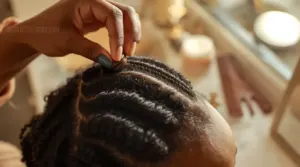
You can turn damp, product-coated hair into neat spirals with nothing but your fingers. Part a small section, smooth on curl cream or gel from root to tip, then wrap the strand around your finger and slide it off once it holds.
Work small, even sections for uniform coils. Let them dry fully, and they’ll often last several days.
Twist-Outs

Twisting your hair gives you control over your curls. Follow hair sectioning tips, smooth leave-in conditioner through damp sections, and twist root to tip with even tension.
Twist-outs pair with curl definition techniques, and overnight hair protection keeps them intact. Wrap twisted hair in a satin bonnet at night. You’ll feel:
- Proud
- Confident
- Free
- Radiant
Braid-Outs

Picture Maya, who braids her damp, moisturized hair into twelve medium plaits on Saturday night and wakes up to soft, stretched waves.
Part your hair into even sections, apply cream to each one, and braid all the way to the tips. Let every plait dry completely, then loosen them gently from the ends. Smaller braids give you tighter, defined waves.
Bantu Knot-Outs

Picture a crown of tiny, coiled buns, each one holding a spring of curl inside it. That’s what Bantu knots do for your hair.
Twist each damp, moisturized section tightly from root to tip, then wrap it around its base and tuck the end underneath. Let your knots dry completely, ideally overnight, under a satin bonnet. Undo from the bottom with oiled fingertips.
Flexi Rod and Perm Rod Sets

Want bouncy curls or tight coils? Your rod choice decides it. Flexi rods are soft foam, so you can sleep on them comfortably and get looser waves. Perm rods are rigid, giving tighter, uniform coils.
Start with stretched or blow-dried hair, add mousse, and section evenly. Wrap with steady tension, then dry completely before unwinding. Smaller rods mean tighter curls.
Dry Completely, Unravel Gently, and Shape Curls

Patience pays off here. Undo too early and every curl you built falls apart, so make sure your hair is completely dry first. Air dry, or use a diffuser on low heat, and check the inner layers near your roots, since that’s where dampness hides.
Rush the unraveling and your hard-earned curls collapse, so let every strand, especially the hidden layers near your roots, dry fully first
Once you’re sure, rub a little oil into your palms. Start at the ends and use your fingers to ease each twist or braid open, working upward. Skip the comb and don’t tug.
Next, shake at the roots to loosen any stiffness and add movement. Smooth lengths with your oiled fingers to soften the crunch from gel.
Gently stretch your curls to gain length and cut shrinkage. Stay light-handed, and you’ll keep your curl definition without frizz.
Maintain Curly Black Hair Between Wash Days

You’ve put in the work, so let’s keep your curls looking good for days. Start with a quick refresh: mist your hair lightly with water, smooth in a small amount of leave-in or cream, and seal with one or two drops of lightweight oil only when your hair feels dry.
At night, pineapple your curls with a satin scrunchie and cover them with a silk scarf or bonnet. It cuts friction and helps with frizz prevention.
Here’s what you’ll gain:
- Soft, bouncy curls you can trust each morning.
- Freedom from daily restyling.
- Pride in hair that’s healthy and fully yours.
Wear braids or buns between washes for protective styling, and wash every 10 to 14 days for tightly coily hair.
Frequently Asked Questions (FAQs)
Does hair porosity affect how well curls form?
Think of your strands as tiny sponges: hair porosity decides how they soak up and hold water, and that shapes every curl. Yes, it matters. Low porosity resists moisture, high porosity loses it fast, so match your care.
Can heat damage permanently loosen natural curl patterns?
Yes, it can. Too much heat breaks down the keratin bonds that hold your curl pattern, so damaged strands may stay loose even after washing. Moisture won’t fix them. Trim the affected sections and use heatless styling from now on.
Can protein treatments help curls hold their shape?
Protein can help a little, but not the way you might hope. It coats strands and softens breakage, so curls look more even. It won’t lock in a set, though. Styling method and full drying matter far more.
How often should natural black hair be trimmed?
Think of your ends as the frayed tip of a rope. Trim natural black hair every 8 to 12 weeks, or every 6 to 8 weeks if you use heat. Snip about a quarter inch.
Conclusion
Picture Maya, who twists her damp hair on Sunday night and wakes up to soft, springy curls she didn’t have to fight for. That’s the payoff of patience. Once you know how to make natural black hair curly, the routine becomes yours: detangle, moisturize, set, and let it dry fully.
Start with one method this week and trust your texture. Every wash day teaches you something, and your curls will only get easier to love.