This site is supported by our readers. We may earn a commission, at no cost to you, if you purchase through links. This content is for general informational and educational purposes only and is not a substitute for professional medical, dermatological, or nutritional advice.
A 200-grit stone can fix a chipped chisel in minutes. Use that same stone on a straight razor and you’ll ruin the edge before you finish the first pass.
That’s the catch when you learn how to choose a honing stone. Material, grit, size, and lubrication all change how a stone treats your steel. Pick wrong and you’ll waste hours, scratch deep grooves, or round off an edge you worked hard to build.
Pick right and the work feels easy. The stone cuts evenly, holds your angle, and leaves a clean edge. Here’s how to match each factor to your blade.
Table Of Contents
- Key Takeaways
- How Do You Choose a Honing Stone?
- Match Honing Stone Materials to Your Blade
- Choose Honing Stone Grit for Edge Condition
- Select Stone Dimensions for Comfortable Control
- Choose Between Water and Oil Lubrication
- Check Stone Flattening and Cleaning Requirements
- Frequently Asked Questions (FAQs)
- Conclusion
Key Takeaways
- Match your grit to your edge’s condition: use coarse stones (80-220) to repair chips, medium stones (1000-3000) for everyday sharpening, and fine stones (5000-12000) to polish a razor.
- Pick a stone that suits your steel and your blade, since synthetic stones cut fast for repair, natural stones give a smooth finish, and diamond stones are too harsh for finishing a delicate straight razor.
- Choose a stone about 8 inches long and 2 to 3 inches wide, because the extra room gives you longer strokes and keeps your angle steady.
- Commit to one lubricant, either water or oil, and keep your stone flat and clean, since switching lubricants later isn’t possible and a dished stone will round your bevel.
How Do You Choose a Honing Stone?
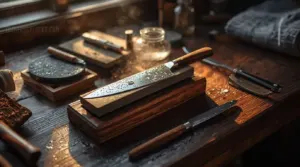
You can narrow down a honing stone by answering four questions about your blades, their material and your habits.
For trimmer blades, this guide on how to sharpen a beard trimmer shows how stone choice and light, overlapping strokes shape the edge.
First, look at what you sharpen. A kitchen knife, a chisel and a straight razor all want different things. Next, judge the edge. A chipped blade needs more aggressive grit than one that’s lost its bite. Very dull or nicked blades usually start on coarse 200-400 grit stones before moving to finer ones.
Then check the size. A stone around 6 inches long and 2 inches wide gives you a steady grip and room for full strokes.
Last, think about upkeep and lubrication. Water stones dish out and need flattening. Oil stones stay steadier. Diamond stones skip lubricant. Your patience for care matters as much as the stone itself.
Get these four right and every stroke gets easier.
Match Honing Stone Materials to Your Blade
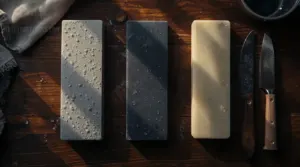
The stone you pick should suit the steel in your blade. Two choices matter most here, and each one changes how your edge turns out. Start with the first, then move on to the second.
Synthetic Versus Natural Stones
Why does a stone’s origin matter? It changes how predictable your results feel. Pick the one that fits your goal:
- Synthetic stones cut fast, stay uniform, and wear slowly.
- Natural stones cut slowly and leave a smooth, misty edge.
- Water stones are softer, so flatten them often.
Use synthetic for repair and middle stages. Use natural for control and finish.
Once your stones are flat, these tips for sharper razor blades show how to pair each grit with its stage.
Diamond Stones and Delicate Razor Edges
Diamond stones are a different animal. They don’t dish, need no soaking, and they remove metal fast. That speed is the problem for a straight razor.
Use a diamond stone for repairing chips or setting a bevel on sturdy knives. Don’t use it to finish a razor. Its deeper scratches and larger burrs can ruin a narrow, fragile edge. Finish on a natural or ceramic stone instead.
Choose Honing Stone Grit for Edge Condition
Grit tells you how fast a stone cuts and how fine an edge it leaves. Your edge condition decides which grit you reach for first. Here’s how to match each stage to the right range, from repair to finishing.
Coarse Grits for Edge Repair
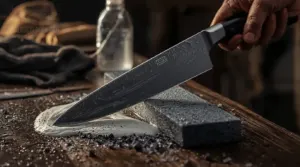
Say you drop a chef’s knife and the tip chips. A fine stone won’t fix that. You’d spend an hour polishing a flaw that’s still there.
Reach for coarse grits instead, somewhere between 80 and 220. Press firmly until a burr forms along the whole edge. That burr tells you the abrasive grains are removing enough metal. Expect a toothy, scratchy edge when you finish.
Medium Grits for Sharpening
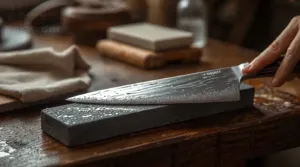
A medium grit stone does most of your real sharpening. Aim for 1000 to 3000 grit, and pick one that suits your steel.
- Use 800 to 1500 grit on softer steel.
- Choose 1000 to 3000 grit for harder blades.
- Match stone hardness to your steel.
- Check lubricant compatibility before you start.
- Plan for regular dressing and maintenance.
Keep pressure steady.
Fine Grits for Straight Razor Finishing
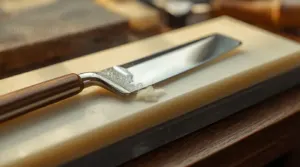
Why does fine grit matter so much for a razor? It decides how smooth the edge feels. Polish with 5000-8000 grit, then finish at 10000-12000.
| Grit | Stone | Use |
|---|---|---|
| 5000-8000 | Synthetic | Polishing |
| 10000-12000 | Synthetic | Finishing |
| 20000-30000 | Natural | Slurry |
| Diamond | Avoid | Too harsh |
Your thumbnail should glide without catching, and a hanging hair should part cleanly. Always keep your stone flat, too.
Select Stone Dimensions for Comfortable Control
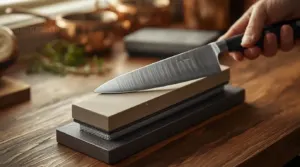
A stone that’s too small is like writing a long letter on a sticky note. You’ll keep running out of room.
Honing on a stone that’s too short is like cramming a whole speech onto an index card, and you’ll always run out of space
For most kitchen knives, pick a honing stone about 8 inches long. Your blade can ride along most of the surface, so you make longer strokes and reposition less. Short stones let the edge overhang, and your angle drifts.
Aim for a width of 2 to 3 inches. That gives your knife room to travel without slipping off the side. Thicker stones resist flexing and last through more flattening. Thin ones need a holder.
Here’s what the right size gives you:
- Calm, because your strokes stay smooth and unhurried.
- Confidence, because the blade never slips off the edge.
- Pride, because your angle stays steady from heel to tip.
- Safety, because your hands have space to grip.
Add a non-slip base and keep the area clear.
Choose Between Water and Oil Lubrication
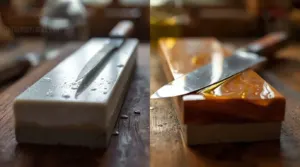
You might think the lubricant is a minor detail. It isn’t, because it shapes how your stone cuts and how long it lasts.
The waterstone vs oilstone choice comes down to a few trade-offs:
- Water stones cut faster because they shed a fine slurry.
- Oil gives a smoother action and stays put on the stone.
- Water costs nothing and rinses off easily.
- Oil stones need no soaking, so they’re ready at once.
Whatever you pick, commit to one lubricant. Oil clogs the pores and repels water, so you can’t switch back later. Magnesia-bonded stones should only see water, since oil can crack them as they dry.
Steady coolant and lubrication keeps the blade gliding. Pick water if you’re still unsure.
Check Stone Flattening and Cleaning Requirements
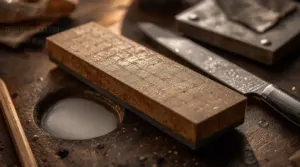
A stone that cuts well today can wreck your edge tomorrow. Waterstones wear unevenly, and the hollows they develop turn flat bevels convex. Soft, fast-cutting stones dish quicker than hard ones, so check how often you’ll need to dress yours.
Flattening costs stone material, so frequent work shortens its life. A diamond flattening plate is fast and stays true. Silicon-carbide powder on glass is a cheaper route. Draw a pencil grid on the surface and rub until it vanishes evenly.
Cleaning matters just as much. Rinse your stone during use, because swarf loads the surface and slows cutting. Wipe it between stages so coarse grit never reaches a finer stone. Diamond plates need only a rinse, not flattening.
Soaking stones need saturating first, while splash-and-go types only need wetting.
Frequently Asked Questions (FAQs)
What is the best angle for honing?
Your razor knows the answer. Lay it flat on the stone with spine and edge touching, and the natural sharpening angle is set, usually 16 to 17 degrees. Go lower and you’ll lose edge retention.
Can one stone sharpen both knives and chisels?
Yes, one stone can handle both. A water stone or a diamond stone works best. Pick a combination stone, like 1000/6000, and keep it wide enough for your chisel. Clean it well between tools.
Do beginners need a combination stone first?
Say you own a dull paring knife and a 1000/6000 combination stone. You can fix the edge and polish it on one block. No, not required, but it’s a smart, simple first buy.
How often should honing stones be replaced?
Replace a stone when flattening no longer fixes an uneven surface, or when cracks, chips, or stubborn glaze show up. Diamond stones last 10 to 20 years at home, but only 2 to 5 years with daily professional use.
How should you store honing stones safely?
Dry your honing stone completely before you put it away. Keep it in a spot with steady room temperature, not a cold garage. Wrap oil stones in paper towels. Store water stones in a dedicated tool box.
Conclusion
Match the material to your steel. Match the grit to your edge. Match the size to your hands.
Once you know how to choose honing stone for each job, sharpening stops feeling like guesswork. Coarse stones repair, medium stones sharpen, and fine stones polish. Keep your stone flat, clean, and properly lubricated, and it will hold your angle for years.
Start with one good medium-grit stone. Learn how it cuts. Then build your kit from there.