
This site is supported by our readers. We may earn a commission, at no cost to you, if you purchase through links.
You set your clippers to what looks right, make the first pass, and watch more hair hit the floor than you planned. That quarter-inch difference between a #2 and a #4 guard just cost you three weeks of growth. Blade size isn’t about numbers on plastic—it’s the difference between walking out confident and wearing a hat for a month.
Your hair type, face shape, and lifestyle all dictate which guard delivers the cut you actually want, not the disaster you’re trying to fix in the mirror. Getting this choice right means understanding how those numbered guards translate to real length on your specific hair.
Table Of Contents
- Key Takeaways
- What Are Hair Clipper Blade Sizes?
- How Do Clipper Guard Sizes Affect Hair Length?
- Which Blade Size Works for Your Hair Type?
- How Face Shape Influences Blade Size Choice
- Matching Blade Size to Haircut Style
- Considering Maintenance and Lifestyle Needs
- Tips for Safe and Accurate Blade Selection
- Communicating Blade Size Choices to Barbers
- Caring for and Maintaining Clipper Blades
- Frequently Asked Questions (FAQs)
- Conclusion
Key Takeaways
- Clipper guard numbers directly translate to specific hair lengths (guard #1 = 1/8 inch, guard #2 = 1/4 inch, guard #4 = 1/2 inch), and understanding this system prevents the common mistake of cutting too short by accidentally choosing the wrong guard.
- Your hair’s texture dictates which guard sizes work best—fine hair needs shorter guards (1-3) to avoid over-cutting, thick hair tolerates longer guards (4-6) for efficient bulk removal, and curly hair requires guards 4-6 to preserve natural curl definition.
- Face shape determines optimal blade length: round faces need 1.5-6mm guards to create visual length without excessive width, while square faces require 6-9mm on top with tapered fades to soften angular jawlines.
- Shorter guard sizes (0-2) demand trims every 2-3 weeks and deliver low-maintenance wash-and-go styles, while longer guards (5-8) allow 3-6 weeks between cuts but require more daily styling effort.
What Are Hair Clipper Blade Sizes?
Hair clipper blade sizes are standardized measurements that determine how much hair remains after cutting. You’ll encounter numbers ranging from 0 to 8, with each corresponding to a specific length in fractions of an inch.
Understanding this system starts with three core concepts: how the numbering works, what lengths each size produces, and how blades differ from guards. Once you know how hair clipper guard sizes work, you can predict exactly what length you’ll get before you even start cutting.
Numbering System Explained
Clipper blade size determines how much hair you’ll leave after cutting. Most blade compatibility charts use a numeric scale—0.5 yields a nearly bald finish, blade 1 leaves about 1/8 inch, and blade 2 produces 1/4 inch. This system differs from guard attachments, which add extra length over the base blade.
Always check your clipper models against official haircut number guides to confirm blade size charts match your tools. Understanding the importance of methodological rigor is essential for precise cutting techniques.
Common Clipper Blade Sizes and Lengths
You’ll find blade size charts list fixed lengths in millimeters. A 0.5 mm blade delivers stubble-length finishes, while a 1.0 mm (1/8 inch) gives you short, tight clipper lengths. Here’s what you need to know:
- 2.0 mm blades cut roughly 6 mm when paired with guard systems
- 3.0 mm configurations leave 9–10 mm of hair
- Haircut numbers map directly to these clipper blade size measurements
Guard size adds length beyond the base blade. Choosing the right guard length for your face shape can make a big difference—different beard trimming styles work with various guard sizes to complement your features.
Difference Between Blade and Guard Sizes
Knowing your blade versus guard is like understanding foundation versus paint. Your blade’s physical cutting edge—the actual metal—determines the base clipper blade size. Guards snap on top, adding length increments without touching blade sharpness or heat. Understanding blade mechanics helps you choose the right types of haircuts for men that match your texture and maintenance preference.
The blade cuts the hair; the guard adds length on top without affecting sharpness or heat
Here’s the breakdown:
| Component | Function | Effect on Length |
|---|---|---|
| Blade Material | Cuts hair at contact point | Sets minimum length |
| Guard Systems | Adds detachable length | Controls cutting lengths |
| Combined Use | Blade + guard = final result | Ensures consistent passes |
Guard size doesn’t sharpen your blade—it just sets how much hair you’ll remove.
How Do Clipper Guard Sizes Affect Hair Length?
Guard sizes directly control how much hair you’ll keep after cutting. Each number corresponds to a specific length, and knowing these measurements helps you get exactly what you want.
Here’s how guard sizes translate to hair length and which ones work best for different styles. For a sharp neckline, many barbers recommend using clippers with a shorter guard than your main beard length to create definition without harsh lines.
Size-to-Length Conversion Chart

You need a clear clipper size guide to avoid guessing games. Every guard number corresponds to a precise hair length, measured in inches or millimeters. Here’s your conversion tables breakdown:
- Guard #1: 1/8 inch (3.175 mm) – Nearly scalp-tight
- Guard #2: 1/4 inch (6.35 mm) – Standard short cut
- Guard #3: 3/8 inch (9.525 mm) – Balanced grooming length
- Guard #4: 1/2 inch (12.7 mm) – Conservative professional look
- Guard #5: 5/8 inch (15.875 mm) – Noticeable texture retention
Use this hair clipper blade size chart for accurate length measurement tips every time.
Popular Guard Sizes for Different Styles
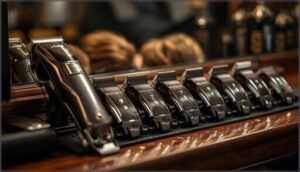
Each style variation demands its own guard option. A 0 guard delivers ultra-short buzz cuts at 1.5–2 mm. Guard 1 yields tight 3 mm fades for sharp hair texture. Guard 2 provides 6 mm for scissor-like finishes. Guard 3 gives 9 mm for subtle blending. Guard 4 reaches 13 mm for softer transitions.
Match your clipper size to your cutting techniques using this clipper blade size chart for precision results every hair type deserves. When shopping for portable hair clippers for travel, prioritize models with 4 to 8 guard settings and self-sharpening blades for consistent performance on the go.
Half Sizes and Their Uses

Intermediate lengths between standard guard sizes deliver clipper precision you won’t achieve with full steps alone. Half size benefits include smoother fade techniques and refined transitions—a 1.5 guard bridges 1 and 2 for smooth blending. These guard size options expand your hair clipper sizes toolkit.
Proper clipper blade maintenance ensures accurate half-guard results every session.
Which Blade Size Works for Your Hair Type?

Your hair’s natural texture determines which blade size delivers the cleanest cut. Fine hair behaves differently under clippers than thick or coarse strands, and ignoring this difference leads to uneven results.
Here’s how to match blade size to your specific hair type.
Fine Vs. Thick Hair Considerations
Your hair type dictates everything about blade selection. Fine hair needs shorter guards—1 to 3—to prevent over-cutting and preserve hair volume. You’ll avoid visible clipping lines with precise blade maintenance.
Thick hair tolerates longer clipper guard sizes, usually 4 to 6, for efficient bulk removal. You’ll need multiple passes and frequent cleaning to manage resistance and maintain cutting techniques across different hair textures.
Curly, Straight, and Wavy Hair Needs
Curl patterns demand longer clipper guard sizes—4 to 6 to preserve definition and maintain frizz control. You’ll protect hair elasticity while showcasing natural texture.
Straight hair works best with shorter guard sizes, delivering clean haircut length without bulk.
Wavy hair sits in the middle: size 3 to 5 guards balance style versatility across different hair types.
Test hair clipper sizes on small sections first.
Managing Coarse or Textured Hair
Thick strands with tight coils need strategic blade lubrication to prevent snagging and heat damage. You’ll choose guard sizes 5 to 7 for textured cut styles—they preserve volume and natural curl pattern management while reducing choppy edges.
- Analyze your hair shaft analysis: larger diameter means slower length growth
- Oil blades every 10 minutes when cutting coarse hair
- Start with longer haircut length guards to maintain fullness
- Clean hair clipper sizes between passes to preserve accuracy
- Replace worn clipper guard sizes regularly for consistent cuts
How Face Shape Influences Blade Size Choice

Your face shape acts like a blueprint for choosing the right blade size. The proportions of your jawline, cheekbones, and forehead determine which lengths add balance and which create unwanted emphasis.
Here’s how to match blade sizes to the three most common face shapes.
Best Blade Sizes for Round Faces
Round faces require strategic blade selection to create visual length. A 1.5 to 3 mm clipper guard size delivers a close, soft finish without excessive elongation. Moving to 4 mm reduces bulk around the jawline while maintaining fullness. For balanced definition at the sides, 6 mm works well.
Here’s your quick reference:
| Blade Size | Hair Length Left | Best Use on Round Styles |
|---|---|---|
| 0.5–1 mm | Ultra-close | Tight fades preserving facial fullness |
| 1.5–3 mm | Close finish | Soft cut without over-elongating |
| 4 mm | Fuller edge | Reduced bulk, maintained width |
| 6 mm | Medium length | Subtle side definition |
| 9 mm | Substantial | More crown shape, soft silhouette |
Understanding haircut numbers and hair clipper sizes helps you communicate blade selection needs for your face shape clearly. Proper clipper maintenance ensures consistent hair texture results across all haircut styles for face shapes.
Ideal Cuts for Oval and Square Faces
Oval and square face shapes call for different blade strategies. Oval proportions handle blended transitions and softer angles—think 4 to 6 mm guards on the sides for balanced symmetry.
Square faces need angular reduction through:
- 6 to 9 mm on top to soften the jawline
- Tapered fades with rounded edges using 1.5 to 4 mm
- Textured crops that respect your natural hairline design
Facial symmetry guides every haircut number you choose.
Customizing for Unique Face Shapes
Heart and diamond faces demand specialized clipper blade selection. For heart shapes, you’ll use 3 to 5 mm guards on the sides to balance a narrower chin—fuller tops prevent top-heavy looks.
Diamond faces need mid-length guards (size 3–5) emphasizing cheekbones while minimizing temple width.
Face shape analysis guides your tailored haircut designs, matching hair texture considerations to facial structure enhancement across all haircut styles and clipper guard sizes.
Matching Blade Size to Haircut Style
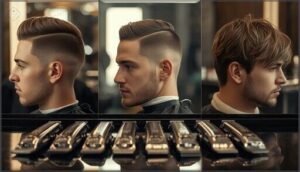
Your haircut style determines which blade size you’ll need. A buzz cut requires different guards than a fade, and layered styles need their own approach entirely.
Here’s how to match blade size to the three most common haircut styles.
Buzz Cuts and Ultra-Short Styles
You’ll achieve a classic buzz cut with guards 1 through 3—each delivers distinct Hair Clipper Sizes for ultra-short maintenance. Guard 1 leaves 1/8 inch for a close finish, guard 2 offers 1/4 inch with better coverage, and guard 3 provides 3/8 inch when you want visible texture. These Haircut Numbers define your Short Style Trends:
- Guard 1: Ultra-close, scalp-visible buzz requiring weekly trims
- Guard 2: Popular short buzz balancing coverage and low upkeep
- Guard 3: Textured buzz with softer appearance and easier maintenance.
For the best results, consider using clipper guard sizes to achieve your desired hairstyle.
Fades and Blended Transitions
You’ll create smooth fade techniques by using guard sequencing that steps down gradually—start with guard 4 at the crown, then move to 3, 2, and 1 toward the neckline. These haircut numbers prevent harsh lines in your taper fade. Clipper angles matter: tilt away from the scalp for softer blended cuts.
Here’s your guard progression:
| Zone | Guard Size | Length | Purpose |
|---|---|---|---|
| Crown | 4 | 1/2 inch | Starting point |
| Mid-head | 3–2 | 3/8–1/4 inch | Shift styles |
| Sides | 2–1 | 1/4–1/8 inch | Defined blend |
| Neckline | 1 or trimmer | 1/8 inch or less | Clean finish |
Check symmetry from multiple angles—uneven tension creates inconsistent depth across your blended cuts.
Longer, Layered, and Textured Looks
You’ll preserve hair volume in layered cuts by selecting guards between 5 and 8—these cutting techniques maintain movement without excessive bulk removal. Textured styles need mid-length clipper guard sizes to accentuate separation between layers.
Your blade progression for texture:
- Crown lift: Guard 6–7 prevents flat zones
- Face-framing layers: Guard 5–6 for softness near temples
- Blend zones: Guard 4–5 creates smooth gradients
Check hair type before committing—fine hair flattens with ultra-short haircut styles, while coarse textures hold definition better. Regular style maintenance preserves layer edges and prevents shaggy regrowth.
Considering Maintenance and Lifestyle Needs

Your haircut isn’t just about how it looks—it’s about how it fits your life. The blade size you choose directly impacts how often you’ll need trims and how much daily upkeep you’ll face.
Let’s break down the practical side of picking a length that works with your schedule, not against it.
Low-Maintenance Haircut Options
You’ll find your sweet spot with cuts that require zero fuss. Buzz cuts with guard size #1 or #2 give you wash-and-go freedom—no combing needed. Tapered fades keep their shape longer between trims.
For Easy Upkeep Styles, match Hair Clipper Sizes to your Hair Texture Analysis: straight hair holds uniform lengths better, while wavy types benefit from guards #3-4 that minimize frizz without daily styling.
| Cut Style | Best Guard Size |
|---|---|
| Classic buzz cut | #1–#2 |
| Short tapered fade | #2–#3 |
| Textured crop | #3–#4 |
| Minimal-style pixie | #4–#5 |
| Uniform short layer | #5–#6 |
Low Maintenance Cuts depend on Maintenance Needs: trim every 4–6 weeks, clean blades after use, and skip heat tools. Busy Lifestyle Hair thrives on Haircut Numbers that let natural texture do the work, keeping Hair Length consistent with fewer salon visits.
Styles for Active or Busy Lifestyles
You’ll spend less time grooming when you choose guard sizes 0–2 for Quick Trims like Buzz Cut or Fade Haircuts. These Active Styles skip blow-drying and product—snap-on guards swap lengths in seconds.
Shorter Haircut Length means Fast Grooming after workouts, while self-sharpening blades cut upkeep.
Busy Haircuts thrive on Low Maintenance systems that match your Haircut Number to a no-fuss routine.
Frequency of Trims Based on Blade Size
Shorter Guard Sizes reveal growth faster—you’ll need trims every 2–4 weeks. Here’s how Blade Wear and Hair Growth shape your Trim Schedules:
- Guard Sizes 0–2: Book appointments every 2–3 weeks for crisp edges
- Haircut Number 3–4: Maintain even Hair Length with trims every 2–3 weeks
- Hair Clipper Sizes 5–8: Stretch visits to 3–6 weeks for blended styles
- Individual growth shifts intervals by ±1 week
- Regular Maintenance Tips preserve Clipper Efficiency between cuts
Tips for Safe and Accurate Blade Selection

Choosing the right blade size means nothing if you can’t use it safely. Small mistakes in attachment, compatibility, or technique can lead to uneven cuts or damage to your clipper.
Here’s how to select and use blades with confidence and precision.
Ensuring Proper Guard Attachment
A loose guard can ruin your cut in seconds. Before you power on, align the guard until you hear or feel a click—that’s your lock-in point.
Check for wobble by gently shaking the clipper. If the guard shifts, debris or a worn latch might be the culprit. Clean the blade attachment area, reseat the guard, and confirm it’s flush.
Proper guard alignment isn’t optional—it’s clipper safety 101.
Checking Compatibility With Your Clipper
Not every blade fits every clipper—mismatch these, and you risk motor damage or jagged cuts. Here’s your compatibility checklist:
- Verify the blade part number against your clipper model’s official list before buying.
- Check the attachment system (snap-on or lever-fit) matches your clipper’s mounting lugs.
- Confirm blade materials align with guard systems to prevent corrosion or wear.
- Test cordless vs. corded ratings to guarantee consistent clipper blade tension.
- Contact manufacturer support when serial numbers or compatibility checks seem unclear.
Avoiding Common Blade Size Mistakes
Mixing haircut numbers with clipper guard sizes leads to uneven results—that’s the biggest blade size error you’ll make. Always verify guard-to-clipper compatibility before powering on, or you’ll face cutting technique flaws and potential safety hazards.
Don’t skip testing a small section first; hair type changes how blade and guard combinations perform. Skipping this step creates hair length mistakes you can’t undo mid-cut.
Communicating Blade Size Choices to Barbers

Getting the right haircut starts with clear communication. You’ll need to speak your barber’s language—using guard numbers, describing length, and showing what you want.
Here’s how to make sure you walk out with exactly the cut you’d in mind.
How to Describe Your Desired Length
Precision wins every haircut conversation. You’ll avoid confusion when you combine exact guard numbers with measurements—”a number 2 guard all over, that’s 1/4 inch” communicates clipper settings clearly. Describe your hair texture and desired style using consistent haircut numbers.
Here’s your approach:
- State the specific guard sizes you want (e.g., “number 3 on top”)
- Mention hair length in inches or millimeters for precision
- Reference your hair texture and how it affects length measurement
- Clarify whether you want one clipper guard size throughout or sectioned cuts
Bringing Reference Photos
Words alone leave room for error—photos close that gap. You’ll communicate haircut length and clipper guard sizes most effectively with high-resolution images (at least 1080p) shot in natural lighting.
Include frontal, side, and rear reference angles showing your hair type and texture. Close-ups of fades, layers, and transitions give your barber the exact guard sizes and blade details needed for precision client communication.
Discussing Hair Type and Style Goals
Once you’ve shared photos, pair them with details about your hair. Your barber needs three specifics:
- Hair texture and density—Fine strands are cut differently than coarse hair, affecting which clipper guard sizes create the desired haircut number.
- Style preferences—Maintenance frequency and lifestyle shape haircut styles and hair length choices.
- Facial features—Jawline and proportions guide tailored cuts using proper clipper techniques.
Caring for and Maintaining Clipper Blades

Your clipper blades won’t perform well if you don’t maintain them properly. Regular care keeps cuts sharp, extends blade life, and prevents damage to both your equipment and hair.
Here’s what you need to do to keep your blades in professional condition.
Cleaning and Oiling Best Practices
Your hair clipper blades won’t perform without proper clipper maintenance. Clean your clipper guards and blades after every use with a brush and isopropyl alcohol for blade sanitizing. Apply two drops of clipper oil on each blade edge, then run the hair clipper briefly to distribute it—that’s smart oil application.
Follow these cleaning schedules and lubrication tips religiously. You’ll prevent friction, heat buildup, and premature wear.
Sharpening and Replacing Blades
You’ll know it’s time for blade sharpening when your clipper blades tug instead of glide smoothly. Professional sharpening services restore high-carbon steel maintenance and ceramic blades alike—send them in when performance drops.
Replacement costs vary by material and tooth design, but proper clipper maintenance extends blade durability markedly. Heavy daily use demands more frequent clipper blade sharpening than occasional home grooming.
Check clipper blade tension regularly.
Storing Blades and Guards Safely
Proper blade storage tips start with dry, ventilated containers—moisture invites rust fast. Apply light clipper oil before storing to protect edges.
Keep clipper guards in labeled organizers to prevent size mix-ups and maintain blade organization. Storage solutions like magnetic strips or foam inserts boost guard safety and prevent accidental nicks.
Always check clipper blade tension after retrieval to verify secure attachment and ideal clipper maintenance.
Frequently Asked Questions (FAQs)
Can I use different brand guards on my clipper?
Mixing brands rarely fits like puzzle pieces that belong together. Clipper compatibility demands guards designed for your specific model—cross-brand experiments risk poor blade safety, uneven cuts, and potential damage. Always verify clipper guard sizes match your manufacturer’s system.
How do seasonal changes affect blade size choices?
Seasonal humidity changes your hair’s texture and scalp oil production. Dry months require slightly longer clipper guard sizes to prevent snagging, while humid conditions allow closer cuts with shorter blade performance.
What blade size works best for childrens haircuts?
Children’s sensitive scalps demand guard sizes 3–6 (6–9 mm) to prevent nicks.
You’ll find these haircut numbers deliver kid-friendly cuts with gentle fades, while clipper guard sizes around 6 mm balance safety precautions with practical child haircare for pediatric trimming.
Should blade size change as hair grows out?
Yes, you’ll adjust blade sizes as growth progresses. Hair texture and growth patterns demand blade adjustment every 2–4 weeks.
Maintenance schedules preserve style evolution, keeping fades sharp and haircut length consistent across guard sizes.
Do wet and dry cutting require different sizes?
You’ll use the same blade size for both wet and dry cutting. Hair clipper sizes don’t change, but moisture causes hair swelling, so guard selection may need minor technique adjustments for consistent haircut length.
Conclusion
Bad haircuts happen when you guess. Professional results happen when you know how to choose the right hair clipper blade size for your specific hair type, face shape, and lifestyle. That numbered guard isn’t arbitrary—it’s engineered precision that determines whether you’re confident or hiding under a hat.
Master the blade-to-length relationship, understand your hair’s behavior, and communicate clearly with your barber. Your next cut won’t be damage control. It’ll be exactly what you planned.
- https://www.fashionbeans.com/article/best-haircuts-for-men/
- https://x.com/godofprompt/status/1990526288063324577
- https://www.linkedin.com/posts/bohdanlukianets_tasks-study-research-activity-7373377539521667072-UTEi
- https://www.sciencedirect.com/science/article/pii/S0749208123000268
- https://arxiv.org/html/2507.17948v2