This site is supported by our readers. We may earn a commission, at no cost to you, if you purchase through links. This content is for general informational and educational purposes only and is not a substitute for professional medical, dermatological, or nutritional advice.
Grab three men off the street with beards and you’ll find three different tools built them: scissors, a trimmer, or two months of patience. That’s the thing about facial hair—length alone doesn’t make a style. Shape does.
A designer stubble stays sharp at 2mm while a Van Dyke demands clean cheeks and a mustache that never touches the chin. Your jawline, your face shape, even your growth pattern all factor into what actually works on you.
Master the different beard trimming styles explained here, and you’ll stop guessing at the mirror. Precision beats guesswork every time you pick up the trimmer.
Table Of Contents
- Key Takeaways
- Beard Trimming Styles by Length
- Popular Beard Styles Explained
- Best Beard Styles for Face Shapes
- Beard Trimming Techniques and Tools
- Advanced Beard Shaping Tips
- Frequently Asked Questions (FAQs)
- Do you need a beard trim guide?
- When should you trim your beard?
- How do you trim a beard properly?
- What is a beard trimming style?
- How to trim a beard with scissors?
- What are the different types of beard styles?
- How to choose the correct beard style?
- What shape should I trim my beard?
- What is a number 3 beard cut?
- How often should I replace my beard trimmer blades?
- Conclusion
Key Takeaways
- Your beard length dictates everything—stubble, boxed, medium, or full—and each stage demands its own trim schedule, from every 2-3 days to just once every few weeks.
- Picking a style like a goatee, Van Dyke, or Balbo isn’t about trends; it’s about matching the shape to your jawline and bone structure.
- Your face shape sets the real blueprint, so round faces need sharp angles while square jaws benefit from softer, rounded fullness.
- Sharp results come down to technique and tools—scissors for control, trimmers for speed, and constant symmetry checks to keep both sides honest.
Beard Trimming Styles by Length
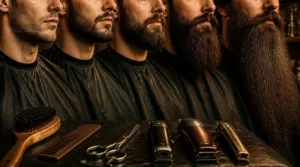
Length changes everything about how a beard looks and how much work it takes. Every stage, from barely-there stubble to a full chest-length beard, comes with its own rules. Let’s break down each length category, so you know exactly what you’re signing up for.
If you’re weighing your options, browsing these stylish beard designs and ideas can help you picture how each length might actually suit your face.
Designer Stubble
Designer stubble sits in the 1–3mm range, giving you that rugged five-o’clock shadow without looking careless.
Guard 1 works best for daily wear, while guard 0.5 pushes into heavier territory.
Trim every 2–3 days to hold the shape. Define your neckline at the Adam’s apple, then check symmetry side-to-side before calling it done.
For best results, consider your face shape when choosing stubble.
Short Boxed Beard
Ready to add structure? The short boxed beard runs 3–6mm, with cheeks trimmed tighter and chin left slightly longer for shape.
Use a precision trimmer for sharp cheek line architecture and straight edges. Neckline placement starts two fingers above your Adam’s apple.
Trim weekly. This cut screams jawline emphasis without the upkeep of longer styles.
Medium Beard
Past the boxed stage, you’re building real dimension. Medium beards run 15–25mm, giving you enough length to shape, not just trim.
Expect 2-3 months of growth to get here. Trim twice weekly with a 1-3mm guard, brush daily, and apply oil to keep flyaways tamed.
Round and oblong faces benefit most from this added length and structure.
Long Full Beard
Give it another month or two and you’re in true long-beard territory, extending past 4 inches from the chin.
Full beard characteristics mean no bald patches. Daily brushing prevents tangles, while bottom edge shaping and neckline definition keep growth deliberate, not wild.
- Command a room the moment you walk in
- Own a look nobody else can fake
- Wear your patience as proof of discipline
Maintenance Frequency
Every length demands its own rhythm. Stubble wants attention every 2-3 days. Short beards need weekly trims. Medium growth holds shape for about a week before edges blur.
Long beards flip the script—trim every 2-4 weeks, but handle neckline cleanup weekly. Track your growth rate, adjust for skin type, and treat consistency as the real secret to a sharp beard maintenance routine.
Popular Beard Styles Explained

Length is only half the equation. The style you choose shapes your whole look, from jawline to attitude. Here are five classic cuts worth knowing before you pick up the trimmer.
Full Beard
A Full Beard is your canvas—full coverage, no bare patches, grown 2-3 months minimum for real density.
Keep it sharp with:
- Weekly neckline definition
- Cheek line shaping along your jaw
- Daily beard oil application
Symmetry evaluation matters here; step back, check both sides. It’s the foundation style—master this before chasing complex beard shaping techniques.
Goatee
Goatee facial hair keeps things simple: chin coverage, clean cheeks, your call on the mustache connection.
Define goatee shape boundaries with straight edges—don’t let it creep onto cheeks.
Goatee maintenance tips: trim every few days, check symmetry, clean stray hairs. This style builds beard style confidence fast, proving small, sharp facial hair grooming beats sprawling, unkempt growth every time.
Van Dyke
Named for painter Anthony van Dyck, this style splits your mustache and chin beard with clean-shaven cheeks between them—no bridge, no blending.
That gap demands precision line work twice weekly. Charles I wore it. So did Colonel Sanders.
Rounded, petite, and anchor variations exist, but classic Van Dyke means a pointed goatee paired with a waxed handlebar mustache.
Balbo
Italian aviator Italo Balbo made this cut famous in the 1930s, and it’s still commanding attention today.
Grow four weeks minimum. Shave cheeks clean, keep a soul patch, shape chin hair into rounded or squared lines. Guard sizes 2-4mm maintain it.
Square and round faces wear it best. Trim biweekly, oil weekly, and guard that cheek line symmetry.
Anchor Beard
Picture a ship’s anchor traced onto your jaw. That’s the shape you’re chasing here.
Chin point stays narrow and centered. Jawline arms taper up clean, cheeks stay bare. Mustache connects through the soul patch for that sharp anchor outline.
Symmetry check matters most. Compare both sides before you commit to the final line.
Best Beard Styles for Face Shapes
Your face shape sets the rules before you ever pick up a trimmer. Match your beard to your bone structure, and you’ll sharpen what works and soften what doesn’t. Here’s how to read your shape and choose the cut that fits.
Round Faces

Ever notice how a round face needs sharp lines, not more curves? Skip the rounded beard entirely.
Go angular. A Van Dyke or Balbo builds jawline definition through pointed chin hair, while cheek line shaping trims bulk sideways.
Keep length around 10-20mm for verticality—enough to stretch the face without smothering your features.
Square Faces
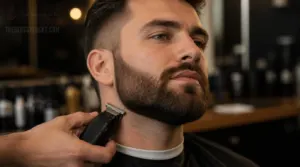
Square jaws already own the room—so work with that strength, not against it.
Rounded Full Beard or Circle Beard softens corners while Angular Trimming keeps Cheek Line Balance sharp. Aim for 3-6mm.
- Feel your jawline finally look sculpted, not boxed in
- Watch a patchy beard become a defined statement
- Build confidence with every clean neckline pass
- Own a squared beard that commands respect
Heart-Shaped Faces

A square jaw owns the room—a heart-shaped face plays a different game entirely.
Forehead width analysis shows the widest point up top, so your jawline emphasis strategy flips: build chin weight.
| Feature | Trim Focus |
|---|---|
| Cheekbone prominence | High cheek line trim |
| Chin point definition | Full, rounded natural trim |
Van Dyke or Balbo styles balance the inverted triangle silhouette fast.
Diamond Faces

Wide cheekbones, narrow forehead, narrow chin—your diamond face shape needs width balanced at the center.
- Trim cheeks to 4-5mm, curved not straight
- Build chin volume with graduated length styling
- Try a Balbo beard for clean, controlled width
- Keep extended chin beard at 12-14mm
- Fuse cheek line shaping into sideburns smoothly
Precise jawline sculpting turns sharp angles into balanced, magazine-cover symmetry.
Oblong Faces

When your face length runs 1.5 times your width, the goal shifts: build out, not down.
| Style | Length | Effect |
|---|---|---|
| Full Width Beard | 12-14mm | Adds side fullness |
| Short Boxed Beard | 10-15mm | Squares the jawline |
| Wide Stubble | 4-5mm | Sharp horizontal edges |
Raise your cheek line for width, keep the neckline tight, and fuse sideburns clean into the beard line.
Beard Trimming Techniques and Tools

Picking a style is only half the job. Getting it right comes down to technique, and the tools you reach for matter just as much as your hand. Here’s what you need to know before the blade touches skin.
Scissor Trimming
Scissors give you control clippers can’t match. Use a fine-toothed comb, cutting only what extends past the teeth—this is precision cutting at its finest.
Work dry hair only, trimming longest strands first in small sections. Cut upward for texture, never straight across.
Sharp blades prevent split ends; dull ones crush hair. That’s how you preserve length while shaping.
Electric Trimmers
Speed wins the day when you’re short on time. A solid electric trimmer runs 5,000-9,000 RPM, powered by brushless motors that hit 20-60% more efficiency than old brushed models.
Look for:
- Guard progression control (0.5-2mm jumps)
- Waterproof design for rinse cleaning
- Ergonomic grip under 250 grams
- USB-C quick charge, 15-30 minutes
- Sharp blade types for line up sharpness
Comb and Scissor
Precision lives here. Hold the comb in your less dominant hand, scissors in the other, and let the teeth guide every cut.
Lift hair against its grain, cut only what extends past the comb, and work chin-outward in small sections. Finish one side, then check symmetry before matching the other.
Keep the beard dry — wet hair lies longer than it is, and you’ll overcut without meaning to.
Neckline Shaping
Get this line wrong and your whole beard looks off. Use the two-finger rule, stacking fingers above your Adam’s apple to find true neckline placement.
- Trim horizontally from center outward
- Choose U-shaped or inverted-U styles
- Go slower with longer guards
- Ease gradually into a shift gradient
Too high exposes your chin. Too low kills definition. Check symmetry with a handheld mirror before committing.
Cheek Line Cleanup
Where beard meets bare cheek is where your whole shape lives or dies. Carve it too high, you lose density; too low, no jaw definition.
| Beard Length | Cheek Line Style | Tool |
|---|---|---|
| Stubble | Light edging | Detail trimmer |
| Medium | Perimeter trim | Trimmer + comb |
| Long | Anti-spread carving | Scissors |
Check both sides before committing—symmetry beats speed every time.
Advanced Beard Shaping Tips
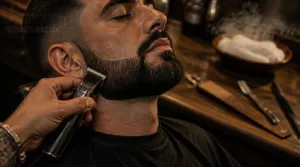
You’ve got the basics down, so now it’s time to sharpen your skills. This next stretch separates a decent beard from a genuinely dialed-in one. Here’s what to master next.
Beard Fade
Think of a taper fade like a sunset—no hard edges, just a smooth gradient from skin to full beard.
A great beard fade has no hard edges, just a smooth gradient from skin to full beard, like a sunset
- Sideburn fade: lengthens gradually toward the chin
- Cheek fade: starts at the cheek line, builds toward the jaw
- Neck fade: rises from neckline upward
- Classic fade: smooth gradient into a full center
Mix with upward, overlapping strokes for sharp line-up precision.
Patchy Beard Blending
Fades smooth transitions between lengths. Patchiness is a different animal — bare patches need real correction.
Run a guard length differential: trim sparse cheeks 3-5mm shorter than fuller areas. Brush daily with beard oil to train hair over gaps. Consider dye blending or a barber consult for stubborn density issues before your next trim.
Symmetry Checks
Correcting patches only matters if both sides match. Stand square to the mirror and check Midline Alignment first — everything else measures off that line.
Run this quick pass:
- Ear to Jaw Edge — even contour both sides
- Cheek Line Mirror — matching height, similar density
- Jaw Corner Balance — no lean, no sharper corner
Confirm Neckline Levelness before cheek line carving for true beard symmetry.
Guard Length Control
Guard length control comes down to your trimmer’s precision dial, not guesswork. Most dials adjust in 0.5mm increments, so a 3mm guard leaves 3mm—no estimating involved.
| Guard Type | Best For |
|---|---|
| Metal, dual-bearing | Fades, dense beards |
| Plastic | Light touch-ups |
| Adjustable dial | Micro-adjustments |
| Fixed guard | Beginners |
| Fine-toothed | Sparse zones |
Match guard to density—thick beards need sturdier hardware.
Sensitive Skin Care
Skin under your beard takes a beating from friction and stubble contact. Rinse after every trim, then apply a fragrance-free, barrier repair moisturizer with ceramides. Choose hypoallergenic products, patch test new ones, and skip strongly scented beard oil on irritated skin.
Broad-spectrum sunscreen finishes the job—gentle post-trimming care keeps your face calm, not just your beard sharp.
Frequently Asked Questions (FAQs)
Do you need a beard trim guide?
Picture a sculptor facing raw stone, no plan, just instinct. That’s a guessing game with your jawline.
A real beard length guide covers trimming frequency, neckline shaping, cheek line cleanup, and symmetry checks—turning scattered snips into confident, repeatable beard maintenance.
When should you trim your beard?
Trim short beards every 4-7 days, medium lengths every 2-3 weeks. Watch for flyaways, uneven patches, or neck hair past two fingers above your Adam’s apple — those signs mean it’s time.
Between trims, a quick daily pass of washing and combing keeps the shape crisp — this guide to professional beard grooming breaks down how to maintain that polished look at work.
How do you trim a beard properly?
Like a sculptor working marble into shape, proper technique starts before the blade ever touches hair: wash, dry, and comb first. Trim with the grain, define your cheek line and neckline with precision, then finish with aftercare.
What is a beard trimming style?
A beard trimming style is the length, shape, and design you cut into your facial hair, grounded in trimming purpose and personal preference, built through consistent grooming essentials to match your face shape.
How to trim a beard with scissors?
Grip your scissors firmly, comb hair upward, and snip stray ends above the comb. Work in small, incremental passes side to side, then shape the neckline and check symmetry before finishing.
What are the different types of beard styles?
Your face is basically a canvas, not a fixed sentence. Beard trimming styles run from designer stubble to a long full beard, with goatees, Van Dykes, and Balbos between — each one matched to face shape and growth pattern.
How to choose the correct beard style?
Start with face shape analysis: measure forehead, cheekbones, and jawline. Match round faces to angular cuts, square jaws to softer fullness, heart shapes to chin coverage. Then weigh lifestyle, maintenance time, and growth pattern before committing.
What shape should I trim my beard?
Sharp jaws soften, narrow chins widen, wide foreheads balance—your beard face shape matching dictates the contour. Round faces gain length at the chin, square jaws need rounded softening, and oval faces handle nearly any beard shaping strategy.
What is a number 3 beard cut?
Set your trimmer guard to number 3, and you’ll land at 10mm of even coverage—short beard territory that reads sharp, not scruffy. It’s the sweet spot between stubble and a fuller beard, ideal for weekly maintenance and a polished, professional look.
How often should I replace my beard trimmer blades?
Blades dull like a blacksmith’s edge under daily fire. Swap yours every 4-6 weeks with daily use, 3-4 months weekly. Watch for tugging or snagging—your first sign it’s time.
Conclusion
Pick up that trimmer tomorrow, and the mirror looks completely different.
Different beard trimming styles explained mean nothing until your hands actually learn them—guard lengths, cheek lines, the patience a Balbo demands. Your face shape gave you the blueprint. Your tools give you the execution. Stop copying photos; start reading your own jawline instead.
Precision isn’t talent; it’s a habit built one careful, deliberate pass at a time. Master the shape, and the beard follows.