This site is supported by our readers. We may earn a commission, at no cost to you, if you purchase through links. This content is for general informational and educational purposes only and is not a substitute for professional medical, dermatological, or nutritional advice.

A ragged fade ruins a clean look faster than most grooming mistakes. One skipped guard length leaves a visible stripe across your jaw, and no amount of styling hides it once it’s there.
Knowing how to do a beard fade separates a sharp finish from a choppy, uneven trim. It’s the detail that makes your beard look intentional, not grown out. The difference comes down to technique, prep, and the right tools, not expensive trips to a barber chair.
This guide covers every step, from setting your neckline to blending your cheek line to finishing without a guard.
Table Of Contents
- Key Takeaways
- What is a Beard Fade and Where Should It Blend?
- How to Prepare Your Beard, Skin, and Tools
- How to Do a Beard Fade Step by Step
- Common Beard Fade Mistakes, Fixes, and Maintenance
- Top 8 Products for a Beard Fade
- 1. Braun Multi Grooming Kit MGK3060
- 2. Gillette Styler All Purpose Grooming Kit
- 3. Hard Case for Multigroom Trimmer Kit
- 4. Bevel Cordless Beard and Mustache Trimmer
- 5. Kent Fine and Wide Tooth Comb
- 6. ZilberHaar Stiff Boar Bristle Brush
- 7. Andis Slimline Pro Cordless Beard Trimmer
- Gillette Fusion5 ProGlide Men’s Razor
- Frequently Asked Questions (FAQs)
- What is the 4 week beard rule?
- What fade goes best with a beard?
- Are you supposed to fade your beard?
- What tools do I need to fade my beard?
- How often should I trim my faded beard?
- Does fading a beard make it look thinner?
- Is a beard fade better than a regular beard trim?
- Can I fade my beard with scissors?
- Are beard fades harder to do than other beard styles?
- How often should I trim my beard fade?
- Conclusion
Key Takeaways
- A beard fade works by stepping through progressive guard lengths from shorter at the edges to longer toward the center, and skipping any guard size leaves visible bands instead of a smooth gradient.
- Prep determines the result: wash and fully dry your beard before trimming, since damp or oily hair clumps against the guard and cuts unevenly.
- The neckline must be defined first because it sets the fixed lower boundary the entire fade builds up from, and getting it wrong undermines every step that follows.
- Checking symmetry from the front and both 45-degree angles is essential, since facial asymmetry registers in about two seconds and an uneven fade is immediately noticeable.
What is a Beard Fade and Where Should It Blend?

When you fade a beard, you’re creating a gradient from shorter hair at the edges to longer hair toward the center. The effect comes from progressive guard length adjustment on your beard trimmer, stepping up through sizes so there’s no hard boundary where one length ends and another begins. The result reads as a smooth shift rather than a blunt edge.
Mastering the transitions between each guard size is what separates a polished fade from a choppy one, and this guide on blending your beard seamlessly into your hair shows exactly where those transitions matter most.
Placement matters as much as technique. The fade starts at your cheek line and sideburns, where hair sits thinnest, and deepens toward your chin and jaw. Your neckline sets the floor: define it first, because the short-to-long shift needs a fixed lower boundary to build from. Keep the jawline corner blended, or the fade splits into two visible zones.
How to Prepare Your Beard, Skin, and Tools
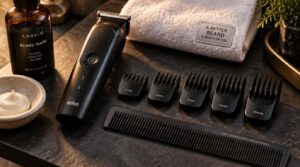
Solid beard preparation determines whether your gradient holds or breaks down mid-session. Start with beard hygiene: wash and fully dry your facial hair before touching the trimmer. Wet or oily hair clumps against a trimmer guard, and clumped hair cuts unevenly. A dedicated beard wash and conditioner kit strips away oil and buildup while softening coarse hair, giving your trimmer a clean, even surface to work with.
Your skin care routine matters here too. Clean, residue-free skin lets guards glide without drag, keeping your fade zone consistent pass to pass.
Before you start, check your tools:
- Confirm your blade alignment and lever lock so guard lengths don’t shift mid-session.
- Keep guards from the same set so gradation steps stay predictable.
- Use a fine-tooth comb to lift hair and catch length inconsistencies before beard trimming.
Set a uniform starting length with your largest guard, and you’re ready to begin.
How to Do a Beard Fade Step by Step
Now it’s time to put technique into practice. The process breaks down into six focused steps, each building on the last to create a clean, smooth fade. Follow them in order and you’ll have full control over the result.
Set Neckline and Cheek Line
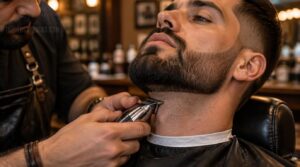
Picture your neck as a canvas. Set the neckline just above the Adam’s apple, following the curve. Then mark the cheek line where the beard fade begins to rise. A trimmer guard keeps both sides even for facial symmetry.
| Line | Position | Error |
|---|---|---|
| Neckline | Above Adam’s apple | Too low |
| Cheek line | Mid-jaw curve | Too high |
| Guard | Same height, both sides | Skipped |
Trim The Base Length

With your lines set, trim the bulk down to a uniform base length. Choose a higher trimmer guard than your fade endpoint. Keep controlled trimming passes steady and follow the hair’s natural growth direction.
Stay clear of the neckline and cheek line. Light pressure matters: pressing harder shifts the effective cut length. Comb through after to catch any stray hairs.
Fade Sideburns With Guards
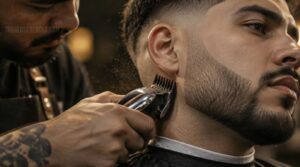
Along the sideburn, start with your shortest guard at the lower boundary and work upward. Step through two or three guard sizes, using short, overlapping strokes as you move up. Your guard selection sets how gradual the change looks, so don’t skip sizes. Keep each pass controlled around the curve to avoid patchy spots in the sideburn fade.
Blend Cheeks and Jawline
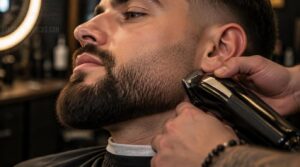
Blending the cheek fade into the jawline is where beard blending either works or breaks.
The right trimmer makes all the difference here, and these beard grooming kits near you include precision tools designed specifically for that tricky cheek-to-jawline transition.
- Target the mix zone, not just the endpoints
- Overlap guard strokes so no step remains visible
- Follow the jaw’s curve, not a flat line
- Shift guard selection one size at a time
- Keep even pressure for a consistent gradient effect
Detail Without a Guard
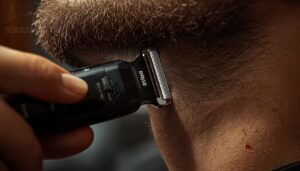
Without a guard, even a few degrees of wrist angle changes how much hair you remove.
Keep the trimmer nearly parallel to the skin, walking short passes along the edge where lengths change. Work from longer to shorter lengths. Brush flyaways flat first so your cheek line reads clean, and avoid guardless detailing on damp beard sections since clumping causes patchy results.
Check Symmetry and Finish

Studies show most people detect facial asymmetry within two seconds of eye contact. To check symmetry on your beard fade, view from the front, then rotate to 45° on each side. Match the fade’s lowest point on both cheeks.
Facial asymmetry registers in two seconds, so check your beard fade from the front and both 45-degree angles
Comb the beard down, check that the neckline is level, and confirm the shift flows cleanly from sideburn into the jawline.
Common Beard Fade Mistakes, Fixes, and Maintenance

Most beard fades fail before the clipper even starts. If you skip brushing the beard out, longer hairs ride over shorter ones and hide actual length, leaving visible bands after trimming.
Starting the fade too low pushes the shift onto your throat. Identify your natural taper line first, then work upward from there.
Four mistakes that hurt beard fade progression:
- Skipping intermediate guard lengths, which creates striped bands instead of a smooth gradient
- Cutting dry, causing hair to clump and exaggerate unevenness
- Leaving product residue on before trimming, which makes guards snag and shift the shift
- Waiting too long between touch-ups, so regrowth creates sharp steps you’ll have to re-fade
For beard fade maintenance, touch up every one to two weeks. The shorter the gap, the easier the shift.
Top 8 Products for a Beard Fade
The right tools make every step of a beard fade cleaner, faster, and more consistent. Below are eight products worth having, covering trimmers, guards, combs, brushes, and razors. Each one earns its place in your kit for a specific reason.
Pairing a quality trimmer with the right beard grooming combs and brushes makes blending transitions noticeably smoother and more controlled.
1. Braun Multi Grooming Kit MGK3060
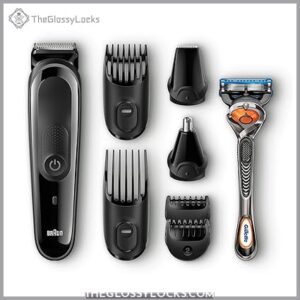
The MGK3060 gives you 13 precision length settings from 0.5mm to 21mm, so you can dial in any fade with real accuracy. Four combs handle the transitions, and the stainless steel, ceramic-coated blade cuts cleanly without pulling.
You get 60 minutes of cordless runtime per charge, enough to cover a full grooming session. The design is fully washable, so cleanup under the tap takes seconds. It also includes a detail trimmer and a nose/ear trimmer for finishing work.
Since USB charging and dual-voltage chargers keep this trimmer ready anywhere, our guide to the best hair clippers for travel shows what to pack for your next trip.
Worth noting: some users have reported battery degradation around the 60-day mark. If you use it daily, factor that in when considering long-term value.
| Best For | Home groomers who want salon-level precision for hair and beard trimming without the recurring cost of a barber. |
|---|---|
| Water Resistance | Fully Washable |
| Power Source | Lithium-Ion Battery |
| Battery Runtime | 60 Minutes |
| Primary Material | Stainless Steel/Ceramic |
| Durability Notes | Battery degrades ~60 days |
| Portability | Auto-Voltage (100–240V) |
| Additional Features |
|
- 13 length settings across four combs give you fine control over fades and beard lengths, from 0.5mm to 21mm
- Fully washable and includes both a detail trimmer and nose/ear trimmer, making it a genuine all-in-one kit
- Auto-adjusting voltage (100V–240V) means it works anywhere in the world without an adapter
- Battery life has been reported to degrade noticeably around the 60-day mark, which is a real concern for daily users
- The motor can bog down on thick beard hair, often requiring multiple passes to get an even cut
- Several users have reported full unit failure within two months, raising questions about long-term durability
2. Gillette Styler All Purpose Grooming Kit
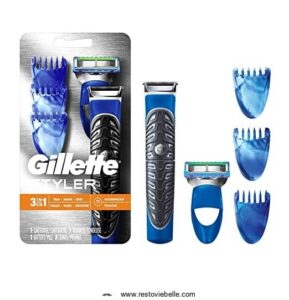
The Gillette Styler takes a different approach than the Braun. Where the MGK3060 gives you a wide range of precision settings, the Styler keeps things focused: three comb attachments at 2mm, 4mm, and 6mm cover the fade transitions most barbers reach for regularly.
It runs on a single AA battery and lasts roughly one to one-and-a-half months on a standard grooming schedule. Waterproof construction means you can trim in the shower and rinse guards under the tap between passes.
The standout feature is razor compatibility. It accepts all Gillette 5-blade refills (GilletteLabs excluded), so you can move from trimming to a clean shave without picking up a second tool.
| Best For | Guys who want a single tool that handles trimming, edging, and shaving without a cluttered bathroom counter. |
|---|---|
| Water Resistance | Fully Waterproof |
| Power Source | Single AA Battery |
| Battery Runtime | 1–1.5 Months |
| Primary Material | Plastic Combs |
| Durability Notes | Combs prone to snapping |
| Portability | Battery-Powered |
| Additional Features |
|
- Fully waterproof, so you can trim in the shower and rinse the guards without a second thought
- Accepts all Gillette 5-blade refills, letting you switch from trimming to a clean shave with the same handle
- Three comb lengths (2mm, 4mm, 6mm) cover the most common fade transitions without overcomplicating the setup
- Plastic comb attachments can snap with regular heavy use
- Hair tends to build up in internal compartments, making thorough cleaning a hassle
- Blade performance fades over time, so you’ll need to budget for refill replacements
3. Hard Case for Multigroom Trimmer Kit
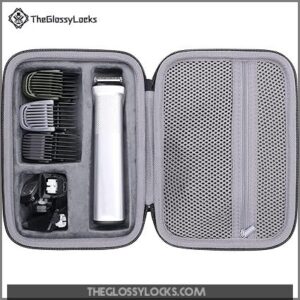
The Gillette Styler travels light, but your full multigroom kit needs more than a pocket. The co2CREA hard case gives your trimmer setup a proper home.
The shockproof EVA shell is water-resistant and dustproof, so drops and spills don’t reach your blades. Inside, a soft anti-static lining prevents scratches on metal surfaces and keeps your guards from rattling loose. At 9 x 7 x 3 inches and just over nine ounces, it’s compact enough for a gym bag or carry-on without taking up too much space.
Compatible with MG3750/60, MG5750/49, and MG7750/49 models, it holds your trimmer, charger, and all attachments in one place. The hand strap and strong zipper keep everything secure and organized between sessions.
| Best For | Anyone who travels or goes to the gym with a full multigroom kit and wants to keep their trimmer, charger, and attachments protected and organized in one place. |
|---|---|
| Water Resistance | Water-Resistant Shell |
| Power Source | N/A |
| Battery Runtime | N/A |
| Primary Material | EVA Shell |
| Durability Notes | Shockproof construction |
| Portability | Carry-On Compatible |
| Additional Features |
|
- Shockproof, water-resistant, and dustproof shell guards against drops and everyday wear
- Anti-static lining protects blades and metal surfaces from scratches
- Compact at 9 x 7 x 3 inches and under ten ounces, so it fits easily in a bag or carry-on
- Case only — trimmer and accessories are sold separately
- May feel oversized if you only carry the trimmer without attachments
- No dedicated padding compartments beyond the anti-static lining
4. Bevel Cordless Beard and Mustache Trimmer
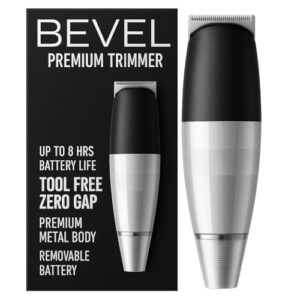
Once your kit’s protected, the trimmer inside matters most. The Bevel Cordless gives you tool-free zero-gap adjustment, so you can dial in blade distance without stopping mid-fade. That level of control is what separates clean lines from rough, uneven blending.
At 1.54 pounds, it feels substantial in hand, and the ergonomic grip holds steady through slow, overlapping passes. It runs fully cordless and offers an interchangeable T-blade, sold separately, which opens up head shaping and tighter face work.
Battery life draws mixed feedback from users, so charge it fully before each session. For clean lineups and well-defined edges right at home, it’s a capable tool that delivers consistent results.
| Best For | Home groomers who want salon-level precision for lineups, fades, and beard shaping without a trip to the barbershop. |
|---|---|
| Water Resistance | N/A |
| Power Source | Lithium-Ion Battery |
| Battery Runtime | N/A |
| Primary Material | N/A |
| Durability Notes | Breakage within 6 months |
| Portability | Fully Cordless |
| Additional Features |
|
- Tool-free zero-gap adjustment lets you fine-tune blade distance on the fly for cleaner, more controlled cuts
- Fully cordless with an ergonomic grip that stays comfortable through longer grooming sessions
- Compatible with an interchangeable T-blade that expands its range to head shaping and detailed face work
- Battery life is inconsistent — some users report it doesn’t hold a charge reliably, so plan to charge before each use
- Durability is a concern, with reports of units breaking within six months of regular use
- The T-blade isn’t included and must be purchased separately, adding to the overall cost
5. Kent Fine and Wide Tooth Comb
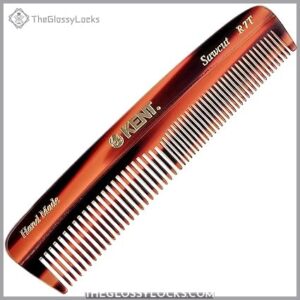
The trimmer does the cutting, but a quality comb controls exactly where that cut lands. The Kent Fine and Wide Tooth Comb gives you both in a compact 5.1-inch design, so you’re not swapping tools mid-fade. Its saw-cut, hand-polished teeth are cellulose acetate, meaning they glide through your beard without snagging or building up static.
Use the wide side to detangle thicker growth before you trim. Switch to the fine side for precise line work along your cheeks and jawline, where control matters most. The material also resists heat, so it holds up better than standard plastic combs over time.
After each session, rinse with mild shampoo and air dry fully to prevent odor buildup.
| Best For | Barbers, groomers, and anyone who wants precise control for beard shaping, fades, and everyday styling with a tool that fits in a pocket. |
|---|---|
| Water Resistance | Rinseable |
| Power Source | N/A |
| Battery Runtime | N/A |
| Primary Material | Cellulose Acetate |
| Durability Notes | Outlasts standard plastic |
| Portability | Pocket-Sized (5.1 in) |
| Additional Features |
|
- Saw-cut, hand-polished teeth glide smoothly through hair without snagging, pulling, or creating static
- Dual-sided design handles both detangling and fine line work without switching tools
- Compact size fits easily in a bag, car, or bathroom drawer for grooming on the go
- Too small to comb long hair effectively, making it a poor fit for lengthier styles
- The limited combing surface can slow down grooming for thicker or fuller hair types
- Some buyers find the price hard to justify given its small size and basic function
6. ZilberHaar Stiff Boar Bristle Brush
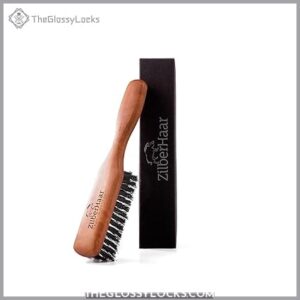
Brushing is the step that keeps your fade looking sharp between trims. The ZilberHaar uses 100% stiff boar bristles with uneven tufting that reaches down through coarse facial hair to exfoliate the skin underneath. It distributes natural oils evenly and pulls out trapped debris, which cuts down on beardruff.
Use it on dry hair for best results. The oiled pearwood handle gives you a firm grip and holds up well with daily use. Note that the bristles can feel aggressive on shorter beards, so ease up on pressure if you’re working close to the skin.
Rinse with warm water after each session and air-dry flat.
| Best For | Anyone with a medium to long beard who wants to keep their skin healthy and their beard well-groomed between trims. |
|---|---|
| Water Resistance | Rinseable |
| Power Source | N/A |
| Battery Runtime | N/A |
| Primary Material | Boar Bristles/Pearwood |
| Durability Notes | Built for daily use |
| Portability | N/A |
| Additional Features |
|
- 100% stiff boar bristles with uneven tufting reach through thick, coarse hair to exfoliate skin and clear out debris
- Distributes natural oils evenly along the beard, helping reduce beardruff
- The oiled pearwood handle is comfortable to grip and built to last with daily use
- The small size may not cover enough ground for very large, full beards
- Stiff bristles can feel harsh on shorter beards or sensitive skin
- Natural bristles may produce a temporary odor when the brush is new
7. Andis Slimline Pro Cordless Beard Trimmer
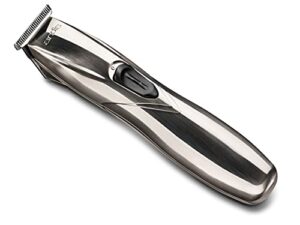
Detail work separates a clean beard fade from a messy one, and the Andis Slimline Pro is built exactly for that. Its self-sharpening stainless steel blades run at 6,000 to 6,500 RPM, giving you the speed and precision to outline and fade without pulling or overheating.
At 4.8 ounces, it’s light enough to hold steady through extended sessions. The two-hour battery runtime controls multiple passes, and a quick charge gets you 20 to 30 minutes if you’re short on time.
Three guide combs (1.5 mm, 3 mm, and 6 mm) cover most fade work. Priced around $55 to $65, it’s a practical choice for barbers who want consistent results.
| Best For | Barbers and grooming professionals who need precise detailing, outlining, and fade work on beards, necklines, and mustaches. |
|---|---|
| Water Resistance | N/A |
| Power Source | Lithium-Ion Battery |
| Battery Runtime | 2 Hours |
| Primary Material | N/A |
| Durability Notes | Breakage within 3 months |
| Portability | Worldwide Voltage (110/220V) |
| Additional Features |
|
- Self-sharpening stainless steel blades run at 6,000–6,500 RPM for fast, precise cuts without pulling or overheating
- Two-hour cordless runtime with worldwide voltage compatibility makes it reliable in the salon and easy to travel with
- Zero-gap blade adjustment and included guide combs (1.5 mm, 3 mm, 6 mm) give you flexibility for everything from tight outlines to longer fade work
- Battery performance can degrade over time, with some users reporting charging and runtime issues after regular use
- Durability is a concern, as some units have broken within three months of purchase
- The on/off switch is a reported weak point and may fail under the demands of daily professional use
Gillette Fusion5 ProGlide Men’s Razor
Most men get 5-7 shaves per cartridge before sharpness drops noticeably**. For precise beard fade edges, that window is tight.
The Fusion5 ProGlide’s five-blade cartridge reaches close to the skin without drag, and the flex hinges follow your jaw and neckline contours carefully. When the lubrication strip fades, replace the cartridge.
A dull razor ruins your beard blending work fast. For clean, defined lines, a precision razor for beard edging gives you the control a worn cartridge simply can’t.
Frequently Asked Questions (FAQs)
What is the 4 week beard rule?
It’s a commitment rule: don’t shave during the awkward growth phase, usually weeks two through four, when your beard looks patchy and feels itchy. Most men quit too early and miss their beard’s full potential.
What fade goes best with a beard?
The fuller the beard, the lower the fade. Low and mid taper fades go naturally into fuller beard mass, keeping your silhouette smooth. High fades suit short or patchy beards, where less length needs blending.
Are you supposed to fade your beard?
No, it’s optional. A beard fade helps with cheek and jaw cleanup or reducing bulk, but if your density is even and you prefer uniform length, skip it.
What tools do I need to fade my beard?
Think of fading as sculpting in layers. You’ll need a trimmer with clipper guards to build each length step, a detail razor to sharpen clean boundary lines, and a beard brush to expose unblended transitions.
How often should I trim my faded beard?
Regular beard trimming every one to two weeks keeps your fade looking sharp. Short, tight fades need weekly touch-ups.
For a truly polished result, mastering the art of blending sideburns seamlessly into your beard makes each trim look intentional rather than rushed.
Check the neckline closely around day ten to fourteen; that’s where the gradient breaks down first.
Does fading a beard make it look thinner?
Picture two beards side by side: one faded high near the cheeks, one faded low near the neck. A high beard fade thins visible coverage noticeably. A lower fade keeps your beard looking completely full.
Is a beard fade better than a regular beard trim?
It depends on what you want. A beard fade gives you defined facial sculpting and a sharper, more polished look that holds longer between sessions. For simple beard maintenance, a basic trim works just fine.
Can I fade my beard with scissors?
Like painting with a roller instead of an airbrush, shears can handle the broad strokes of beard shaping but can’t deliver the smooth, graduated length control a proper beard fade demands. Use trimmer guards instead.
Are beard fades harder to do than other beard styles?
Beard fades are harder than most beard styles. You’re coordinating multiple guard lengths, blending across curved surfaces, and matching both sides for symmetry. The cheek and jawline areas leave very little room for trimmer error.
How often should I trim my beard fade?
Trim your beard fade every one to two weeks. Coarser or faster-growing facial hair usually needs weekly touch-ups. When you spot a distinct step where the shift used to be, it’s time to re-blend it.
Conclusion
Studies show 67% of men feel more confident after improving their grooming routine. That confidence starts with the details, and few details matter more than a clean shift.
Learning how to do a beard fade takes patience the first few times. But once your hands know the guard sequence and your eye catches the transitions, it clicks. Keep your tools sharp, your lines consistent, and your technique tighter with every trim.