This site is supported by our readers. We may earn a commission, at no cost to you, if you purchase through links. This content is for general informational and educational purposes only and is not a substitute for professional medical, dermatological, or nutritional advice.

Fresh regrowth at the roots against faded lengths creates that harsh two-tone line most people dread. Learning how to dye roots darker than the rest of hair lets you erase that line at home, and it hinges on one skill above all: stopping the dye exactly where your old color begins. Overlap even half an inch and your mid-lengths turn muddy.
Section correctly, control your processing time, and feather the mix, and you’ll get a smooth shift that looks salon-done. The steps below walk you through preparation, application, blending, and the maintenance habits that keep those roots rich for weeks.
Table Of Contents
- Key Takeaways
- How to Prepare and Choose Dye for Darker Roots
- How Do You Dye Roots Darker Than The Rest of Your Hair?
- How to Blend Dark Roots With Blonde or Bleached Hair
- How Can You Fix Light, Dark, or Uneven Roots?
- How to Maintain Darker Roots and Extend Color
- Frequently Asked Questions (FAQs)
- How to dye hair if roots are darker?
- Are your roots darker than the rest of your hair?
- How do you fix roots lighter than rest of hair?
- How can I darken my roots at home?
- How to dye a dark hair color?
- Can I dye my roots a darker color?
- How to dye a hairline?
- Why do people want to darken their roots?
- Should I do a root touch up if my hair is darker?
- How do I dye my hair?
- Conclusion
Key Takeaways
- Precision is the core skill: apply dye only to the regrowth and stop exactly at the old-color boundary, since even half an inch of overlap turns mid-lengths muddy.
- Prep determines the result: patch-test 48 hours ahead, protect your hairline with petroleum jelly, choose a permanent shade one to two levels darker than your target, and stick with 20-volume developer.
- Section hair into four quadrants (working bottom first), start your timer when the first section is saturated, and check color at the halfway mark because porous bleached roots grab pigment faster.
- Treat the root-to-blonde transition as a feathered bridge rather than a hard line—thin the application past the root line, shorten processing in the mix zone, and maintain the color afterward with sulfate-free washes, UV protection, and a gloss every four to six weeks.
How to Prepare and Choose Dye for Darker Roots

Getting the preparation right is what separates a clean, lasting result from one that fades or damages your scalp. Before you touch a brush, you need to make three decisions that shape everything else. Here’s what to lock in before application begins.
A solid pre-shave routine for head shaving covers everything from cleansing to choosing the right products, so nothing gets overlooked. If you’re unsure where to start, a step-by-step hair care routine guide can help you pick products that keep your scalp healthy before the razor ever touches it.
Patch-Test and Protect Skin
Start with a patch test behind your ear or inner elbow, then wait the full 48 hours. Redness, itching, or swelling means you stop. Hairline protection prevents staining and unwanted chemical exposure.
- Apply petroleum jelly along your hairline and ears.
- Wear gloves throughout.
- Drape a protective cape over your shoulders.
- Never dye over broken skin; scalp irritation avoidance is non-negotiable.
Choose Permanent or Temporary Color
Once your skin’s protected, decide between permanent or temporary color. Permanent dye penetrates the cortex using an oxidative developer, lasting 4-6 weeks before visible regrowth appears.
Temporary root dye coats the hair shaft without peroxide and washes out in just 1-2 shampoos. If you want commitment and depth, go permanent. For low-risk testing, temporary gives you control without long-term consequences.
Match Shade, Tone, and Developer
Once you’ve chosen permanent, pick the right shade by going one to two shades darker than your target hair level. Hair dye shade selection hinges on tone: neutral (N) formulas prevent unwanted shift, while ash pulls cool and warm pulls brassy at the root.
For a full walkthrough of shade matching and gray coverage, this guide to the best hair dye for men breaks down which formulas suit warm and cool undertones. It’s also worth protecting your color investment from the start — our guide to hair growth serums for braids covers how to keep your scalp and roots healthy underneath dyed hair.
For developer volume selection, use 20 vol. Mismatching the developer changes your hair dye application entirely.
How Do You Dye Roots Darker Than The Rest of Your Hair?
You’ve prepped your hair and picked the right shade, so now it’s time for the application itself. This is where precision matters most, because darker roots only look intentional when the dye goes exactly where you want it. Follow these four steps in order, and you’ll get clean, controlled coverage every time.
Section Hair Into Quadrants

Picture a clean map drawn across your scalp, four crisp territories meeting at the crown. That’s what sectioning hair gives you before you apply the dye.
Use your hair parting technique to part your hair left to right, then front to back, and clip each quadrant. Why bother?
- No dye bleed across your part lines
- Even saturation in every quadrant
- Consistent root height from nape to crown
- Protected upper sections while you work below
- Confidence that your final color matches everywhere
Work the bottom quadrants first so loose strands can’t drop dye onto untouched roots. Keep subsections thin and boundaries clean, and you’ll merge dark roots with blond hair seamlessly later.
Apply Dye Without Overlapping
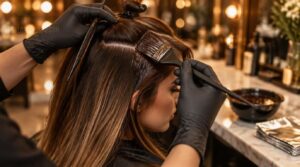
Before you apply the dye, part your hair into fine slices so the regrowth edge stays visible. Apply dye to the roots irregularly, stopping at the old-color boundary. Load your brush moderately, coat both sides, then reposition. For a smooth shift, follow this map:
| Slice | Boundary | Risk |
|---|---|---|
| 1 | Regrowth | None |
| 2 | Regrowth | Low |
| 3 | Feather | Some |
| 4 | Avoid | High |
| 5 | Gloss |
Control Processing Time

Processing time is your control dial. Start your timer when the first section is fully saturated, not when you finish applying. Roots on bleached hair grab pigment faster, so check color at the halfway mark.
Watch for these cues:
- Bronze shimmer forming at the root line
- Dye shifting from gray to deep brown
- Edges darkening before the center
- Scalp tingling under heat protection
- Strands feeling tacky, signaling pigment retention
Extend or shorten each section’s window to match your target depth, and keep developer volume consistent so color blending stays smooth.
Rinse and Condition Gently

Imagine pigment sealed under a glass pane, one careless rinse away from cracking. That’s your hair right now.
Rinse with cool water rinse technique, low pressure, until the runoff runs clear. Skip shampoo entirely; it strips freshly deposited pigment before it stabilizes.
Work a colorsafe conditioner through mid-lengths and ends only, avoiding your new roots. Wait the full directed time, then blot gently. Aggressive towel rubbing lifts cuticles and sabotages pigment retention.
How to Blend Dark Roots With Blonde or Bleached Hair

Think of the mix zone as a bridge, not a border. A hard line between dark roots and blonde lengths reads as a mistake; a gradual shift reads as dimension.
Treat the mix zone as a bridge, not a border—a gradual shift reads as dimension, while a hard line reads as a mistake
Your root touchup succeeds or fails at that bridge. To mix dark roots with blond hair, follow this sequence:
- Start every section at the same point where light hair begins, so you avoid uneven bands.
- Use your hair dye brush to feather dye slightly past the root line, thinning the application as you go.
- Shorten processing time in the mix zone; keep it on the dark roots only.
- Choose a neutral-cool dark shade slightly lighter than your target, since porous blonde grabs pigment fast.
This color blending technique delivers a smooth mix you control.
How Can You Fix Light, Dark, or Uneven Roots?

Uneven roots aren’t a failure, they’re a diagnosis. Read the problem before you mix anything.
- Too light at the scalp? Your regrowth is under-lifted or porous, so it grabbed less pigment. Re-dye only that zone.
- Too dark? You overlapped previously colored hair. Stop reprocessing; a clarifying wash softens it slightly over days.
- Patchy spots? Missed saturation. Target them with a dye applicator brush, not a full re-soak.
- Visible banding? Feather the border with a root touchup, blending a half-inch past the line.
- Crown darker than sides? Heat sits there. Check it at the 20-minute mark next time.
Match your hair dye kit to the shade family already on your lengths, apply to the fault zone only, and process in 10-minute increments. You’ll get a smooth, even result without punishing the rest of your hair. Follow with conditioner meant for color-treated hair to lock the correction in place.
How to Maintain Darker Roots and Extend Color

Your color’s fate is decided after you leave the chair, not during it. You control the fade.
Follow this five-step routine:
- Wash only two to three times weekly with sulfate-free shampoo in cool water.
- Apply a leave-in conditioner to create a barrier against pigment-stripping surfactants.
- Use UV-filtered products before sun exposure; UV rays oxidize dye molecules and dull darker tones.
- Install a shower filter if you have hard water, because mineral buildup scatters light and makes color look uneven.
- Book a gloss or root smudging touch-up every four to six weeks.
This is color fade reduction in practice: consistent washing habits and smart salon visit extension keep your root-to-length contrast stable. Master the maintenance, and your hair color maintenance schedule stretches weeks longer.
Frequently Asked Questions (FAQs)
How to dye hair if roots are darker?
If your roots are naturally darker, pick a shade matching that root level and apply it to your mid-lengths and ends only. Skip the root area, avoid overlap, and use color-safe conditioner after rinsing.
Are your roots darker than the rest of your hair?
Like a shadow creeping across your lengths, darker roots appear when regrowth shows your natural base or dye deposits extra pigment there. Check your part line in daylight, and compare tone against your ends.
How do you fix roots lighter than rest of hair?
Too-light roots mean under-depositing, so reapply permanent dye with the right undertone and extend your hair dye processing time. Section carefully, saturate fully, and avoid overlap for a smooth finish.
How can I darken my roots at home?
Want salon-level roots without the salon price? Patch-test first, then choose a permanent shade up to two shades darker. Section hair, apply dye to the roots irregularly for a smooth shift, and process exactly per directions.
How to dye a dark hair color?
Dark hair dye is a commitment, not a fling. Patch-test first, choose permanent dye for lasting depth, apply evenly, process fully, rinse cool, and maintain with conditioner meant for color-treated hair.
Can I dye my roots a darker color?
Picture an anchor grounding a ship: darker roots give blonde lengths depth. Yes, you can dye them one to two shades darker using permanent dye, roots only, processing 20–45 minutes.
How to dye a hairline?
Nothing matters more than your hairline. Apply dye there last, use 10-volume developer, and cap processing at 5–10 minutes. Prevent hairline staining with barrier cream, then smooth edges using a root touchup pen for a natural look.
Why do people want to darken their roots?
People darken their roots for three main reasons: to conceal regrowth, create a smooth mix with blonde lengths, and stretch time between appointments. This smooth shift reduces damage and delivers a polished, **low-maintenance look’.
Should I do a root touch up if my hair is darker?
Want that regrowth line gone? If your roots already match your darker lengths, skip it. But when regrowth looks lighter, a root touchup restores your smooth mix, prevents hair dye fading, and cuts damage.
How do I dye my hair?
Nothing changes your look faster than color. Patch-test first, choose a permanent shade one to two levels deeper, apply the dye to roots in quadrants, process 40 minutes, then wash the dye off with water and use the conditioner included.
Conclusion
Think of a client who touched up her roots every three weeks and still saw a line by week two. Her problem wasn’t the dye, it was overlap.
Mastering how to dye roots darker than the rest of hair comes down to precision: clean sections, careful timing, and a feathered edge.
Check your color in natural light, refresh with a gloss when needed, and your roots will stay rich, dark, and blended for weeks.