This site is supported by our readers. We may earn a commission, at no cost to you, if you purchase through links. This content is for general informational and educational purposes only and is not a substitute for professional medical, dermatological, or nutritional advice.
Most people pick their hair dye the same way they pick a paint color—by holding it up and hoping for the best. But permanent and semi-permanent formulas work in completely different ways inside your hair, and that chemistry gap changes everything: how long the color lasts, how much it damages your strands, and whether it can cover gray at all.
Permanent dye opens the hair shaft and chemically bonds color deep inside the cortex, while semi-permanent sits on the outside like a temporary stain.
Knowing the difference between permanent and semi-permanent hair dye, explained through actual science—not just box labels—puts you in control of every coloring decision.
Table Of Contents
- Key Takeaways
- Permanent Hair Dye Explained
- Semi-Permanent Hair Dye Explained
- Permanent Vs Semi-Permanent Differences
- Hair Health and Color Maintenance
- Choosing The Right Hair Dye
- Frequently Asked Questions (FAQs)
- What is Demi-Permanent Hair Color?
- What is Temporary Hair Color?
- What is Permanent Hair Color?
- What’s the point of semi-permanent hair dye?
- How long does permanent hair color last?
- Is semi-permanent hair color damaging to hair?
- How do I know which type of hair color is best for me?
- Can permanent dye be removed without damage?
- Does semi-permanent dye work on dark hair?
- Are there natural alternatives to hair dyes?
- Conclusion
Key Takeaways
- Permanent dye chemically bonds color deep inside your hair’s cortex using ammonia and peroxide, making it the only real option for full gray coverage and lasting color that lasts six to eight weeks.
- Semi-permanent dye sits on the outside of the hair shaft without any developer or ammonia, so it fades gradually with washing and causes less than 5% moisture loss compared to permanent’s 20%.
- Your ability to go lighter is exclusive to permanent dye — semi-permanent can only add tone or darken, and even then it barely shows on dark hair without pre-lightening first.
- Matching the dye type to your hair’s condition and goals is the real decision-maker: reach for semi-permanent when your hair is damaged or you want low commitment, and go permanent when you need reliable gray coverage or a bold, lasting color change.
Permanent Hair Dye Explained
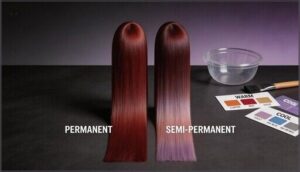
Permanent hair dye does more than just change your color — it actually changes your hair’s structure from the inside out. Understanding how it works helps you make smarter decisions before you commit to a color.
If you’re not sure which shade to commit to, taking a hair colour quiz to find your perfect match before reaching for the permanent dye is a smart first move.
Here’s what you need to know.
What Makes Permanent Dye Permanent
What makes permanent hair colour truly permanent comes down to chemistry. Through oxidative polymerization, tiny dye molecules react with a developer — usually hydrogen peroxide — and alkaline activation from ammonia to form larger, stabilized pigments.
These undergo cortex embedding, locking deep into your hair’s core.
Their molecular size means water simply can’t wash them out. That’s real color hold.
How It Penetrates The Hair Shaft
Think of your hair cuticle like roof shingles. Permanent hair colour slightly lifts those shingles — that’s the Cuticle Lift Mechanics at work — creating just enough space for tiny dye molecules to slip through.
- Lifted cuticle opens the Cortex Diffusion Pathway
- Molecule Size Reduction lets pigment travel inward
- Temperature Assisted Uptake speeds absorption
- Porosity Based Absorption controls depth and evenness
Role of Ammonia and Peroxide
Once those cuticle shingles lift, ammonia and peroxide get to work — and they’re a powerful team.
Ammonia manages pH Regulation, pushing the hair’s environment to around 10 so the Oxidation Mechanism can kick in. Meanwhile, hydrogen peroxide drives Pigment Lift, breaking down your natural melanin while triggering Color Bonding deep inside the cortex through Cuticle Swelling.
| Ingredient | Role in Permanent Hair Colour |
|---|---|
| Ammonia | Opens cuticle, regulates pH |
| Hydrogen Peroxide | Oxidizes melanin, deposits color |
| Developer Volume | Controls lift intensity |
| Oxidative Dye Precursors | Form permanent color molecules |
Why It Offers Strong Gray Coverage
Gray hair has a Resistant Gray Texture — the cuticle sits tighter and repels color more stubbornly. That’s exactly where permanent hair colour earns its reputation.
Its High Pigment Load pushes dense color molecules deep into each strand, while the Even Deposit Technique ensures nothing looks patchy.
Pair that with smart Neutral Shade Balance and solid Root Match Control, and grey coverage actually holds.
Permanent dye offers full gray coverage, ensuring even color on stubborn strands.
When Permanent Color Works Best
Permanent hair colour is your best friend when you want results that actually stick. grey coverage, a bold shade change, or low-fade performance is the goal, this is it. It suits ammonia tolerant scalp and healthy strands ready for professional color commitment.
Think of it as hair colour longevity and fading on your terms — vibrant longevity that holds for six to eight weeks. Professional salons often use pigment shield technology for extended wash resistance.
Semi-Permanent Hair Dye Explained
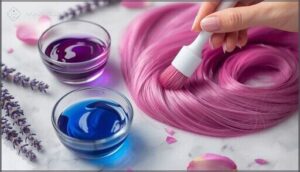
Semi-permanent hair dye works completely differently from permanent color, and once you understand how it actually makes a lot of sense. It’s a gentler option that doesn’t require mixing or chemicals, which is a big deal for a lot of people.
what you need to know about how it works and when it’s the right call.
How Semi-permanent Color Coats The Hair
Semi-permanent hair colour works like a tinted conditioner — it wraps a conditioning film around the outside of each hair shaft rather than sinking in.
That gentle, coat-and-go approach makes it a great starting point if you’re exploring hair dye options matched to your hair type.
The pigment molecule size is actually too large to penetrate deeply, so electrostatic bonding and pH level effects around 6 hold colour depositing molecules against the surface. That’s what gives your hair colour that soft, glossy finish and why hair colour fade happens gradually with each wash.
Why It Does Not Need Developer
Unlike permanent hair colour, which needs a low-volume developer to trigger an oxidation reaction, semi-permanent hair colour comes ready to go — no mixing, no measuring.
Here’s why it works without one:
- Preformed pigments are already fully developed before you open the bottle.
- No oxidation needed means no chemical reaction has to happen inside your hair.
- Low pH formulation (around 6–7) keeps the cuticle mostly closed.
- Ammonia-free chemistry means no strong alkalinity forcing the cuticle open.
- Single-step application removes developer dependency entirely.
That gentle alkalinity is actually one of the biggest differences between permanent and semi-permanent hair colour.
How It Fades After Washing
Think of semi-permanent colour as a stain sitting on top of your hair — not locked in. Every wash loosens those pigment molecules a little more.
Sulfate shampoo impact is real: harsh cleansers strip colour fast. Water temperature influence matters too — hot water lifts the cuticle and lets colour escape.
Hair porosity role, UV exposure fade, and skipping a conditioner seal effect all quietly shorten your colour’s life.
Why It Adds Tone and Shine
Here’s something most people don’t realize: semi-permanent color doesn’t just change your tone — it actually makes your hair look healthier. Here’s why:
- Acidic cuticle tightening seals the hair cuticle flat.
- Cationic shine boost bonds conditioning ingredients to keratin.
- Light reflectance boost creates that glossy finish chemistry you notice instantly.
- Low-lift pigment deposit adds color-depositing richness without damage.
Smoother cuticle, more mirror-like shine. Simple as that.
When Semi-permanent Color Works Best
It really shines in the right situations. Here’s a quick guide to help you decide:
| Hair Goal | Best Fit | Why It Works |
|---|---|---|
| Dark Base Boost | Deep reds, blues, purples | Adds richness without bleach |
| Bold Fashion Shades | Porous Hair Absorption | Vivid results on pre-lightened hair |
| Gentle Hair Treatment | Damaged or fragile hair | No ammonia, no structural change |
| Short-Term Trends | Temporary hair colour | Fades in 4–12 washes |
| Grey Hair Blending | Demi-permanent hair colour | Softer coverage than permanent |
Semi-permanent hair colour is your go-to when flexibility matters more than hair colour longevity and fading resistance.
Permanent Vs Semi-Permanent Differences
Once you line them up side by side, the real differences between permanent and semi-permanent dye become pretty clear. Each one behaves differently from the moment it touches your hair to the day it fades out.
Here’s what actually sets them apart.
Cuticle Penetration Vs Surface Staining

Here’s really happening beneath the surface. Permanent hair colour uses ammonia to raise your hair’s pH to around 9–10, pushing tiny oxidative molecules deep into the hair shaft. Once inside, those molecules react and lock in. Semi-permanent hair colour works differently — it relies on larger molecules that simply sit on the cuticle, like a stain rather than a structural change.
| Feature | Permanent | Semi-Permanent |
|---|---|---|
| Molecule Size | Small, penetrating | Large, surface-level |
| pH Balance | 9–10 (alkaline) | 6–7 (near-natural) |
| Bonding Chemistry | Internal cortex bonds | Weak surface attachment |
| Color Depth vs Shine | Rich, multi-dimensional color depth | High-gloss shine, less longevity |
That bonding chemistry explains everything — color depositing inside the shaft stays put, while hair colour stains on the outside and washes away gradually.
Longevity and Fading Speed
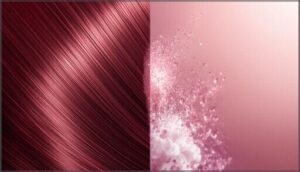
How long your color actually lasts comes down to chemistry and habits. Permanent dye bonds inside the cortex and holds for 6–8 weeks, while semi-permanent fades within 6–12 washes — hair colour longevity and fading work very differently between the two.
| Factor | Permanent | Semi-Permanent |
|---|---|---|
| UV Protection needed | Moderate | High |
| Sulfate-Free Shampoos | Extends 4+ weeks | Essential every wash |
| Heat Styling Impact | Gradual fade | Accelerates quickly |
Porosity effects and peroxide concentration play a big role too — porous or bleached hair releases color quickly regardless of type.
Gray Coverage Results

gray strand resistance is real — gray hair is coarser and fights color harder. Permanent hair colour wins here, offering up to 100% grey hair coverage with strong shade matching accuracy. Semi-permanent hair colour softens grays rather than hiding them, with blend softness level being its strength.
| Coverage Factor | Permanent | Semi-Permanent |
|---|---|---|
| Coverage Uniformity | High | Moderate |
| Fade Predictability | Consistent | Variable |
Grey hair masking works best when you match the right tool to your gray percentage.
Lightening Vs Darkening Ability

Coverage tells half the story. The other half is whether your hair colour change goes lighter or darker — and that’s where permanent and semi-permanent part ways completely.
Permanent hair colour uses oxidative lift to break down your natural melanin. The hydrogen peroxide, combined with the right developer volume, creates real lightening. Semi-permanent hair colour? It can only darken or tone — no chemical bleaching happens at all.
| Factor | Permanent Hair Colour | Semi-Permanent Hair Colour |
|---|---|---|
| Oxidative Lift | Yes | No |
| Molecule Size | Small (penetrates deep) | Large (surface only) |
| Developer Volume | 10–40 volume | None required |
| Base Shade Interaction | Changes underlying tone | Depends on existing shade |
| Fade Pattern | Gradual, structured | Washes out evenly |
Your base shade interaction matters more than most people realize — semi-permanent dye on dark hair barely shows up unless you’ve pre-lightened first.
Root Regrowth and Visible Lines
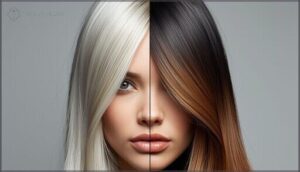
Permanent color draws a hard line as your roots grow — that sharp demarcation is tough to ignore, especially with high-contrast hair colour change. Semi-permanent fades evenly, so regrowth blends naturally.
| Regrowth Factor | Permanent | Semi-Permanent |
|---|---|---|
| Root Visibility | Sharp line | Soft fade |
| Contrast Visibility | High | Low |
| Spray Touch-up Need | Every 4–6 weeks | Rarely needed |
Parting Strategies like zigzag parts and Root Blending Techniques help stretch touchup timing. Growth Cycle Timing matters — roots grow faster when contrast is strongest.
Processing Time and Application Steps
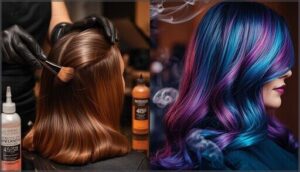
Time is where these two really split apart. Permanent dye needs 30–45 minutes with a mixed developer — get your Developer Ratio wrong, and results suffer. Semi-permanent skips that entirely, processing in 20–40 minutes, sometimes faster with Heat Activation.
| Step | Permanent | Semi-Permanent |
|---|---|---|
| Developer Needed | Yes (Low-volume developer) | No |
| Processing Timer | 30–45 min | 20–40 min |
| Sectioning Technique | Four quadrants | Flexible |
Always wear gloves — Glove Safety isn’t optional.
Hair Health and Color Maintenance

Getting the color right is only half the battle — keeping your hair healthy afterward is where the real work begins. Whether you’re using permanent or semi-permanent dye, both your hair’s condition and how long that color lasts come down to a few key habits.
Here’s what you need to know.
Effects on Dryness and Porosity
Your hair’s moisture levels shift more than you’d think after coloring. Permanent hair colour can reduce hydration by up to 20%, thanks to ammonia opening the cuticle. Semi‑permanent hair colour, being ammonia‑free and mixed with no low‑volume developer, causes less than 5% hydration loss.
Permanent hair colour strips up to 20% of moisture, while ammonia-free semi-permanent causes less than 5% hydration loss
Smart porosity management means:
- Rinse with cool water
- Use humectant-rich masks weekly
- Skip harsh sulfates for moisture retention
Damage Risk With Repeated Coloring
Every 4–6 weeks of permanent hair colour use adds up fast. Ammonia in hair dye and peroxide repeatedly open the cuticle, triggering cumulative breakage, protein loss, and hair elasticity decline.
Chemical fractures — tiny weak spots deeper than split ends — form along the shaft.
Scalp irritation also builds with each session.
Semi-permanent hair colour, with no ammonia or low-volume developer, skips that cycle entirely.
Wash Habits That Affect Fade
How you wash your hair matters more than most people realize. Hot water lifts the cuticle and accelerates color fading fast.
Rinsing with cool or lukewarm water instead helps seal the cuticle and pairs beautifully with the natural scalp remedies using oils like coconut and jojoba that keep your hair hydrated between washes.
Switch to a Cool Rinse and use a Sulfate-Free Shampoo — sulfates are notorious for color stripping. Gentle Rinsing, washing two to three times weekly, and finishing with a Leave-In Sealant and Low-Heat Drying dramatically improve hair colour longevity and shampoo resistance.
Root Touch-ups Vs Full Refreshes
Not every visit needs a full reset. If your lengths still look great, a root touch-up targets just that first inch or two of regrowth — saving you time, money, and unnecessary chemical exposure on already-processed ends.
- Appointment Length: Touch-ups take 45–60 minutes vs. 1–3 hours for a full refresh
- Product Usage: Less product means lower cost and reduced damage risk
- Color Consistency: Full refreshes suit cases where colour fading has affected mid-lengths unevenly
Aftercare Tips for Longer-lasting Color
Once your color is in, keeping it means playing defense. Small habits add up fast.
| Habit | Why It Helps |
|---|---|
| Low-Heat Styling | Prevents dye oxidation and fading |
| Swim Cap Protection | Blocks chlorine from lifting the cuticle |
UV Filter Sprays, a weekly Protein Mask Routine, and a Color-Boosting Conditioner are your best tools for hair colour longevity. Hair colour maintenance tips genuinely make your color last.
Choosing The Right Hair Dye
The right dye really does come down to your hair’s current condition, your goals, and how much upkeep you’re willing to commit to. Everyone’s situation is a little different, and that’s exactly why there’s no single answer that fits all.
Here’s a look at which option usually works best for different needs.
Best Option for First-time Coloring
If you’re new to hair colour, semi-permanent is your best Gentle Starter Choice — no developer, no ammonia, no drama.
This Non-Peroxide Formula works as a Low-Commitment Hue that simply fades wash by wash, so there’s no harsh regrowth line to manage.
Think of it as a Soft Fade Test — a Beginner Friendly Shade to try before committing to permanent hair colour.
Best Option for Covering Gray Hair
Gray density really does change everything.
If you’ve got more than 50 percent gray, permanent hair colour is your most reliable grey hair coverage option — it goes deep into the strand and replaces pigment completely. Semi-permanent hair colour just tones the surface, giving softer, sheer results.
Factor in fade resistance, application skill, lifestyle flexibility, and cost effectiveness, and permanent wins for solid, lasting coverage.
Best Option for Temporary Color Changes
Not every change needs to last forever — and that’s where temporary color earns its place.
If you’re testing event-ready shades before committing, or just want quick washout color for a festival or shoot, temporary is your friend. Spray application, chalk highlights, and direct creams make it easy.
Here’s when it beats semi-permanent hair colour every time:
- You want color gone after one wash
- Light hair compatibility makes vivid results easy without pre-lightening
- You’re testing a shade before choosing permanent hair colour
- You need a fast, no-mix application
- You want zero root regrowth to manage afterward
Best Option for Damaged or Fragile Hair
When your hair is already fragile, choosing the right hair dye type really comes down to one thing — minimizing stress. Semi-permanent hair colour is your safest bet here.
It’s ammonia-free, skips the developer entirely, and won’t force open a weakened cuticle.
If you need just a touch more coverage, demi-permanent hair colour with a low-volume developer is a gentler middle ground.
Always do hair porosity testing first, and follow up with protein conditioning to rebuild strength.
When Demi-permanent May Be a Better Fit
Sometimes the choice isn’t black or white — and that’s exactly where demipermanent hair colour shines. It’s ideal for a soft root change, subtle tone shifts, or an introductory color trial before committing fully.
If you’re handling porous hair compatibility issues or simply want low chemical exposure, demi sits perfectly between the two extremes.
Understanding demipermanent versus semipermanent colour helps you choose the right hair dye type confidently.
Frequently Asked Questions (FAQs)
What is Demi-Permanent Hair Color?
Think of demi-permanent hair colour as the sweet spot between worlds.
It uses a low-volume developer with a mild pH formula — no ammonia — to gently deposit tone, add glossy finish, and deliver real hair softening benefits.
What is Temporary Hair Color?
Temporary color is exactly what it sounds like — no commitment, no chemicals.
It coats the surface and rinses out in one to three washes, making it perfect for event styling or a quick experiment.
What is Permanent Hair Color?
Permanent hair color works by sending oxidative dye chemistry deep into your hair’s cortex, where cortex color bonding locks in the shade — making it genuinely resistant to washing out.
What’s the point of semi-permanent hair dye?
Semi-permanent hair dye is your go-to for low-commitment color — no developer, no damage.
It’s fragile hair friendly, delivers a glossy tone boost, and is perfect for DIY at-home coloring or seasonal shade play.
How long does permanent hair color last?
Like a good coat of paint on a solid wall, permanent color holds strong — usually six to eight weeks before root regrowth or fading nudges you back to the salon.
Is semi-permanent hair color damaging to hair?
Good news — semi-permanent hair colour is genuinely gentle. Without ammonia or peroxide, there’s no cuticle swelling or protein loss.
Most formulas actually deliver conditioning benefits, leaving your hair softer than before.
How do I know which type of hair color is best for me?
Start with your goals. Think about commitment level, skin sensitivity, and lifestyle compatibility.
When in doubt, a professional consultation clears the confusion quickly — a colorist reads your hair better than any label can.
Can permanent dye be removed without damage?
Not entirely — and here’s the honest truth.
Gentle color removers and gradual fading methods can lift artificial pigment, but once permanent dye oxidizes inside the cortex, bond-repair technology and protein repair treatments only minimize damage, never fully undo it.
Does semi-permanent dye work on dark hair?
Semi-permanent hair dye does work on dark hair, but results depend on your hair’s porosity impact and pigment strength.
Without pre-lightening needs addressed first, vivid shades show as a subtle sheen rather than bold color.
Are there natural alternatives to hair dyes?
Yes — henna, indigo, cassia, and coffee rinses are popular plant-based pigments worth exploring. They’re ammonia-free and gentler, but expect subtler results and limited gray coverage compared to conventional dyes.
Conclusion
Choosing the right hair dye is like picking between a tattoo and temporary ink—both transform, but one commits. Understanding the science behind how these formulas interact with your hair’s structure turns guesswork into strategy.
Permanent dye’s chemical bond ensures longevity, while semi-permanent’s surface stain offers playful flexibility. This knowledge lets you weigh damage risks, fading timelines, and gray coverage like a pro.
Ultimately, the difference between permanent and semi-permanent hair dye explained here gives you the power to choose color that aligns with your hair’s health and your lifestyle goals. Walk into your next color adventure with confidence, knowing exactly what’s happening inside those strands.