This site is supported by our readers. We may earn a commission, at no cost to you, if you purchase through links. This content is for general informational and educational purposes only and is not a substitute for professional medical, dermatological, or nutritional advice.

That orange streak along the shelf isn’t just an eyesore—it’s a sign your caddy is already losing the battle against your bathroom. Metal and moisture have never been friends, and a shower is about as hostile an environment as metal can face: constant humidity, soap residue, hard water minerals, and temperature swings, all day, every day.
Most caddies rust not because they’re cheap, but because nobody told you what to do after you hung them up.
A few simple habits and the right materials can keep your shower caddy rust-free for years.
Table Of Contents
Key Takeaways
- Rust starts with moisture, soap scum, and hard water minerals — wipe your caddy dry after every shower and clean it weekly to cut off rust before it takes hold.
- Your caddy’s material is your first line of defense — grade 316 stainless steel, anodized aluminum, or plastic outlast chrome-coated steel by years in a wet bathroom.
- A thin coat of clear enamel spray, silicone spray, or even petroleum jelly on exposed metal edges creates a moisture barrier that keeps rust from starting.
- Catch rust early — a small spot scrubbed away with vinegar and a non-scratch pad takes two minutes, but a deeply pitted caddy can’t be saved and has to be replaced.
Why Shower Caddies Rust
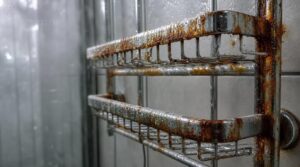
Your shower caddy isn’t working against you — your bathroom environment is.
Sometimes a quick rethink of your whole setup — like the ideas in this guide to minimalist shower caddy alternatives — is all it takes to reclaim your space.
A mix of moisture, mineral buildup, and poor airflow quietly breaks down metal over time.
Here’s what’s actually causing the rust.
Constant Moisture Exposure
Every shower leaves behind more than clean skin — it leaves moisture clinging to your caddy long after you’ve dried off. That’s how rust gets its foothold.
Constant moisture does:
- Creates microclimate formation in hidden crevices
- Triggers daily condensation cycle management problems
- Opens moisture penetration paths under coatings
- Disrupts vapor diffusion control on metal surfaces
- Overwhelms natural humidity buffer zones
Understanding cyclic moisture exposure effects reveals that repeated wet‑dry cycles can accelerate rust buildup at the metal surface.
Dry your shower caddy after every use.
Soap Scum Buildup
Moisture isn’t the only villain here. Soap, shampoo, and conditioner residue build up fast — and soap scum is basically a rust welcome mat.
| Cause | Effect |
|---|---|
| Bar soap residue | Bonds minerals to metal |
| Conditioner film | Traps moisture underneath |
| Skipped pH‑balanced cleaning | Scum hardens into scale |
| No citric‑acid treatment | Mineral deposits accumulate |
| Delayed seal inspection routine | Hidden buildup corrodes joints |
Switch to body wash and clean weekly.
Hard Water Minerals
Soap scum sets the stage, but hard water finishes the job. Calcium scale and magnesium deposits from water above 120 ppm bond to metal surfaces, acting as rust-nucleation sites.
You can measure your hardness with an inexpensive test strip. Water softener installation keeps levels below 60 ppm, cutting corrosion dramatically.
Weekly cleaning with an acidic cleaner choice like diluted vinegar dissolves mineral deposits before they cause real damage.
Damaged Metal Coatings
Hard water leaves deposits, but damaged coatings open the real door to rust. A single scratch triggers Scratch-Induced Corrosion, turning your antirust coating into a liability overnight. Here’s what breaks protective coatings down fast:
- Coating Delamination loosens adhesion, letting moisture sneak underneath
- Microcracking Issues from Thermal Cycling Damage create hidden entry points
- UV Degradation weakens binders, increasing permeability
- Chipped chrome exposes bare steel within weeks
- Abrasive cleaners strip rust-resistant coatings and rust inhibitors completely
Poor Bathroom Airflow
Bad bathroom ventilation is a silent rust accelerator. When your exhaust fan has a low CFM rating or suffers from duct path restriction, humid air lingers long after your shower ends. Skipping vent grille cleaning exacerbates the issue.
Pairing better ventilation with a top-rated shower squeegee cuts lingering moisture faster than a fan alone ever could.
Additionally, pair your exhaust fan with window cross ventilation and check your humidity sensor timing. This combined approach helps manage moisture effectively.
Proper ventilation and consistent humidity management keep metal dry, preventing rust and maintaining a healthy environment.
Keep It Dry After Every Shower

Moisture is the enemy, and your caddy meets it every single day. The good news is that a few quick habits after each shower can stop rust before it even thinks about starting.
Here’s what to do.
Wipe With Microfiber Cloth
A microfiber cloth is your bathroom’s first line of defense. After every shower, grab one folded into quadrants and wipe down all metal surfaces. Use proper dampness—not soaking wet—then follow with a separate dry cloth to finish the job.
Key techniques include:
- Wipe in one direction for moisture control
- Use folded quadrants to avoid spreading grime
- Avoid fabric softener—it kills absorbency
- Practice regular sanitizing for corrosion prevention
Consistent upkeep ensures lasting protection against wear and tear.
Drain Standing Water
Standing water is rust’s best friend. After each shower, empty every shelf and tip out pooled water from hollow tubes or trays.
A good Channel Drain Design under your shower helps, but Floor Slope Optimization does the heavy lifting — water that drains fast can’t linger on metal.
Stay on top of Water Flow Monitoring weekly, and you’ll prevent moisture from ever settling in.
Squeegee Wet Surfaces
A squeegee is one of the fastest tools for moisture control after a shower. Run it across caddy shelves with the right blade angle — keep edge clearance tight so water droplets don’t sneak past.
Flexible sweep strokes work better than rigid ones on curved surfaces.
A dual blade model with a quick blade change system makes drying thoroughly even faster, tackling standing water in seconds.
Avoid Direct Shower Spray
Direct spray is your caddy’s worst enemy. Angle your showerhead to create a natural showerhead arc away from shelves — that one shift does a lot.
A handheld diverter lets you redirect water during rinsing.
Elevated mounting cuts splash contact greatly.
Add a splash guard for extra spray deflection.
Less water hitting the caddy means less rust to fight.
Let Bottles Dry Separately
Wet bottles sitting together on a shelf pass moisture back and forth, straight onto your caddy. Pull them off and dry them separately after every shower.
- Use a ventilated drying rack with individual drying slots
- Keep upright bottle placement so water drains fully
- Allow separate air circulation around each bottle
- Practice cross moisture prevention by spacing bottles apart
- Prevent standing water from pooling on caddy shelves
Choose Rust-Resistant Caddy Materials

The easiest win against rust starts before water ever hits your caddy. Picking the right material means you’re not constantly fighting a losing battle.
Here are the best options to explore.
Stainless Steel Caddies
Grade 316 stainless steel is your best defense against a rusty caddy. It resists chlorides in water and cleaning products far better than basic 304 steel.
Look for solid welded seams, a good load rating for your bottles, and drainage holes in the bracket design. These features ensure durability and functionality.
Finish options like brushed satin hide water spots effectively, maintaining a clean appearance.
Corrosion testing confirms its longevity—this material lasts.
Anodized Aluminum Options
Stainless steel is tough, but anodized aluminum offers a distinct advantage: a rust-resistant coating integrated directly into the metal itself, not merely layered on top.
- Hard coat thickness up to 50 micrometers ensures exceptional durability
- Built-in UV color stability prevents fading over time
- Lightweight design simplifies installation and repositioning
- Microscopic sealing blocks moisture penetration effectively
- Custom color options enhance visual organization on shelves
Plastic Shower Organizers
Plastic shower organizers are completely rust-free — no coatings, no corrosion risk, ever. Made from ABS or polypropylene, they handle humidity without complaint. These materials ensure durability in wet environments, making them a reliable choice for bathrooms.
Mounting options include suction cups, adhesive, or over-door styles, offering flexibility for different spaces. Many feature mold prevention surfaces that wipe clean fast, reducing maintenance effort. Practical design elements like clearly labeled weight limits enhance functionality.
Eco-friendly plastics and aesthetic customization through color choices further appeal to environmentally conscious users. With low-maintenance benefits, plastic organizers simplify bathroom upkeep while remaining stylish and practical.
Avoid Chipped Chrome Steel
Chrome looks sharp at first, but it’s basically a disguise. Once chrome’s thin coating cracks from impact or stress, the steel underneath rusts fast — sometimes within weeks.
Coating thickness matters more than appearance. Apply an anti-corrosion spray for basic metal preservation, keep up a chip inspection routine monthly, and avoid metal-to-metal contact at mounting points.
Stress-free mounting with impact-resistant fasteners prevents the micro-cracks that start everything.
Rust-free Hanging Designs
The way your caddy hangs matters more than you’d think. Vented mount brackets and airflow-optimized racks keep air moving around the metal, drying it roughly 40% faster than enclosed mounts. Pair these with rubber gasket fasteners to block moisture at every joint.
Corrosion-proof hooks and elevated shelf placement further enhance rust prevention, creating a solid protective barrier for metal preservation.
Apply Protective Anti-Rust Coatings
Even the toughest caddy materials benefit from an extra layer of protection. A good coating acts like a shield between the metal and all that daily moisture.
Here are five easy options worth trying.
Clear Enamel Spray

Clear enamel spray is one of the easiest rust prevention tips you can use right now. This rust-resistant coating bonds directly to your metal shower caddy, sealing out moisture before it causes damage.
Begin with surface preparation: clean and dry the caddy completely. Apply using a steady spray technique, holding the can 8–12 inches away. Allow the full curing duration of 24 hours before use, and reapply within the recoat window if needed.
Always maintain safety ventilation during application.
Waterproof Silicone Spray

Silicone spray is one of the most underrated rust prevention tips. As an antirust spray, it bonds to your caddy using Surface Compatibility across metal, plastic, and rubber alike.
Apply a light mist—that’s your Application Technique—let it dry fully, then wipe excess. Film Longevity lasts weeks, so follow a monthly Reapplication Schedule.
Prioritize Safety Precaution by maintaining ventilation during use.
Baby Oil Barrier

Baby oil works as a surprisingly effective rust barrier for your shower caddy. Apply a thin coat — Film Thickness matters here — along all exposed metal edges for solid Material Compatibility with steel, aluminum, and chrome trim.
Application Timing is simple: let it sit 5–10 minutes, then wipe excess. Follow a Reapplication Frequency of every two to four weeks.
Observe basic Safety Precautions — work in a ventilated space and wipe surfaces dry before stepping in.
Petroleum Jelly Film
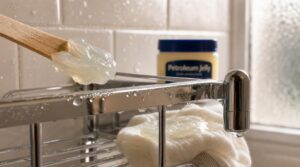
Petroleum jelly is a reliable anticorrosion coating hiding in plain sight. Rub a thin layer — film thickness of 0.1 to 0.3mm works best — along exposed metal edges using a soft cloth as your application technique.
This water repellent barrier prevents rust formation by cutting oxygen contact. Watch for dust accumulation and UV degradation, and reapply monthly.
Clear Nail Polish Touchups
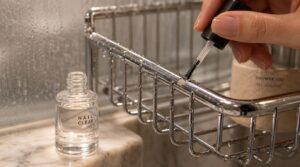
Got a chip on your caddy’s coating? Clear nail polish is your quick fix for concealing chips before rust sneaks in.
- Use brush precision — target only the chipped edge for smooth blending.
- Build thin layers, letting each dry fully before the next.
- Finish with a refreshing coat of polish to seal the protective layer.
This keeps your shower caddy’s protective coating intact.
Clean Rust Before It Spreads

Rust doesn’t wait — once it starts, it moves fast. Catching it early is the difference between a quick fix and tossing out your caddy entirely.
Catch rust early — a small spot ignored today becomes a caddy you replace tomorrow
Here’s what to do before a little spot becomes a real problem.
Weekly Soap Scum Removal
Soap scum doesn’t just look bad — it traps moisture and speeds up rust. A weekly scrub is your best defense. Use a warm solution with a dwell time of 5–10 minutes, employing mild detergent or Baking Soda Paste, then wipe top to bottom with a soft cloth. For stubborn film on glass, using a plastic scraper lifts residue without scratching.
| Cleaner Type | Best For | Dwell Time |
|---|---|---|
| Baking Soda Paste | Stuck-on soap scum | 5–10 min |
| Mild Detergent Spray | Regular cleaning | 5 min |
| Enzymatic Cleaner | Protein-based soap film | 10–15 min |
| Warm Soapy Water | Light soap buildup | 3–5 min |
| Commercial Soap Scum Remover | Heavy deposits | 10 min |
Enzymatic cleaners excel here by breaking down soap residue at the molecular level, making weekly maintenance faster over time.
Vinegar for Mineral Buildup
Mineral deposits are rust’s best friend — they grip onto metal and hold moisture in place. A simple vinegar solution addresses both. Mix equal parts white vinegar and water, following basic dilution guidelines, and soak your shower caddy for 15–60 minutes.
- Soak fully for best application duration results
- Rinse completely after each treatment
- Check surface compatibility on chrome first
- Follow safety measures — wear gloves, ventilate well
- Repeat weekly for consistent re‑application frequency
Non-scratch Scrub Pads
Once you’ve rinsed off the vinegar, use a non-scratch abrasive pad to scrub away stubborn rust spots.
Look for pads with a foam core and water-channel design—they rinse clean fast. Microfiber texture lifts grime without scratching. Color coding helps keep caddy pads separate from cookware ones. Most are dishwasher safe, so cleanup stays simple.
Dry Thoroughly After Cleaning
After scrubbing, don’t skip the dry-down step. Grab a clean towel or microfiber cloth and wipe every surface. For a Drying Time Target, zero visible moisture is your goal. Use a hair dryer on low for Heat Assisted Drying in tight corners.
Set the caddy on a Moisture Absorbing Mat, boost Air Circulation with proper ventilation, and Humidity Monitoring keeps you on track.
Replace Badly Rusted Caddies
Sometimes rust wins. If pitting is deep, coating is flaking, or the mounting hardware is corroding, no rust removal methods will save it — replace it.
- Pick eco-friendly materials like anodized aluminum or ABS plastic with solid warranty terms
- Explore budget alternatives with aesthetic styles that match your bathroom
- Try DIY installation using stainless-steel screws for lasting metal care tips
Frequently Asked Questions (FAQs)
What material won’t rust in a shower?
Want something that truly laughs at rust? Stainless steel, plastic, and silicone elastomers are your best bets — rust-free by nature, no rust-resistant coating required.
Should caddy mounting hooks have rubber or plastic sleeves?
Rubber sleeves win on grip and shock absorption, while plastic edges out ahead on rust prevention and installation ease.
For most showers, rubber is the better long-term pick despite minor durability tradeoffs.
How often should caddy bolts be loosened and retightened?
Check bolts every one to three months.
In steamy bathrooms, inspect every four to six weeks.
Snug them with a hex key — firm, not forced.
That’s your rust prevention starting point.
Conclusion
The shower caddy that never needs attention is the one you give a little attention to. That’s the quiet trade-off behind knowing how to keep a shower caddy from rusting for good.
Wipe it down. Choose the right material. Seal the surface before damage starts. Catch rust early when it’s still just a spot. None of these steps takes more than a minute—but skipping them costs you a replacement.
Small habits win this one.