This site is supported by our readers. We may earn a commission, at no cost to you, if you purchase through links. This content is for general informational and educational purposes only and is not a substitute for professional medical, dermatological, or nutritional advice.

A handful of curry leaves and a cup of coconut oil. That’s all it takes to make the golden-green oil that generations of kitchens have rubbed into scalps.
Your pantry probably holds most of it already, and you control every ingredient that touches your head. Learning how to make curry leaves oil for hair growth takes about 15 minutes of gentle simmering, one clean bottle, and a little patience.
Here’s the part nobody should skip: the science is still thin, so smart habits matter. You’ll get the exact recipe, storage tips, a weekly routine, and a patch test that keeps your scalp safe.
Table Of Contents
- Key Takeaways
- Ingredients and Proportions for Homemade Curry Leaves Hair Oil
- How Do You Make Curry Leaves Oil for Hair Growth?
- How Should You Strain and Store Curry Leaves Oil?
- How Often Should You Apply Curry Leaves Oil, and for How Long?
- Does Curry Leaves Oil Really Help Hair Growth?
- Frequently Asked Questions (FAQs)
- Can curry leaves oil regrow hair?
- How to prepare curry leaves oil for hair growth?
- Do curry leaves make your hair grow?
- How long does it take for curry leaves oil to work?
- Can I use curry leaves oil on my scalp if I have dandruff?
- What are the side effects of using curry leaves oil?
- Can you add other herbs to curry leaves oil?
- How do you know when curry leaves oil has spoiled?
- Conclusion
Key Takeaways
- You can make the oil in about 15 minutes by gently simmering a 1:1 mix of dry curry leaves and coconut oil (add fenugreek if you like), keeping the heat low so you don’t burn the leaves or lose the nutrients.
- You’ll keep it fresh by straining it once it’s cooled, storing it in a clean, dry, dark glass bottle in a cool spot, and tossing it if it smells off, changes color, or shows mold.
- You’ll get the best results by massaging it into your scalp two to three times a week for 30 minutes to overnight, and by giving it at least two weeks before judging whether it works.
- You should treat it as a soothing scalp treatment rather than a proven hair-growth fix, patch test it for allergies first, and see a dermatologist if hair loss worries you.
Ingredients and Proportions for Homemade Curry Leaves Hair Oil
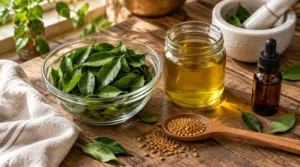
Simplicity makes homemade curry leaves oil so rewarding, and you only need a few ingredients to get started. Ready to gather them?
If you’d like to pair your curry leaves oil with a salon-style smoothing routine, the benefits of keratex hair oil show how it can add frizz control and shine.
Start with 1 cup fresh curry leaves, roughly 20 to 30 leaves. Wash them well and dry them completely, because leftover moisture can spoil your oil. Pair them with 1 cup of coconut oil. That 1:1 ratio is your safe, reliable base, and coconut oil is a favorite for good reason: it’s known for penetrating hair easily. Coconut oil penetrates the hair shaft to reduce protein loss, while curry leaves add vitamin B and antioxidants, which is why this coconut and curry leaf blend is favored for root strength and delaying early graying.
Want a little extra? Add 1 to 2 tablespoons of fenugreek seeds per cup of oil. They’re optional, but they’re a popular choice for hair growth routines.
Expect about 100 to 150 mL of finished oil from a small batch. Some oil evaporates and some soaks into the leaves, so measure generously and you’ll stay in control!
How Do You Make Curry Leaves Oil for Hair Growth?
Now that your ingredients are ready, let’s turn them into curry leaves oil. It’s easier than you think!
Pour 1 cup of coconut oil into a heavy pan and warm it on a low flame. Keep the heat gentle, because high heat wrecks the nutrients you’re after.
- Add your dry curry leaves, plus the fenugreek seeds if you’re using them.
- Simmer for 10 to 15 minutes, stirring now and then, until the leaves shrink and the oil turns light green.
- Switch off the flame and let the oil cool for about an hour.
Watch the pan closely. Burnt leaves turn the oil bitter and cancel out the benefits, so lower the flame if you hear heavy sizzling.
If you’re curious how this simple kitchen habit helps your hair, how curry leaves can support hair growth explains the nutrients involved and how to use them well.
Follow these steps and your homemade recipes will deliver a fragrant oil that helps with scalp health and hair growth. You’ve got this!
How Should You Strain and Store Curry Leaves Oil?
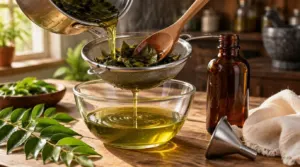
Your oil has cooled for an hour, so it’s time to strain the oil and lock in all that goodness. You’re almost there!
Pour it through a fine-mesh strainer or cheesecloth set over a bowl. Warm oil flows best, but never hot. Press the leaves gently with the back of a spoon to squeeze out every last drop.
Now pick your container:
- Use a clean, bone-dry glass bottle, ideally dark, to shield the oil from light.
- Label it with today’s date.
- Store it in a cool, dark cabinet, or in the fridge if your climate is hot and humid.
If you plan to reuse your favorite hair oil recipe often, make small batches. Shake gently before each use, and dispense with clean hands. Toss it if it smells off, changes color, or shows mold. Fresh oil keeps your hair care routine safe and simple!
The same small-batch rule applies to a natural DIY heat protectant for hair, which is best mixed fresh and refrigerated since it only lasts one styling session.
How Often Should You Apply Curry Leaves Oil, and for How Long?

Your oil is bottled and labeled, so how often should you use it? Consistency beats intensity, so aim for two to three times a week. Storing your blend in amber glass dropper bottles protects it from light and makes it easy to measure out the right amount each time.
Start with clean, mildly shampooed hair. Here’s your simple routine:
- Warm a small amount of oil between your palms.
- Work it into your scalp and roots with a gentle scalp massage for 5 to 10 minutes.
- Leave it on for 30 minutes to 1 hour, or overnight for a deeper treatment.
- Rinse with mild shampoo until your hair feels clean.
That massage boosts hair nourishment and helps support hair strengthening, which matters if you’re dealing with hair loss.
Give it at least two weeks before judging results. Hair growth takes time, so stay steady. You’ve got this!
Does Curry Leaves Oil Really Help Hair Growth?
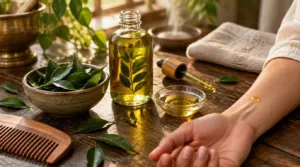
So, does curry leaves oil really help your hair grow? Let’s look at what it may do for you and where the proof runs thin. Then you’ll learn how to patch test first, so your scalp stays happy and safe!
Potential Benefits and Evidence Limits
Curious if curry leaves hair oil really works? Here’s the honest picture.
| Claim | Evidence |
|---|---|
| Scalp nourishment | Plausible |
| Hair growth | Unproven |
| Reversing gray hair | Unsupported |
| Dandruff relief | Traditional use |
Evidence is mostly anecdotal. Treat it as a gentle natural remedy, enjoy the scalp massage, and keep expectations realistic. Hair loss that worries you deserves a dermatologist’s input, so book one soon.
Treat curry leaf oil as a gentle remedy, enjoy the massage, keep expectations realistic, and see a dermatologist if hair loss worries you
Patch Testing and Scalp Safety
A quick round of patch testing protects your scalp before you commit. Mix one part curry leaves oil with four parts carrier oil, dab it on your inner forearm, and wait 48 hours. Watch for redness, itching, or swelling for up to 96 hours.
Scalp safety comes first with a natural remedy. Hair growth needs calm skin. Stop if it burns.
Frequently Asked Questions (FAQs)
Can curry leaves oil regrow hair?
Sure, and your toaster might cure hair loss too! Here’s the honest truth: no conclusive evidence shows curry leaves oil revives dormant hair follicles.
Its antioxidant properties may support hair growth by reducing breakage, though.
How to prepare curry leaves oil for hair growth?
Your kitchen is an apothecary! Warm 1 cup coconut oil on low, add 10-15 dry curry leaves, and simmer until crispy. This homemade oil, rooted in Ayurvedic medicine, makes curry leaves oil for hair growth.
Do curry leaves make your hair grow?
Here’s the honest answer: no proof yet. Curry leaves oil may nourish your scalp, but studies don’t confirm hair growth. Try homemade curry leaves oil with coconut oil and fenugreek seeds, and patch test first.
How long does it take for curry leaves oil to work?
Expect softer, shinier hair in 2 to 4 weeks, less hair fall by weeks 8 to 12, and real hair growth around six months. Massage your scalp 2 to 3 times weekly for hair vitality.
Can I use curry leaves oil on my scalp if I have dandruff?
Does curry leaves oil calm dandruff? Mostly, yes. Its antifungal, soothing properties support scalp health improvement and hair growth. Patch test first, then use it in your hair mask recipe once weekly. You’ve got this!
What are the side effects of using curry leaves oil?
Even a golden remedy casts a shadow.
Curry leaves oil can cause allergic reactions, greasy buildup, or stained towels, and it may worsen dandruff. Patch test first, and stop if itching, rash, or swelling appears.
Can you add other herbs to curry leaves oil?
Picture your oil pan turning deep green, with fenugreek seeds bobbing like tiny gold beads. Yes, you can add other herbs! Try amla or hibiscus with coconut oil, simmer gently, strain, and enjoy richer curry leaves oil.
How do you know when curry leaves oil has spoiled?
Picture fresh, nutty gold turning into old paint and wet cardboard. That’s your cue! Sniff your curry leaves oil, check for mold, cloudiness or stickiness, and toss it fast.
Your scalp deserves safe nourishment, always!
Conclusion
Picture Meera on a quiet Sunday, warming a small pan of oil and feeling proud that every ingredient is hers. That’s the real win. Now you know how to make curry leaves oil for hair growth, from simmering to straining to storing.
Stay consistent, patch test first, and keep expectations realistic. The evidence is modest, but a steady weekly ritual can make your scalp feel cared for. Start small, stay safe, and truly enjoy it.