This site is supported by our readers. We may earn a commission, at no cost to you, if you purchase through links. This content is for general informational and educational purposes only and is not a substitute for professional medical, dermatological, or nutritional advice.
Most people spend more on their moisturizer than on their technique—and that’s exactly where the results fall short. A $12 drugstore cream applied correctly will outperform a $90 luxury formula slapped on dry skin every single time. The difference lives in the details: the timing, the motion, the amount, even which finger you use near your eyes.
Your skin barrier isn’t passive. It’s a living structure that either lets hydration lock in or lets it evaporate, depending on how well you work with it. Getting that relationship right takes maybe 90 seconds added to your routine—but the payoff shows up in your mirror within weeks.
What follows is the practical guide your esthetician would walk you through chair-side: specific, science-backed, and stripped of the fluff.
Table Of Contents
- Key Takeaways
- Why Proper Moisturizer Application Matters
- How to Choose The Right Moisturizer for Your Skin
- Key Ingredients to Look for in a Moisturizer
- When to Apply Moisturizer for Best Absorption
- How Much Moisturizer Should You Actually Use
- Step-by-Step Guide to Applying Facial Moisturizer
- Why Use a Moisturizer With SPF Daily
- Top 8 Moisturizers and Cleansers Worth Trying
- Common Moisturizing Mistakes to Stop Making
- Why is My Face Still Dry After Moisturizing
- Frequently Asked Questions (FAQs)
- Conclusion
Key Takeaways
- Applying moisturizer to slightly damp skin within five minutes of cleansing can boost moisture retention by up to 40%, making timing one of the most impactful — and most overlooked — steps in your routine.
- Your skin type should dictate both the formula you choose and how much you use, ranging from a dime-sized amount for oily skin to a quarter-sized portion for dry skin, because using the wrong amount or formula can actively work against your barrier.
- Technique matters as much as the product itself — starting from the center of your face, moving outward with upward circular motions, and patting (not rubbing) protects collagen, supports lymphatic drainage, and helps your moisturizer absorb more effectively.
- A $12 drugstore moisturizer applied correctly will consistently outperform an expensive formula used carelessly, which means mastering a 90-second application routine delivers better results than upgrading your products ever will.
Why Proper Moisturizer Application Matters
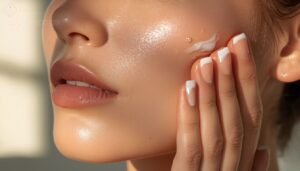
Most people grab their moisturizer, rub it on, and call it done — but how you apply it actually changes what your skin gets out of it. Your skin’s barrier is doing a lot of quiet, important work, and the right technique helps it do that job better. Here’s what you need to understand before we get into the how.
Understanding how moisturizers interact with your skin barrier on a mechanical and structural level makes it easier to see why technique matters as much as the product itself.
How Skin Barrier Function Works
Think of your skin as a fortress. The outermost layer, called the stratum corneum, is your first line of defense. It uses a "bricks and mortar" structure — corneocytes as bricks, lipids as mortar — to control what enters and exits. Here’s what keeps that system running:
- Lipid matrix seals moisture in
- Natural moisturizing factor retains water inside cells
- Acid mantle maintains protective pH balance
- Ceramides reinforce barrier integrity
The intercellular lipid membrane comprises roughly 20% of the stratum corneum’s volume, highlighting its role in barrier function.
What Happens When You Skip Moisturizer
Now that you know how that fortress works, imagine leaving the gate wide open. Skip your moisturizer, and transepidermal water loss kicks in within minutes — skin starts feeling tight, dull, and parched.
Oily skin fights back with excess sebum production, clogging pores fast.
Meanwhile, barrier gaps let irritants sneak in, triggering inflammation, breakouts, and long-term accelerated collagen breakdown that ages your skin prematurely.
Benefits of Correct Application Technique
The way you apply moisturizer matters as much as which one you pick. Upward, circular fingertip motions don’t just feel nice — they support lymphatic drainage, reducing puffiness over time.
Patting instead of rubbing boosts moisturizer absorption by stimulating circulation and protecting your skin barrier from unnecessary friction. Do it on damp skin, and you can lock in up to 40% more moisture.
How to Choose The Right Moisturizer for Your Skin
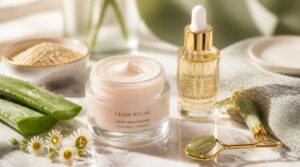
Not all moisturizers are created equal, and the one that works beautifully for your friend might leave your skin feeling greasy or tight. Your skin type is the starting point for finding a formula that actually does its job. Here’s what to look for based on yours.
Best Picks for Dry Skin Types
Dry skin is basically a broken bucket — it loses moisture faster than it can hold it. That’s why you need a rich, creamy moisturizer with ingredients that both attract and lock in water.
Here are four ingredient types that genuinely make a difference:
- Ceramides restore your lipid barrier, cutting moisture loss by up to 30% within four weeks
- Glycerin pulls water directly to your skin’s surface, keeping it soft and plump throughout the day
- Shea butter forms an occlusive layer that seals hydration in and soothes rough, flaky patches
- Squalane delivers lightweight but deep hydration — no greasy residue, just comfortable moisture
Always apply to clean, damp skin right after cleansing. That slight dampness helps every ingredient absorb more effectively.
Gel Formulas for Oily and Acne-prone Skin
If oily or acne-prone skin is your reality, a lightweight gel-based moisturizer is your best tool. Gel formulas absorb in seconds, leave a dry‑touch, matte finish, and won’t clog pores.
Look for niacinamide and zinc PCA — they regulate sebum and fight acne‑causing bacteria.
Centella asiatica calms redness fast.
Best part? Gel layers perfectly under sunscreen and makeup without pilling.
Balancing Combination Skin Zones
Combination skin plays by its own rules — your T-zone stays shiny while your cheeks beg for hydration. Don’t apply moisturizer evenly and call it done.
- Use a gel formula on your forehead, nose, and chin
- Apply a richer cream on dry cheeks
- Adjust thickness seasonally as cheeks get drier
- Spot-treat flaky patches without overloading oily zones
Fragrance-free Options for Sensitive Skin
If your skin reacts to almost everything, fragrance-free isn’t optional — it’s essential. Unlike "unscented" products, which can contain masking scents that still irritate, truly fragrance‑free moisturizers skip synthetic perfumes and essential‑oil triggers entirely.
Look for ceramides, glycerin, and niacinamide — ingredients that repair your skin barrier without added irritants. Dermatologist‑recommended options like CeraVe are noncomedogenic and ideal for managing eczema flares.
Always apply moisturizer to clean, damp skin for best absorption.
Lightweight Creams for Normal Skin
Normal skin has the luxury of choice — but that doesn’t mean anything goes. A lightweight water-based cream hits the sweet spot: enough facial hydration without that heavy, greasy feel.
Look for glycerin, hyaluronic acid, and non-comedogenic squalane to keep your skin texture balanced. Apply to damp skin right after cleansing, and your makeup will sit more smoothly all day.
Key Ingredients to Look for in a Moisturizer
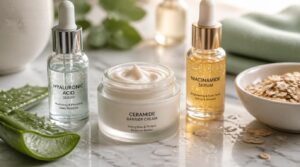
Not all moisturizers are created equal, and the difference usually comes down to what’s actually in the bottle. Certain ingredients do the heavy lifting — pulling water into your skin, sealing it in, or rebuilding what your barrier has lost. Here are the ones worth looking for.
Hyaluronic Acid and Glycerin as Humectants
Think of humectants as tiny sponges working inside your moisturizer. Hyaluronic acid can hold up to 1,000 times its weight in water, while glycerin pulls moisture from deeper skin layers. Together, they cover hydration at every level:
If your skin leans reactive, pairing these humectants with a gentle cleanser for sensitive skin helps lock in that hydration without stripping your barrier.
- Surface plumpness from high-weight HA
- Deeper moisture anchoring from glycerin
- Reduced evaporation in dry or heated climates
Apply both on slightly damp skin for best absorption.
Ceramides for Barrier Repair
Your skin barrier is basically a brick wall — ceramides are the mortar holding it all together. These sphingolipid molecules lock into the lipid matrix between skin cells, cutting transepidermal water loss by up to 30%.
Look for products listing ceramides 1, 3, and 6-II, and pair them with niacinamide, which actively stimulates your skin’s own ceramide production.
Shea Butter and Jojoba Oil for Dry Skin
If ceramides are the mortar, shea butter and jojoba oil are the materials that rebuild the wall from scratch.
Shea butter’s stearic and oleic acids mirror your skin’s own fatty acids, allowing it to melt directly into dry patches at body temperature — locking in moisture and slowing water loss by up to 40%. Jojoba oil mimics sebum so closely that your skin accepts it without resistance, delivering hydration without greasiness.
Retinol and Vitamin C for Anti-aging
Once your barrier is rebuilt, it’s time to go deeper. Retinol metabolizes into retinoic acid, triggering collagen synthesis and reducing fine lines by up to 44% over 12 months.
Vitamin C neutralizes free radicals and boosts fibroblast collagen production by up to 144%.
Use vitamin C in the morning, retinol at night — your antiaging skincare routine, working around the clock.
Not sure when to begin? Check what age you should start using retinol, though even at 30 or beyond it still smooths texture and softens fine lines.
Genetics and sun exposure still play a role, but pairing these steps with insights from how vitamin C serum helps reduce wrinkles can help you build a routine that actually holds up over time.
Non-comedogenic Ingredients for Acne-prone Skin
If retinol is your night‑shift worker, think of a non-comedogenic moisturizer as your acne‑prone skin’s daytime bouncer — letting hydration in, keeping pore‑clogging oils out. Look for glycerin and hyaluronic acid as humectants.
Lightweight oils like sunflower oil hydrate without blocking pores. Skip fragrances; irritation fuels breakouts.
An oil‑free moisturizer keeps your routine clean and clear.
When to Apply Moisturizer for Best Absorption

Timing matters more than most people realize — even a great moisturizer won’t work its best if you’re applying it at the wrong moment. Your skin is most receptive to hydration at specific points in your routine, and knowing those windows makes a real difference. Here’s when to apply moisturizer so your skin actually absorbs it.
Applying on Damp Skin After Cleansing
The window for locking in hydration closes fast. After you cleanse, apply moisturizer to clean damp skin within five minutes — not dripping wet, just visibly moist. That trace of surface water helps your moisturizer spread evenly and pull hydration deeper, preventing transepidermal loss before it starts.
- Slightly damp means no water running down your face — just visible moisture
- Skin that dries fully first loses surface water your moisturizer can’t recover
- A quick mist application works if you stepped away and skin dried out
Morning Vs. Nighttime Application Timing
Your skin actually follows a 24-hour circadian cycle — protection by day, repair by night.
Morning moisturizing prepares your barrier against pollutants, indoor heating, and drying conditions before you step outside.
Nighttime moisturizing aids the skin’s natural recovery phase while you sleep, delivering uninterrupted hydration for hours.
Match your product texture to that rhythm: lighter formulas in the morning, richer creams at night.
Waiting Period Before Sunscreen Layering
Once your moisturizer is on, don’t rush straight to sunscreen. Give it 2–5 minutes to absorb first — this prevents pilling and keeps both products working properly.
For mineral sunscreen, 1–2 minutes is plenty. For chemical sunscreen, apply it right after that short wait, then wait 15–20 minutes before sun exposure — not between steps.
Adjusting Routine in Cold or Dry Climates
Cold air pulls moisture out fast.
Use a slightly larger amount of moisturizer, and layer a barrier oil — rosehip or argan — on top to seal everything in. Run a bedroom humidifier overnight to fight heater-induced dryness.
Switch to a cream-based cleanser so you’re not stripping oils you can’t afford to lose in winter.
How Much Moisturizer Should You Actually Use
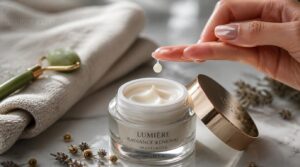
Most people either use way too much or barely enough — and both can work against you. Getting the amount right comes down to your product type and your skin’s specific needs. Here’s what to know before you squeeze anything out of that tube.
Nickel-sized Amount for Water-based Creams
Think of a nickel sitting flat in your palm — that’s exactly how much water-based moisturizer you need for one full face application.
This small amount spreads easily across your entire face without pooling around your nose or chin.
It absorbs cleanly, leaves no greasy residue, and keeps your skin’s hydration balanced from the start.
Dime-sized Amount for Thicker Formulas
Thick creams and ointments play by different rules. A dime-sized amount is your sweet spot — enough to warm between your fingertips until it softens, then glide evenly across both cheeks, forehead, and jawline without leaving waxy buildup.
Press gently rather than rubbing to help emollients distribute uniformly and settle into a comfortable, non-sticky finish.
Risks of Over-applying Moisturizer
More isn’t better here — it’s actually a setup for trouble.
Loading on extra product beyond a dime- or nickel-sized amount can leave sticky residue sitting on your skin instead of being absorbed. That film traps oil, dead cells, and debris, setting up clogged pore buildup that shows up as blackheads or rough, bumpy skin texture — especially frustrating on acne-prone skin.
How Skin Type Affects The Right Dosage
Your skin type is the real driver behind moisturizer dosage.
Oily skin already produces 2–3 times more sebum than dry skin, so stick to a dime-sized amount.
Dry skin needs a nickel- to quarter-sized portion.
For combination skin, apply more to dry cheeks, less to the T-zone.
Sensitive skin does well with just a pea-sized amount.
Step-by-Step Guide to Applying Facial Moisturizer
Knowing what to apply is only half the equation—how you apply it makes all the difference. Your technique directly affects how well your skin absorbs the moisturizer and how long that hydration actually lasts. Here’s exactly how to do it, step by step.
Start From Center, Move Outward

Start at the center of your face — the forehead, nose, and chin — then sweep outward toward your ears.
This spiral pattern follows your skin’s natural contour lines, delivering even coverage without buildup at the hairline or jawline.
Apply moisturizer to your T-zone first, then distribute outward, so every zone gets exactly what it needs.
Using Upward and Circular Fingertip Motions

Once you’ve spread the moisturizer outward, use your fingertips to massage it into your face and neck with upward circular motions.
- Stimulates lymphatic drainage along the jawline
- Boosts blood flow for a healthy glow
- Enhances product absorption into deeper layers
- Gently lifts facial muscles over time
- Releases tension in forehead muscles
Patting Vs. Rubbing for Better Absorption
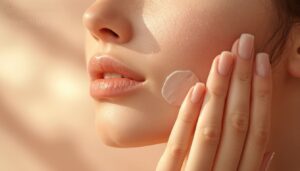
After those circular motions, how you finish matters. Pat, don’t rub.
Patting applies less mechanical force, which protects collagen and keeps skin barrier intact. Rubbing stretches skin fibers over time, breaking down structure.
Use your fingertips to lightly press the moisturizer in. Your product absorbs well either way — but your skin stays healthier, longer, with the gentler choice.
Extending Product to Neck and Décolletage

Don’t stop at your jawline — your neck and décolletage deserve the same care.
- Use upward application strokes on the front and sides of your neck
- Extend across the chest hydration zones above the cleavage line
- This prevents a neck texture mismatch between your face and upper chest
- It also reduces clothing friction protection issues from collars and scarves
Eye Area Technique With Ring Finger

The eye area needs its own approach. Use your ring finger — its weaker muscles naturally limit pressure on skin that’s only 0.5mm thick. Since that delicate under-eye skin is just half a millimeter thick, pairing the right technique with a lightweight, non-comedogenic facial moisturizer makes all the difference.
Dispense a grain-of-rice-sized amount, warm it between both ring fingers, then gently pat along the orbital bone.
This tapping motion helps lymphatic drainage while keeping the product from migrating into your eye.
Why Use a Moisturizer With SPF Daily
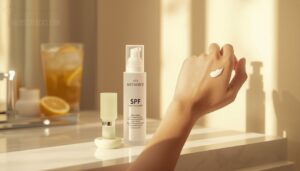
Skipping SPF during the day is one of the fastest ways to undo all your other skincare efforts. A moisturizer with built-in sun protection simplifies your routine while keeping your skin defended against daily UV exposure. Here’s what you need to know to make it work for you.
Just like sun damage builds gradually with each unprotected day, hair damage from over-processing sneaks up too, which is why knowing how to fix orange hair after bleaching can save your strands before the damage becomes permanent.
What SPF Stands for and How It Works
SPF — short for sun protection factor — measures how well a sunscreen blocks UVB rays, the ones that cause sunburn. The FDA first defined it in 1978.
SPF 30 filters roughly 97% of UVB rays. That sounds like a lot, but here’s the catch: most people apply far less than the tested 2 mg/cm², so real‑world protection drops dramatically.
UVA Vs. UVB Protection Explained
Think of UVA and UVB as two different troublemakers working in different ways. UVB rays hit the skin’s outer layer and cause sunburn and DNA damage — the kind you actually feel.
UVA rays go deeper, driving photoaging and pigmentation changes silently, without any burning sensation. They even pass through clouds and glass, making daily sun protection non‑negotiable.
SPF Moisturizers for Skin of Color
If you have melanin-rich skin, finding a moisturizer with SPF that doesn’t leave a chalky cast is a real challenge.
Look for tinted or sheer formulas with iron oxides — they blend naturally with deeper complexions while still delivering solid UV protection.
Fragrance-free, non-comedogenic options keep skin hydrated without greasiness, making your daytime moisturizer do double duty beautifully.
Choosing Broad-spectrum SPF 30 or Higher
Not all sunscreens are created equal — and broad-spectrum SPF 30 is the baseline your skin genuinely needs.
Here’s what that label actually protects you from:
- UVB rays cause sunburn and are blocked at roughly 97% with SPF 30
- UVA rays penetrate glass and drive photoaging — broad-spectrum coverage covers both
- Mineral filters like zinc oxide offer the widest UVA range with minimal irritation
- Water-resistant formulas (40 or 80 minutes) hold up better through sweat and humidity
Choose a face sunscreen that says "broad-spectrum" — that wording guarantees balanced UV protection, not just sunburn prevention.
When to Reapply Sunscreen During The Day
Broad-spectrum SPF 30 gets you covered at the start — but that protection doesn’t last all day. Reapply every two hours while you’re outside, full stop.
After swimming, towel off and apply again immediately — towel friction strips coverage just as effectively as water does. Heavy sweat has the same effect.
Stepped back into shade? Your two‑hour clock resets when you return to direct sun.
Top 8 Moisturizers and Cleansers Worth Trying
Finding the right products doesn’t have to feel like guesswork. These eight options cover a solid range of skin types, concerns, and steps in your routine — from cleansing to SPF. Here’s a closer look at each one.
1. Tatcha Dewy Milk Moisturizer
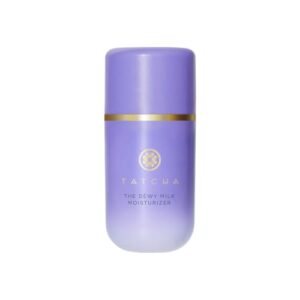
If you’re looking for a moisturizer that feels like a cool drink of water for your skin, Tatcha The Dewy Milk is worth a close look. This lightweight, milky formula is built for combination to oily skin — it delivers steady hydration through glycerin, sodium hyaluronate, and squalane without leaving shine or residue.
At $64 for 4.16 oz, it’s a premium pick, but the fast absorption and oil-balancing finish make it a reliable daily base before sunscreen.
| Best For | Those with combination to oily skin who want a lightweight, hydrating daily moisturizer that controls shine and works well under makeup. |
|---|---|
| Product Type | Moisturizer |
| Skin Type | Combination/Oily |
| Fragrance Status | Lavender Scent |
| Key Ingredient | Oil-Balancing Complex |
| Texture | Milky, Lightweight |
| Best Use Time | AM/PM |
| Additional Features |
|
- Absorbs quickly with a milky texture that never feels greasy or heavy
- Balances oil while keeping skin visibly plump and dewy throughout the day
- Gentle enough for sensitive skin, with some users seeing relief from eczema flare-ups
- At $64, it’s a significant investment that may not suit every budget
- The small 4.16 oz bottle can run out fast if you’re using it morning and night
- The opaque container makes it impossible to tell how much product you have left
2. Medicube Triple Collagen Moisturizer
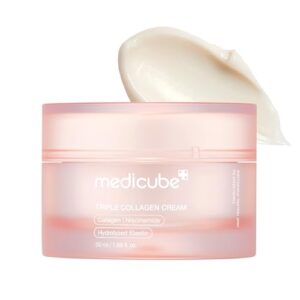
Where Tatcha leans light and oil-balancing, the Medicube Triple Collagen Moisturizer takes a different direction — it’s built for skin that needs deeper nourishment. Its triple collagen blend pairs with hyaluronic acid, niacinamide, and shea butter to firm, hydrate, and support your barrier simultaneously.
One honest note: it does have a scent, so if fragrance sensitivity is a concern for you, patch test first. At 1.69 oz, it’s compact but effective for dry or mature skin.
| Best For | This moisturizer is best for those with dry or mature skin looking for deep, long-lasting hydration and firming benefits. |
|---|---|
| Product Type | Moisturizer |
| Skin Type | Dry/Mature |
| Fragrance Status | Perfume-Like Scent |
| Key Ingredient | Triple Collagen Blend |
| Texture | Rich, Creamy |
| Best Use Time | AM/PM |
| Additional Features |
|
- Triple collagen blend with hyaluronic acid, niacinamide, and shea butter delivers deep, long-lasting hydration
- Helps improve firmness and reduce the appearance of fine lines with consistent use
- Lightweight enough to layer under makeup for both day and night routines
- Contains a noticeable scent despite being marketed as fragrance-free
- Richer texture may feel too heavy for oily or acne-prone skin
- Visible anti-aging results require consistent twice-daily use over several weeks
3. CeraVe Hydrating Facial Cleanser
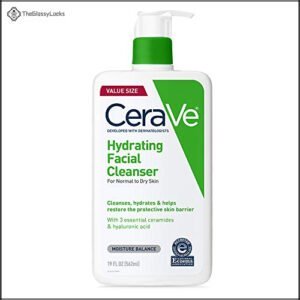
Once your moisturizer is pulling its weight, what you wash with matters just as much. CeraVe Hydrating Facial Cleanser uses three essential ceramides plus hyaluronic acid to clean without stripping your barrier.
Its lotion-like, non-foaming texture rinses clean and suits normal to dry skin, even doubling as a gentle hand or body wash.
Fragrance-free and non-comedogenic, it’s a dermatologist-developed staple that pairs perfectly with your next moisturizing step.
| Best For | Anyone with normal to dry or eczema-prone skin who wants a gentle, hydrating cleanser that won’t strip their moisture barrier. |
|---|---|
| Product Type | Cleanser |
| Skin Type | Normal/Dry |
| Fragrance Status | Fragrance-Free |
| Key Ingredient | Ceramides + Hyaluronic Acid |
| Texture | Creamy Lotion |
| Best Use Time | AM/PM |
| Additional Features |
|
- Contains three essential ceramides, hyaluronic acid, and glycerin to support moisture retention
- Fragrance-free, paraben-free, and non-comedogenic, with National Eczema Association certification
- Versatile lotion-like texture that doubles as a hand or body wash
- Rich, creamy texture may feel too heavy for oily or combination skin
- Low-foaming formula won’t appeal to those who prefer a traditional foamy wash
- Lacks exfoliating or acne-fighting ingredients, so extra products are needed for those concerns
4. Kiehl’s Ultra Facial Cleanser
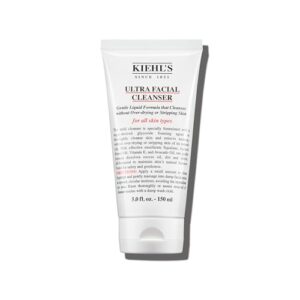
If you want a cleanser that multitasks, Kiehl’s Ultra Facial Cleanser earns its spot. This pH-balanced foaming wash combines squalane, avocado oil, and glycerin to remove makeup, sunscreen, and daily grime without leaving your skin tight or stripped.
It’s fragrance-free, non-comedogenic, and dermatologist-tested — making it a solid fit for all skin types. At $26, it’s a modest investment for a cleanser that genuinely nourishes your moisture barrier instead of working against it.
| Best For | Anyone who wants a gentle, hydrating daily cleanser that works for all skin types — especially those with sensitive, acne-prone, or combination skin. |
|---|---|
| Product Type | Cleanser |
| Skin Type | All Skin Types |
| Fragrance Status | Fragrance-Free |
| Key Ingredient | Squalane + Avocado Oil |
| Texture | Foaming Liquid |
| Best Use Time | AM/PM |
| Additional Features |
|
- Removes makeup, sunscreen, and oil effectively without stripping the skin’s natural moisture barrier
- Fragrance-free, non-comedogenic, and dermatologist-tested — safe for even the most sensitive skin
- Enriched with squalane, avocado oil, and glycerin to actively support hydration while cleansing
- At $26, it’s pricier than most drugstore alternatives for a basic daily cleanser
- Some users notice a faint scent despite the fragrance-free claim
- Very dry skin types may find it slightly drying without a moisturizer to follow
5. Cosrx Snail Mucin Gel Cleanser
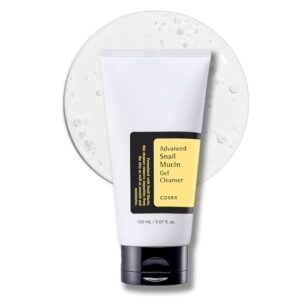
Snail mucin sounds unconventional, but 10,000 ppm snail secretion filtrate is the real deal. The Cosrx Snail Mucin Gel Cleanser transforms from a slick gel into a cushiony, mild foam that lifts dirt and light makeup without stripping moisture.
It’s dermatologist-tested, free of parabens and sulfates, and gentle enough for sensitive or dry skin.
Some users notice a faint scent, so check the regional formula if that matters to you.
| Best For | Anyone with dry, sensitive, or dull skin who wants a gentle daily cleanser that hydrates while it cleans. |
|---|---|
| Product Type | Cleanser |
| Skin Type | Dry/Sensitive |
| Fragrance Status | Light Fragrance |
| Key Ingredient | Snail Mucin Complex |
| Texture | Gel-to-Foam |
| Best Use Time | AM/PM |
| Additional Features |
|
- Snail mucin (10,000 ppm) helps hydrate and support skin repair while cleansing
- Gel-to-foam formula lifts dirt, sunscreen, and light makeup without stripping the skin barrier
- Dermatologist-tested and free of parabens, sulfates, and phthalates — great for sensitive skin
- The slimy gel texture isn’t for everyone and may take getting used to
- Not strong enough for heavy or waterproof makeup — you’ll likely need a separate remover
- Has a light fragrance that could be an issue for those with scent sensitivities
6. Beauty Joseon Green Plum Cleanser
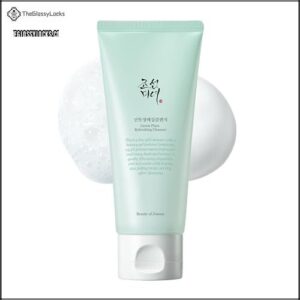
Green plum might sound like a smoothie ingredient, but Beauty of Joseon turns it into something your skin will actually thank you for. This lightweight gel cleanser combines 24% plum water with mung bean seed extract to cleanse without that tight, stripped feeling afterward.
It’s fragrance-free and pH-balanced around 5–6, making it a smart pick for sensitive or acne-prone skin. The mild AHA action gently smooths texture over time — no harsh scrubbing needed.
| Best For | Sensitive, acne-prone, or combination skin types looking for a gentle daily cleanser that exfoliates without irritation. |
|---|---|
| Product Type | Cleanser |
| Skin Type | All Skin Types |
| Fragrance Status | Fragrance-Free |
| Key Ingredient | Plum Water + AHA |
| Texture | Lightweight Gel |
| Best Use Time | AM/PM |
| Additional Features |
|
- 24% plum water plus mung bean extract cleanses effectively while keeping the skin barrier intact
- Fragrance-free and pH-balanced formula makes it safe for daily use, even on reactive skin
- Mild AHA exfoliation gradually smooths texture and reduces blackheads without harsh scrubbing
- May fall short for very oily skin that needs stronger oil control or deeper blackhead removal
- The low-foam, gel texture won’t satisfy those who love a rich, sudsy lather
- A small number of users experienced minor irritation, likely from sensitivity to the AHA content
7. Innisfree Mineral UV Defense SPF45
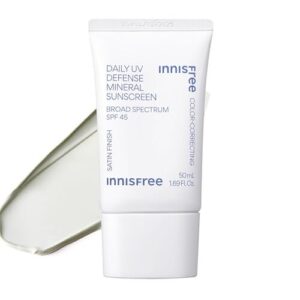
If your morning routine needs a mineral SPF finish, the Innisfree Mineral UV Defense SPF45 is worth a close look. Its green-tinted zinc oxide formula gently corrects redness while delivering broad-spectrum UVA/UVB protection. Eight types of hyaluronic acid and Centella asiatica keep skin hydrated without greasiness.
The lightweight, satin finish layers well under makeup and suits oily or combination skin. Just blend thoroughly — deeper skin tones may notice a slight cast.
| Best For | Those with sensitive, oily, or acne-prone skin who want a mineral SPF that doubles as a lightweight, redness-correcting moisturizer for daily wear. |
|---|---|
| Product Type | Sunscreen |
| Skin Type | Sensitive/Acne-Prone |
| Fragrance Status | Minimal Odor |
| Key Ingredient | Zinc Oxide + 8x Hyaluronic Acid |
| Texture | Lightweight Gel |
| Best Use Time | Morning Only |
| Additional Features |
|
- Broad-spectrum SPF 45 with a soothing green tint that helps neutralize redness and even out skin tone
- Eight types of hyaluronic acid plus Cica keep skin hydrated all day without feeling greasy
- Lightweight, satin finish layers seamlessly under makeup and works well on combination or oily skin
- May leave a white or green cast on deeper skin tones, requiring extra blending
- The color-correcting tint is subtle and won’t fully cover pronounced redness for everyone
- Needs reapplication every two hours or after sweating, swimming, or towel drying
8. Supergoop Unseen SPF 50 Sunscreen
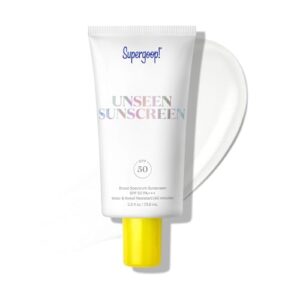
Ever wished sunscreen could just disappear? Supergoop Unseen SPF 50 delivers a weightless gel finish with zero white cast on any skin tone.
It doubles as a makeup-gripping primer, blurring pores while giving broad-spectrum protection. Meadowfoam seed oil and bisabolol soothe as you blend.
Pat it on after moisturizer, before makeup.
Keep in mind it’s pricier and less sweat‑resistant, so reapply often outdoors.
| Best For | Anyone who wants daily sun protection that works across all skin tones and types, especially those who wear makeup or have oily, sensitive, or acne-prone skin. |
|---|---|
| Product Type | Sunscreen |
| Skin Type | All Skin Types |
| Fragrance Status | Fragrance-Free |
| Key Ingredient | Broad-Spectrum Filters |
| Texture | Clear Weightless Gel |
| Best Use Time | Morning Only |
| Additional Features |
|
- Completely invisible on skin with no white cast, making it a true one-size-fits-all formula for every complexion
- Doubles as a smoothing primer that helps makeup go on better and last longer
- Lightweight, non-greasy, and fragrance-free — gentle enough for sensitive and acne-prone skin
- At $48 for 2.5 oz, it’s a significant step up in price from most everyday sunscreens
- Lower sweat and water resistance means you’ll need to reapply more often during outdoor activities or workouts
- The silicone-heavy texture may feel too light or even drying for people with very dry skin
Common Moisturizing Mistakes to Stop Making
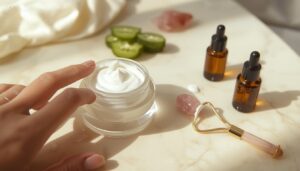
Even the best moisturizer won’t do much if you’re applying it the wrong way or skipping steps without realizing it. Small habits — ones that seem harmless — can quietly work against your skin over time. Here are the most common moisturizing mistakes worth correcting.
Skipping Moisturizer After Cleansing
Skipping moisturizer after cleansing is one of the easiest habits to overlook — and one of the costliest. The moment you rinse your face, transepidermal water loss accelerates fast.
Without moisturizer on clean, slightly damp skin, your skin barrier gets no help rebuilding, leaving you with tightness, reactive sensitivity, and dryness that no amount of makeup can hide.
Using The Wrong Formula for Your Skin Type
Grabbing any moisturizer off the shelf and hoping for the best is where most routines quietly fall apart. Wrong formula for your skin type doesn’t just feel uncomfortable — it actively disrupts your barrier.
A heavy cream on oily skin can trap sebum and trigger breakouts, while a lightweight gel leaves dry skin flaking by noon.
Neglecting Neck and Under-eye Areas
Your face doesn’t stop at your jawline — but your moisturizer often does.
Neck skin ages 5–10 years faster than facial skin and loses moisture twice as quickly. The under-eye area, at just 0.02mm thick, dehydrates even faster. Skip these zones daily, and no amount of facial work will hold back the crepiness creeping in from below.
Neck skin ages a decade faster than your face — yet your moisturizer stops at your jaw
Applying Moisturizer on Completely Dry Skin
Most people towel off completely and then reach for their moisturizer. It feels logical — dry skin, apply cream. But applying to completely dry skin can reduce absorption efficiency by up to 40%.
- Damp skin opens cellular hydration pathways
- Humectants like hyaluronic acid need water to work
- Moisture lock requires trapped surface water
- Slightly wet skin reduces transepidermal water loss
- Apply within one minute of cleansing for best results
Forgetting SPF During Daytime Routine
That damp-skin habit only works if you follow it with sun protection factor SPF. Many apply moisturizer, then walk straight into UV rays with no shield.
Even cloudy days carry hidden UV exposure, and ten unprotected minutes can trigger sunburn consequences.
Daily gaps invite melanin overproduction, premature aging risks, and weaker skin cancer prevention.
Apply before sunscreen, choosing SPF 30 broad-spectrum, every morning, rain or shine.
Why is My Face Still Dry After Moisturizing

You’re doing everything right, yet your skin still feels tight or flaky by midday. That’s frustrating, but it usually points to one small thing, not a total routine overhaul. Let’s look at what might be going on.
Signs Your Moisturizer Isn’t Working
Your moisturizer might be failing you without you even realizing it. Persistent skin tightness four weeks in is a red flag — healthy skin shouldn’t feel stretched after applying product. Visible flaky patches, rough skin texture, and dullness all signal that your skin barrier isn’t retaining moisture effectively.
Watch for these warning signs:
- Immediate stinging sensations after application, pointing to ingredient irritation
- Unexplained acne breakouts within one to two weeks, suggesting the formula is too heavy
- Skin that still feels rough and dull despite consistent use, indicating poor product efficacy
When to Switch to a Richer Formula
Sometimes your skin is simply asking for more. If your current moisturizer stops preventing dryness within two hours of application, that’s a clear signal that it’s time to upgrade.
Barrier damage signs — stinging after cleansing, new sensitivity to products you’ve used for months, or fine lines appearing faster — mean your skin needs heavier reinforcement.
Switch to a thicker cream or ointment containing ceramides and start with your evening routine first.
How Climate and Environment Affect Hydration
Where you live shapes your skin more than most routines can fix.
Cold air below 10°C weakens your barrier, pushing water loss up by 25%. Drop below 30% humidity, and moisture evaporates within minutes. Add wind at just 2 m/s and you’re still losing 25% more water.
Summer sun and heat quietly drain cheek hydration by 15% in under two hours.
Adjusting Your Twice-daily Skincare Routine
Your routine shouldn’t stay frozen while the seasons change around it.
In winter, swap your gel formula for a richer cream and apply it to slightly damp skin right after cleansing — both morning and evening.
When indoor humidity drops below 40%, add a second light layer at night.
Summer calls for lightweight, oil-free options to keep your barrier balanced without congestion.
Frequently Asked Questions (FAQs)
Can moisturizer expire or lose its effectiveness over time?
Yes — expired moisturizer quietly loses its punch. Active ingredients degrade within 6–12 months of opening, and PAO symbol on packaging tells you exactly how long yours stays effective after that first use.
Should you moisturize before or after facial oils?
Moisturizer goes on first. It hydrates the skin, then facial oil seals that moisture in. Applying oil first blocks your moisturizer from absorbing properly — wasting both products.
Is it safe to moisturize over active breakouts or blemishes?
Absolutely — skipping moisturizer during breakouts actually worsens things. A compromised barrier triggers more flares. Stick to oil-free, noncomedogenic options with glycerin or ceramides, and gently pat — never rub — over active blemishes.
Can you use body lotion as a facial moisturizer?
In a pinch, some body lotions work on the face — but check the label first. If it lists fragrance or isn’t marked face-safe, skip it. Facial skin is thinner and reacts faster.
Does drinking more water replace the need for moisturizer?
Drinking more water promotes systemic hydration, but it can’t stop moisture from evaporating off your skin’s surface. Your barrier needs topical moisturizer to actually seal that water in.
Conclusion
Like a key cut to fit one specific lock, knowing how to properly apply facial moisturizer for best results turns an ordinary product into something that actually works for your skin.
Damp skin, the right amount, gentle upward strokes, ring finger near your eyes—these aren’t small details. They’re the whole difference.
Your barrier thrives on consistency and care, not price tags. Give it 90 seconds twice a day, and it will give you exactly what you’re after.