This site is supported by our readers. We may earn a commission, at no cost to you, if you purchase through links. This content is for general informational and educational purposes only and is not a substitute for professional medical, dermatological, or nutritional advice.
You’re staring at tiny white specks cemented to hair strands like microscopic barnacles, and the nit comb you ordered won’t arrive for three days—or worse, your child’s scalp is too tender for another round of metal teeth scraping across sensitive skin.
The reality is that nits, the eggs of head lice, attach themselves with a protein-based adhesive so tenacious that researchers compare it to surgical cement, which explains why standard combing sessions often devolve into tears and frustration.
What most parents don’t realize is that your fingernails, a pair of tweezers, and strategic use of household oils can dismantle a nit infestation with the same precision as specialized tools, provided you understand the biomechanics of how these eggs bond to hair shafts and the exact techniques that exploit their structural vulnerabilities.
Table Of Contents
- Key Takeaways
- Effective Ways to Remove Nits Without a Comb
- Natural Home Remedies to Loosen Nits
- Step-by-Step Nit Removal Process
- Smothering Agents That Help Remove Nits
- Preventing Reinfestation After Nit Removal
- Frequently Asked Questions (FAQs)
- How does vinegar help in removing nits from hair?
- Is there an alternative to using a nit comb for removing nits?
- What are some preventive measures to avoid reinfestation of lice and nits?
- Can nits survive in chlorinated swimming pools?
- Do hair dyes or bleach kill nits?
- How long can nits remain dormant unhatched?
- Are electric lice combs effective without teeth?
- Can nits transfer through shared headphones or helmets?
- Conclusion
Key Takeaways
- Nits bond to hair shafts with a protein-based adhesive comparable to surgical cement, which explains why manual removal using fingernails, fine-tipped tweezers, and systematic one-inch hair sectioning can achieve the same precision as specialized combs when executed with proper lighting and methodical technique.
- Household oils like olive oil, safflower oil, mayonnaise, and petroleum jelly function as smothering agents that coat the hair shaft to reduce friction around nit casings, while acidic rinses using 5-6% white vinegar concentration weaken the cement-like bond, though both approaches require thorough application time and don’t replace meticulous manual extraction.
- The slide-and-pop technique—pinching each hair shaft between thumbnail and index finger and applying gentle upward pressure—mechanically breaks the nit’s adhesive bond, and this method demands dry hair preparation, workspace illumination of at least 1000 lux, and optional 2x to 6x magnification tools to detect translucent, pinhead-sized eggs.
- Preventing reinfestation requires laundering bedding and personal items in hot water above 130°F for 20 minutes, sealing non-washable items in plastic bags for 14 days, conducting weekly scalp examinations within 0.5 cm of the scalp using bright oblique lighting, and isolating personal hair care items to eliminate cross-contamination pathways.
Effective Ways to Remove Nits Without a Comb
When a nit comb isn’t available or practical, you’ll need to rely on alternative removal methods that target the individual eggs directly, breaking the cement-like bond that anchors them to the hair shaft. These techniques require patience, proper lighting, and deliberate precision to systematically work through each strand of hair.
The following approaches offer reliable ways to remove nits manually, providing you with the control necessary to achieve a fully cleared scalp. A thorough scalp treatment for product buildup helps create the clean foundation needed for easier nit detection and removal.
Manual Removal With Fingernails
Manual removal of nits directly from the hair shaft requires precision and patient manual dexterity, offering immediate control when tools aren’t available. Position your fingernail beneath each nit, applying gentle upward pressure to slide the egg away from the strand without breaking its adhesive stalk.
Hair sectioning into one-inch segments isolates treated areas, preventing cross-contamination and ensuring thorough parasite removal across the entire scalp during your fingernail technique session.
Using Fine-Tipped Tweezers
Fine-tipped tweezers give you a precision grip when your fingernails won’t cut it—stainless steel tips grasp individual nits clinging to the hair shaft without snagging surrounding strands.
Hold tweezers perpendicular to each section, pinching the nit casing firmly at its base for clean lice treatment results. After removing nits, restore scalp health with natural dandruff remedies that soothe irritation and prevent dryness from treatment.
Sanitize between uses to prevent cross-contamination, making this tweezer technique your backup weapon when nit removal demands surgical accuracy.
Sectioning Hair for Precision
Once you’ve mastered manual tools, proper hair sectioning transforms nit removal from guesswork into systematic precision techniques that map every inch of the scalp for complete lice infestation control. Start by dividing hair into quadrants with clips, then work through each section methodically—similar to how natural papaya enzymes break down hair during gentle removal treatments.
Strategic sectional removal demands:
- Crown-to-nape progression ensures full scalp mapping without missed zones where nits hide along the hair shaft
- One-inch uniform sections improve nit detection rates while maintaining manageable hair treatment portions
- Clips or headbands stabilize completed areas, preventing cross-contamination during your methodical pass
Natural Home Remedies to Loosen Nits

You don’t need harsh chemicals to weaken the bond that holds nits to hair strands, as several pantry staples can accomplish the same goal through natural acidic or suffocating properties. These home remedies work by either dissolving the cement-like adhesive or coating the nits to make manual removal much easier.
The following options range from common kitchen ingredients to botanical oils, each offering a different mechanism to help you break free from the grip of stubborn nits.
Vinegar and Acidic Rinses
You’ve likely heard that white vinegar can tackle stubborn nit adhesion—and there’s truth to it. An acidic rinse with 5-6% vinegar concentration may weaken the cement-like bond between nits and the hair shaft, making manual removal easier.
However, excessive use disrupts scalp pH balance and can trigger irritation risks, particularly in sensitive individuals, so dilute it well and limit contact time to prevent dryness or discomfort. For a gentler approach that won’t compromise your scalp’s delicate balance, try scalp exfoliation techniques designed specifically for dandruff control to safely clear buildup without the harshness.
Olive Oil, Mayonnaise, and Petroleum Jelly
Oily household staples—olive oil, mayonnaise, and petroleum jelly—work as smothering agents by coating the hair shaft and reducing friction around nit casings, which can make manual removal slightly easier.
However, clinical evidence supporting their superiority over standard conditioner remains limited, and application requires substantial contact time, thorough rinsing, and patience to avoid mess while achieving modest improvements in nit removal outcomes.
Safflower Oil (Carthamus Tinctorius)
Safflower oil (Carthamus tinctorius) offers a lipid-based coating that may reduce nit adhesion during manual removal, though rigorous clinical trials remain scarce. You’ll massage a small amount into your scalp and hair for two to five minutes, emphasizing nit-heavy areas, then allow brief settling before attempting the slide-and-pop technique.
Like olive oil and other smothering agents, safflower application improves slip but doesn’t replace careful fingernail or tweezer work for complete hair treatment and nit removal success.
Ensuring the accuracy of scientific study summaries is vital, and researchers rely on methodological rigor to validate their findings.
Step-by-Step Nit Removal Process
You’ve loosened the nits with your chosen remedy, and now comes the real work: methodical, hands-on removal. This process demands patience, precision, and the right environmental setup to guarantee you don’t miss a single translucent egg clinging to the hair shaft.
The following steps will walk you through preparing your workspace, optimizing your visibility, and executing the slide-and-pop technique that physically breaks the nit’s cement-like bond with the hair.
Preparing Hair and Workspace
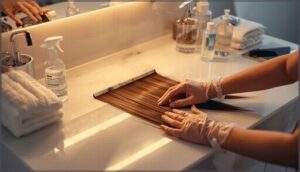
You’ll need dry hair preparation before starting nit removal, as moisture obscures the hair shaft and reduces visibility of translucent eggs. Section hair into one-inch segments to reveal the scalp, then establish workspace sanitizing protocols with protective gear like disposable gloves.
Scalp illumination requires at least 1000 lux for ideal hair care precision, while sterile tools prevent cross-contamination during hair hygiene procedures involving smothering agents.
Lighting and Magnification Tips
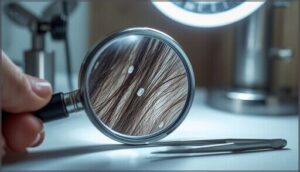
Without proper illumination techniques and optical aids, you’ll miss the translucent, pinhead-sized nits clinging to hair shafts. LED lighting between 5500K and 6500K enhances color contrast, while handheld lenses with 2x to 6x magnification tools reveal details invisible to the naked eye.
For hands-free nit removal:
- Use an LED headlamp for consistent, glare-free workspace visibility
- Position a handheld magnifying glass to examine individual hair sections
- Maintain cool-white light sources that reduce shadows obscuring nit eggs
These optical aids complement fine-tipped tweezers and wet-combing methods, preparing you for precise manual extraction before considering smothering agents or a traditional nit comb.
Sliding and Popping Nits Off Hair
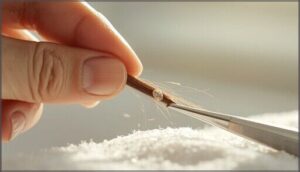
Once you’ve mastered lighting and sectioning for nit removal, pinch each hair shaft firmly between your thumbnail and index finger, then slide upward in one smooth motion to pop the nit free—a fingernail technique that removes stubborn eggs without a nit comb.
Fine-tipped tweezers offer tweezer precision for nits near the scalp, while scalp inspection after each pass confirms complete removal before considering wet-combing or smothering agents.
Smothering Agents That Help Remove Nits

Smothering agents work by suffocating live lice and loosening the adhesive bond that holds nits to the hair shaft, making manual removal much easier than relying on fingernails or tweezers alone. These products, which include both synthetic compounds and natural alternatives, create an occlusive barrier that disrupts the lice life cycle while simultaneously weakening the cement-like substance securing nits in place.
Understanding which agents are most effective, how to apply them safely, and the mechanisms by which they work will help you select the right approach for your specific situation.
Dimethicone and Isopropyl Myristate
Dimethicone benefits include forming a breathable barrier on the scalp that coats nits and disrupts moisture exchange, while isopropyl myristate spreads evenly to dissolve debris around egg sites, making these smothering agents particularly effective for hair lice removal.
Combined formulations improve coverage along the hair shaft, aid gentle traction during manual nit removal, and demonstrate low systemic absorption when you apply topical treatments as directed.
Application Techniques and Safety
You’ll achieve safer, more precise application when you section hair into vertical strips, apply dimethicone or isopropyl myristate with sanitized instruments, and use protective gear to prevent microbial transfer.
Fine-tipped nit removal tools paired with gentle traction minimize scalp irritation and hair breakage, while trimmed fingernails reduce abrasion risk during manual removal sessions that combine smothering agents with essential oils or ivermectin lotion.
How Smothering Agents Work on Nits
Once you grasp the smothering mechanism behind these agents, you’ll understand why they’re such effective suffocating agents for nit removal techniques. Dimethicone and mineral oil create viscous films that reduce oxygen exchange, while isopropyl myristate softens the nit’s cement for easier detachment. Occlusion effects increase humidity around each nit, promoting adhesion disruption through:
- Barrier formation limiting microenvironment oxygen
- Solvent action that softens cement casings
- Humidity elevation making adhesive more pliable
- Film immobilization preventing nit reattachment
Preventing Reinfestation After Nit Removal

You’ve worked hard to clear those nits from your child’s hair, but the battle isn’t over until you’ve tackled the environment and established a solid monitoring routine. Lice don’t survive long off the scalp, but those critical 48 hours demand your attention to prevent the cycle from starting all over again.
The following strategies will help you create a lice-hostile environment in your home, maintain vigilant oversight of your child’s scalp, and minimize the risk of transmission among household members.
Cleaning Bedding and Personal Items
After you’ve treated the scalp, launch a focused assault on your household fabrics to break the reinfestation cycle. Laundry tips for head lice treatment demand hot water treatment at 130°F minimum, paired with high dryer settings for 20 minutes—these sanitizing methods guarantee parasite control.
Seal non-washable items in plastic bags for 14 days, vacuum upholstered surfaces daily, and maintain rigorous fabric cleaning protocols throughout your hair care and hygiene regimen to support public health awareness and eliminate parasite infestation risks.
Scalp Checks and Monitoring
Once you’ve tackled bedding, weekly scalp examination becomes your surveillance system—bright oblique lighting reveals brown-to-gray nits within 0.5 cm of the scalp, catching survivors before they hatch.
Detection methods include:
- Document findings with a standardized checklist to track parasite infestation patterns.
- Watch for infestation signs: persistent itching or crawling sensations.
- Perform individual checks if multiple household members need head lice treatment.
- Use monitoring techniques during active nit removal phases.
Reducing Household Spread
By labeling and isolating personal hair care items, you cut cross-contamination at the source. Household sanitizing means vacuuming mattresses, wiping shared surfaces with EPA-registered disinfectants, and laundering hats and towels daily using laundry tips like hot water above 130°F.
Environmental cleaning paired with family screening stops head lice infestation before it cycles through another child, reinforcing your parasite control and prevention strategy with precision.
Frequently Asked Questions (FAQs)
How does vinegar help in removing nits from hair?
Acetic acid in vinegar weakens the cement-like adhesive that bonds nit casings to your hair shaft. This creates an acidic rinse that dissolves keratin bonds, allowing manual removal techniques to detach stubborn nit eggs more effectively.
Is there an alternative to using a nit comb for removing nits?
Yes—fine tweezers offer precision removal when you section hair carefully, while manual detachment with gloved fingers works for visible nits.
Smothering agents and wetcombing without traditional nit removal tools can also achieve effective results.
What are some preventive measures to avoid reinfestation of lice and nits?
To stop lice from coming back, it is essential to conduct regular scalp checks twice weekly and launder bedding in hot water.
Additionally, avoid sharing personal items and educate household members on head lice prevention to maintain household hygiene and prevent parasite infestation treatment needs.
Can nits survive in chlorinated swimming pools?
Standard pool chlorine won’t reliably kill nits attached to hair shafts; the eggshell provides chemical resistance during brief swimming exposure, meaning mechanical nit removal techniques and targeted pediculosis treatments remain necessary for complete eradication.
Do hair dyes or bleach kill nits?
While bleach treatment and hair dye limitations mean these chemical effects won’t reliably destroy nits on the hair shaft, pediculicides and smothering agents remain your validated nit removal techniques, avoiding unnecessary hair damage from insecticide-ineffective dye applications.
How long can nits remain dormant unhatched?
Nits can remain dormant unhatched for 7 to 10 days off the scalp, though viability drops markedly after two weeks.
Temperature, humidity, and environmental impact all influence hatch timing and nit dormancy duration considerably.
Are electric lice combs effective without teeth?
Electric lice combs without teeth show limited effectiveness for nit removal, lacking the mechanical scraping action needed to dislodge nit shells from hair shafts.
Though they may assist with lice detection through heat or vibration.
Can nits transfer through shared headphones or helmets?
Direct head-to-head contact drives nearly all head lice transmission, while shared headphones and helmets pose minimal nit transfer risk.
Still, wiping shared headgear between users promotes headphone hygiene and lice prevention as sensible public health practice.
Conclusion
The theory that nit removal demands specialized equipment collapses under scrutiny—your fingernails, paired with strategic oil application and methodical sectioning, dismantle infestations with surgical precision when you understand the protein adhesive’s vulnerabilities.
Mastering how to remove nits from hair without a comb transforms what seems like an insurmountable crisis into a manageable protocol, one strand at a time, proving that desperation often births the most effective solutions when conventional tools fail you.