This site is supported by our readers. We may earn a commission, at no cost to you, if you purchase through links. This content is for general informational and educational purposes only and is not a substitute for professional medical, dermatological, or nutritional advice.
Dry hair doesn’t always mean your strands lack moisture—often, the problem is that moisture slips out almost as fast as it goes in. Your hair cuticle acts like a tiny shutter: when it stays flat and smooth, water stays locked inside; when it lifts, hydration escapes within hours.
Most people treat dryness by adding more product, when the real fix is slowing the loss.
How you wash, condition, and protect your hair daily determines whether moisture actually stays. These practical steps work with your hair’s natural structure to keep it hydrated from wash day to wash day.
Table Of Contents
Key Takeaways
- Your hair loses moisture through lifted cuticles, so the real fix is sealing it in—not adding more product.
- Washing every 2–3 days with a sulfate-free shampoo and finishing with a cool rinse keeps your natural oils intact and your cuticles smooth.
- Layering products in the right order—liquid, then oil, then cream—on damp hair locks in hydration far better than any single product alone.
- Daily habits like heat styling, cotton pillowcases, and skipping trims quietly drain moisture, so small swaps like satin fabric and a heat protectant make a real difference.
Build a Moisture-Retaining Wash Routine
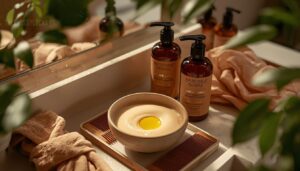
Your wash routine is the first place moisture is won or lost. A few small changes — like how often you wash and what you wash with — can make a real difference.
Small tweaks to your wash routine can go a long way — avoiding common hair washing mistakes helps your scalp stay balanced and your strands hold onto moisture better.
Here’s what to adjust.
Wash Every 2–3 Days
Washing every 2–3 days is one of the simplest wins for moisture retention. Daily overwashing strips your scalp’s natural oils before they can travel down the hair shaft — and those oils are your built-in conditioner.
This schedule also helps control sweat buildup, supports color preservation, and allows adjustments for your hair type. While fine hair may require minor tweaks, most textures thrive with this approach.
Use Sulfate-free Shampoo
Once you’ve nailed your wash schedule, shampoo choice matters just as much. Sulfates strip your scalp’s oils fast—that squeaky-clean foam feel actually signals over-cleansing. Sulfate-free shampoos use alternative surfactants like sodium cocoyl isethionate, cleaning gently without that stripped sensation.
They support moisture retention, offer scalp relief, preserve color longer, and work especially well for curly hair compatibility. These benefits arise from their gentle cleansing action, which avoids disrupting the scalp’s natural balance.
Look for hydrating shampoos containing aloe or argan oil to maximize nourishment and maintain hair health.
Rinse With Cool Water
After switching to a sulfate-free shampoo, finish every wash with a cool water rinse — around 65–75°F for 20–30 seconds.
Cold water rinse benefits include cuticle smoothness, frizz control, and gloss enhancement, because cooler temps flatten the hair’s outer layer and seal moisture in. Scalp soothing is a bonus, too. It’s one of the simplest moisture retention upgrades you can make.
Refresh With Dry Shampoo
Cool water locks in moisture — dry shampoo keeps it there between washes. On non-wash days, a quick spritz at the roots manages oil absorption without disturbing your hair’s natural moisture balance.
Hold the can 8–12 inches away, wait 1–3 minutes, then brush through.
Here’s what to look for:
- Root Lift without flatness
- Matte Finish that cuts shine at the roots
- Fragrance-Free Option for sensitive scalps
- Residue Prevention with fine-milled powders
- Oil Absorption that aids moisture retention without drying hair out
Avoid Stripping Natural Oils
Your scalp works hard to produce natural oils — don’t let your routine undo that. Use a sulfate-free shampoo, avoid over-washing, and swap rough towels for microfiber drying to reduce friction quickly.
Gentle detangling, silicone-free conditioners, and a light oil seal build a protective barrier.
Keep clarifiers minimal, skip harsh chemicals, and try a scalp massage to boost circulation without stripping.
Condition and Seal Hair Properly
Washing is only half the job — what you do right after matters just as much. Conditioning and sealing your hair the right way keeps that moisture locked in instead of escaping into thin air.
Here’s exactly how to do it.
Focus Conditioner on Ends

Your ends are the oldest, most fragile part of your hair — and they need the most attention. Focus conditioner from mid-lengths down, not the roots. This targeted slip smooths end cuticle roughness, boosts moisture lock, and enhances frizz reduction right where it counts.
Consistent conditioner layering here is your first real defense against split ends and dryness creeping up the strand.
Apply Leave-in on Damp Hair

Timing matters here — always apply your leave-in conditioner while hair is still damp, not soaking wet. Use the patting dry method first: gently blot excess water until strands feel wet but not dripping. This ideal moisture level lets your leave-in spread evenly.
Start with a small leave-in quantity, work it through mid-lengths, and practice scalp avoidance. A water-based leave-in spray promotes moisture retention beautifully before you seal with oil.
Try LOC or LCO
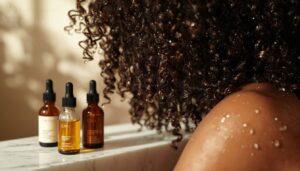
Think of LOC and LCO as layer sequencing systems — each step builds on the last to enhance moisture retention. Apply your water-based leave-in conditioner first, then follow the LOC method (liquid → oil → cream) for a high-porosity strategy, or switch to LCO for a low-porosity choice.
Porosity pairing matters: LCO’s oil sealing finish keeps moisture retention strong on finer hair strands.
Seal With Oils or Creams
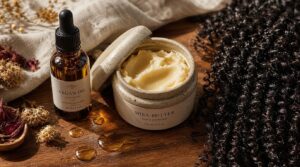
Once you’ve layered your leave-in with LCO, seal with an oil or butter to lock everything in. Oil viscosity and porosity matching both matter here—use a lightweight oil for fine strands, and a richer butter for thicker hair. Thin layer application prevents sealant buildup, and mineral oil’s stability makes it a reliable option year-round.
- Fine hair: 2–3 drops of argan oil
- Coarse or dry hair: a small amount of shea butter
- All types: apply to damp strands only
Section Hair for Coverage
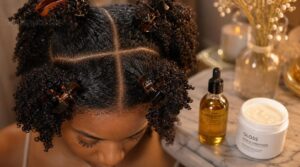
Most people lose moisture retention gains by skipping sections. To prevent this, part your hair into four quadrants using a tail comb, then release a perimeter strip first—this keeps the rest clipped and contained. Match your section size to your hair’s density, and maintain even clip tension to ensure each area receives equal product.
Apply your leave-in conditioner and oil to seal in the moisture, ensuring every strand is reached.
Use Weekly Moisture Treatments

Weekly treatments give your hair the deep hydration it can’t get from daily washing alone. Think of them as a reset — a chance to refill what heat, weather, and styling slowly take away.
Here are five simple options worth adding to your routine.
Deep Condition Once Weekly
Once a week, a deep conditioning treatment is your hair’s reset button. Apply your deep conditioner or deep treatment hair mask after shampooing, then cover with a shower cap. This Warm Cap Method traps warmth and extends conditioning duration, allowing the formula to penetrate effectively.
Humectant benefits from ingredients like glycerin actively pull moisture in, enhancing hydration. Rinse with cool water to seal the cuticle, then proceed directly to Post-Condition Styling on damp hair for optimal results.
If you’re vegan, check the label for third-party certifications, since how to tell if glycerin is vegan isn’t always obvious from sourcing alone.
For an equally gentle approach to cleansing before you condition, try one of these moisturizing bar soaps with shea butter and glycerin to keep skin and hands hydrated too.
Avoid applying products heavily near the roots, as Scalp Considerations are critical to preventing buildup and maintaining scalp health.
Try Hot-oil Treatments
Hot-oil treatments work a lot like your deep conditioning treatment — but oil goes deeper. Warm coconut, argan, or jojoba oil improves hair oil absorption and helps oil to seal in the moisture your strands lose between wash days. Follow these Frequency Guidelines and steps for safe, effective results:
- Temperature Safety – Heat oil until warm, not hot. Test on your wrist first.
- Coverage Technique – Section hair, then work oil from scalp to ends using fingertips.
- Treatment Timing – Leave oil on for 15–30 minutes, covered with a shower cap.
- After-Treatment Cleanse – Shampoo thoroughly to remove residue and prevent buildup.
- Frequency Guidelines – Repeat weekly for dry hair; every two weeks for fine hair.
Banana and Olive Oil Mask
Oils aren’t the only way to give your hair a deep treatment hair mask — your kitchen works too.
Mash one ripe banana with a tablespoon of olive oil until the mask texture is completely smooth, no lumps. Apply from mid-lengths to ends, then leave it on for 20–30 minutes for full moisture retention. Rinse thoroughly — cloudy water means residue is still there.
Aloe Vera Hydration Spray
If masks feel like too much prep, a water-based leave-in spray is your everyday shortcut. Mix ¼ cup aloe vera gel with 240ml water—this aloe concentration keeps the humectant boost steady without buildup.
Your application technique matters: sweep evenly, root to end.
Film formers and preservative choice in store-bought versions help with moisture retention between wash days, making leave-in spray usage simple.
Honey and Coconut Mask
Want a richer treatment? A honey and coconut oil DIY mask delivers real deep conditioning results. Honey pulls moisture in — coconut oil seals it there.
- Mix 2 tablespoons each of honey and coconut oil until smooth
- Apply evenly, leave on 15–20 minutes
- Rinse thoroughly; patch-test first for safety checks
Together, they boost moisture retention without complicated prep.
Protect Hair From Moisture Loss

Moisture doesn’t just disappear on its own — daily habits quietly pull it out. Heat, chemicals, friction, and split ends all work against the hydration you’ve built up.
Daily habits quietly drain your hair’s moisture — heat, friction, and chemicals undo the hydration you’ve worked to build
Here’s what to do to stop that from happening.
Limit Heat Styling
Every pass with a flat iron pulls moisture right out of your strands. Smart Temperature Control starts at the lowest effective setting—usually below 450°F—to minimize damage.
Limit Styling Frequency to two or three times weekly, and adopt a Sectional Technique to ensure each strand endures fewer passes.
Pre-dry preparation is critical: always begin with fully dry hair and prioritize Heat-Safe Tools featuring ceramic plates for even heat distribution.
| Heat Factor | What to Do | Why It Helps |
|---|---|---|
| Temperature | Stay below 450°F | Cuts heat styling damage |
| Frequency | 2–3x per week max | Lowers heat styling risk |
| Technique | Work in small sections | Reduces repeated exposure |
Use Thermal Protectant
Think of a thermal protectant spray as a shield you put on before the heat hits. A good heat protectant spray uses a Silicone Barrier and Heat‑Resistant Polymers to guard each strand — apply it as Pre‑Styling Application on damp hair, never after.
- Spray evenly from mid-lengths to ends
- Choose lightweight formulas for fine hair (Hair Type Suitability)
- Look for Humectant Inclusion — panthenol keeps moisture in during styling
- A quality thermal protection spray can withstand up to 450°F
- Consistent heat damage prevention starts before you even touch the iron
Avoid Harsh Chemical Treatments
Permanent dyes and relaxers break down your hair’s structure — and that makes it harder to hold onto moisture. Whenever you can, choose gentle coloring methods like low-amine dyes or formaldehyde-free straightening treatments.
Pair those with alcohol-free styling products and fragrance-free products to reduce scalp stress. Even switching to sulfate-free shampoo helps with chemical damage repair by keeping your natural hair oils intact.
Sleep on Satin or Silk
Your pillowcase might be quietly wrecking your hair every night. Cotton grabs and pulls at your strands for hours — that friction lifts the cuticle, leaving hair frizzy and dry by morning. Switching to a satin pillowcase or silk pillowcase delivers real cuticle preservation while you sleep.
Key benefits include:
- Satin and silk enable friction reduction so hair glides instead of snags
- Fewer snags overnight means snag-free mornings with less breakage at the brush
- Smooth fabric limits cuticle lifting, supporting nighttime hydration
- A satin bonnet keeps every strand tucked and protected
- Both options improve thermal comfort by reducing heat buildup at the pillow
These fabrics also enhance thermal comfort by minimizing heat retention during sleep. Overnight hair protection this simple is worth trying tonight.
Trim Every 8–12 Weeks
Split ends don’t just look rough — they travel up the shaft and break off healthy hair. A trim every 8–12 weeks manages split end control before that happens, supporting length retention and breakage prevention.
Regular trims also maintain your hair’s shape, ensuring your moisture routine works effectively on hair built to hold it. For ideal growth, stylists often recommend a 6‑8 week trimming schedule.
Top 5 Hair Moisture Products
The right products can make or break your moisture routine. These five picks cover every step — from cleansing to styling — so your hair stays hydrated from wash day to the end of the week.
Here’s what’s worth adding to your shelf.
1. Voice of Hair Deep Cleanse Shampoo
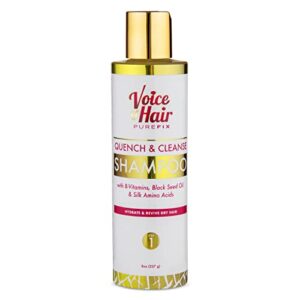
Your wash routine starts here. The Voice of Hair Deep Cleanse Shampoo is sulfate-free, clearing buildup and excess oil without stripping strands of moisture. Its thin, plant-based formula spreads evenly on all hair types—curly, natural, in-between, or chemically treated.
The pH-balanced blend keeps cuticles smooth while prepping your scalp for subsequent treatments.
At 8 fl oz, a little goes a long way, making it a smart, cost-effective first step.
| Best For | Anyone wanting a gentle, effective cleanse that works across all hair types—natural, transitioning, silk-pressed, or chemically treated. |
|---|---|
| Product Type | Clarifying Shampoo |
| Hair Types | All textures |
| Key Ingredient | Hibiscus extract |
| Free Of | Sulfates, parabens, alcohol |
| Price Range | Premium |
| Best Use | Pre-treatment cleanse |
| Additional Features |
|
- Plant-based and free of sulfates, parabens, and alcohol—so it cleans without the damage
- PH-balanced formula preps your scalp so deep conditioners and treatments actually sink in
- A little goes a long way, so that 8 oz bottle lasts longer than you’d expect
- The thin, watery lather can feel like it’s not doing much, even when it is
- Very dry or porous hair will likely need a solid conditioner to follow up
- It’s priced higher than your average drugstore shampoo, so it’s an investment
2. Voice of Hair Black Seed Moisture Conditioner
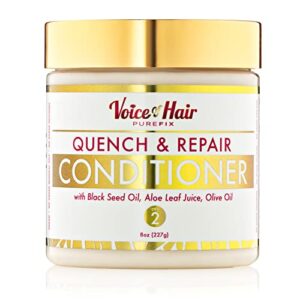
Once your scalp is clean, your strands are ready to drink in moisture. Voice of Hair Black Seed Moisture Conditioner excels at this task. Packed with black seed oil, aloe vera, and fruit extracts, it hydrates from mid-shaft to ends.
Apply the conditioner to damp hair, leave it on for up to 15 minutes with a cap, then rinse with cool water. This process ensures deep hydration without heaviness.
The formula detangles easily, leaves no heavy residue, and works effectively on curly or color-treated hair.
| Best For | Anyone with curly, dry, or color-treated hair—especially those with natural or high-porosity hair who want serious moisture without a lot of fuss. |
|---|---|
| Product Type | Scalp Oil |
| Hair Types | All textures |
| Key Ingredient | Black castor oil blend |
| Free Of | Parabens, alcohol |
| Price Range | Mid-range |
| Best Use | Scalp treatment |
| Additional Features |
|
- Packed with good stuff—black seed oil, aloe vera, and fruit extracts that actually nourish your hair and scalp
- Detangles really well and leaves curls defined without feeling heavy or coated
- Clean formula: no parabens, sulfates, or mineral oils, and it’s cruelty-free
- It’s pricier than most drugstore conditioners, so it might not be an everyday budget pick
- The fragrance is on the strong side, which could be a problem if you’re scent-sensitive
- Getting the best results means leaving it on for 15 minutes with a cap—not ideal when you’re in a rush
3. SheaMoisture Jamaican Black Castor Oil Leave In Conditioner
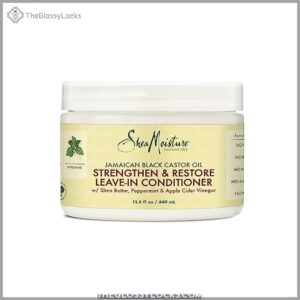
Once your rinse-out step is done, it’s time to lock that moisture in. SheaMoisture Jamaican Black Castor Oil Leave-In Conditioner does exactly that — without feeling heavy on your strands. Spray or smooth it onto damp hair, and the Jamaican Black Castor Oil and Shea Butter get to work sealing your cuticles and softening tangles.
It’s silicone-free, so there’s no buildup to worry about. Works well on curly, kinky, or color-treated hair — from 3A to 4C.
| Best For | Anyone with curly, kinky, wavy, or chemically treated hair who wants a lightweight leave-in that detangles, fights frizz, and adds moisture without weighing strands down. |
|---|---|
| Product Type | Deep Conditioner |
| Hair Types | Curly, natural, color-treated |
| Key Ingredient | Black seed oil |
| Free Of | Sulfates, parabens, alcohol |
| Price Range | Premium |
| Best Use | Deep conditioning |
| Additional Features |
|
- Jamaican Black Castor Oil and Shea Butter soften hair and seal cuticles, making detangling way less of a battle
- Clean formula — no silicones, sulfates, or parabens — so no buildup over time
- Works across a wide range of hair types, from loose waves to tight 4C coils
- The texture runs thinner than older versions, which can feel too light if you have fine hair
- The sweet, honey-like scent is pretty strong — not great if you’re sensitive to fragrance
- It’s a leave-in only, so if your hair is seriously damaged, you’ll still need a dedicated deep conditioner
4. Marc Anthony Leave In Conditioner Spray
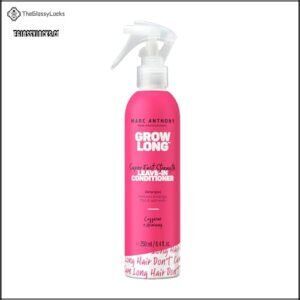
Another solid option for daily moisture is the Marc Anthony Leave-In Conditioner Spray. At $8.67 for 8.45 fl oz, it punches well above its price.
The formula blends ginseng, biotin, caffeine, and vitamin E — so you’re feeding your follicles while fighting frizz.
Spray 2–3 pumps onto damp hair, root to tip, and skip the rinse.
It’s sulfate-free, paraben-free, and works on curly, fine, bleached, or color-treated hair without leaving a greasy finish.
| Best For | Anyone who wants an easy, affordable daily leave-in that works across hair types — especially great for curly, color-treated, or frizz-prone hair. |
|---|---|
| Product Type | Leave-In Cream |
| Hair Types | Kinky, curly, wavy |
| Key Ingredient | Jamaican black castor oil |
| Free Of | Silicones, sulfates, parabens |
| Price Range | Budget |
| Best Use | Daily detangling |
| Additional Features |
|
- Lightweight formula that conditions and detangles without weighing hair down or leaving a greasy feel
- Packed with ginseng, biotin, caffeine, and vitamin E — solid nutrients for stronger, healthier-looking hair over time
- Works on pretty much every hair type and is free of sulfates, parabens, and phthalates
- Can feel a bit stiff or dry when applied to soaking-wet hair — damp or dry hair gets better results
- Fine or thin hair can get greasy fast if you overdo it, so less is more
- Hair growth benefits are slow and gradual — don’t expect overnight results
5. Hot Tools Pro Artist 24K Gold Curling Iron
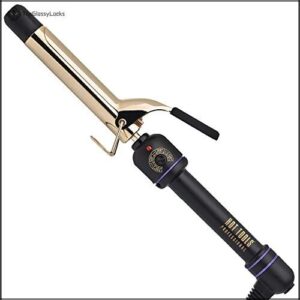
Heat styling doesn’t have to mean dry, damaged hair. The Hot Tools Pro Artist 24K Gold Curling Iron gives you control without the compromise. Its gold barrel spreads heat evenly, preventing scorching in the same spot.
Dial it down to a lower setting for fine or dry strands—it reaches up to 430°F, which is plenty. The swivel cord won’t tangle, and the fold-away stand keeps things tidy.
Just don’t forget to switch it off manually when you’re done.
| Best For | Anyone who styles their hair regularly at home or in the salon and wants precise heat control without sacrificing long-lasting results. |
|---|---|
| Product Type | Leave-In Spray |
| Hair Types | All hair types |
| Key Ingredient | Biotin & caffeine |
| Free Of | Sulfates, parabens, phthalates |
| Price Range | Budget |
| Best Use | Daily styling |
| Additional Features |
|
- The 24K gold barrel heats up fast and distributes warmth evenly, so you’re not fighting hot spots or uneven curls.
- Variable temperature up to 430°F gives you real control—dial it down for fine hair, crank it up for thick or coarse strands.
- The 8-ft swivel cord and fold-away stand make it easy to move around without the usual cord chaos.
- There’s no auto shutoff, so you have to remember to turn it off yourself every single time.
- The clamp runs shorter than the barrel, which can make it tricky to grip longer sections of hair cleanly.
- 430°F is seriously hot—fine or damaged hair needs a careful hand on that dial or you risk overdoing it.
Frequently Asked Questions (FAQs)
Is it okay to sleep with 70% dry hair?
It’s not ideal. Hair is more fragile when damp, and pillow friction can cause breakage overnight. Aim to dry your hair to at least 90% before bed to stay safe.
Since wet strands can lose up to half their strength, following a few simple tips for sleeping with wet hair safely can make a real difference in preventing breakage.
Does hair porosity affect moisture retention methods?
Yes, it does. High porosity hair soaks up moisture fast but loses it just as quickly. Low porosity hair resists water entry but holds it longer once it’s in.
If you’re wondering whether heat styling changes any of this, how straightening affects natural hair growth and length retention is worth a read before you reach for the flat iron.
For high porosity hair especially, sealing in that moisture matters, so pairing your routine with the best holding gel for natural hair can help lock in hydration all day.
Can diet and hydration impact hair moisture levels?
Your diet does affect your hair’s moisture levels. Drinking enough water, eating healthy fats like salmon, and getting key vitamins help your scalp stay balanced and your strands feel softer.
How does humidity affect hair moisture throughout the day?
Humidity plays both sides. Morning air adds moisture to your strands, softening them — but by afternoon, swollen cuticles create frizz.
Indoors, drier air pulls that moisture back out, leaving hair less hydrated by evening.
Are there hairstyles that naturally retain more moisture?
Protective styles like braids, twists, and tucked buns naturally hold moisture longer. They limit air exposure, reduce friction, and keep ends shielded — so your hair stays hydrated between wash days.
Conclusion
Like the tale of the leaky bucket, adding more water never solved the hole — and your hair works the same way. Learning how to retain moisture in hair isn’t about piling on more products. It’s about sealing what you already put in.
Cool rinses, leave-ins on damp strands, satin pillowcases, weekly deep conditioning — each step closes a gap. Work these habits consistently, and dry hair becomes a problem you’ve already solved.