This site is supported by our readers. We may earn a commission, at no cost to you, if you purchase through links. This content is for general informational and educational purposes only and is not a substitute for professional medical, dermatological, or nutritional advice.
Your skin stings after a single pea-sized dab of retinol, and now your cabinet holds a tube you’re afraid to touch. That reaction is common, and it doesn’t mean retinol and sensitive skin can’t coexist.
So, is retinol cream safe for sensitive skin? For most people, yes, with the right formula and a slow start. Retinol speeds up cell turnover, which smooths texture and fades dark spots, but it also loosens your skin barrier and sparks redness along the way.
You can keep the benefits and cut the burn. The right strength, a few supporting ingredients, and smart timing make all the difference.
Table Of Contents
- Key Takeaways
- Is Retinol Safe for Sensitive Skin?
- Why Retinol Can Irritate Sensitive Skin
- Choosing Gentler Retinol for Sensitive Skin
- How to Introduce Retinol to Sensitive Skin
- Retinol Reactions: When to Pause or Stop
- Top 5 Retinol Options and Gentle Alternatives
- Frequently Asked Questions (FAQs)
- Is it okay to use retinol if you have sensitive skin?
- What is the dark side of retinol?
- Who should avoid using retinol?
- What is the 123 rule for retinol?
- Can retinol cream be used around the eyes?
- Does retinol cream expire or lose potency?
- How long until retinol shows visible results?
- Can retinol cream be used on neck?
- Should retinol cream be stored away from light?
- Conclusion
Key Takeaways
- Retinol is usually safe for sensitive skin when you pick a low-strength or encapsulated formula with barrier-supporting ingredients like ceramides and niacinamide, since the product you choose matters as much as how you use it.
- You’ll tolerate it best if you start with one night a week, add nights slowly toward every other night, and apply it to completely dry skin between layers of moisturizer.
- Wear sunscreen every morning and keep acids and benzoyl peroxide away from your retinol routine, because retinol makes your skin more sun-sensitive and stacking strong actives adds irritation.
- Mild tingling, flaking, or purging usually fades as your skin adapts, but you should stop if you get lingering burning, swelling, a spreading rash, or blistering, and see a dermatologist if it doesn’t improve.
Is Retinol Safe for Sensitive Skin?

When your skin reacts easily, can retinol still belong in your routine? Usually, yes. Retinol is safe for most people with sensitive skin, provided you choose a gentle formula and use it with care. Dermatologists often recommend it because few ingredients have stronger evidence for smoothing texture, fading dark spots, and softening fine lines.
Since the delicate skin around your eyes is especially prone to irritation, pairing retinol with one of these under-eye creams for puffiness can keep that area soothed and hydrated.
The catch is that gradual introduction matters more than the product itself. Your skin needs time to adjust, and rushing that process is the most common reason people quit. Dermatologists commonly suggest the retinol sandwich method, which layers moisturizer before and after retinol to minimize irritation and build tolerance. Mild irritation, such as brief redness or light flaking, can happen even with careful use. It usually settles as your skin adapts.
Persistent burning, swelling, or a rash is different, though. Stop and protect your barrier function.
Why Retinol Can Irritate Sensitive Skin
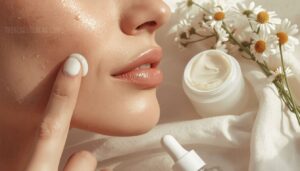
Retinol speeds up how fast your skin sheds old cells, and that’s where the trouble starts. Your skin can’t rebuild its protective lipids as quickly, so water escapes more easily. That barrier disruption shows up as dryness, tightness, and peeling.
Retinol also triggers an inflammatory response. It draws in immune cells that release signaling proteins like IL-8, which is why redness and stinging can linger. In sensitive skin, this reaction starts at a lower threshold, especially if you have eczema, rosacea, or naturally dry skin.
Other habits make it worse. Layering retinol with acids or scrubs, skipping sunscreen, or using fragranced products adds stress your skin can’t absorb. Gradual introduction gives your skin time to adapt, and it’s the foundation of skin sensitivity management.
Choosing Gentler Retinol for Sensitive Skin

Not every retinol product treats sensitive skin the same way, and the formula you pick matters as much as how you use it.
Below, you’ll find three options to look at, each with a different way of lowering the odds of irritation.
Read through them with your own skin’s habits in mind, then choose the one that fits your comfort level and goals.
Low-Strength Retinol and Encapsulated Formulas
Think of encapsulated retinol as a time-release capsule for your face: it opens slowly instead of dumping everything at once. That’s why it suits sensitive skin. Start with 0.1% to 0.3%, or lower if you’re nervous. Pair it with a moisturizer, and expect a mild retinization phase. If irritation lingers, use it less often.
Encapsulated retinol works like a time-release capsule for your face, opening slowly so sensitive skin is never overwhelmed all at once
Barrier-Supporting Ingredients in Retinol Creams
Encapsulation softens retinol’s delivery, but the formula around it matters just as much. Look for ceramides and niacinamide at 4-5%, which helps your skin’s own lipid barrier and calms redness. Panthenol soothes irritation, while cholesterol and fatty acids help rebuild what retinol disrupts.
Together, these ingredients provide barrier function support, so sensitive skin tolerates the process better.
HPR and Bakuchiol: Evidence and Limitations
A gentler label doesn’t guarantee a gentler experience, so treat HPR and bakuchiol with some caution. HPR is a retinoid ester, not retinol, and evidence that it irritates less is limited.
If your skin reacts anyway, pairing these actives with a non-greasy moisturizer for dry skin can cushion dryness without leaving a heavy film.
Bakuchiol is plant-derived and not a retinoid. One small 12-week trial found less stinging than with retinol. Still, irritation can occur on sensitive skin, so patch test and support skin barrier repair.
How to Introduce Retinol to Sensitive Skin
Even a gentle retinol can cause trouble if you rush it, so your routine matters as much as your product. Three habits will help you build tolerance safely, and they’re covered in the steps below. Work through them in order, and you’ll know what to adjust and when.
Starting Frequency and Gradual Increases

Patience protects sensitive skin better than any product. Start with one Retinol application per week for two to four weeks, since retinization (your skin’s adjustment period) happens gradually.
Increase only after two comfortable weeks without tightness or flaking. Add one night at a time, moving toward every other night. Check your skin three days later, because irritation can arrive late.
Dry-Skin Application and Moisturizer Sandwiching

Picture Maya, who has sensitive skin and just washed her face before bed. She smooths on retinol right away, and within minutes her cheeks sting. The culprit is likely damp skin, which lets retinol penetrate faster.
Wait until your face is completely dry. Then try the sandwich method: thin moisturizer, retinol, another moisturizer, ideally with ceramides for barrier repair.
Daily Sunscreen and Ingredients to Separate

Retinol works at night, but sunscreen protects you all day. Apply it every morning, since retinol raises photosensitivity. Mineral formulas with zinc oxide or titanium dioxide cause less irritation on sensitive skin.
Keep acids and benzoyl peroxide away from your retinol routine. Use vitamin C, salicylic acid, or benzoyl peroxide in the morning, retinol at night.
Retinol Reactions: When to Pause or Stop

Not every sting means your skin is failing. Mild tingling and light flaking are common while your skin adjusts, and they usually fade within a couple of weeks. Purging, a temporary round of breakouts from faster cell turnover, can look alarming but isn’t harm. Barrier disruption is different, and it needs a full stop.
Pause retinol completely if you notice any of these:
- Burning or stinging that lingers after application
- Marked redness that isn’t settling
- Swelling, weeping, or a rash that spreads beyond where you applied it
- Blistering, crusting, or open sores
- Pus, fever, or spreading redness, which signal infection
Switch to a gentle cleanser, a ceramide moisturizer, and SPF 30+. Mild irritation usually clears in 3 to 5 days. If symptoms worsen or don’t improve, see a dermatologist.
Top 5 Retinol Options and Gentle Alternatives
The five products below put the advice from earlier into practice, and each one fits a slightly different kind of sensitive skin. You’ll see traditional retinol, encapsulated formulas, and gentler alternatives like HPR and bakuchiol, so you can match your choice to how your skin usually reacts.
Whichever you pick, start slowly and let your skin set the pace.
1. Versed Press Restart Retinol Serum
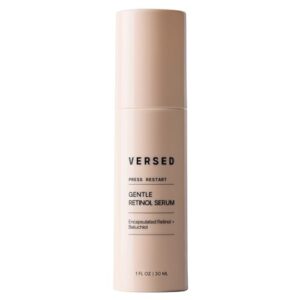
If you’re new to retinol and your skin reacts to everything, this serum is a sensible place to start. It pairs microencapsulated retinol, which releases slowly to limit irritation, with bakuchiol, a plant-based alternative. Antioxidants add extra support.
Used at night, it reforms texture, softens lines, refines tone, keeps pores clear, and helps fade brown spots.
Two caveats apply. Reviews are mixed on fragrance, with some finding it pleasant and others strong. Experienced retinol users may find it too mild. Keep it away from your eyes.
| Best For | People who are new to retinol or have sensitive skin and want a gentle nighttime anti-aging serum. |
|---|---|
| Weight | 2.4 ounces |
| Dimensions | 1.59 x 1.59 x 5 in |
| Model Number | V020-01-0000 |
| Key Actives | Microencapsulated retinol, bakuchiol |
| Sensitive Skin | Formulated for sensitive skin |
| Main Benefit | Softens lines and wrinkles |
| Additional Features |
|
- Microencapsulated retinol and bakuchiol give gentle anti-aging action that is easier on sensitive skin
- Softens lines and wrinkles, improves texture, and refines skin tone overnight
- Keeps pores clear, helps fade brown spots, and includes added antioxidants
- Fragrance gets mixed reviews, with some people finding it too strong
- May not be strong enough for experienced retinol users
- Must be kept away from the eye area during application
2. Caudalie Resveratrol-Lift Instant Firming Serum
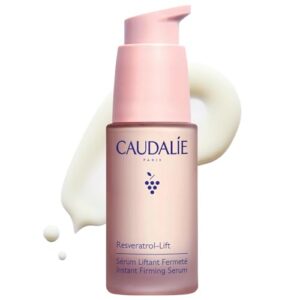
If even gentle retinol feels like too much, this serum skips it entirely. Caudalie’s formula relies on resveratrol, a grape-derived antioxidant, plus two sizes of hyaluronic acid for a soft, hydrated feel. It’s non-comedogenic and non-irritating, and it’s labeled safe during pregnancy and breastfeeding, when retinol is usually avoided.
The brand says it firms three times better than retinol. Still, expect less change in deep wrinkles, and very dry skin may need a richer moisturizer. Some shoppers find it pricey.
| Best For | People who want to firm and hydrate their skin without retinol, including those who are pregnant or breastfeeding, and who have normal to combination skin or only moderately dry skin. |
|---|---|
| Weight | 1.06 ounces |
| Dimensions | 1.57 x 2.36 x 4.72 in |
| Model Number | 424NA |
| Key Actives | Resveratrol, hyaluronic acid, vegan collagen |
| Sensitive Skin | Non-irritating, all skin types |
| Main Benefit | Firms and reduces wrinkles |
| Additional Features |
|
- Uses resveratrol, hyaluronic acid, and vegan collagen to visibly firm skin and reduce the look of wrinkles, with no retinol.
- Non-comedogenic and non-irritating, so it suits all skin types and is safe during pregnancy and breastfeeding.
- Two sizes of hyaluronic acid hydrate the skin and leave it feeling soft, and the aluminum tube is recyclable and refillable.
- May not provide enough moisture for very dry skin, which might need a richer moisturizer on top.
- Likely to be less effective on deep wrinkles than retinol, despite the brand’s claim that it firms three times better.
- Some customers feel it’s overpriced for the results.
3. Cocokind Beginner Retinol Gel 0.1%
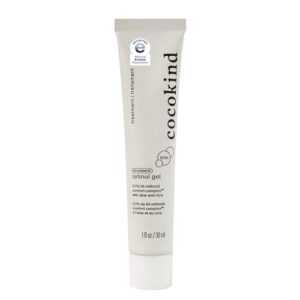
If you’d still like a retinoid, this gel is a gentler way in. Cocokind’s Tri-Retinoid Comfort Complex combines three retinoid types at 0.1% total, so you get a low-strength formula rather than a single high dose. Aloe, cica, and squalane help prevent dryness, and it’s clinically tested for sensitive skin.
Start every other night, and use daily sunscreen. Very sensitive skin may still feel slightly drier, so pair it with a moisturizer. It can help soften fine lines and uneven texture over time.
| Best For | People with sensitive skin who are new to retinoids and want a gentle, low-strength way to soften fine lines and uneven texture. |
|---|---|
| Weight | 1.44 ounces |
| Dimensions | 1.13 x 1.13 x 5.21 in |
| Model Number | 0810041460790 |
| Key Actives | 0.1% Tri-Retinoid complex |
| Sensitive Skin | Clinically tested for sensitive skin |
| Main Benefit | Improves fine lines, texture |
| Additional Features |
|
- Uses a 0.1% Tri-Retinoid Comfort Complex, giving a low-strength formula instead of a single high dose
- Includes aloe, cica, and squalane to help prevent dryness and support the skin barrier
- Clinically tested for sensitive skin and can help skin feel firmer with regular use
- Works best when started slowly, with application only every other night at first
- May still cause a slight increase in dryness for very sensitive skin
- Requires daily sunscreen, since retinol products make skin more sensitive to the sun
4. RoC Retinol Correxion Max Hydration Moisturizer
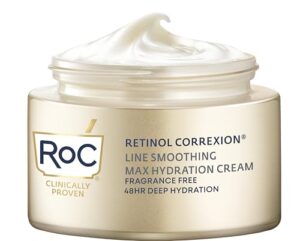
If your skin feels tight after cleansing, this moisturizer pairs retinol with hyaluronic acid and glycerin, which draw in and hold water. It’s fragrance-free, paraben-free, non-comedogenic, and dermatologist-tested, and the 48-hour hydration claim comes from clinical testing.
Begin every other night, since dryness, redness, or mild flaking can show up early. Wear SPF 30+ by day, and skip strong exfoliants while your skin adjusts.
The lightweight texture layers well under makeup. Visible improvement in fine lines can appear within a week.
| Best For | People with dry or tight-feeling skin of any type who want a fragrance-free, lightweight moisturizer that fights fine lines and layers well under makeup. |
|---|---|
| Weight | 1.7 ounces |
| Dimensions | 4.5 x 2.5 x 2.5 in |
| Model Number | N/A |
| Key Actives | Retinol, hyaluronic acid, glycerin |
| Sensitive Skin | N/A |
| Main Benefit | Reduces fine lines, hydrates |
| Additional Features |
|
- Combines retinol with hyaluronic acid and glycerin for both wrinkle reduction and hydration, with 48-hour hydration shown in clinical testing
- Fragrance-free, paraben-free, non-comedogenic, and dermatologist-tested, with an oil-free formula suitable for all skin types
- Lightweight texture layers well under makeup, and smoother skin and fewer fine lines can show within a week
- Can cause dryness, tightness, mild flaking, or redness when you first start using retinol
- Requires daily broad-spectrum SPF 30 during the day while you use it
- Shouldn’t be paired with other strong exfoliants while your skin adjusts, which limits your routine at first
5. Elizabeth Arden Retinol + HPR Cream
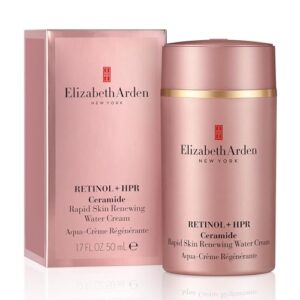
If you want a retinol cream built around barrier care, this one pairs 2% retinol and HPR with ceramides, which help strengthen your moisture barrier. It comes in a 1.7 oz airless pump, so each dose stays consistent. You can use it day or night, even as a first-time retinol user, though starting slowly is still sensible.
Results vary. Some people report irritation or no visible improvement, and reviews on value are mixed. Skip acids and exfoliants while using it.
| Best For | People who want an anti-aging retinol cream with added moisture barrier support, including those trying retinol for the first time. |
|---|---|
| Weight | 1.7 oz |
| Dimensions | 2 x 2 x 4 in |
| Model Number | A0133041 |
| Key Actives | 2% retinol, HPR |
| Sensitive Skin | First-time retinol users |
| Main Benefit | Reduces wrinkles, pores |
| Additional Features |
|
- Contains 2% retinol and HPR to target wrinkles and visible signs of aging
- Formulated with ceramides to strengthen the moisture barrier
- Airless pump delivers consistent dosing and can be used day or night
- Some users report no visible improvement or skin irritation
- Mixed feedback on value for money relative to results
- Should not be combined with acids or exfoliants, which limits routine flexibility
Frequently Asked Questions (FAQs)
Is it okay to use retinol if you have sensitive skin?
About 30% of people with sensitive skin quit retinol early because of irritation. Still, you can use it. Start low, patch test first, and watch for barrier disruption. Go slowly, and your skin usually adapts.
What is the dark side of retinol?
You might think retinol’s reputation is overblown, and for many people it is. Still, it can cause irritation, barrier disruption, and flare-ups of eczema or rosacea. It also raises sun sensitivity and isn’t safe during pregnancy.
Who should avoid using retinol?
If you’re pregnant, trying to conceive, or have a known retinoid allergy, skip retinol. Also hold off with active eczema, rosacea flares, dermatitis, or cracked, sunburned skin, and check first with your dermatologist about isotretinoin.
What is the 123 rule for retinol?
Say you buy your first retinol on Sunday and want to use it nightly. The 123 rule stops that: apply once weekly, then twice, then three times, each for one week, so sensitive skin adapts gradually.
Can retinol cream be used around the eyes?
Eye-area formulas usually keep retinol at 1% or below. Yes, you can use it there with care on sensitive skin, but avoid eyelids, since irritation and barrier compromise come quickly. Moisturizer also helps moisture retention.
Does retinol cream expire or lose potency?
Like a candle left burning, retinol quietly fades. It does expire, usually within 6-12 months of opening, and potency can drop without visible changes. Encapsulated retinol, timerelease retinol, and antioxidant protection help slow this loss.
How long until retinol shows visible results?
Ever wonder why patience pays off? Texture visibly improves in 4 to 6 weeks, once cell turnover and the skin adaptation phase settle.
Fine lines need 12 to 24 weeks, as your collagen production builds.
Can retinol cream be used on neck?
Think of your neck as the quieter, more delicate cousin of your face. Yes, with caution: retinol works there, but use a lower strength, apply it after moisturizer, start twice weekly, and wear sunscreen daily.
Should retinol cream be stored away from light?
Picture a cut apple browning on the counter. Retinol does something similar in sunlight. Yes, keep your cream away from light. Store it in a cool, dark drawer, and choose opaque tubes for better retinol stability.
Conclusion
Picture someone who starts with a gentle encapsulated retinol twice a week, buffers it with moisturizer, and wears sunscreen every morning. Six weeks later, her skin looks smoother and nothing burns.
So, is retinol cream safe for sensitive skin? Usually, yes, when you go slow and listen to your skin. Pick a low strength, protect your barrier, and pause at the first sign of real irritation. Patience beats potency every time, and calm skin wins.