This site is supported by our readers. We may earn a commission, at no cost to you, if you purchase through links. This content is for general informational and educational purposes only and is not a substitute for professional medical, dermatological, or nutritional advice.

Shea butter does seal moisture into your skin, but not the way most people think. It’s not a true occlusive, and it’s not a humectant. It works as a semi-occlusive sealant, slowing evaporation rather than blocking it completely.
That distinction matters when you’re building a skincare or haircare routine. Apply it wrong and you get minimal moisture retention, or clogged pores. Apply it right and it performs exactly as intended.
Knowing whether shea butter is a sealant, and what kind, tells you when to use it, where to put it, and what to layer it with.
Table Of Contents
- Key Takeaways
- Is Shea Butter a Sealant or a Moisturizer?
- How Shea Butter Forms a Semi-Occlusive Barrier
- How to Use Shea Butter as a Skin Sealant
- How to Use Shea Butter as a Hair Sealant
- How Shea Butter Compares With Other Sealants
- Frequently Asked Questions (FAQs)
- Is shea butter moisturizing or sealing?
- What is a good natural hair sealant?
- What are the disadvantages of shea butter for skin?
- Which is better for my skin, vaseline or shea butter?
- Does shea butter expire or go rancid over time?
- Is refined shea butter less effective than unrefined?
- Can shea butter seal in serums and treatments?
- Does shea butter work as a lip sealant?
- How long does shea butters sealing effect last?
- Conclusion
Key Takeaways
- Shea butter is a semi-occlusive sealant, not a true occlusive or humectant — it slows moisture loss rather than blocking it completely, so it needs existing moisture to be effective.
- Apply shea butter to damp skin or over water-based products; without prior hydration, it only adds grease without sealing anything in.
- On acne-prone skin or near your scalp, use it sparingly — its high lipid content can clog pores and cause buildup when applied too heavily or in the wrong areas.
- Unrefined shea outperforms refined for skin healing since refining strips key anti-inflammatory compounds, though both forms retain similar moisture-sealing ability.
Is Shea Butter a Sealant or a Moisturizer?
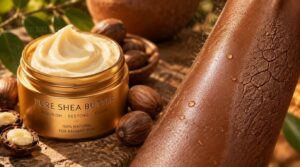
The short answer is both, but with limits. Shea butter is primarily an emollient moisturizer. It softens skin and hair by filling gaps in the outer surface layers, which reduces the dryness you can feel. That’s its strongest role.
Its ability to sink into the skin’s surface layers — rather than just sitting on top — is what makes it such a standout among organic skincare ingredients for dry skin.
Its sealant behavior is real but partial. It slows water loss from your skin and hair rather than blocking it completely. True occlusives like petrolatum form a near-impermeable film. Shea butter doesn’t do that. It functions as a semi-occlusive sealant, meaning some moisture still escapes through it.
It’s not a humectant either, so it won’t draw water into your skin. What it does is help retain the moisture that’s already there. Understanding that key distinction helps you use it more effectively.
How Shea Butter Forms a Semi-Occlusive Barrier
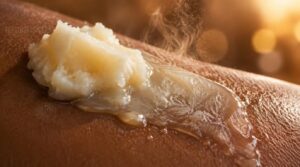
When shea butter contacts your skin, its triglycerides and stearyl esters solidify into a lipid film. It doesn’t bond to keratin. It deposits fats across the surface, and that deposition drives its sealant effect.
That film reduces transepidermal water loss by slowing evaporation. But it’s not a complete block, which separates shea from a true occlusive agent like petrolatum. It forms a semiocclusive barrier, which means some moisture and gas can still pass through.
Five factors shape how well that moisture barrier holds:
- Layer thickness determines coverage uniformity.
- Skin temperature controls lipid fluidity.
- Fat crystallization increases water diffusion resistance.
- Skin hydration changes how the film sits.
- Time thins the film as it absorbs, warms, or mixes with sweat and sebum.
How to Use Shea Butter as a Skin Sealant
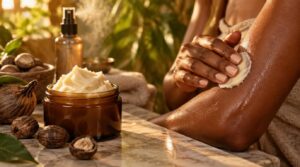
Shea butter works best as a sealant when you apply it correctly. A few simple habits make the difference between locking in moisture and wasting the product. Here’s what to keep in mind before and during application.
Pairing shea butter with a quality hydrating base—like one of these best leave-in conditioners for wavy hair—gives the sealant something worth locking in.
Apply to Damp Skin
Think of a damp sponge. It holds more than a dry one. That’s how your skin works, too.
Your skin, like a damp sponge, absorbs and retains far more than when it’s dry
| Skin | Effect | Retention |
|---|---|---|
| Dry | Minimal | Low |
| Damp | Strong | High |
| Wet | Weak | Moderate |
Apply shea to your damp skin right after cleansing. Trapped moisture slows evaporation. As a sealant, it acts as an occlusive agent, locking in moisture and building a moisture barrier.
For even better results, pair this technique with budget-friendly face hydration methods that maximize shea’s sealing power without overloading your routine.
Avoid Clogged Pores
Locking in moisture is the goal, but it’s worth knowing high lipid content carries comedogenic potential. On acne-prone skin, thick application leaves a greasy residue that traps sebum inside follicles.
Keep your layers thin. Focus on drier areas like elbows and legs, where pore-clogging potential is lower. On your face, especially the T-zone, go light or choose a noncomedogenic alternative.
How to Use Shea Butter as a Hair Sealant
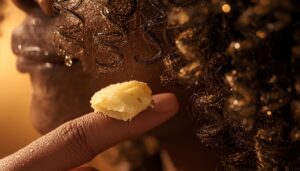
Shea butter works as a hair sealant the same way it works on skin — it locks in moisture already present in the strand. Using it correctly depends on the order of application and where you put it. A few simple steps will help you get the most out of it without weighing your hair down.
Layer After Water-based Products
Order your steps carefully. A water-based product hydrates and softens the hair shaft first, giving shea butter actual moisture to retain. That’s when it works as a proper sealant, slowing evaporation through its lipid film.
Your application technique matters: apply the leave-in, let it absorb, then layer the butter on top. Occlusives support hydration retention, not create it from nothing.
Focus on Dry Ends
Because dry hair ends are more porous, they lose moisture fastest and need the most attention in any hair sealing technique. After applying your water-based leave-in, work a small amount of shea butter between your fingers and press into the ends.
It’s a simple cuticle sealing step that creates a lasting barrier, essential for moisture retention and hair breakage prevention.
For even longer-lasting results, a hair cuticle sealant spray can reinforce that barrier on the go, keeping ends sealed and hydrated between wash days.
Prevent Scalp Buildup
Picture greasy residue building silently beneath each layer of shea butter near your roots. Sweat and sebum cling to it, thickening the film. Good scalp health doesn’t mean clogging roots: Swapping heavy butters for a lightweight scalp treatment oil lets your roots breathe without sacrificing the moisture your hair still needs.
- Keep shea butter on ends, not roots
- Clarify weekly with a sulfate shampoo
- Don’t combine heavy sealants near your scalp
- Check for buildup after every wash
How Shea Butter Compares With Other Sealants
Shea butter works well as a sealant, but it’s not your only option. Depending on your skin or hair needs, other sealants may outperform it in ways worth knowing. Here’s how shea butter stacks up against the most common alternatives.
Petrolatum and Mineral Oil
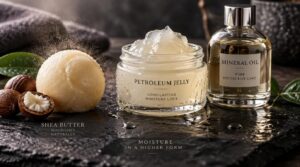
are the strongest occlusive agents you’ll find. As petroleum-based moisturizers, they deliver a tighter moisture lock than shea butter ever can.
| Sealant | Occlusion Level | Skin Feel |
|---|---|---|
| Shea Butter | Moderate | Light |
| Petrolatum | Very High | Greasy |
| Mineral Oil | High | Oily |
These are synthetic sealants that work, but their thick, greasy texture is a real trade-off for acne-prone skin.
Dimethicone and Plant Oils

Dimethicone creates a uniform, hydrophobic film that water can’t easily cross. Shea butter deposits lipids but doesn’t form the same tight, continuous seal. Plant oils behave similarly, with their occlusive properties shifting based on fatty-acid profile and viscosity. For a closer look at how shea butter behaves as a barrier ingredient, Is Shea Butter a True Sealant? breaks down why its lipid-rich profile makes it nourishing but inherently less occlusive than silicone-based films.
With synthetic sealants, you get surface consistency. With natural emollients like shea, you also get lipid nourishment alongside a looser semi-occlusive barrier.
Frequently Asked Questions (FAQs)
Is shea butter moisturizing or sealing?
Shea butter plays both sides. It’s a moisturizing emollient that softens your skin with fatty acids, but its occlusive properties also slow water loss through evaporation. That dual action places it between moisturizer and sealant.
What is a good natural hair sealant?
Heavier plant-based butters are your best bet for natural hair. Their occlusive properties help slow moisture loss more reliably than light oils do. Shea butter is a practical, widely available option with solid sealing ability.
What are the disadvantages of shea butter for skin?
Does plant-derived mean safe for your skin? Shea’s comedogenic rating is unclear, and its pore-clogging potential is real on acne-prone skin. It’s purely an occlusive, not a humectant, so that thick greasy residue won’t hydrate.
Which is better for my skin, vaseline or shea butter?
Think of a dam versus a soft cloth. Vaseline blocks transepidermal water loss more tightly than shea butter. Shea softens and partially seals your skin. For very dry skin, choose Vaseline. Otherwise, shea works well.
Does shea butter expire or go rancid over time?
Ironically, the more natural your shea butter is, the faster it can spoil. Unrefined shea butter has a shorter shelf life because natural oil extraction leaves more reactive compounds.
Store it cool, dark, and sealed.
Is refined shea butter less effective than unrefined?
For sealing, it’s not. Both forms retain the same fatty acid profile, so moisture-locking ability stays comparable. But refining strips anti-inflammatory compounds like lupeol by roughly 81%, making unrefined the far better choice for healing.
Unrefined shea butter also contains naturally occurring cinnamic acid, which provides mild UV protection and healing support that refined versions lack.
Can shea butter seal in serums and treatments?
It’s marketed as a sealant, yet shea butter doesn’t actually trap actives chemically. What it does is form a semi-occlusive barrier that slows evaporation, which helps keep your serums and treatments on the skin longer.
Does shea butter work as a lip sealant?
Shea butter can act as a semi-occlusive barrier on your lips, slowing moisture loss rather than truly sealing it. Saliva, friction, and lip movement break down the coating, so it won’t last like petrolatum does.
How long does shea butters sealing effect last?
Think of applying it before a morning workout.
Shea butter’s semi-occlusive film doesn’t last for days, it fades within a few hours. Sweat, friction, and washing all disrupt it, cutting your moisture retention window short.
Conclusion
Dermatologists often compare shea butter to a screen door: it slows airflow without sealing the room. That’s exactly how it works on your skin and hair.
Shea butter is a sealant, but a semi-occlusive one. It needs moisture already present to lock anything in. Use it on damp skin or after water-based products, and it performs well. Skip that step, and you’re just adding grease with no payoff.