This site is supported by our readers. We may earn a commission, at no cost to you, if you purchase through links. This content is for general informational and educational purposes only and is not a substitute for professional medical, dermatological, or nutritional advice.

You wash your curls, style them with care, and still see scalp shining through at the part. I’ve heard that frustration from so many people with low density curly hair, and it’s maddening. Your hair isn’t broken. It’s just working with fewer follicles.
Here’s the twist: density and strand thickness are two different things. You can have wide, coarse strands and still look sparse, or fine strands packed tight and look full. Heavy products, too much oil, and the wrong cut all flatten the curls you do have.
Once you know what you’re working with, volume gets much easier to build.
Table Of Contents
- Key Takeaways
- Identify Low Density Curly Hair
- Cleanse and Condition Low-Density Curls Lightly
- 3 Shampoos and Leave-Ins for Low-Density Curls
- Style Low-Density Curls for Root Volume
- Choose Haircuts That Make Curls Look Fuller
- Preserve Curl Volume Between Wash Days
- Frequently Asked Questions (FAQs)
- Conclusion
Key Takeaways
- Density (how many follicles you have) is separate from strand thickness and curl pattern, so check for change over time, like a widening part or sparser temples, to tell natural sparseness from true thinning.
- Keep your routine light by shampooing only your scalp and roots, conditioning just your mid-lengths and ends, and clarifying every two weeks to once a month so buildup doesn’t flatten your curls.
- Build root volume by clipping your roots upright as they dry, scrunching in lightweight gel or mousse, skipping full plopping, and diffusing until completely dry.
- Your follicle count is fixed at birth, so you can’t grow more hair, but a blunt cut with a few crown layers, regular trims, and less heat damage will make the curls you have look fuller.
Identify Low Density Curly Hair
I know how frustrating it is to stare at your curls and wonder why they never look as full as everyone else’s. Before you buy another product, it helps to figure out what’s really going on with your hair. Below, we’ll look at density versus thickness, a few simple checks you can do at home, and how to tell natural sparseness from new thinning.
Once you know your density and porosity, these natural hair product reviews can help you find formulas that suit your curl pattern and moisture needs.
Density Versus Strand Thickness
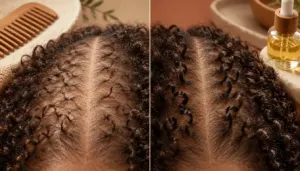
Confusion between density and thickness trips up almost everyone, and I’ve made the mix-up myself. Density is how many follicles sit on your scalp. Thickness is how wide each strand is. Density is counted in strands per square inch, independent of strand width, and it shapes your perceived hair volume.
You can have fine curly hair and still have plenty of follicles, or coarse strands with fewer follicles than you’d guess. Curl pattern is a separate thing entirely.
Fine strands can sit on a crowded scalp while coarse ones sit sparsely, and how your hair curls tells you nothing about how much grows
At-Home Density Checks and Their Limits
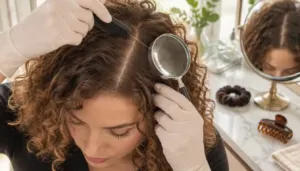
So how do you actually check? Start with scalp visibility. Part your dry, product-free hair in bright light. Clear scalp suggests lower density. Check a few spots, though, because one area won’t tell the whole story.
The ponytail test is quick, but strand width and curl clumping skew it. A grid count at the same spot, tracked over time, shows change. Only a trichoscopy can give you real hairs per square centimeter.
Natural Sparseness Versus New Thinning
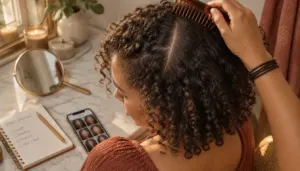
I used to panic over every wide part. Don’t. Hair density genetics often explain it. Here’s what suggests hair thinning instead:
- A part widening over several months
- Temples looking sparser than before
- Ponytails needing extra wraps
- Shed hairs with white bulbs increasing
- Tender scalp or bumps along your edges
Natural sparseness stays steady. Change is what matters, so track it.
Cleanse and Condition Low-Density Curls Lightly

Once you know where your hair stands, the fix starts in the shower. Low density curly hair flattens quickly, so lighter habits usually win.
Focus shampoo on your scalp and roots, using a quarter-size amount. Rinse conditioner out fully, and keep it off your roots.
| Step | Light approach |
|---|---|
| Shampoo | Scalp and roots only |
| Conditioner | Mid-lengths to ends, rinsed well |
| Deep condition | Pre-poo, or skip the roots |
| Styling aids | Water-based sprays or foams |
Wash frequency surprises people. You may need to shampoo daily or every other day, since oil and humidity flatten fine curls fast. Alternate a lathering low-poo shampoo with the occasional co-wash, and use a clarifying shampoo every two weeks to once a month.
Expect some trial and error.
3 Shampoos and Leave-Ins for Low-Density Curls
I know how discouraging it feels when a "volumizing" product leaves your curls flat by noon. The three picks below are the ones I’d reach for first, and they cover both the wash and the leave-in step. Each one keeps things light and residue-free, so your curls can actually clump and lift.
1. GIOVANNI Tea Tree Triple Treat Shampoo
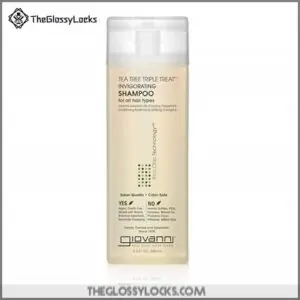
Ever grab a shampoo that promised a fresh start and got a squeaky, tight scalp instead? That’s the risk with clarifying formulas, so go in gently.
This one pairs tea tree, peppermint, eucalyptus, and rosemary with botanical oils. It’s vegan, Leaping Bunny Certified, and color-safe, and it rinses without residue. You get a cooling tingle, and it can calm flaking.
It does dry some people out, and a few report itching. Try it once a week, and follow with conditioner. At $8.33 for 8.5 ounces, testing it is cheap.
| Best For | People with a dry, flaky scalp or oily buildup who want a refreshing, color-safe, vegan clarifying shampoo at a low price. |
|---|---|
| Net Volume | 8.5 fl oz |
| Dimensions | 1.38 x 2.4 x 7.52 in |
| Model Number | 13008 |
| Color-Safe | Yes |
| Product Type | Cleansing shampoo |
| Customer Complaints | Can be drying |
| Additional Features |
|
- Made with tea tree, peppermint, eucalyptus, and rosemary plus botanical oils for a deep clean and a cooling, refreshing feel.
- Leaping Bunny Certified, vegan, and color-safe, and it rinses clean without leaving residue.
- Helps ease scalp dryness and flaking while strengthening hair, at just $8.33 for 8.5 fluid ounces.
- Some users find the formula drying.
- Experiences with scalp irritation and severe itching are mixed.
- The $8.33 price may vary depending on the retailer.
2. Briogeo Rice Amino Avocado Leave-In Crème
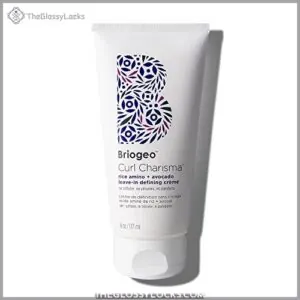
I’ve learned that low-density curls don’t need heavy products, they need smart ones. This lightweight leave-in crème fits that bill. It’s made for wavy, curly, and coily textures, with rice amino acids, avocado oil, and shea butter to lock in moisture and soften strands.
It’s free of silicones, sulfates, parabens, and phthalates, and it’s safe on color-treated hair. You’ll get better curl definition and less frizz.
Reviews on frizz control are mixed, though, and the 5.6-ounce jar costs more than some people like.
| Best For | People with wavy, curly, or coily hair, especially low-density or color-treated hair, who want a lightweight leave-in that adds moisture and curl definition without silicones or sulfates. |
|---|---|
| Net Volume | 5.6 oz |
| Dimensions | 9 x 6 x 3 in |
| Model Number | 123 |
| Color-Safe | Yes |
| Product Type | Leave-in crème |
| Customer Complaints | Mixed frizz control |
| Additional Features |
|
- Rice amino acids, avocado oil, and shea butter lock in moisture and soften strands without weighing hair down.
- Enhances curl definition, restores elasticity and shine, and reduces breakage.
- Vegan, cruelty-free, and free of silicones, sulfates, parabens, and phthalates, and safe for color-treated and chemically processed hair.
- Customer feedback on frizz control is mixed, with some reporting dull or frizzy results.
- Several customers feel it is expensive for its 5.6-ounce size.
- Product details are unclear in places, including an undefined model number and multilingual packaging.
3. Kenra Clarifying Shampoo Deep Cleansing Formula
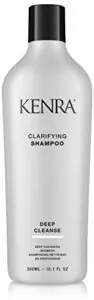
Say you’ve been using a leave-in for weeks, and your curls suddenly look flat and dull no matter what you do. I’ve been there. Buildup is usually the sneaky culprit.
This is where Kenra’s clarifying shampoo helps. It removes up to 99% of deposits, and it’s color-safe, even on bleached strands. It works in hard or well water too, and it cleanses without drying. The 10.1-ounce bottle lasts a while. Fair warning: the fragrance divides people, and the lather can be hit or miss.
| Best For | People with color-treated, bleached, gray, or highlighted hair, or anyone dealing with hard or well water, who needs to clear out dulling buildup and restore shine before a color service. |
|---|---|
| Net Volume | 10.1 fl oz |
| Dimensions | 1.6 x 2.25 x 8 in |
| Model Number | 2471147 |
| Color-Safe | Yes |
| Product Type | Clarifying shampoo |
| Customer Complaints | Polarizing fragrance |
| Additional Features |
|
- Removes up to 99% of dulling deposits and product buildup
- Color-safe for all hair types, including bleached strands
- Cleanses deeply without drying the hair and works in hard or well water
- The fragrance gets mixed reactions and may not suit every scent preference
- The lather can be inconsistent, according to user reports
- The polarizing aroma makes it a gamble for anyone sensitive to smell
Style Low-Density Curls for Root Volume
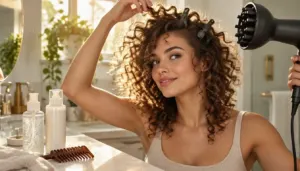
Imagine this: you wash your hair, scrunch in gel, and by lunch your crown looks flat and your part looks wide. I’ve been there, and it’s frustrating. With low density curly hair, the fix usually starts at the roots.
Clip your roots upright with duckbill clips while they dry, and pin them opposite your natural part. Skip full plopping, since a towel presses everything against your scalp.
Scrunch a lightweight gel or mousse into the roots, then focus on mid-lengths and ends. Don’t style soaking-wet hair, because it clumps and shows scalp.
Diffuse until completely dry. Diffusing for volume sets the roots in place. Once dry, scrunch out the cast and brush upward at the roots to finish it off.
Choose Haircuts That Make Curls Look Fuller

I’ve sat through enough bad haircuts to know the sting of walking out flatter than you walked in. Low density curly haircuts work best when they keep weight where you need it and leave the rest alone.
A short curly bob haircut that lands between your chin and collarbone is a great starting point. A layered curly lob haircut works too, as long as the layers stay few.
Here’s what to ask for:
- Blunt perimeter: keep the ends solid and skip thinning shears or razors.
- Crown layers only: four or five short ones lift the top without stealing bulk.
- Dry cutting: your stylist sees your real shrinkage before snipping.
Add soft face-framing pieces and you get an illusion of thickness.
Preserve Curl Volume Between Wash Days

Day three curls can feel like a lost cause. I’ve been there, staring at flat roots and a frizzy halo, ready to give up and wash.
Don’t. A little water goes a long way. Mist your curls lightly with a spray bottle, then scrunch from the ends upward. That reactivates the product already in your hair and re-clumps the pattern.
Protect your shape overnight too. A satin pillowcase cuts friction, and a loose updo keeps curls undisturbed.
For the roots, skip heavy butters and reach for dry shampoo right at the scalp. Oil travels slowly, so your lengths stay clean longer than your roots do. Add a quick finger-coil to smooth stray frizz.
It takes some trial and error, but you’ll find your rhythm.
Frequently Asked Questions (FAQs)
Can low density curly hair grow thicker over time?
Honestly, not really. Your follicle count is fixed at birth, so no routine can create new ones. But you can protect what you have. Good hair retention keeps your curls looking fuller.
Do supplements help low density curls look fuller?
I used to think a bottle could give me more hair. It can’t. Follicle count is set at birth, so supplements won’t add strands. They can help in two ways: fixing a true deficiency, and thickening existing strands.
Are hair toppers or fibers suitable for low density curls?
Think of your curls as a sheer curtain: you want light through, not a wall. Toppers and fibers can work for low-density curls. Pick a lightweight human hair topper; use fibers only where strands exist.
Does heat styling make low density curls look thinner?
Heat is a quiet thief when your curls are already sparse. Yes, it can make them look thinner. Damaged strands loosen, frizz up and snap, so heat styling damage steals volume and curl definition fast.
How often should low density curls be trimmed?
I know it’s tempting to stretch trims, but low-density curls do best with a light trim every 8 to 12 weeks. Fine, color-treated or heat-styled hair needs one closer to 6 to
Conclusion
Ready to stop fighting your hair and start working with it? Low density curly hair doesn’t need rescuing. It needs a lighter touch, a smart cut, and a little patience.
Keep your routine simple and light, lift your roots when you style, and protect your curl pattern between washes. Some days will go better than others, and that’s normal. Test one change at a time, notice what your curls respond to, and keep what works.